Net peptide content explained: vial mass vs peptide mass
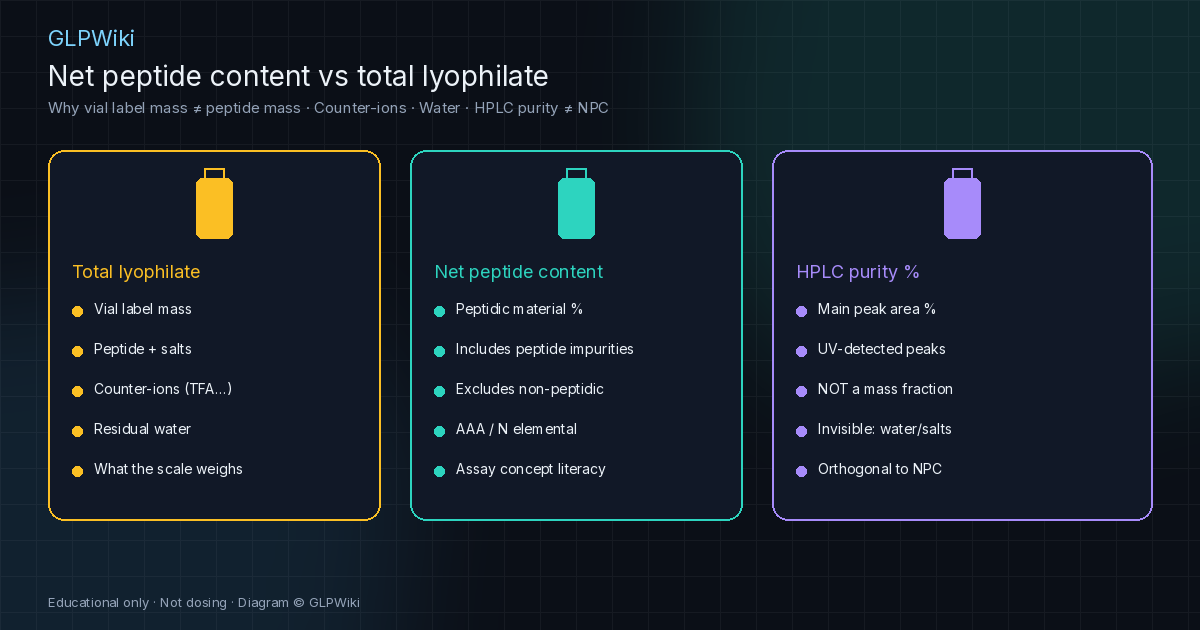
The already-live how-to-read-a-peptide-coa guide has a short Step 4 on net peptide content versus HPLC purity. This companion deepens that literacy: why vial label mass / total lyophilate is not the same as net peptide content; how counter-ions (TFA, acetate, HCl), residual water, and salts change the weighed solid; how NPC is typically estimated (elemental nitrogen and amino acid analysis concepts at high level); why HPLC area% is not a mass fraction; and how ambiguous mass inputs break reconstitution arithmetic literacy — concept only, no doses. Educational and YMYL-safe only — verify COAs and approved labels; research catalogs are not finished-drug PI.
UPDATED 03 OCT 2026 · 14 MIN READ
KEY TAKEAWAYS
- Total lyophilate mass (what a vial label or balance often reports) includes peptide material plus counter-ions, residual water/solvent, and other non-peptidic solids — not free-base peptide alone.
- Net peptide content (NPC) is the percentage of peptidic material relative to non-peptidic material (mostly counter-ions and moisture). It is not the same field as HPLC purity.
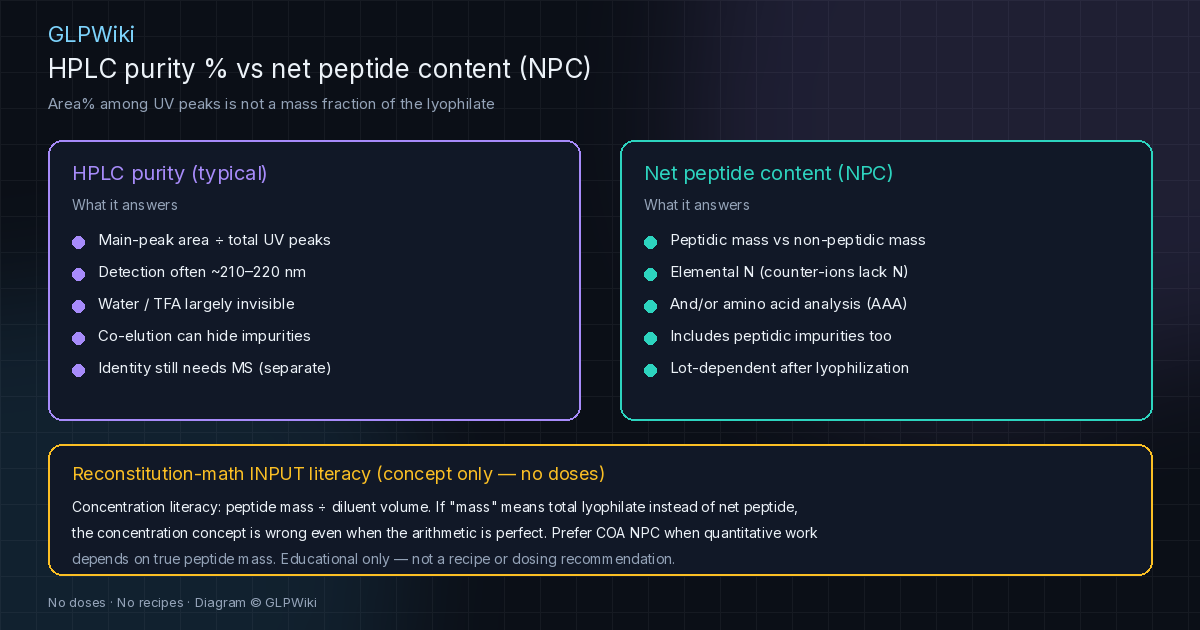
- HPLC purity is typically a UV peak-area percentage among detected peptidic peaks; counter-ions and water are largely invisible to that calculation, so purity % is not a mass fraction of the lyophilate.
- NPC is commonly estimated from elemental nitrogen analysis (non-peptidic counter-ions/water lack nitrogen) and/or amino acid analysis (AAA) — high-level assay concepts, not DIY lab protocols.
- Peptides rich in basic residues (Arg, Lys, His, free N-terminus) often bind more counter-ions (e.g., TFA after RP-HPLC), so even a high-purity lot can show a relatively low NPC.
- Ambiguous mass inputs break reconstitution arithmetic literacy: concentration = peptide mass ÷ diluent volume — if "mass" means total lyophilate instead of net peptide, the concentration concept is wrong even when the calculator is perfect.
- Approved finished-drug labels and research-catalog COAs/ADS documents are different regulatory contexts. This page is educational only: no doses, no reconstitution recipes, no product picks.
Why this companion exists (and what it is not)
Peptide vial stickers and Certificates of Analysis often report a mass (for example, milligrams of lyophilized solid) next to a purity percentage. Readers commonly collapse those two numbers into one story: "the vial contains X mg of pure peptide." That collapse is a literacy failure. The weighed solid is usually a lyophilate — a freeze-dried cake that can include the intended peptide, peptidic impurities, counter-ions such as trifluoroacetate (TFA), acetate, or chloride, residual water, and residual solvents.
The already-live guide on how to read a peptide Certificate of Analysis remains the field-by-field checklist for lot matching, HPLC, mass spectrometry, and a short Step 4 on NPC versus purity. This page does not rewrite that COA walkthrough. It zooms into net peptide content literacy: what total lyophilate mass means, what NPC answers, how manufacturers typically estimate it at a conceptual level, and why ambiguous mass inputs break reconstitution math literacy — without any dose or recipe.
Nothing here is a protocol to assay a vial, reconstitute a peptide, or choose a supplier. For FDA-approved finished products, open Drugs@FDA / DailyMed Prescribing Information. For research-use materials, read the lot-specific COA or Analytical Data Sheet (ADS) and institutional laboratory policy — and never treat research labeling as clinical use authorization.
Total lyophilate mass vs net peptide content
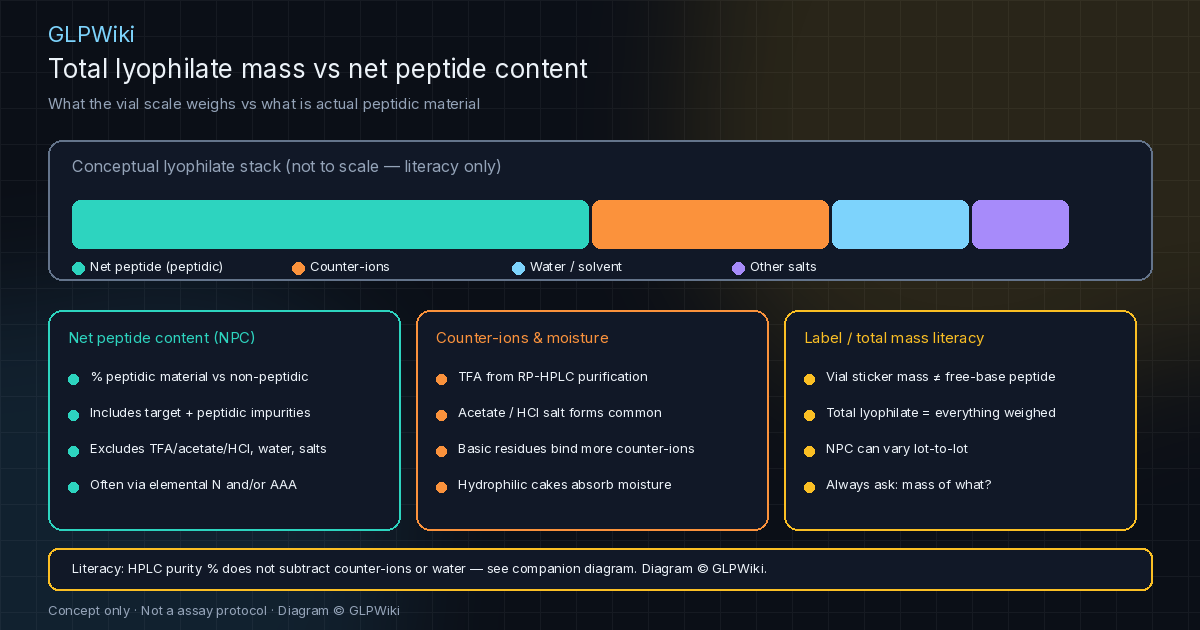
After solid-phase peptide synthesis, purification, and lyophilization, the white powder in a research vial is rarely "peptide only." Manufacturer educational materials (for example, Bachem’s quality-control guide) explain that lyophilized products typically contain residual water and/or solvents, and that most peptides also contain trifluoroacetic acid or acetic acid bound to the free N-terminus and basic side chains (Arg, Lys, His) as salts.
Net peptide content (NPC) is defined as the percentage of peptides relative to non-peptidic material — mostly counter-ions and moisture. Critically, NPC includes peptidic contaminants (related peptide impurities), not only the main intended sequence. HPLC purity and NPC therefore answer different questions: purity asks how dominant the main UV peak is among detected peaks; NPC asks how much of the weighed solid is peptidic versus salt/water.
Literacy consequence: a vial labeled "5 mg" of lyophilate is not automatically "5 mg of free-base peptide." A low NPC can appear even when HPLC purity is high — especially for hydrophilic peptides that absorb moisture or for peptides with many basic sites that bind more counter-ions. NPC can also vary lot-to-lot depending on final purification and lyophilization conditions.
Counter-ions, residual water, and why basic peptides weigh "heavy"
Trifluoroacetic acid is widely used in reverse-phase HPLC purification of synthetic peptides. The recovered material is often isolated as a TFA salt: basic functionalities and the N-terminus form trifluoroacetates. Acetate and hydrochloride salt forms are also common when manufacturers exchange counter-ions for formulation or pharmacopeial reasons. Those counter-ions contribute mass that a balance weighs but that HPLC UV purity at peptide-bond wavelengths typically does not subtract.
Residual water is another non-peptidic contributor. Lyophilizates can be hygroscopic; hydrophilic sequences can absorb moisture from humidity. Manufacturer guidance notes that water content is often measured by Karl Fischer titration, residual solvents by gas chromatography, and acetic acid or residual TFA by HPLC or ion chromatography — separate assays from the UV purity percentage.
Educational takeaway (not a formula sheet): the more basic sites a peptide has, the more counter-ion mass can ride along after salt formation. That is why "99% pure by HPLC" and "high net peptide content" are not synonyms. Asking "mass of what?" is the literacy habit — total lyophilate, free base, acetate salt hydrate, or NPC-corrected peptide mass.
How NPC is typically measured (high-level assay concepts)
Two complementary concepts dominate manufacturer and instrument-vendor educational pages: elemental nitrogen analysis and amino acid analysis (AAA). Non-peptidic contaminants such as TFA counter-ions and residual water do not contain nitrogen, so the nitrogen content of the lyophilized powder can be used to estimate the fraction that is peptidic material. Instrument vendors describe calculating NPC once absolute nitrogen in the powder is known — framed here as literacy about why nitrogen is informative, not as a DIY assay protocol.
Amino acid analysis hydrolyzes the peptide (classically under strong acid conditions), separates and quantifies amino acids, and can support both composition verification and content estimation. Manufacturer QC guides note that AAA does not by itself provide sequence information, and that elemental analysis (C, H, N compared with calculated molecular formula values) is also used for identity and content context — especially for shorter peptides.
Public educational materials also reference pharmacopeial total-protein / nitrogen-related procedures (for example, USP <1057> method framing cited by elemental-analysis vendors) as the standards landscape behind some NPC workflows. This encyclopedia page does not instruct readers to run USP methods at home. It only teaches what the COA field is trying to answer when NPC appears — and why it may be supplied on request for custom peptides rather than on every catalog ADS.
Why HPLC purity % is not a mass fraction
Analytical reverse-phase HPLC with UV detection (commonly around 210–220 nm) reports purity as the main-peak area relative to the total area of detected peaks under those conditions. That is an area percentage among UV-absorbing peptidic species — not grams of peptide per gram of lyophilate. Impurities that do not absorb at the detection wavelength do not reduce the purity number. Counter-ions, residual water, and many salts are largely invisible to that UV purity calculation.
Bachem’s public QC guide states explicitly that NPC and purity are not equivalent because NPC includes peptidic contaminants, and that both NPC and purity must be considered when preparing solutions of biologically active peptides for assays. Orthogonality matters: HPLC purity, mass spectrometry identity, and NPC (when reported) answer three different questions. Collapsing them into one "% pure" social-media claim is how literacy fails.
Reconstitution-math INPUT literacy (concept only): concentration literacy is peptide mass divided by diluent volume. If the mass you typed into an educational calculator is total lyophilate mass while the COA’s NPC says only a fraction of that mass is peptidic, the concentration concept is wrong even when the arithmetic is flawless. Prefer documented NPC (or other content assays on the controlling document) when quantitative work depends on true peptide mass — and never treat calculator output as a dose.
Approved finished-drug labels vs research catalog COAs
For FDA-approved peptide and incretin finished products, strength, content, and quality live in the approved application and Prescribing Information — not in a third-party research COA PDF. How Supplied / Description / Dosage Form sections on DailyMed or Drugs@FDA are the authority for labeled medicines. Research-use-only (RUO) catalog peptides with an ADS/CofA are a different regulatory category: analytical paperwork for a lot, not an approved drug label.
FDA has published ongoing concerns about unapproved GLP-1 drugs used for weight loss, including quality, labeling, dosing-error, salt-form, and fraudulent "research use" marketing risks. A glossy purity percentage on a seller page does not make an unapproved or research-labeled product interchangeable with an approved finished drug — and it does not replace lot-matched content literacy when someone is still using research materials in a laboratory context.
Keep categories honest: approved finished-product PI → Drugs@FDA / DailyMed; research materials → lot-matched COA/ADS + institutional policy; compounded preparations → pharmacy labeling and applicable compounding standards. Crossing those categories with "same mg on the sticker" language is a status and content literacy failure.
Verify-path checklist: net content claims
Step 1 — Capture the claim: product name, stated mass on the vial/listing, whether a purity % and/or NPC % appear, and whether the material is an FDA-approved finished drug, compounded preparation, or research-labeled catalog item.
Step 2 — Match the lot: COA/ADS lot number must match the physical vial and packing documents before any content number is meaningful.
Step 3 — Separate the fields: HPLC purity (area%) vs NPC (peptidic vs non-peptidic mass) vs MS identity. Ask which assays were actually run and whether method context is present.
Step 4 — Ask "mass of what?": total lyophilate, free base, specific salt form, or NPC-corrected peptide mass. Do not feed ambiguous mass into reconstitution arithmetic literacy tools.
Step 5 — For finished drugs, open Drugs@FDA / DailyMed strength and labeling. For research materials, read the current lot COA/ADS. Categorize unsupported social-media "mg pure peptide" tips honestly and discard tips that conflict with the controlling document.
- Lot mismatch → content numbers do not describe your vial.
- Purity without NPC → mass fraction of lyophilate is still unknown.
- NPC without identity (MS) → peptidic mass may include wrong sequences.
- Research ADS ≠ FDA-approved PI content statement.
What this page deliberately does not do
No doses, schedules, reconstitution recipes, diluent volumes, target concentrations, or syringe-draw instructions for any product.
No pharmacy, telehealth, clinic, or supplier recommendations; no purchasing advice; no affiliate links.
No claim that every research peptide must list NPC, or that a given NPC number proves clinical suitability.
No instruction to use research-use materials in humans. RUO and finished-drug contexts stay separate.
For whether any medicine is appropriate for a person, consult a licensed clinician using the official label. Adverse events and quality concerns can be reported through MedWatch.
Where to read next
Continue with how-to-read-a-peptide-coa for the full field-by-field COA checklist (including short Step 4 that this page deepens), how-to-read-a-peptide-vial-label for sticker literacy, and peptide-lyophilization-explained for cake-structure context.
For arithmetic literacy without recipes, see peptide-dosing-math and how-to-reconstitute-peptides. For storage and handling after the solid is dissolved, see peptide-storage-and-handling.
Editorial standards and the medical disclaimer explain sourcing limits and what GLPWiki never publishes.
Frequently asked questions
- Is net peptide content the same as HPLC purity?
- No. HPLC purity is usually an area percentage among UV-detected peaks. Net peptide content estimates how much of the solid mass is peptidic versus water, salts, and counter-ions. Both can appear on a thorough COA, and they answer different questions.
- Why can a "99% pure" peptide have a much lower net peptide content?
- HPLC purity does not subtract counter-ions or residual water that still weigh on the balance. Peptides with many basic residues often bind more TFA or other counter-ions after purification, so NPC can be substantially lower than the purity percentage even when the main peak dominates the chromatogram.
- How is net peptide content usually determined?
- Manufacturer educational materials describe elemental nitrogen analysis and/or amino acid analysis as common approaches, because non-peptidic counter-ions and water lack nitrogen. Exact methods and whether NPC is reported on every ADS vary — read the lot paperwork. This page is not a lab protocol.
- Does the milligram number on a research vial mean free-base peptide?
- Not safely assume that. Many labels and listings refer to total lyophilate mass (peptide plus counter-ions, moisture, and related solids). Ask "mass of what?" and check whether NPC or salt form is documented on the COA/ADS.
- Should I use vial mass alone in reconstitution calculators?
- Only with inputs you understand. Educational concentration literacy is peptide mass ÷ diluent volume. If the mass is total lyophilate and NPC is unaccounted for, the concentration concept is wrong even if the arithmetic looks tidy. GLPWiki calculators never recommend a dose.
- Does a research COA with NPC make a product FDA-approved?
- No. A COA/ADS is analytical paperwork for a batch. FDA approval is a separate regulatory status verified on Drugs@FDA and official labeling for finished products.
SOURCES
- 01Quality Control of Amino Acids & Peptides: A Guide (HPLC purity; NPC definition; counter-ions/moisture; AAA / elemental N content)— Bachem Knowledge Center
- 02Analytical Data Sheet (ADS) — lot-specific documentation lookup— Bachem Knowledge Center
- 03NPC analysis / peptide content via elemental nitrogen (educational instrument framing; USP <1057> method reference context)— Elementar
- 04FDA’s Concerns with Unapproved GLP-1 Drugs Used for Weight Loss (quality, labeling, fraudulent research-use marketing context)— U.S. Food and Drug Administration
- 05Understanding the Risks of Compounded Drugs— U.S. Food and Drug Administration
- 06MedWatch: FDA Safety Information and Adverse Event Reporting Program— U.S. FDA
- 07Drugs@FDA: FDA-Approved Drugs database (finished-product label verification habit)— U.S. FDA
EDUCATIONAL REFERENCE ONLY · Not medical advice. Nothing here diagnoses, treats, cures or prevents any disease, and nothing here is a dosing recommendation. Consult a licensed clinician before any treatment decision.