GLP-1 medicines and muscle: lean-mass loss data, protein, resistance training and investigational add-ons
Weight lost on GLP-1-based medicines is not all fat. This guide walks through the body-composition (DXA) data from semaglutide and tirzepatide trials, explains why 'lean mass' is not the same as muscle, ranks the evidence for resistance training and protein, and summarises the Phase 2 results for investigational muscle-preserving add-ons such as bimagrumab, apitegromab, trevogrumab and enobosarm. None of those add-ons is approved. Educational only: no doses, schedules or product recommendations.
UPDATED 08 OCT 2026 · 16 MIN READ
KEY TAKEAWAYS
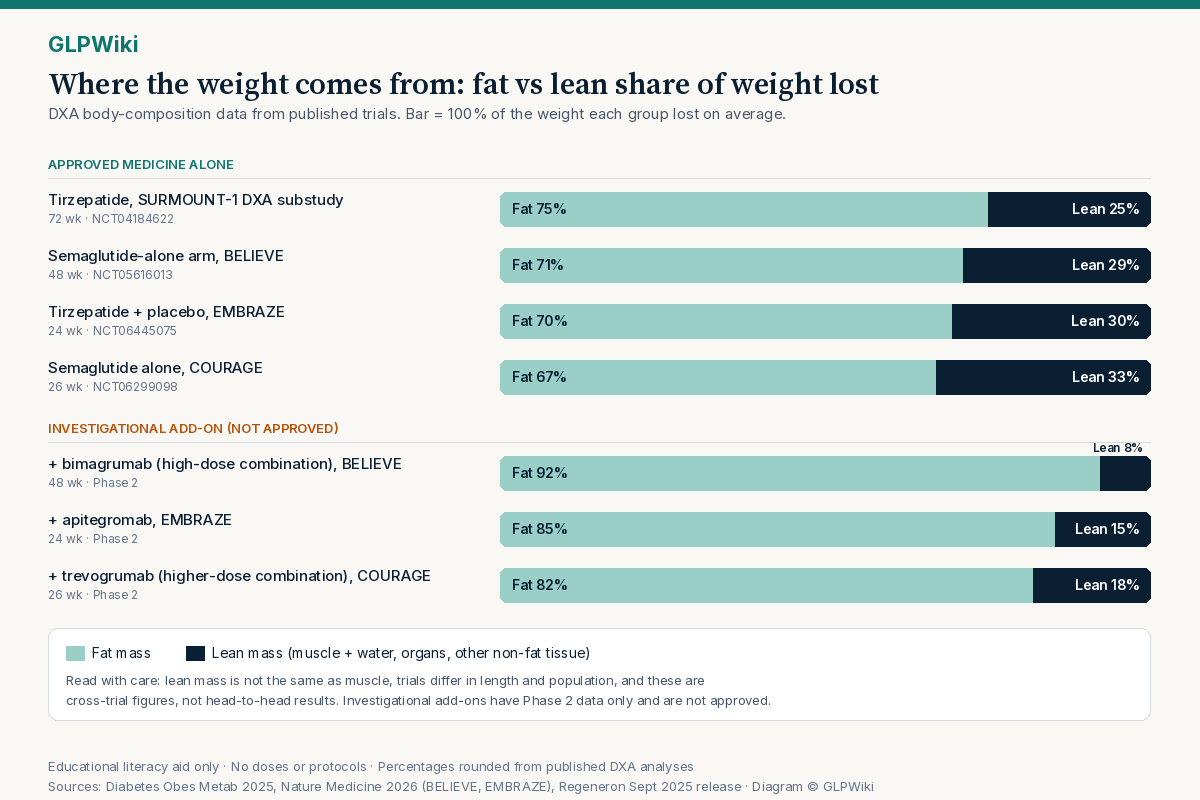
- Weight lost on semaglutide or tirzepatide is mostly fat, but not all of it. In trial DXA substudies roughly a quarter to a third of the weight lost was lean mass: about 25% with tirzepatide in SURMOUNT-1 and about 29% to 33% with semaglutide alone in the BELIEVE and COURAGE trials.
- In absolute terms, semaglutide in the STEP 1 substudy reduced total fat mass by 19.3% and total lean mass by 9.7%; tirzepatide in SURMOUNT-1 reduced fat mass by 33.9% and lean mass by 10.9%. Because fat fell faster, lean mass made up a larger share of remaining body weight.
- Lean mass is not the same as muscle. DXA lean mass also counts water, organs and other non-fat tissue, and MRI studies suggest muscle quality (for example, less fat inside muscle) can improve during treatment.
- Whether the loss matters clinically is still debated. Concern is greatest for older adults, people with low muscle mass or frailty, and anyone losing weight very quickly; function and strength outcomes are rarely measured in obesity-drug trials.
- Resistance or combined exercise has the strongest supporting evidence. In a randomized trial in dieting older adults, lean mass fell about 2% to 3% with resistance or combined training versus about 5% with aerobic training alone, and strength and function improved.
- Expert advisories (ACLM, ASN, OMA and The Obesity Society, 2025) prioritise adequate protein and resistance training during GLP-1 therapy, but few randomized trials test protein specifically alongside GLP-1 medicines. Individual targets belong with a clinician or registered dietitian.
- Investigational add-ons such as bimagrumab (an activin type II receptor antibody), apitegromab and trevogrumab (myostatin antibodies) and enobosarm (a selective androgen receptor modulator) shifted weight loss toward fat in Phase 2 trials. None is FDA-approved for this use, and function and long-term safety data are limited.
- Products sold online as 'muscle-sparing' peptides or SARMs are not the trial drugs and have no qualifying evidence alongside GLP-1 medicines.
What this guide adds to the June 2026 blog post
GLPWiki's June 2026 deep dive, 'Muscle loss on incretin therapy: what the data say', gave a short overview. This guide expands it into a full reference: trial-by-trial body-composition numbers with registry (NCT) numbers, a plain-language explanation of what DXA lean mass measures, an evidence ladder for exercise, protein and investigational drugs, and two original GLPWiki diagrams. The original post stays online with a link to this guide.
- New Phase 2 publications: BELIEVE (bimagrumab with semaglutide, Nature Medicine, March 2026) and EMBRAZE (apitegromab with tirzepatide, Nature Medicine, June 2026).
- New sponsor results: COURAGE (trevogrumab with semaglutide) 52-week and MRI muscle-volume data, announced October 1, 2026.
- Status check: as of October 8, 2026, no muscle-preserving add-on is FDA-approved for use alongside GLP-1 medicines.
Lean mass, fat-free mass and muscle: what is actually measured
Most obesity-drug trials measure body composition with dual-energy X-ray absorptiometry (DXA), usually in a substudy of a few hundred participants or fewer. DXA divides the body into fat mass, bone mineral and 'lean' soft tissue. Lean mass includes skeletal muscle, but also organs, skin, connective tissue, blood and body water, including the water stored with glycogen.
That matters for interpretation. Early in any weight loss, glycogen and water fall quickly, which shows up as lean-mass loss even though it is not muscle protein. Organs such as the liver also shrink as fat inside them decreases. A 2024 review in Diabetes, Obesity and Metabolism (Neeland and colleagues) noted that reported lean-mass loss on GLP-1-based therapies ranges widely, from roughly 40% to 60% of weight lost in some studies to about 15% or less in others, and that MRI-based studies suggest muscle changes are broadly in line with what would be expected for the amount of weight lost, with improved muscle quality.
The share of weight lost as lean tissue is also not unique to medicines. Diet-induced and surgical weight loss typically show a similar 25% to 40% lean component. The question is less whether GLP-1 medicines 'destroy muscle' and more whether large, fast weight loss in vulnerable people leaves them with too little muscle and strength.
Lean-mass loss data from semaglutide and tirzepatide trials
The numbers below come from DXA analyses reported in peer-reviewed papers or sponsor releases. Percentages describe group averages under trial conditions, which included lifestyle counselling, and are not predictions for any individual.
Semaglutide: STEP 1 DXA substudy (NCT03548935)
STEP 1 randomized 1,961 adults with overweight or obesity and without diabetes to once-weekly semaglutide or placebo for 68 weeks. In the 140-person DXA substudy, body weight fell 15.0% with semaglutide versus 3.6% with placebo. Total fat mass fell 19.3% and total lean mass fell 9.7% with semaglutide. Because fat fell faster, the proportion of the body made up of lean mass rose by 3.0 percentage points, and the lean-to-fat ratio improved more in people who lost more weight.
Tirzepatide: SURMOUNT-1 DXA substudy (NCT04184622)
SURMOUNT-1 randomized 2,539 adults with obesity or overweight and without diabetes for 72 weeks. In the 160-person DXA substudy published in 2025 (Look and colleagues), body weight, fat mass and lean mass changed by -21.3%, -33.9% and -10.9% with tirzepatide versus -5.3%, -8.2% and -2.6% with placebo. About 75% of the weight lost was fat and 25% was lean mass in both the tirzepatide and placebo groups, and those proportions were broadly consistent across sex, age and weight-loss subgroups.
Control arms of the muscle-preservation trials
Newer add-on trials also report how much lean mass the approved medicine alone removes. In BELIEVE (NCT05616013), about 71% of the weight lost on semaglutide alone at 48 weeks was fat, so about 29% was lean. In EMBRAZE (NCT06445075), lean mass made up 30.2% of the weight lost on tirzepatide plus placebo over 24 weeks. In COURAGE (NCT06299098), Regeneron reported that 33% of semaglutide-induced weight loss over 26 weeks was lean mass. These shorter trials capture the fast early phase of weight loss, when lean-mass loss tends to be greatest.
Does the lean-mass loss matter?
Researchers disagree on how much weight. In a 2024 JAMA Viewpoint, Conte, Hall and Klein argued that concern about GLP-1-induced weight loss causing frailty or sarcopenia is not supported by current data, noting that fat-free mass is not a direct measure of skeletal muscle and that the lean-mass share of weight lost is similar to other forms of weight loss. In published correspondence, other researchers replied that reassurance is premature, particularly for older adults, because skeletal muscle has rarely been measured directly in these trials.
Others point out that obesity-drug trials have rarely measured strength, physical function, falls or fractures, which are the outcomes that matter to patients, and that lean mass lost may not be fully regained if weight is later regained mostly as fat. Higher-risk groups usually named include adults over about 60 or 65, people with low baseline muscle mass or sarcopenia, people losing weight very rapidly, and people with conditions or medicines that already affect muscle or bone.
The practical takeaway at evidence level: lean-mass loss is real and measurable, its clinical significance varies by person, and the strongest available tools to limit it are not drugs.
Resistance training: the best-supported way to protect muscle
The clearest randomized evidence on exercise during weight loss comes from trials of diet-induced weight loss, not GLP-1 medicines. In the LITOE trial (Villareal and colleagues, NEJM 2017, NCT01065636), 160 older adults with obesity were assigned to a weight-management programme plus aerobic, resistance or combined training, or to a control group. Body weight fell about 9% in all exercise groups. Lean mass fell less with resistance (about 2%) or combined training (about 3%) than with aerobic training alone (about 5%), and strength rose with resistance-containing programmes. Combined training improved physical performance scores the most.
Evidence pairing exercise with a GLP-1 receptor agonist is more limited. In the S-LiTE trial (Lundgren and colleagues, NEJM 2021, NCT04122716), 195 adults who had lost weight on a low-calorie diet were randomized for one year to exercise, liraglutide, both, or placebo. The combination reduced body-fat percentage by about 3.9 percentage points, roughly twice as much as either exercise or liraglutide alone, and was the only strategy that improved insulin sensitivity and cardiorespiratory fitness.
Large, dedicated trials of structured resistance training alongside semaglutide or tirzepatide are still needed. GLPWiki does not publish exercise programmes; the type and intensity of training that is safe depends on age, health and mobility and is best set with a clinician or qualified exercise professional.
Protein and nutrition: consistent advice, thinner direct evidence
GLP-1-based medicines reduce appetite and food intake, which can make it harder to eat enough protein and micronutrients. Reviews of weight loss in general, such as Cava and colleagues (Advances in Nutrition 2017), conclude that higher protein intake during calorie restriction helps preserve lean mass, particularly when combined with resistance exercise and in older adults.
In 2025, the American College of Lifestyle Medicine, the American Society for Nutrition, the Obesity Medicine Association and The Obesity Society published a joint advisory on nutrition during GLP-1 therapy (Mozaffarian and colleagues, American Journal of Clinical Nutrition). It lists muscle and bone loss among the main challenges and names preserving muscle and bone through resistance training and an appropriate diet as a priority, alongside baseline assessment of muscle strength, function and body composition.
What is missing is randomized evidence testing specific protein strategies in people taking semaglutide or tirzepatide. Advisory targets are usually expressed per kilogram of body weight and need adjusting for kidney function and other conditions, so GLPWiki does not list numbers; a clinician or registered dietitian can set an individual target.
Investigational muscle-preserving add-ons (not approved)
Several companies are testing drugs designed to be taken alongside GLP-1-based medicines so that more of the weight lost comes from fat. Everything in this section is investigational. None of these agents is FDA-approved for obesity or for use with GLP-1 medicines, the trials are Phase 2, and most report DXA lean mass rather than strength or function.
Bimagrumab: activin type II receptor antibody (Eli Lilly)
Bimagrumab is a monoclonal antibody that blocks activin type II receptors, a pathway that limits muscle growth. In a 48-week Phase 2 trial in 75 adults with type 2 diabetes and obesity (Heymsfield and colleagues, JAMA Network Open 2021, NCT03005288), bimagrumab alone reduced fat mass by 20.5% versus 0.5% with placebo while lean mass rose 3.6% versus falling 0.8%. In the larger BELIEVE trial (Heymsfield and colleagues, Nature Medicine 2026, NCT05616013), 507 adults with obesity received placebo, bimagrumab, semaglutide or combinations. At 48 weeks the high-dose combination produced the largest weight loss (-17.8 kg versus -14.2 kg with semaglutide alone and -3.3 kg with placebo), and about 92% of the weight lost was fat versus about 71% with semaglutide alone. Lean mass changed by -0.8% to -2.3% in combination groups versus -4.7% to -6.9% with semaglutide alone. Muscle spasms, diarrhoea and acne were common with bimagrumab, and discontinuation for adverse events was higher in bimagrumab-alone groups (14.0% to 21.4%) than with semaglutide (3.6% to 8.8%). A Phase 2 trial of bimagrumab with tirzepatide (NCT06643728) is ongoing.
Apitegromab: selective myostatin antibody (Scholar Rock)
Apitegromab blocks activation of myostatin, a natural brake on muscle growth. In the 24-week Phase 2 EMBRAZE trial (Pratley and colleagues, Nature Medicine 2026, NCT06445075), 102 adults taking tirzepatide were randomized to apitegromab or placebo. Lean-mass loss was 1.6 kg with apitegromab versus 3.5 kg with placebo, a 54.9% relative preservation, with similar total weight loss (11.2 kg versus 12.5 kg). Lean mass made up 14.6% of weight lost versus 30.2%. Exploratory physical-function tests showed no notable difference, and adverse events were similar between groups. The study was small, short and mostly female.
Trevogrumab, with or without garetosmab (Regeneron)
Trevogrumab is another myostatin antibody; garetosmab blocks activin A. In the Phase 2 COURAGE trial (NCT06299098), Regeneron reported that at 26 weeks lean mass fell 6.5% with semaglutide alone versus 3.3% to 3.8% with trevogrumab combinations and 2.0% with the triple combination, which also had substantially more discontinuations and adverse events. On October 1, 2026, Regeneron reported 52-week results from a lower-dose portion in which trevogrumab preserved about 20% to 43% of DXA lean mass relative to semaglutide alone and, in an MRI substudy, about 64% to 73% of thigh-muscle volume. The company said the results are in press at The Lancet; until then these are sponsor-reported figures.
Enobosarm: selective androgen receptor modulator (Veru)
Enobosarm is an investigational selective androgen receptor modulator (SARM). In the 16-week Phase 2b QUALITY trial (NCT06282458) in 168 adults aged 60 or older taking semaglutide, Veru reported that total lean mass fell 1.2% with enobosarm versus 4.1% with placebo, a 71% relative reduction in lean-mass loss. These are sponsor topline results. SARMs sold online are a different matter: FDA has warned that SARMs sold in so-called supplements are unapproved and have been linked to serious risks, including liver injury and heart attack or stroke.
Putting it together: an evidence ladder
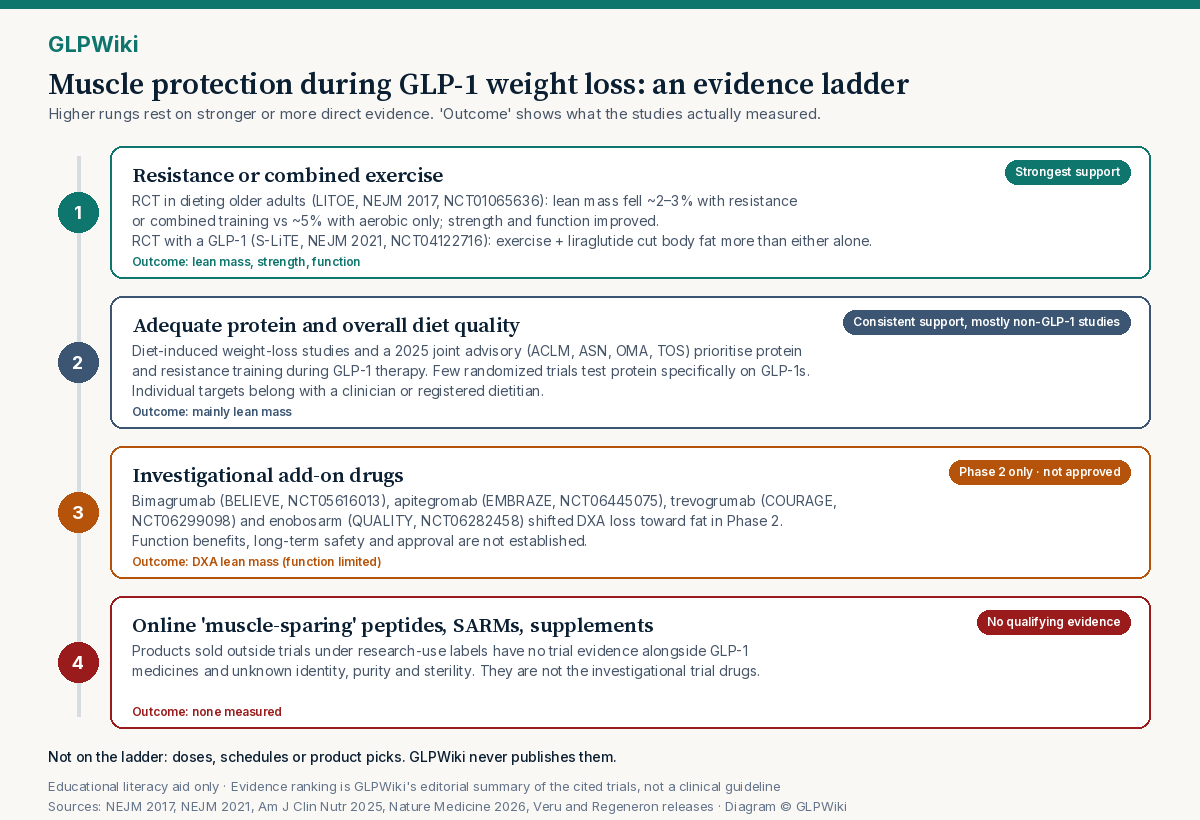
The diagram ranks the main muscle-protection approaches by how strong and how direct the evidence is. It is GLPWiki's editorial summary of the trials cited on this page, not a clinical guideline.
- Ask what was measured: DXA lean mass, MRI muscle volume, strength and physical function are different outcomes, and function is the one that matters most to people.
- Check the comparison: 'preserved 55% of lean mass' is relative to the control group's loss, not to baseline.
- Check the stage: Phase 2 results and sponsor releases are early evidence. Look for peer-reviewed Phase 3 trials and an FDA approval on Drugs@FDA before treating any add-on as established.
- Check the product: trial results apply only to the trial drug under trial conditions, not to similarly named products sold online.
How to check claims about muscle and GLP-1 medicines
Claims about 'muscle-sparing' products and protocols spread quickly online. Primary sources settle most of them.
- ClinicalTrials.gov: search an NCT number from this page to see design, population, status and whether results are posted. A trial record is never an approval.
- PubMed and journal sites: confirm that a number comes from a peer-reviewed paper, and note whether it describes DXA lean mass, muscle volume or function.
- Drugs@FDA: check whether any add-on has been approved, for which use and under which brand name.
- FDA labels for semaglutide and tirzepatide products describe approved uses and recommend use with reduced-calorie diet and increased physical activity; they do not list a muscle-preserving companion drug.
Scope, disclaimer and review date
This guide is educational. It summarises published body-composition data, exercise and nutrition evidence and investigational drug trials. It does not provide doses, titration schedules, exercise or diet prescriptions, sourcing information or individual medical advice, and nothing here recommends starting, stopping or combining any medicine. Trial figures are group averages under protocol conditions. Decisions about medicines, protein targets and training belong with a licensed clinician and, where relevant, a registered dietitian or qualified exercise professional.
Last reviewed: October 8, 2026. Trial results and regulatory status may have changed since; verify with ClinicalTrials.gov, PubMed and Drugs@FDA.
Frequently asked questions
- Do GLP-1 medicines like semaglutide and tirzepatide cause muscle loss?
- They cause lean-mass loss alongside fat loss, as other forms of substantial weight loss do. In trial DXA substudies roughly 25% to 33% of the weight lost was lean mass, for example about 25% with tirzepatide in SURMOUNT-1. Lean mass includes water and organs, not only muscle.
- How much lean mass was lost on semaglutide in STEP 1?
- In the 140-person STEP 1 DXA substudy, total lean mass fell 9.7% and total fat mass fell 19.3% over 68 weeks with semaglutide, while body weight fell 15.0%. The proportion of body weight made up of lean mass rose by 3.0 percentage points.
- How much lean mass was lost on tirzepatide in SURMOUNT-1?
- In the 160-person SURMOUNT-1 DXA substudy, tirzepatide reduced fat mass by 33.9% and lean mass by 10.9% over 72 weeks, versus 8.2% and 2.6% with placebo. About 75% of weight lost was fat and 25% was lean in both groups.
- Is lean mass the same as muscle?
- No. DXA lean mass includes skeletal muscle plus organs, skin, connective tissue, blood and body water. Early weight loss includes water and glycogen, which appear as lean-mass loss. MRI studies give a more direct picture of muscle volume and quality.
- What is the best-supported way to protect muscle during weight loss?
- Resistance or combined resistance and aerobic training. In the LITOE randomized trial in dieting older adults, lean mass fell about 2% to 3% with resistance or combined training versus about 5% with aerobic training alone, and strength and function improved. Programmes should be set with a clinician or qualified professional.
- How much protein should someone on a GLP-1 medicine eat?
- GLPWiki does not give individual targets. A 2025 joint advisory from four medical and nutrition societies prioritises adequate protein and resistance training during GLP-1 therapy, but needs vary with body size, kidney function and other conditions. A clinician or registered dietitian can set a target.
- What is bimagrumab and is it approved?
- Bimagrumab is an investigational antibody that blocks activin type II receptors to promote muscle and reduce fat. In the Phase 2 BELIEVE trial with semaglutide, about 92% of the weight lost with the high-dose combination was fat versus about 71% with semaglutide alone. It is not FDA-approved.
- Are any muscle-preserving drugs approved for use with GLP-1 medicines?
- No. As of October 8, 2026, bimagrumab, apitegromab, trevogrumab and enobosarm are investigational for this use, with Phase 2 results only. Check Drugs@FDA for current status.
- Do 'muscle-sparing' peptides or SARMs sold online work with GLP-1 drugs?
- There is no qualifying trial evidence for products sold online under research-use labels, and their identity, purity and sterility are unknown. FDA has warned about SARMs sold as supplements. Trial results for investigational drugs do not apply to these products.
- Who is most at risk from lean-mass loss on GLP-1 medicines?
- Researchers most often name older adults, people with low muscle mass or sarcopenia, people losing weight very rapidly, and people with conditions or medicines that already affect muscle or bone. Strength and function outcomes are rarely measured in obesity-drug trials.
SOURCES
- 01Wilding JPH, et al. Once-Weekly Semaglutide in Adults with Overweight or Obesity (STEP 1). N Engl J Med 2021;384:989-1002. doi:10.1056/NEJMoa2032183. PMID 33567185— New England Journal of Medicine
- 02Wilding JPH, et al. Impact of Semaglutide on Body Composition in Adults With Overweight or Obesity: Exploratory Analysis of the STEP 1 Study. J Endocr Soc 2021;5(Suppl 1):A16— Journal of the Endocrine Society (PMC)
- 03STEP 1 (NCT03548935)— ClinicalTrials.gov
- 04Jastreboff AM, et al. Tirzepatide Once Weekly for the Treatment of Obesity (SURMOUNT-1). N Engl J Med 2022;387:205-216. doi:10.1056/NEJMoa2206038. PMID 35658024— PubMed
- 05Look M, et al. Body composition changes during weight reduction with tirzepatide in the SURMOUNT-1 study of adults with obesity or overweight. Diabetes Obes Metab 2025;27:2720-2729. doi:10.1111/dom.16275. PMID 39996356— PubMed
- 06SURMOUNT-1 (NCT04184622)— ClinicalTrials.gov
- 07Neeland IJ, Linge J, Birkenfeld AL. Changes in lean body mass with glucagon-like peptide-1-based therapies and mitigation strategies. Diabetes Obes Metab 2024;26 Suppl 4:16-27. doi:10.1111/dom.15728. PMID 38937282— PubMed
- 08Conte C, Hall KD, Klein S. Is Weight Loss-Induced Muscle Mass Loss Clinically Relevant? JAMA 2024;332:9-10. doi:10.1001/jama.2024.6586. PMID 38829659— PubMed
- 09Villareal DT, et al. Aerobic or Resistance Exercise, or Both, in Dieting Obese Older Adults (LITOE). N Engl J Med 2017;376:1943-1955. doi:10.1056/NEJMoa1616338. PMID 28514618— PubMed
- 10LITOE (NCT01065636)— ClinicalTrials.gov
- 11Lundgren JR, et al. Healthy Weight Loss Maintenance with Exercise, Liraglutide, or Both Combined (S-LiTE). N Engl J Med 2021;384:1719-1730. doi:10.1056/NEJMoa2028198. PMID 33951361— PubMed
- 12S-LiTE (NCT04122716)— ClinicalTrials.gov
- 13Cava E, Yeat NC, Mittendorfer B. Preserving Healthy Muscle during Weight Loss. Adv Nutr 2017;8:511-519. doi:10.3945/an.116.014506. PMID 28507015— PubMed
- 14Mozaffarian D, et al. Nutritional priorities to support GLP-1 therapy for obesity: a joint Advisory from ACLM, ASN, OMA and The Obesity Society. Am J Clin Nutr 2025;122:344-367. doi:10.1016/j.ajcnut.2025.04.023. PMID 40450457— PubMed
- 15Heymsfield SB, et al. Effect of Bimagrumab vs Placebo on Body Fat Mass Among Adults With Type 2 Diabetes and Obesity: A Phase 2 Randomized Clinical Trial. JAMA Netw Open 2021;4:e2033457. doi:10.1001/jamanetworkopen.2020.33457. PMID 33439265— PubMed
- 16Heymsfield SB, et al. Bimagrumab plus semaglutide alone or in combination for the treatment of obesity: a randomized phase 2 trial (BELIEVE). Nat Med 2026;32:869-882. doi:10.1038/s41591-026-04204-0. PMID 41772149— PubMed
- 17BELIEVE, bimagrumab and semaglutide (NCT05616013)— ClinicalTrials.gov
- 18Bimagrumab and tirzepatide Phase 2 (NCT06643728)— ClinicalTrials.gov
- 19Pratley RE, et al. Apitegromab for lean mass preservation during tirzepatide-induced weight loss: a randomized, double-blind, placebo-controlled phase 2 trial (EMBRAZE). Nat Med 2026;32:2673-2678. doi:10.1038/s41591-026-04440-4— Nature Medicine
- 20EMBRAZE, apitegromab with tirzepatide (NCT06445075)— ClinicalTrials.gov
- 21Regeneron: COURAGE 26-week results presented at EASD (Sept 17, 2025)— Regeneron Pharmaceuticals
- 22Regeneron: Phase 2 COURAGE trial 52-week and MRI muscle results (Oct 1, 2026)— Regeneron Pharmaceuticals / GlobeNewswire
- 23COURAGE, trevogrumab with or without garetosmab plus semaglutide (NCT06299098)— ClinicalTrials.gov
- 24Veru: Phase 2b QUALITY topline results, enobosarm with semaglutide (Jan 27, 2025)— Veru Inc.
- 25QUALITY, enobosarm in patients taking a GLP-1 (NCT06282458)— ClinicalTrials.gov
- 26FDA Warns of Use of Selective Androgen Receptor Modulators (SARMs) Among Teens, Young Adults (consumer update)— U.S. Food and Drug Administration
- 27Drugs@FDA: FDA-Approved Drugs database— U.S. Food and Drug Administration
EDUCATIONAL REFERENCE ONLY · Not medical advice. Nothing here diagnoses, treats, cures or prevents any disease, and nothing here is a dosing recommendation. Consult a licensed clinician before any treatment decision.