How to read a peptide datasheet (compound and medication pages)
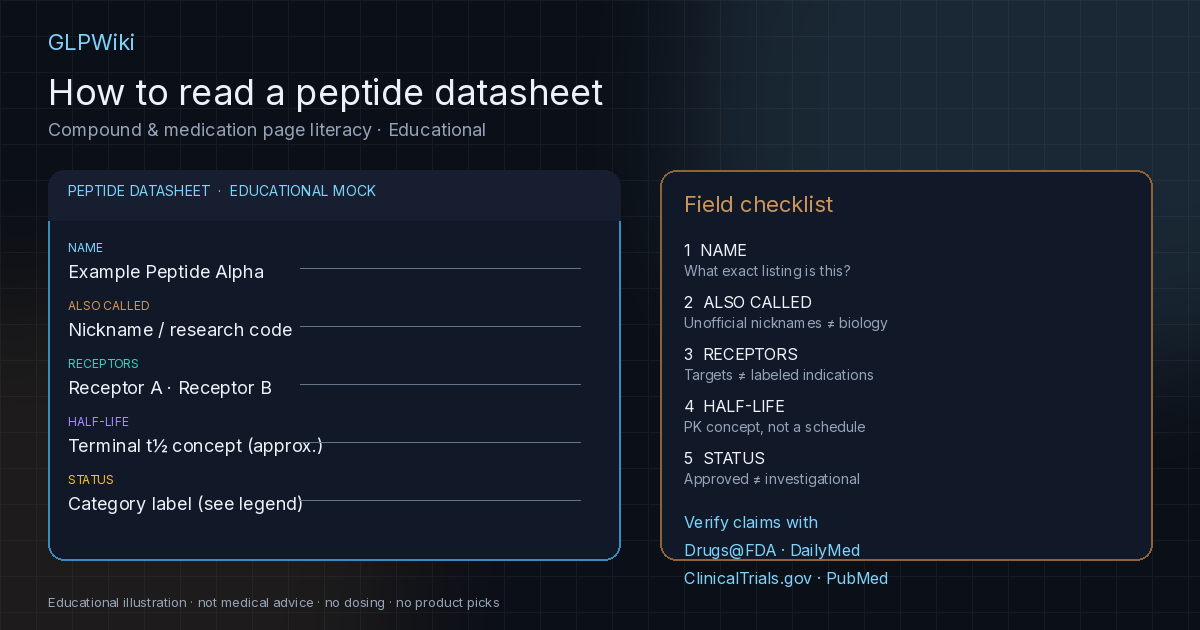
Compound cards and medication pages compress identity, pharmacology shorthand, approximate pharmacokinetics, and status into a few labeled fields. This literacy guide explains what each field answers, why nicknames are not biology, why half-life is not a dosing clock, and how to verify claims with the right official document type. Educational only: no dosing, no protocols, no product picks.
UPDATED 20 SEPT 2026 · 14 MIN READ
KEY TAKEAWAYS
- A datasheet field answers a specific question — identity, alias, class, targets, approximate PK concept, or regulatory/development status — and should not be treated as a complete clinical story.
- Also-called nicknames and research codes aid discovery; they do not redefine hormones, receptors, or approved uses (example pattern: unofficial GLP-3 for retatrutide is a nickname, not a hormone).
- Receptor lines are pharmacology shorthand for known targets; they are not labeled indications.
- Half-life on a datasheet is an approximate terminal-elimination concept from pharmacokinetic data — not a personal schedule or dosing clock.
- Status labels name different evidence and document pathways: FDA-approved finished medicine, investigational phase labels, research-use-only, and compounded are not interchangeable.
- Verify approved finished products with Drugs@FDA and DailyMed; verify trials with ClinicalTrials.gov; verify papers with PubMed — do not mix document types.
- A molecule name shared across categories does not transfer labeling, approval, or evidence from one category to another.
- This page publishes no doses, schedules, stacks, compounding recipes, or product recommendations.
- Read GLPWiki compound and medication cards as navigation aids that point you toward primary sources, not as substitutes for official labeling.
Why datasheet literacy matters on compound and medication pages
Peptide and incretin discussions often start with a short card: a name, a nickname, a receptor line, a half-life figure, and a status badge. Those fields are useful for orientation. Problems begin when a reader treats the card as a full evidence package, or when one field is silently stretched into a claim it was never designed to support — for example reading a receptor list as an indication, or reading a Phase 3 label as an approval.
GLPWiki compound pages, medication pages, and similar educational datasheets are structured summaries. They help you find the right molecule and the right category of sources. They are not Prescribing Information, not a ClinicalTrials.gov record, and not a peer-reviewed paper. Literacy means knowing which question each field answers and which official document you still need to open.
This guide teaches that verification habit. It does not recommend any medicine, product, manufacturer, pharmacy, telehealth service, or research material. It publishes no numeric doses, schedules, titration programs, stacks, administration instructions, or compounding recipes.
Field anatomy: what each datasheet line answers
Most educational peptide datasheets share a familiar layout. Name (or title) identifies the listed compound or finished-product concept. Also called lists nicknames, research codes, or informal labels people search for. Class places the entry in a pharmacology or therapeutic navigation bucket. Receptors summarize known or claimed molecular targets in shorthand. Half-life conveys an approximate pharmacokinetic concept when a reliable figure is available. Status states the regulatory or development category that governs which documents apply.
Read each line as a question-and-answer pair. Name answers what exact listing is this. Also called answers what other strings might lead here. Class answers where this sits among related mechanisms. Receptors answer what targets are commonly cited in pharmacology summaries. Half-life answers what approximate terminal-elimination concept is reported in source PK material. Status answers which evidence and document pathway should I use next.
A datasheet is intentionally incomplete. It omits full methods, denominators, limitations, labeling revisions, and product-specific conditions of use. When a claim matters, leave the card and open the matching primary source.
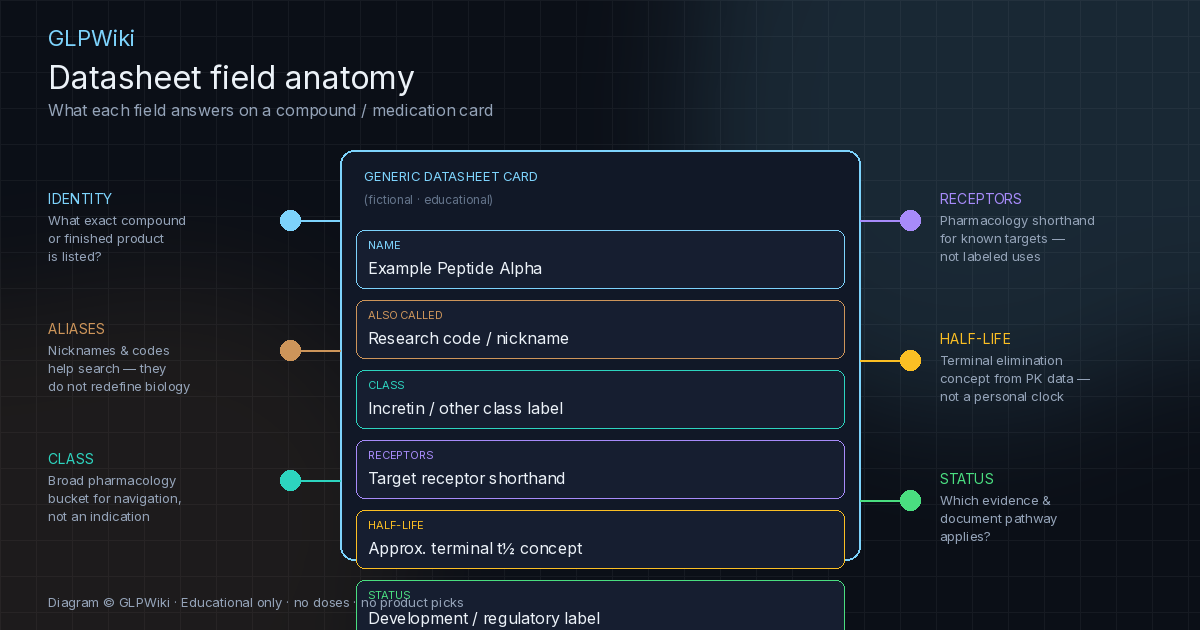
- Identity fields: name and exact listing context.
- Alias fields: search nicknames and codes — not redefined biology.
- Pharmacology fields: class and receptor shorthand.
- PK concept field: approximate half-life when sourced — not a schedule.
- Status field: which document pathway applies next.
Name and also-called: identity vs nicknames
The name field should identify the compound or finished-product concept as precisely as the page scope allows. Prefer the established nonproprietary or common research name used in registries and literature over marketing shorthand. When a page discusses both a molecule and one or more finished products, keep those layers separate in your reading — a shared active-ingredient name does not make every listing the same approved medicine.
Also-called fields exist because people search nicknames, development codes, and informal labels. Those aliases are discovery aids. They do not create a new hormone, receptor, or approved use. A well-known pattern on GLPWiki is the internet nickname GLP-3 for retatrutide: useful for search, but not evidence of a GLP-3 hormone or GLP-3 receptor.
If an online claim leans on a nickname alone, ask whether the claim still holds when rewritten with the precise compound or finished-product name and the correct status category. Nickname inflation is a common way investigational or research-use materials get discussed as if they were approved medicines.
Class and receptors: navigation, not indications
Class labels (for example incretin, dual agonist, growth-hormone secretagogue) help readers browse related mechanisms. They are taxonomy tools. A class membership does not by itself establish an approved indication, a trial result, or a quality standard for a listing.
Receptor lines compress pharmacology into shorthand such as GLP-1, GIP, or glucagon receptor engagement. That shorthand can be accurate as a high-level description of known targets and still be misread as a clinical indication. Receptor biology is not the same document as Indications and Usage in FDA Prescribing Information.
When a claim says a peptide works on a receptor, treat that as a pharmacology statement until you see the matching evidence type: approved labeling for a finished product, a registered trial for an investigational claim, or a paper for a published finding. Do not let a receptor list silently become a use claim.
Half-life literacy: PK concept, not a dosing clock
Datasheet half-life values, when present, usually gesture at a terminal elimination half-life concept reported in pharmacokinetic summaries, reviews, or labeling for a finished product. They are approximate orientation aids. They vary by formulation, population, assay methods, and how authors define the terminal phase.
Half-life is not a personal schedule. It does not tell a reader when to take a medicine, how to titrate, how to travel with a vial, or how to interpret an individual response. Those questions — when they apply at all — belong to current official labeling for approved products and to licensed clinicians, not to an educational card.
If a half-life figure appears without a clear source path, treat it as unverified summary text. Prefer the PI Clinical Pharmacology section for approved finished products, or the methods and PK tables in primary literature for investigational compounds, and keep the document type named.
Status literacy: four categories, not a shopping ladder
Status is the most abused datasheet field because readers often rank labels as if they were product quality tiers. They are not. FDA-approved finished medicine, investigational Phase 1/2/3, research-use-only, and compounded preparation are different categories with different evidence, different documents, and different regulatory meanings.
An FDA-approved finished medicine has product-specific labeling and an Agency approval record for defined uses. Investigational phase labels describe clinical development stages for a study program; a Phase 3 badge is not an approval decision. Research-use-only materials are outside the approved-medicine pathway and should not be narrated as if approved human labeling applies. Compounded preparations are pharmacy-prepared and are not FDA-approved finished products; they do not inherit a brand medicine Prescribing Information merely because a familiar molecule name appears.
Read status as a pointer to the next verification path, not as a ranked shopping ladder or a recommendation.
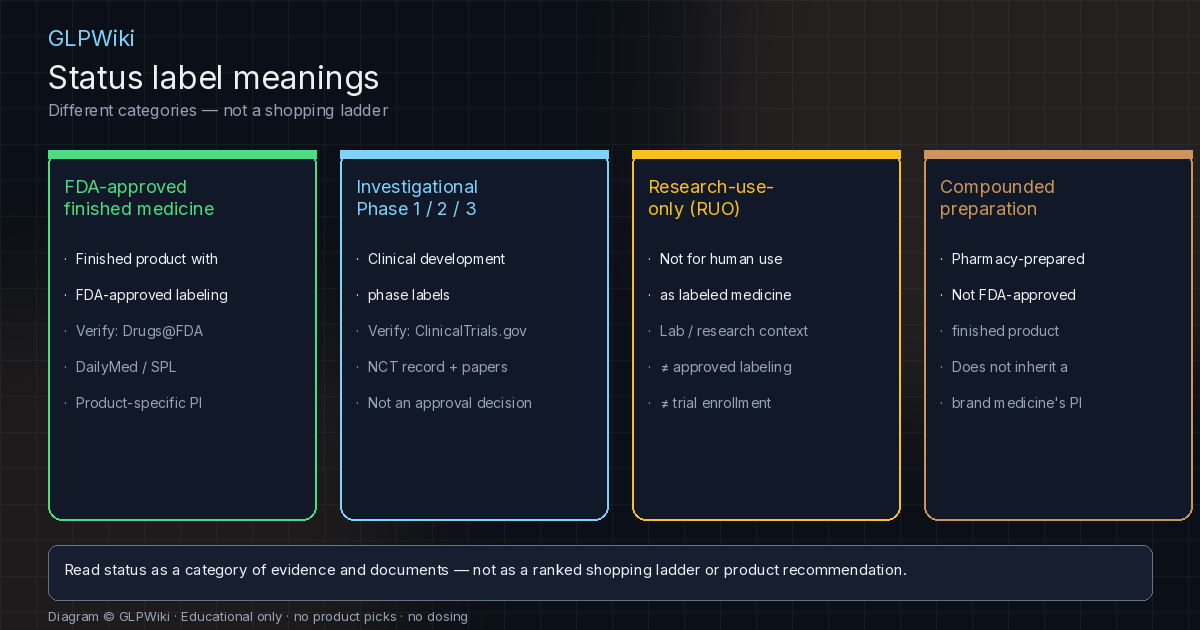
- FDA-approved finished medicine → Drugs@FDA / DailyMed / product PI.
- Investigational Phase 1/2/3 → ClinicalTrials.gov + papers.
- Research-use-only → lab/research context; not approved labeling.
- Compounded → not an FDA-approved finished product; does not inherit brand PI.
How to verify claims without mixing document types
Start from the claim, then choose the document type that can actually support it. For U.S. approval status and Agency-posted labeling of a finished human drug, search Drugs@FDA and open the current label for the exact product. Use DailyMed when structured SPL text is useful, remembering NLM note that in-use DailyMed labeling may differ from the most recent FDA-approved labeling.
For investigational programs, search ClinicalTrials.gov, record the NCT identifier, and read status, outcomes, and eligibility as registry facts — not as approval. For published evidence, find the paper in PubMed and read beyond the abstract. For educational literacy on how labels themselves are organized, use the companion guide on FDA Prescribing Information; for trial structure, use the companion guide on reading a peptide clinical study.
Never let a shared molecule name erase the document boundary. A true statement about a receptor in a paper does not become an approved indication. A true Phase 3 registration does not become Drugs@FDA approval. A true compounded listing does not inherit a brand PI.
- Approved finished product / current PI: Drugs@FDA (DailyMed for SPL).
- Investigational study record: ClinicalTrials.gov.
- Published study: PubMed / PMC when available.
- Keep molecule name, product, status, and document type named separately.
What this page does not do
This guide teaches datasheet literacy for compound and medication pages. It does not recommend a medicine, product, manufacturer, pharmacy, telehealth service, or research material. It publishes no numeric doses, schedules, titration sequences, stacks, administration instructions, compounding recipes, or product comparisons framed as personal choices.
It also does not replace current Prescribing Information, patient labeling, a licensed clinician, or emergency services. Cards and summaries change as sources update. Always verify the current official record for the exact finished product or study, and use qualified clinical guidance for personal decisions.
Next reading
Continue with approved versus investigational peptides for category boundaries, then compounded versus FDA-approved GLP-1 medicines for finished-product distinctions. How to read FDA peptide labeling explains Prescribing Information structure; how to read a peptide study covers trial phases, endpoints, and registration.
Peptide classes overview helps place class fields in a broader taxonomy without treating class membership as an indication. Together these guides keep datasheet fields connected to the right primary sources.
Frequently asked questions
- What is a peptide datasheet on GLPWiki?
- An educational summary card on a compound or medication page that lists identity, aliases, class, receptor shorthand, approximate half-life concepts when available, and status. It is a navigation aid toward primary sources, not a substitute for FDA labeling, a trial registry record, or a peer-reviewed paper.
- Does also called mean the nickname is a real hormone or receptor?
- No. Also-called fields collect search nicknames and research codes. They help discovery. They do not redefine biology. For example, GLP-3 is an unofficial nickname associated with retatrutide discussions; it does not establish a GLP-3 hormone or GLP-3 receptor.
- Are receptor lines the same as approved indications?
- No. Receptor lines are pharmacology shorthand for known or claimed molecular targets. Approved indications are product-specific uses stated in FDA Prescribing Information for a finished medicine.
- Can I use datasheet half-life as a dosing schedule?
- No. Half-life on an educational datasheet is an approximate pharmacokinetic concept. This page publishes no doses, schedules, or titration advice. Individual care belongs with licensed clinicians and current official labeling for approved products.
- What does a Phase 2 or Phase 3 status mean on a datasheet?
- It usually points to an investigational clinical development stage described in trial registries and related literature. Phase labels are not FDA approval decisions for a finished product.
- Is a compounded listing the same as an FDA-approved medicine?
- No. Compounded preparations are not FDA-approved finished products and do not inherit a brand medicine Prescribing Information merely because a familiar molecule name appears.
- Where should I verify an approval claim?
- Search the exact finished product in Drugs@FDA and inspect its application record and current FDA-posted labeling. Use DailyMed for structured SPL when helpful, and keep the Drugs@FDA vs DailyMed distinction in mind.
- Where should I verify an investigational claim?
- Search ClinicalTrials.gov for the NCT record and read status, outcomes, and study design fields. Use PubMed for published papers. Do not treat a registry entry or paper as approved labeling.
- Why do molecule names cause category confusion?
- The same or similar name may appear on an approved finished medicine, an investigational trial, a compounded preparation, or a research-use listing. Those categories have different documents and evidence bars, so the exact product and document type must be named.
- Does this page recommend products or doses?
- No. GLPWiki publishes educational reference material only. This page includes no product picks, no doses, no schedules, no stacks, and no compounding recipes.
SOURCES
- 01Drugs@FDA— U.S. Food and Drug Administration
- 02DailyMed— U.S. National Library of Medicine
- 03About DailyMed (including Drugs@FDA vs DailyMed differences)— U.S. National Library of Medicine
- 04Frequently Asked Questions about Labeling for Prescription Medicines— U.S. Food and Drug Administration
- 05ClinicalTrials.gov— U.S. National Library of Medicine
- 06PubMed— U.S. National Library of Medicine
- 07FDA's Labeling Resources for Human Prescription Drugs— U.S. Food and Drug Administration
- 08Compounding and the FDA: Questions and Answers— U.S. Food and Drug Administration
EDUCATIONAL REFERENCE ONLY · Not medical advice. Nothing here diagnoses, treats, cures or prevents any disease, and nothing here is a dosing recommendation. Consult a licensed clinician before any treatment decision.