BAC water basics: benzyl alcohol, multi-dose vials and diluent literacy

Bacteriostatic Water for Injection (often called BAC water) is a sterile diluent that typically contains benzyl alcohol as a preservative and is supplied in multiple-dose vials. This guide explains what BAC water is and is not, how it differs from Sterile Water for Injection, how multi-dose beyond-use framing works at a concept level, and why labels warn against neonate use — including the historical gasping-syndrome reports. Educational only: no reconstitution volumes, doses or product recommendations.
UPDATED 11 OCT 2026 · 12 MIN READ
KEY TAKEAWAYS
- Bacteriostatic Water for Injection, USP is labeled as a sterile, nonpyrogenic diluent/solvent containing benzyl alcohol (commonly 0.9% / 9 mg/mL or 1.1% / 11 mg/mL) as a bacteriostatic preservative, supplied in a multiple-dose container.
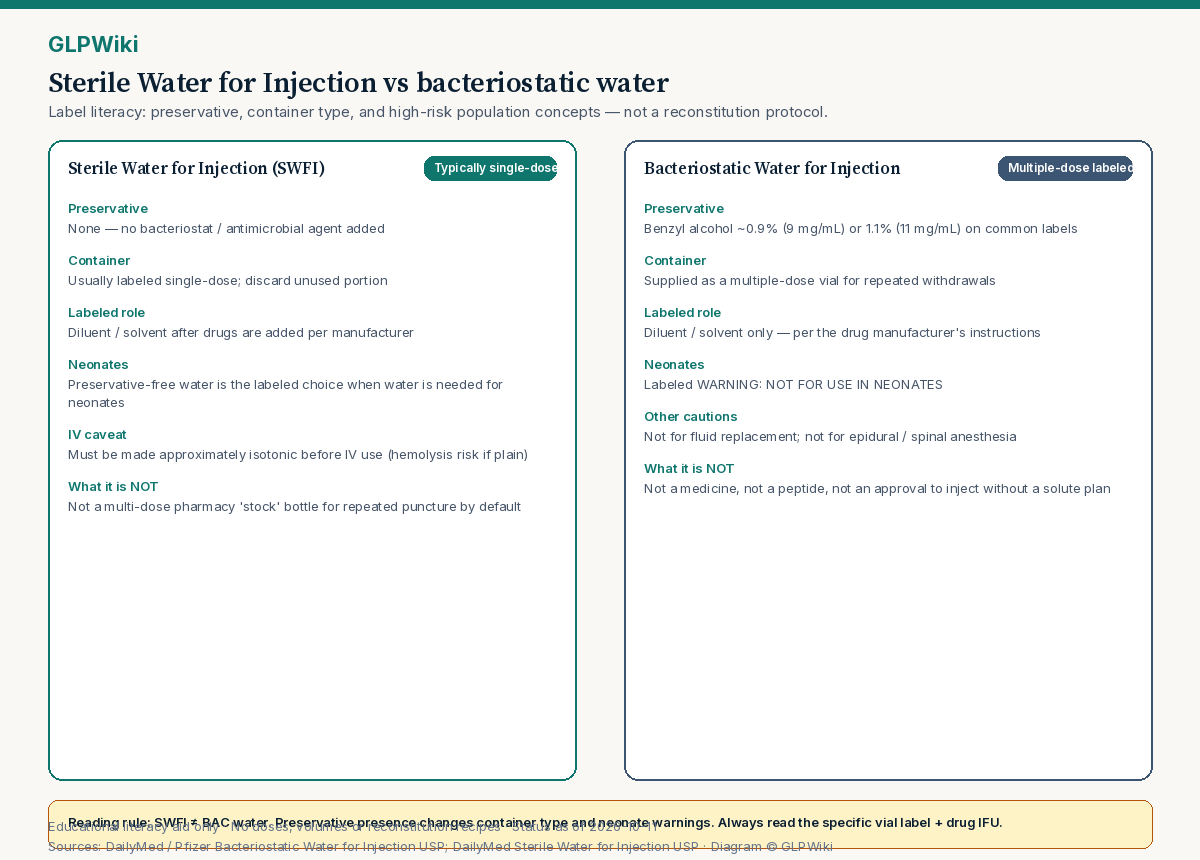
- Sterile Water for Injection (SWFI) contains no bacteriostat and is typically supplied in single-dose containers; unused portion is discarded. SWFI and BAC water are not interchangeable when a preservative-free diluent is required.
- Labeled warnings on BAC water include NOT FOR USE IN NEONATES; not for fluid replacement; not for epidural or spinal anesthesia; and the preparation must be made approximately isotonic before intravenous use.
- Multi-dose vial literacy (CDC / USP <797> framing): after first puncture, date the vial and discard within 28 days unless the manufacturer specifies a different opened-vial period; the beyond-use date never exceeds the manufacturer's original expiration. Unopened vials follow the labeled expiration.
- Preservatives slow bacterial growth after repeated access; they do not inactivate viruses and do not replace aseptic technique.
- 1982 CDC MMWR and related literature linked benzyl alcohol–preserved flush solutions and diluents to neonatal deaths described as gasping syndrome — the historical basis for neonate labeling warnings.
- BAC water is a diluent vehicle, not a peptide medicine and not an FDA approval for any research peptide. Concentration/ratio math lives on GLPWiki's bac-water-ratios guide; reconstitution walkthroughs and aseptic technique have their own pages.
What this guide covers (and what it does not)
GLPWiki already publishes bac-water-ratios (concentration and ratio literacy), how-to-reconstitute-peptides (reconstitution concepts), aseptic-technique-peptide-vials (multi-dose aseptic handling), and peptide-storage-and-handling. Those pages stay in place. This guide is the missing safety and label-literacy deep-dive: what BAC water is chemically and regulatorily, how benzyl alcohol functions as a preservative, how multi-dose dating concepts are framed in public guidance, and why neonate warnings appear on labels.
- Primary sources: DailyMed / manufacturer labeling for Bacteriostatic Water for Injection and Sterile Water for Injection; CDC injection-safety multi-dose vial literacy; CDC MMWR 1982 benzyl alcohol neonatal deaths; peer-reviewed gasping-syndrome reports.
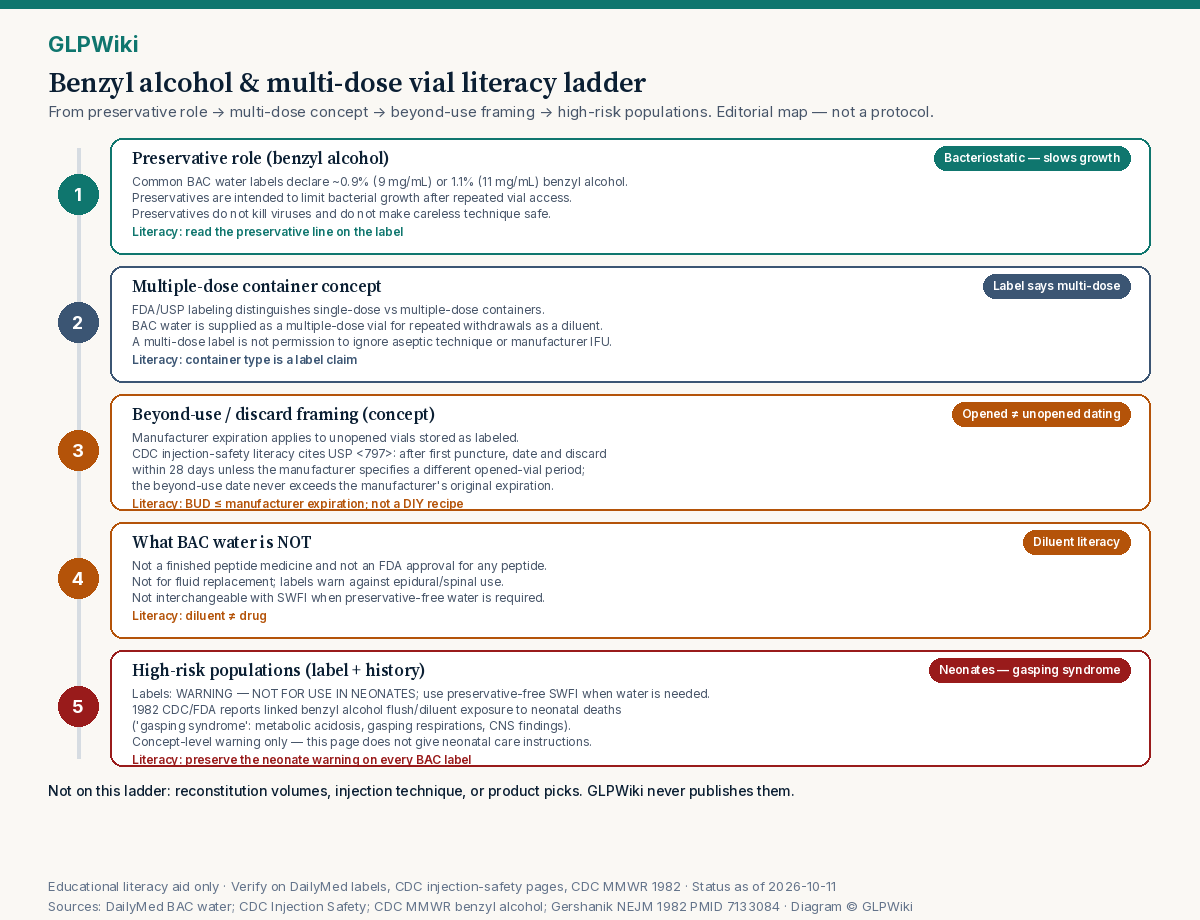
- Two original GLPWiki diagrams: SWFI vs BAC map, and a benzyl alcohol / multi-dose beyond-use literacy ladder.
- Out of scope: reconstitution volumes, peptide doses, injection technique tutorials, and vendor or product picks.
What bacteriostatic water is (identity literacy)
On U.S. labeling, Bacteriostatic Water for Injection, USP is described as a sterile, nonpyrogenic preparation of water for injection containing benzyl alcohol added as a bacteriostatic preservative. Common Hospira / Pfizer labeling lists 0.9% (9 mg/mL) benzyl alcohol in 30 mL plastic multiple-dose vials and 1.1% (11 mg/mL) in a glass multiple-dose presentation. The preparation is indicated only for diluting or dissolving drugs for intravenous, intramuscular or subcutaneous injection according to the instructions of the manufacturer of the drug to be administered.
Bacteriostatic means the preservative is intended to inhibit bacterial growth, supporting repeated withdrawals from a multiple-dose container. It is not a claim that the vial is immune to contamination, viral transmission or technique failures.
Online shorthand 'BAC water' usually points to this labeled diluent class. Research-use or unofficial bottles sold beside peptide vials are not the same as reading a finished-drug DailyMed label: lot identity, sterility claims and regulatory status still need separate verification.
Sterile Water for Injection vs bacteriostatic water
Sterile Water for Injection, USP is labeled as sterile water with no bacteriostat, antimicrobial agent or added buffer, typically supplied only in single-dose containers. Labels instruct not to reuse single-dose containers and to discard the unused portion. Like BAC water, SWFI used as a pharmaceutic aid must generally be made approximately isotonic before intravenous administration because plain water can cause hemolysis.
The practical literacy distinction: SWFI is preservative-free and single-use oriented; BAC water carries benzyl alcohol and is labeled multiple-dose. When neonate labeling or a drug's instructions require preservative-free water, BAC water is the wrong vehicle — BAC water labels themselves state that where water is required for preparing or diluting medications for neonates, only preservative-free Sterile Water for Injection should be used.
Label literacy: what to read on a BAC water vial
Finished-drug BAC water labels put several claims on the principal display and warnings sections. Literacy means being able to find them — not inventing a reconstitution plan.
- Product identity: Bacteriostatic Water for Injection, USP (not a peptide name).
- Multiple-dose vial language and fill volume (for example 30 mL presentations on common labels).
- Preservative declaration: benzyl alcohol concentration (0.9% / 9 mg/mL or 1.1% / 11 mg/mL on cited labels).
- WARNING: NOT FOR USE IN NEONATES (prominent on cited labeling).
- Indication: diluent or solvent only, following the drug manufacturer's instructions.
- Contraindications / warnings: not for fluid replacement; not for epidural or spinal anesthesia; approximately isotonic before IV use; hemolysis risk if given IV without solute.
- Storage: USP controlled room temperature framing on cited labels (20 to 25 °C / 68 to 77 °F).
- Lot and expiration dating for the unopened container.
Multi-dose vials and beyond-use dating (concept level)
Public CDC injection-safety materials summarise USP General Chapter <797> framing for multi-dose vials of sterile pharmaceuticals: an unopened multi-dose vial is discarded according to the manufacturer's expiration date; once opened or accessed (needle-punctured), the vial should be dated and discarded within 28 days unless the manufacturer specifies a different (shorter or longer) date for that opened vial. The beyond-use date should never exceed the manufacturer's original expiration date. Medication vials should always be discarded whenever sterility is compromised or questionable.
That framing is literacy about dating concepts used in healthcare settings. It is not a peptide reconstitution protocol, not a permission to share vials across patients casually, and not a substitute for the specific manufacturer's instructions for either the diluent or the drug being dissolved. CDC also emphasises that preservatives in multi-dose vials do not affect viruses and do not provide complete protection against bacterial contamination.
Neonates, benzyl alcohol and gasping syndrome (historical framing)
BAC water labeling carries a prominent neonate contraindication because benzyl alcohol toxicity in newborns is a documented historical safety story, not a marketing footnote.
In 1982, CDC's MMWR reported sixteen neonatal deaths thought to be caused by benzyl alcohol preservative in intravascular solutions, linked at two medical centers to bacteriostatic normal saline containing 9 mg/mL benzyl alcohol used as catheter flush. The clinical picture included metabolic acidosis progressing to respiratory distress and gasping respirations, with CNS findings and late cardiovascular collapse. FDA recommended that intravascular flush solutions containing benzyl alcohol not be used for newborns and that diluents with this preservative not be used as medications for these infants.
Peer-reviewed reports from the same period — including Gershanik and colleagues in the New England Journal of Medicine (PMID 7133084) describing the gasping syndrome, and Brown, Buist and colleagues in The Lancet on fatal benzyl alcohol poisoning in a neonatal intensive care unit — form the literature backbone behind today's NOT FOR USE IN NEONATES labeling. Modern BAC water labels still state that solutions containing benzyl alcohol must not be used in neonates and that preservative-free Sterile Water for Injection should be used when water is required for neonatal medication preparation.
This section is concept-level historical and label literacy. It does not provide neonatal dosing, flush protocols or clinical management advice.
What BAC water is not
Several online misunderstandings collapse diluent literacy into peptide marketing.
- Not a peptide, hormone or finished therapeutic with an efficacy claim of its own — it is a vehicle.
- Not interchangeable with SWFI when preservative-free water is required (including neonate contexts on the label).
- Not a license to ignore the drug manufacturer's choice of diluent, volume or route.
- Not proof that a research peptide vial is sterile, correctly identified or clinically appropriate.
- Not a substitute for aseptic technique, sharps safety or proper discard of compromised vials.
- Not covered here as a recipe: volumes, peptide milligrams and syringe-unit math belong on other GLPWiki pages if at all, and never as medical advice.
Scope, disclaimer and review date
This guide is educational. It maps labeled identity of bacteriostatic water, benzyl alcohol preservative concepts, SWFI contrasts, multi-dose beyond-use framing from public CDC/USP literacy materials, and historical neonate toxicity warnings. It does not provide reconstitution volumes, peptide doses, titration schedules, injection technique tutorials, sourcing advice or individual medical advice, and nothing here recommends starting, stopping or combining any medicine or research chemical. Decisions about health care belong with a licensed clinician and, for approved medicines and diluents, the official label.
Last reviewed: October 11, 2026. Labeling and guidance may have changed since; verify with DailyMed, manufacturer labeling, CDC injection-safety pages and your clinician or pharmacist.
Frequently asked questions
- What is BAC water?
- In pharmacy labeling, Bacteriostatic Water for Injection, USP is sterile water for injection containing benzyl alcohol as a bacteriostatic preservative, supplied in a multiple-dose vial and indicated only as a diluent or solvent according to the drug manufacturer's instructions.
- What does 0.9% benzyl alcohol mean on the label?
- Common BAC water labels declare 0.9% benzyl alcohol, equal to 9 mg/mL, as the preservative. Some presentations list 1.1% (11 mg/mL). That line identifies the preservative amount; it is not a peptide dose.
- How is bacteriostatic water different from sterile water for injection?
- SWFI typically has no preservative and is supplied in single-dose containers with instructions to discard unused portion. BAC water contains benzyl alcohol and is labeled as a multiple-dose diluent. They are not interchangeable when preservative-free water is required.
- Why do BAC water labels say not for use in neonates?
- Benzyl alcohol has been associated with serious toxicity in newborns historically described as gasping syndrome. 1982 CDC and FDA communications and peer-reviewed reports led to strong warnings against benzyl alcohol–preserved flushes and diluents in neonates. Modern labels retain the neonate contraindication.
- What is the 28-day multi-dose vial rule?
- CDC injection-safety literacy citing USP <797> states that once a multi-dose vial is opened or needle-punctured, it should be dated and discarded within 28 days unless the manufacturer specifies a different opened-vial period, and the beyond-use date must not exceed the manufacturer's original expiration. Unopened vials follow the labeled expiration. This is dating literacy, not a reconstitution recipe.
- Does the preservative make the vial virus-safe?
- No. CDC notes that antimicrobial preservatives in multi-dose vials help limit bacterial growth but do not affect viruses and do not provide complete protection against bacterial contamination. Aseptic technique still matters.
- Can BAC water be used as IV fluid replacement?
- No. Cited BAC water labeling contraindicates use for fluid replacement and warns that intravenous administration without a solute may result in hemolysis. It is a diluent vehicle, not a hydration fluid.
- Is BAC water an FDA-approved peptide?
- No. Bacteriostatic Water for Injection is a labeled diluent finished drug (for example under NDA 018802 on cited DailyMed entries). It is not an approval for any peptide research chemical dissolved in it.
- Where do reconstitution ratios and syringe math live on GLPWiki?
- Concentration and ratio concepts are on /guides/bac-water-ratios. Reconstitution walkthrough literacy is on /guides/how-to-reconstitute-peptides. This page stays focused on preservative, multi-dose and safety literacy.
- Does this page recommend doses or reconstitution volumes?
- No. GLPWiki publishes educational diluent and label literacy only. Doses, volumes, injection technique and product sourcing are out of scope.
SOURCES
- 01DailyMed — BACTERIOSTATIC WATER injection, solution (setid 87d6e9dc-fe3b-4593-ac9a-d7493d1959c7; Hospira / NDA 018802)— U.S. National Library of Medicine / DailyMed
- 02BACTERIOSTATIC WATER for Injection, USP — manufacturer labeling (Pfizer / Hospira ShowLabeling id=4666)— Pfizer / Hospira labeling
- 03DailyMed — STERILE WATER water injection (preservative-free single-dose framing; example setid 386a0a2f-4ff7-f128-e063-6294a90a7d4d)— U.S. National Library of Medicine / DailyMed
- 04Preventing Unsafe Injection Practices — multi-dose vial key points and USP <797> 28-day beyond-use framing— Centers for Disease Control and Prevention
- 05Neonatal Deaths Associated With Use Of Benzyl Alcohol -- United States— CDC MMWR
- 06Gershanik J, et al. The Gasping Syndrome and Benzyl Alcohol Poisoning. N Engl J Med. 1982;307:1384-1388. PMID 7133084— New England Journal of Medicine / PubMed
- 07Brown WJ, Buist NRM, et al. Fatal benzyl alcohol poisoning in a neonatal intensive care unit. Lancet. 1982;319(8283):1250. DOI 10.1016/S0140-6736(82)92377-7— The Lancet
- 08American Academy of Pediatrics. Benzyl Alcohol: Toxic Agent in Neonatal Units. Pediatrics. 1983;72(3):356-358— American Academy of Pediatrics / Pediatrics
- 09FDA Injection Dosage Form Questions — single-use vs multiple-dose labeling expectations— U.S. Food and Drug Administration
- 10Joint Commission FAQ — Managing Multi-dose Vials of Injectable Medication (28-day beyond-use framing)— The Joint Commission
EDUCATIONAL REFERENCE ONLY · Not medical advice. Nothing here diagnoses, treats, cures or prevents any disease, and nothing here is a dosing recommendation. Consult a licensed clinician before any treatment decision.