Growth hormone peptides compared: tesamorelin, sermorelin, ipamorelin, CJC-1295 and related secretagogues
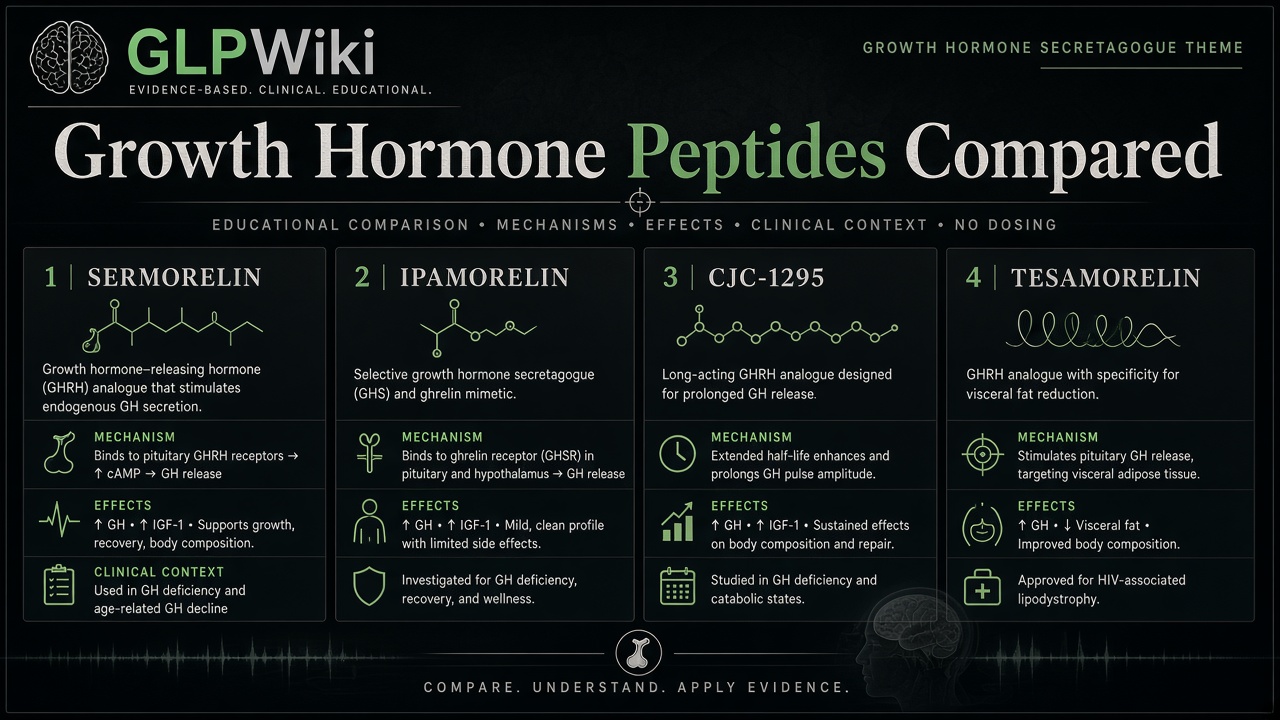
Several peptides raise growth hormone, but they are not interchangeable. This guide separates GHRH-receptor analogues from ghrelin-receptor (GHS-R1a) agonists, maps FDA-approved tesamorelin against historically approved then withdrawn sermorelin, and summarises the thinner human evidence for ipamorelin, CJC-1295 (with and without DAC) and hexarelin. Educational only: no doses, schedules or product recommendations.
UPDATED 09 OCT 2026 · 15 MIN READ
KEY TAKEAWAYS
- Tesamorelin (Egrifta family) is a GHRH analogue FDA-approved since 2010 to reduce excess abdominal visceral fat in HIV-infected adults with lipodystrophy. It is not labeled for general weight loss.
- Sermorelin (Geref) was FDA-approved for paediatric idiopathic growth-hormone deficiency and as a diagnostic GH stimulant, then withdrawn from the U.S. market. In 2013 FDA determined the withdrawal was not for safety or effectiveness; no approved sermorelin product is currently marketed.
- Ipamorelin is a selective GHS-R1a (ghrelin-receptor) agonist. Its published Phase 2 programme targeted postoperative ileus and did not meet its primary endpoint; there are no controlled body-composition efficacy trials.
- CJC-1295 with DAC is a long-acting albumin-binding GHRH analogue studied in healthy adults for GH and IGF-1 pharmacology. Material sold as 'CJC-1295 without DAC' is a short-acting modified GRF (1–29) and does not share those multi-day half-life figures.
- No published randomised trial has tested the popular CJC-1295 + ipamorelin combination as a pair. Synergy claims often cite older GHRH + GHRP/ghrelin studies with different molecules.
- Hexarelin and other GHRPs have early human GH-release data but no approved U.S. medicine. Online research-use products are not trial materials.
- Secretagogues require an intact pituitary axis. Exogenous recombinant growth hormone is a different product class with its own labeled uses and risks.
What this guide adds to the July 2026 blog post
GLPWiki's July 2026 deep dive, 'GH secretagogues compared: sermorelin, ipamorelin, CJC-1295, tesamorelin', gave a short overview of two receptors and an evidence gradient. This guide rebuilds that comparison as a full reference: receptor map, compound-by-compound status with primary citations, CJC-1295 with-versus-without DAC literacy, and an evidence ladder. The original post stays online with a link to this guide.
- Primary sources: FDA labels (NDA 022505), Federal Register determination on Geref, ClinicalTrials.gov NCT numbers, and peer-reviewed pharmacology and Phase 2 papers.
- Status check as of October 9, 2026: tesamorelin remains the only currently marketed FDA-approved GHRH analogue in this comparison set.
- Two original GLPWiki diagrams: receptor families and evidence maturity.
Two receptors, two families
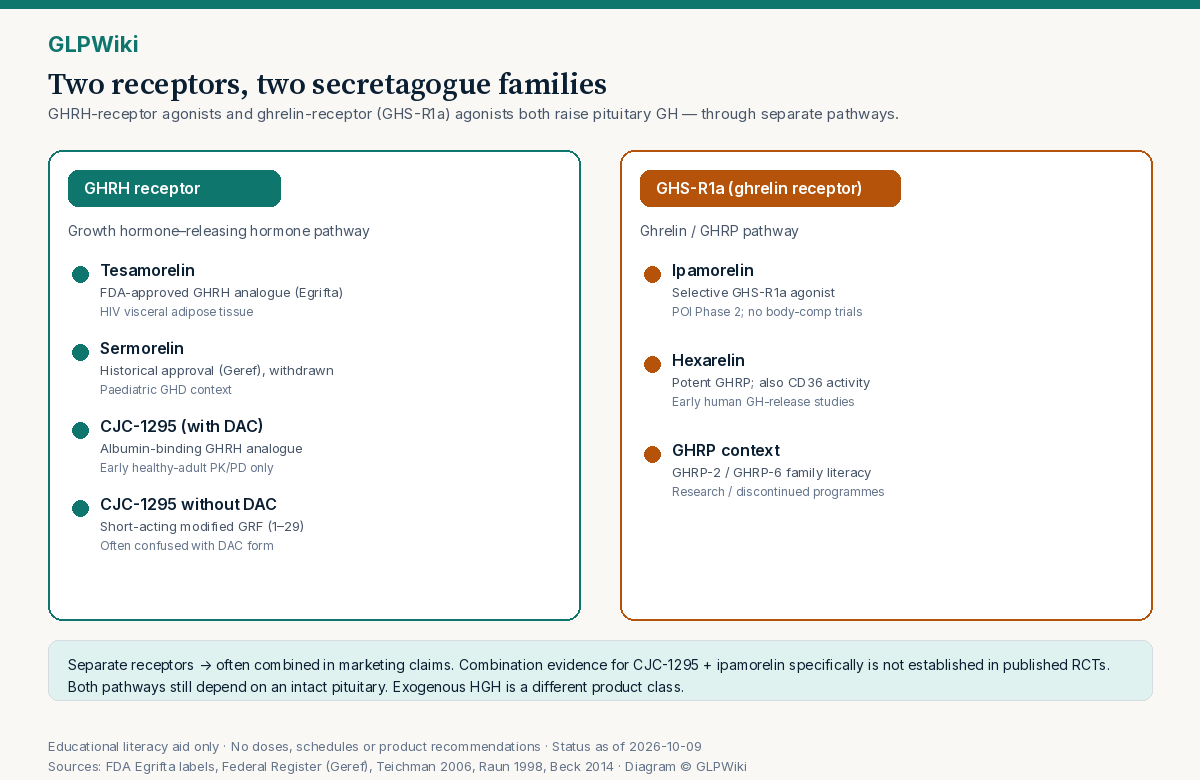
Growth-hormone secretagogues are often lumped together because they all raise circulating GH. Mechanistically they fall into at least two families that act on different pituitary receptors.
GHRH analogues (tesamorelin, sermorelin, CJC-1295 / modified GRF) bind the growth hormone–releasing hormone receptor. Ghrelin-receptor agonists — also called GHRPs — bind GHS-R1a. Hexarelin and ipamorelin sit in that second family. Because the pathways are separate, marketers often pair a GHRH analogue with a GHRP; that pairing is a hypothesis, not proof that any specific pair improves clinical outcomes.
Both families still need working somatotroph cells. People with pituitary destruction, hypophysectomy or other hypothalamic–pituitary disruption are outside the labeled population for tesamorelin and are a reason secretagogues are not interchangeable with recombinant GH.
Tesamorelin: the FDA-approved benchmark
Tesamorelin is a synthetic analogue of human growth hormone–releasing factor. FDA approved it in November 2010 (NDA 022505) as Egrifta for reduction of excess abdominal fat in HIV-infected adults with lipodystrophy. Later labeled presentations include Egrifta SV and Egrifta WR; formulation and reconstitution details differ, but the indicated use remains the same class of visceral adipose reduction in that population.
In a randomised Phase 3 trial published in the New England Journal of Medicine (Falutz and colleagues, 2007; NCT00123253), daily tesamorelin for 26 weeks reduced visceral adipose tissue by about 15% versus an increase on placebo, with improvements in triglycerides and the total-to-HDL cholesterol ratio and a rise in IGF-1. A pooled analysis of two Phase 3 programmes (Falutz and colleagues, 2010) in 806 ART-treated adults reported a treatment effect of about −15.4% VAT at week 26, with maintenance of VAT and lipid changes in those who continued through week 52.
The current prescribing information states limitations of use that matter for literacy: long-term cardiovascular safety has not been established; the product is not indicated for weight-loss management (weight-neutral effect on the label); and there are no data that it improves antiretroviral adherence. Contraindications include disruption of the hypothalamic–pituitary axis, active malignancy, hypersensitivity and pregnancy. GLPWiki does not reproduce dosing instructions; labeled use belongs with a clinician and the official label.
- Receptor family: GHRH receptor.
- Evidence level: Phase 3 outcomes + FDA approval for a specific labeled use.
- Not a general 'fat-loss peptide' for people without the labeled indication.
Sermorelin: historical approval, not a current approved product
Sermorelin is the 1–29 amidated fragment of human GHRH (often called GRF 1–29). Under the brand Geref, FDA approved a diagnostic presentation (NDA 19-863, 1990) to evaluate pituitary GH reserve and a therapeutic presentation (NDA 20-443, 1997) for idiopathic growth-hormone deficiency in children with growth failure.
The manufacturer discontinued U.S. marketing. In a March 4, 2013 Federal Register notice, FDA determined that Geref products were not withdrawn from sale for reasons of safety or effectiveness. That determination is about the historical products; it does not mean an approved sermorelin medicine is available today. As of this review, there is no currently marketed FDA-approved sermorelin finished drug. Compounded sermorelin preparations are not the withdrawn approved product and are not reviewed for safety, effectiveness or quality the way an NDA product is.
Online claims that 'sermorelin is FDA-approved' are therefore incomplete without the historical-versus-current distinction. Historical paediatric GHD data do not establish adult anti-ageing or body-composition uses.
CJC-1295: with DAC versus without DAC
CJC-1295, developed by ConjuChem, is a GHRH analogue designed for prolonged action. In the published human pharmacology papers, 'CJC-1295' refers to the drug-affinity-complex (DAC) form: a modified GRF (1–29) linked so it can covalently bind serum albumin after injection.
Teichman and colleagues (Journal of Clinical Endocrinology & Metabolism, 2006; PMID 16352683) reported that in healthy adults a single subcutaneous injection raised mean GH for six or more days and IGF-1 for about 9–11 days, with an estimated half-life of roughly 5.8–8.1 days. Multiple doses kept mean IGF-1 above baseline for up to 28 days. Ionescu and Frohman (JCEM 2006; PMID 17018654) showed that pulsatile GH secretion persisted during this prolonged stimulation, with higher trough and mean GH and higher IGF-1 after one dose.
Those multi-day figures apply to the DAC construct studied in those trials. Material marketed as 'CJC-1295 without DAC' or 'modified GRF 1–29' lacks the albumin-binding moiety, so it behaves as a short-acting GHRH fragment. Treating no-DAC vials as if they had Teichman's half-life is a common literacy error. Clinical development of CJC-1295 did not produce an approved medicine; a later programme was terminated. No labeled therapeutic indication exists.
Ipamorelin: selective GHS-R1a agonist, limited efficacy evidence
Ipamorelin is a pentapeptide described by Raun and colleagues (European Journal of Endocrinology, 1998; PMID 9849822) as a selective growth-hormone secretagogue at the ghrelin receptor, with little stimulation of ACTH or cortisol relative to earlier GHRPs in the models they tested.
Human clinical development focused on postoperative gastrointestinal recovery, not body composition. Beck and colleagues (International Journal of Colorectal Disease, 2014; PMID 25331030; NCT00672074) reported a randomised proof-of-concept Phase 2 study after bowel resection: ipamorelin was well tolerated but did not significantly shorten time to first tolerated solid meal versus placebo (primary endpoint p = 0.15). A larger dose-finding Phase 2 study (NCT01280344) completed without a landmark efficacy publication establishing a labeled use.
There are no published randomised trials showing that ipamorelin improves muscle mass, fat loss or healthy-ageing outcomes in humans. Claims that borrow GH-pulse pharmacology from healthy-volunteer or animal work overstate what the clinical record supports.
Hexarelin and other GHRP context
Hexarelin (examorelin) is a hexapeptide GHRP that stimulates GH release in humans after several routes of administration in early studies (for example, Ghigo and colleagues, PMID 8126144). It also has literature on CD36-related cardiac effects in experimental models. Like other research GHRPs, it did not become a currently marketed FDA-approved medicine for GH deficiency or body composition.
Older human work combining native GHRH with ghrelin or hexarelin (for example, Hataya and colleagues, PMID 11238504) supports the idea that GHRH-receptor and GHS-R1a pathways can produce larger acute GH pulses together than either alone. That mechanistic observation is not a trial of CJC-1295 with ipamorelin, and it does not establish long-term safety or benefit for online blends.
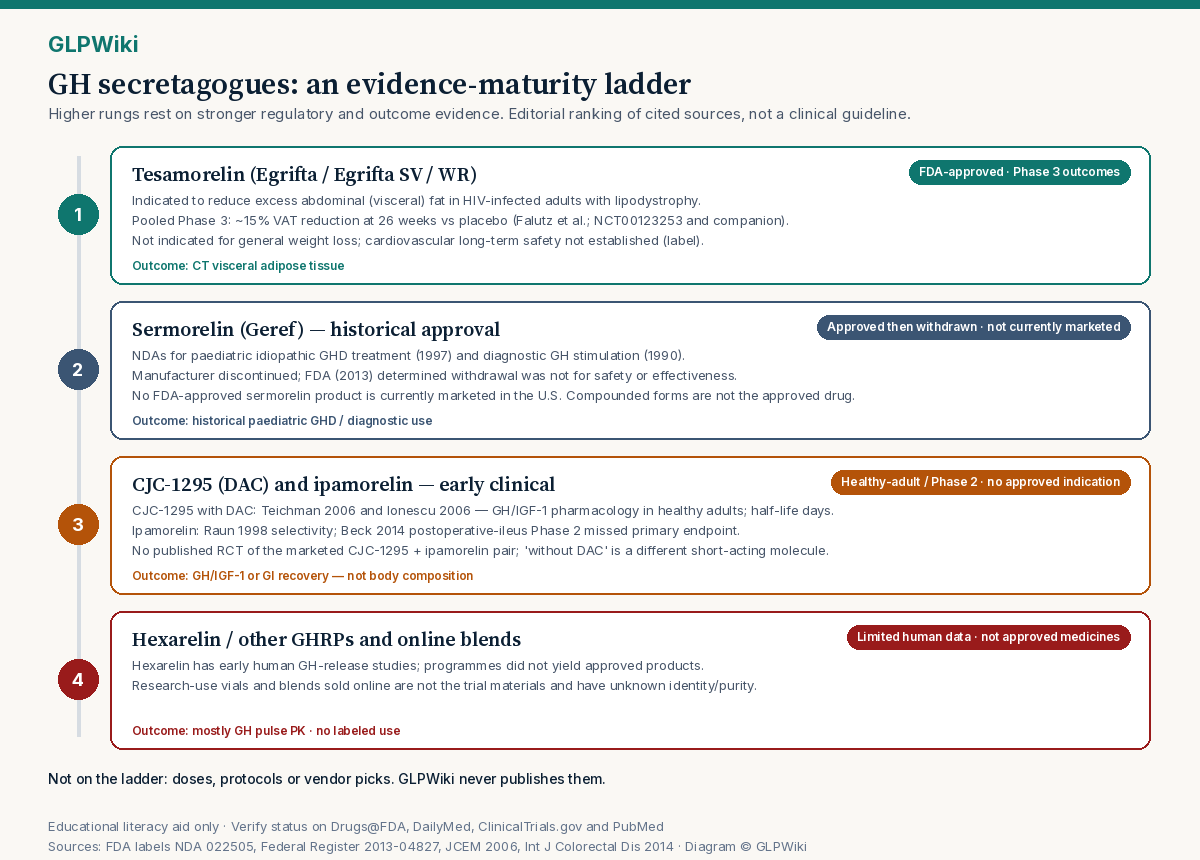
Putting it together: evidence maturity
The diagram ranks the compounds discussed here by regulatory and outcome evidence. It is GLPWiki's editorial summary of the cited sources, not a treatment guideline.
- Ask which receptor the claim is about (GHRH-R versus GHS-R1a).
- Ask whether 'FDA-approved' means currently marketed for a labeled use, or only historically approved.
- Ask whether CJC-1295 claims cite DAC pharmacology papers or no-DAC marketing names.
- Ask whether combination claims cite a trial of that exact pair, or only older different molecules.
- Check Drugs@FDA / DailyMed for labeled products and ClinicalTrials.gov + PubMed for everything else.
How to verify GH-peptide claims
Secretagogue marketing often mixes approved medicines, withdrawn historical products and research chemicals.
- Drugs@FDA and DailyMed: confirm whether a finished drug is currently approved and for which indication (tesamorelin / Egrifta family).
- Federal Register and FDA discontinued-product determinations: clarify sermorelin / Geref history.
- ClinicalTrials.gov: look up NCT numbers from this page; a registry record is never an approval.
- PubMed: confirm whether a number comes from peer-reviewed human pharmacology, a Phase 2 efficacy trial or a review.
- WADA and sport authorities separately prohibit many GH secretagogues; that is anti-doping policy, not FDA approval status.
Scope, disclaimer and review date
This guide is educational. It compares receptor families, regulatory status and published human evidence for selected growth-hormone secretagogues. It does not provide doses, reconstitution or titration schedules, sourcing advice, stacking protocols or individual medical advice, and nothing here recommends starting, stopping or combining any medicine or research chemical. Decisions about approved medicines belong with a licensed clinician and the official label.
Last reviewed: October 9, 2026. Trial results and regulatory status may have changed since; verify with Drugs@FDA, DailyMed, ClinicalTrials.gov and PubMed.
Frequently asked questions
- Is tesamorelin the same as HGH?
- No. Tesamorelin is a GHRH analogue that stimulates the pituitary to release the body's own growth hormone. Recombinant human growth hormone is a different product class that supplies GH directly. Tesamorelin is FDA-approved only to reduce excess abdominal fat in HIV-infected adults with lipodystrophy.
- Is sermorelin still FDA-approved?
- Sermorelin (Geref) was historically FDA-approved for paediatric idiopathic GH deficiency and as a diagnostic stimulant, then withdrawn from U.S. sale. FDA later determined the withdrawal was not for safety or effectiveness. There is no currently marketed FDA-approved sermorelin finished drug; compounded products are not that approved medicine.
- What is the difference between CJC-1295 with DAC and without DAC?
- Published human half-life and multi-day GH/IGF-1 data (Teichman 2006; Ionescu 2006) describe the albumin-binding DAC form. 'Without DAC' / modified GRF (1–29) lacks that linker and is short-acting. The names are often confused in online listings.
- Has CJC-1295 plus ipamorelin been proven in a clinical trial?
- No published randomised trial of that specific combination was identified. Each peptide has separate early human data. Synergy arguments often cite older GHRH + ghrelin/GHRP studies with different molecules.
- Did ipamorelin work in its Phase 2 trials?
- In the published postoperative-ileus proof-of-concept study (Beck 2014), ipamorelin was well tolerated but did not significantly improve the primary recovery endpoint versus placebo. It was not developed to an approved body-composition indication.
- Are online 'research' GH peptides the same as trial or approved drugs?
- No. Trial results and labels apply to the studied or approved products under controlled conditions. Research-use vials sold online have separate identity, purity and sterility uncertainties and are not approved medicines.
- Why do people combine GHRH analogues with GHRPs?
- Because they act on different receptors that both stimulate GH release. Acute combination of native GHRH with ghrelin or hexarelin can raise GH pulses more than either alone in short human studies. That does not prove long-term benefit or safety for any marketed research pair.
- Is hexarelin FDA-approved?
- No. Hexarelin has early human GH-release studies but no current FDA-approved finished-drug indication in this comparison.
- Who should not use tesamorelin according to the label?
- The prescribing information lists contraindications including disruption of the hypothalamic–pituitary axis, active malignancy, known hypersensitivity and pregnancy. Full contraindications, warnings and monitoring are in the official label; clinicians decide individual suitability.
- Does this page recommend doses or protocols?
- No. GLPWiki publishes educational comparisons and status literacy only. Doses, schedules and product sourcing are out of scope.
SOURCES
- 01Falutz J, et al. Metabolic Effects of a Growth Hormone-Releasing Factor in Patients with HIV. N Engl J Med 2007;357:2359-2370. doi:10.1056/NEJMoa072375. PMID 18057338— New England Journal of Medicine
- 02Tesamorelin Phase 3 VAT trial (NCT00123253)— ClinicalTrials.gov
- 03Falutz J, et al. Effects of tesamorelin (TH9507) in HIV-infected patients with excess abdominal fat: pooled Phase 3 analysis. J Clin Endocrinol Metab 2010;95:4291-4299. doi:10.1210/jc.2010-0490. PMID 20554713— PubMed
- 04EGRIFTA (tesamorelin) approval letter, NDA 022505 (Nov 10, 2010)— U.S. Food and Drug Administration
- 05EGRIFTA SV (tesamorelin) prescribing information, label 2024— U.S. Food and Drug Administration
- 06EGRIFTA WR (tesamorelin) prescribing information, label 2025— U.S. Food and Drug Administration
- 07Drugs@FDA: FDA-Approved Drugs database— U.S. Food and Drug Administration
- 08DailyMed: labeled drug information— U.S. National Library of Medicine
- 09Federal Register: Determination That GEREF (Sermorelin Acetate) Injection Was Not Withdrawn From Sale for Reasons of Safety or Effectiveness (Mar 4, 2013)— U.S. Federal Register
- 10Teichman SL, et al. Prolonged stimulation of GH and IGF-I by CJC-1295, a long-acting GHRH analog, in healthy adults. J Clin Endocrinol Metab 2006;91:799-805. doi:10.1210/jc.2005-1536. PMID 16352683— PubMed
- 11Ionescu M, Frohman LA. Pulsatile secretion of GH persists during continuous stimulation by CJC-1295. J Clin Endocrinol Metab 2006;91:4792-4797. doi:10.1210/jc.2006-1702. PMID 17018654— PubMed
- 12Raun K, et al. Ipamorelin, the first selective growth hormone secretagogue. Eur J Endocrinol 1998;139:552-561. doi:10.1530/eje.0.1390552. PMID 9849822— PubMed
- 13Beck DE, et al. Prospective, randomized, controlled, proof-of-concept study of the Ghrelin mimetic ipamorelin for postoperative ileus. Int J Colorectal Dis 2014;29:1527-1534. doi:10.1007/s00384-014-2008-6. PMID 25331030— PubMed
- 14Ipamorelin postoperative ileus Phase 2 (NCT00672074)— ClinicalTrials.gov
- 15Ipamorelin GI recovery dose-finding Phase 2 (NCT01280344)— ClinicalTrials.gov
- 16Ghigo E, et al. Growth hormone-releasing activity of hexarelin after intravenous, subcutaneous, intranasal, and oral administration in man. J Clin Endocrinol Metab 1994;78:693-698. doi:10.1210/jcem.78.3.8126144. PMID 8126144— PubMed
- 17Hataya Y, et al. Endocrine activities of ghrelin in humans: comparison and interactions with hexarelin and GHRH. J Clin Endocrinol Metab 2001;86:1163-1168. doi:10.1210/jcem.86.3.7323. PMID 11238504— PubMed
- 18Stanley TL, et al. Effects of tesamorelin on hepatic fat in HIV: a randomized trial. Lancet HIV 2019;6:e821-e830. doi:10.1016/S2352-3018(19)30338-8. PMID 31307944— PubMed
- 19ClinicalTrials.gov registry home— U.S. National Library of Medicine
- 20World Anti-Doping Agency Prohibited List— World Anti-Doping Agency
EDUCATIONAL REFERENCE ONLY · Not medical advice. Nothing here diagnoses, treats, cures or prevents any disease, and nothing here is a dosing recommendation. Consult a licensed clinician before any treatment decision.