Data monitoring committees and IND safety reporting literacy: who watches GLP-1 trials while they run, how stopping guidelines work, and what 21 CFR 312.32's 7-day and 15-day reports are

Big GLP-1 outcome trials such as LEADER, SELECT, FLOW, SOUL and SURPASS-CVOT run for years with thousands of participants, and almost nobody involved is allowed to know how the drug is doing while the trial runs. Two separate safety systems keep watch in the meantime. An independent data monitoring committee, sometimes called a DSMB, looks at the unblinded results behind an information firewall and can recommend stopping a trial for benefit, harm or futility. In parallel, FDA's IND safety reporting rule, 21 CFR 312.32, requires the sponsor to tell FDA and every participating investigator about serious, unexpected suspected adverse reactions and other important risk findings, within 15 calendar days, or within 7 days for unexpected fatal or life-threatening cases. This guide explains how both systems work, how they connect, what changed in 2025 and 2026, and how to read news that a trial was stopped early. It is educational only: no doses, no treatment advice and no legal advice.
UPDATED 20 NOV 2026 · 34 MIN READ
KEY TAKEAWAYS
- A data monitoring committee (DMC, also called a DSMB or IDMC) is a small independent group, usually clinicians plus a biostatistician, that reviews unblinded interim safety and efficacy data and recommends whether a trial should continue, change or stop. The sponsor makes the final decision.
- FDA strongly recommends a DMC when participants face risk of serious outcomes such as heart attack, stroke or death, which is why large GLP-1 cardiovascular and kidney outcome trials use them. A DMC is legally required only in a narrow case: emergency research run under the exception from informed consent (21 CFR 50.24).
- The information firewall is the point: the sponsor, investigators and steering committee stay blinded to results by treatment arm, while an independent statistician prepares closed reports for the DMC. FDA treats data shown by group (A versus B) as unblinded even if the groups are not named.
- Stopping guidelines are planned in advance in the protocol and DMC charter. Group sequential methods such as O'Brien-Fleming boundaries make early stopping for benefit require very strong evidence; trials stopped early for benefit still tend to overestimate the treatment effect.
- The FLOW kidney outcomes trial of semaglutide was stopped early in October 2023 after its independent DMC found that a prespecified interim analysis met criteria for efficacy; the company said it remained blinded to the results until the trial closed.
- Under 21 CFR 312.32, sponsors must report serious and unexpected suspected adverse reactions, significant risks from other studies or animal and laboratory work, and clinically important increases in the rate of serious reactions to FDA and all participating investigators within 15 calendar days; unexpected fatal or life-threatening suspected reactions go to FDA within 7 days of first receipt.
- FDA finalized its sponsor and investigator safety reporting guidances in December 2025, and since April 1, 2026 most commercial sponsors must send SUSAR reports electronically to FDA's Adverse Event Monitoring System (formerly FAERS) in E2B(R3) format.
- Readers rarely see individual IND safety reports. What reaches the public is usually a company announcement, a registry update, a label or consent change, or the published paper, so knowing which system produced the news helps you judge it.
Why trial monitoring and safety reporting matter for GLP-1 readers
Most news about GLP-1 and obesity medicines starts with a finished trial: a headline result, a hazard ratio, a press release. But the largest trials in this field take years. LEADER followed more than 9,300 people with type 2 diabetes for a median of 3.8 years. SELECT enrolled 17,604 adults with cardiovascular disease and overweight or obesity and followed them for a mean of almost 40 months. SOUL randomized 9,650 participants for a median of about four years, and SURPASS-CVOT randomized 13,299. During all that time, participants keep taking a study medicine whose long-term effects are, by definition, not fully known.
Someone has to watch for trouble while the trial runs, and someone has to tell regulators and doctors quickly when a new risk appears. In US drug development those are two different jobs done by two different systems. The first is interim monitoring by an independent data monitoring committee, which looks at results by treatment arm and can recommend changing or stopping a trial. The second is expedited IND safety reporting under 21 CFR 312.32, which obliges the sponsor to send FDA and every participating investigator a formal report when certain safety information meets defined criteria.
Both systems shape what you eventually read. A trial that is 'stopped early for efficacy' was stopped because of a DMC recommendation. A consent form that suddenly adds a new risk paragraph, or a letter to investigators about a laboratory finding, usually traces back to an IND safety report. And the long gap between a trial's first participant and its first published result is filled with these quiet, mostly confidential processes.
This guide explains what each system does, who is allowed to see what, how the 7-day and 15-day clocks work, how GLP-1 outcome trials have used DMCs, and how to read announcements about trials that stop early or change course. It builds on GLPWiki's guides to INDs, informed consent and IRBs, clinical investigator inspections and financial disclosure, and FAERS and MedWatch reporting, and it does not repeat them.
Two safety systems that run side by side
It helps to keep the two systems apart from the start, because news coverage often blurs them.
Interim monitoring is about the trial as a whole. A DMC looks at accumulating results, compares the groups, and asks a broad question: given everything we can see so far, is it still right to keep randomizing and treating people under this protocol? Its tools are comparative analyses, prespecified statistical boundaries and clinical judgment. Its output is a recommendation to the sponsor.
IND safety reporting is about specific risk information. The sponsor reviews every piece of safety information it receives from any source, decides whether any of it meets one of the reporting triggers in 21 CFR 312.32(c), and if so sends an IND safety report to FDA and to all participating investigators within a fixed number of calendar days. Its output is a regulatory report with a clock attached.
The two connect. A DMC that sees an imbalance in serious adverse events can trigger the sponsor's duty to investigate and possibly report. A pattern found in aggregate safety reviews may be something the DMC needs to know. But they are run by different people with different access to data, and they answer different questions. FDA's 2024 draft DMC guidance notes that the threshold a DMC uses to recommend stopping or significantly modifying a trial may be higher than the threshold for reporting a potential serious risk in an IND safety report.
What a data monitoring committee is
A data monitoring committee is a group of individuals with relevant expertise that reviews accumulating data from one or more ongoing clinical trials. The same thing goes by several names: data and safety monitoring board (DSMB), data and safety monitoring committee (DSMC) and independent data monitoring committee (IDMC). FDA's 2006 guidance, Establishment and Operation of Clinical Trial Data Monitoring Committees, is still the final guidance in effect. In February 2024 FDA published a revised draft, Use of Data Monitoring Committees in Clinical Trials, which will supersede the 2006 document when finalized; as of this review it is still a draft.
The 2024 draft describes the DMC's unique position plainly: DMCs are often the only group with access to accumulating unblinded safety and efficacy data. A DMC monitors safety, monitors interim effectiveness to see whether results support benefit or futility, and helps protect the scientific integrity of the trial. To judge risks properly it should see safety results in the context of efficacy, so it gets both.
Members are usually appointed by the sponsor or the trial's steering committee. A typical committee includes clinicians in the relevant specialty, such as cardiology, nephrology or endocrinology for GLP-1 outcome trials, and at least one biostatistician experienced in interim analysis; some add an ethicist or other experts. The draft guidance recommends that members be screened for financial and intellectual conflicts of interest, that they have no involvement in designing or running the trial, and that, apart from payment for committee work, they have no significant financial ties to the sponsor.
A DMC is not an IRB. An IRB reviews and approves research at its sites to protect participants' rights and welfare; it does not normally see unblinded comparative results. A DMC is not the clinical event committee either. Event adjudication committees are blinded experts who decide whether reported events, such as a suspected heart attack or a kidney failure event, meet the protocol's definitions so they can count as endpoints. And a DMC is not the sponsor's internal safety team, which reviews individual adverse event reports for regulatory reporting.
When FDA expects a DMC
FDA regulations do not require a DMC for most trials. The one explicit requirement is in 21 CFR 50.24, the exception from informed consent for emergency research, which requires establishment of an independent data monitoring committee to exercise oversight of such studies.
For other trials it is a recommendation. FDA's 2024 draft says FDA strongly recommends establishing a DMC if trial subjects are at risk of serious morbidity or mortality, giving hospitalization, heart attack, stroke and death as examples. Other reasons include limited experience in a therapeutic area, vulnerable populations and adaptive designs. The draft also notes that a DMC may add little for short trials that enroll and finish quickly, where other safety oversight can be more practical.
Other bodies take similar positions. The NIH Policy for Data and Safety Monitoring, issued in 1998, requires DSMBs for NIH-supported multi-site clinical trials involving interventions that entail potential risk to participants. The European Medicines Agency's Guideline on Data Monitoring Committees, in effect since 2006, covers the same ground for trials in the EU, and ICH E9 discusses interim analysis and independent monitoring committees as part of statistical good practice.
The DMC charter
FDA recommends that every DMC operate under a written charter agreed before the trial begins enrolling. According to the 2024 draft, the charter should state the committee's purpose and responsibilities, how members are chosen and how conflicts are handled, the meeting schedule, the format of open and closed sessions, who prepares the unblinded analyses, who besides the DMC may see them, how minutes are kept, what counts as a quorum, and the statistical guidelines for considering early termination. FDA may ask to see the charter and usually considers it when reviewing the protocol.
The charter also says what the DMC should not do. The 2024 draft says DMCs should not have a role in redesigning the trial after seeing unblinded data, because changes made with knowledge of interim results can bias the outcome. That is one reason adaptive trials often use a separate adaptation committee or route specific adaptations through carefully prespecified rules.
The information firewall: who sees what
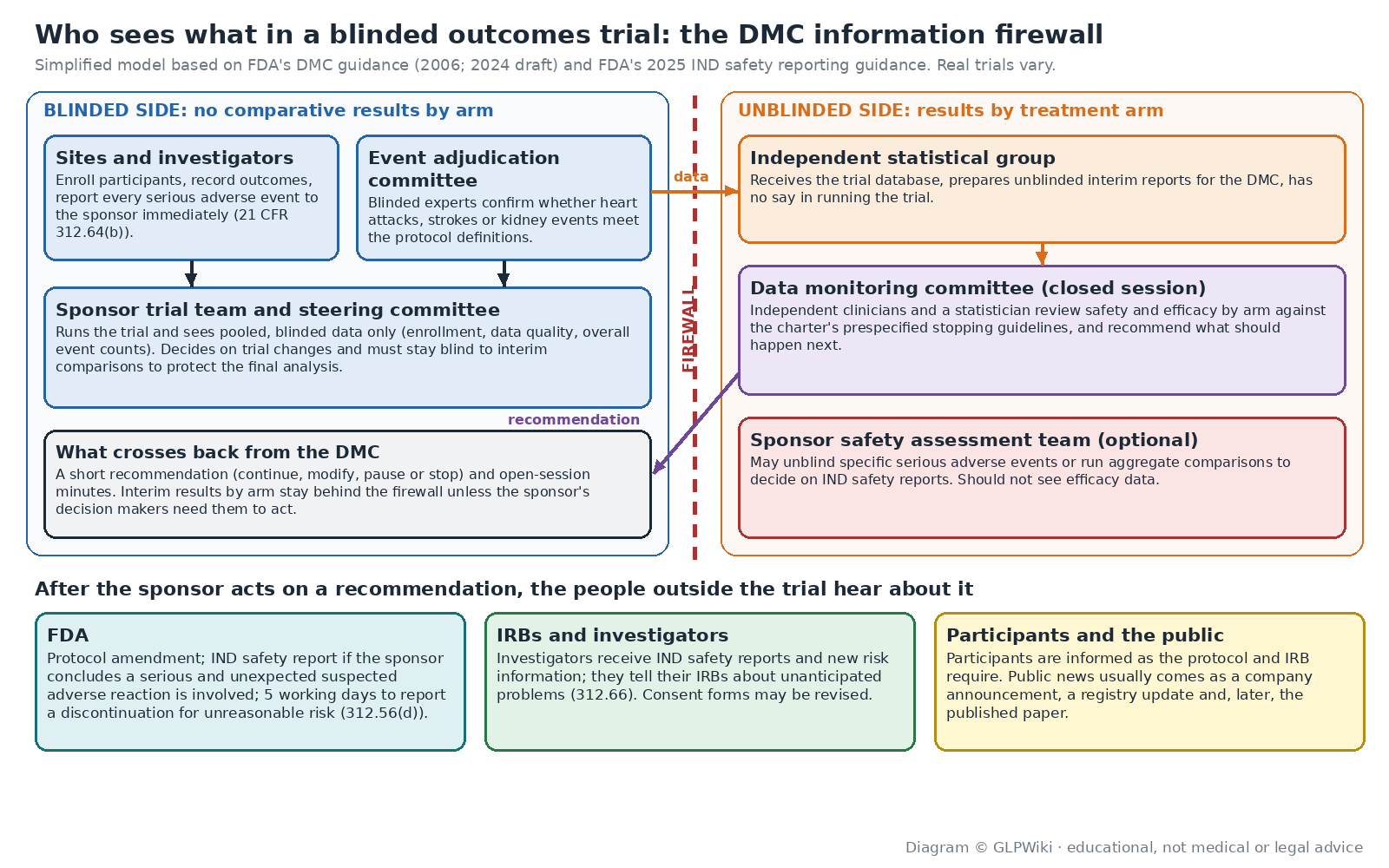
The core idea of interim monitoring is that knowledge of how the drug is doing must be tightly contained. If the sponsor, investigators or steering committee learned midway that one arm was ahead, they could change how they enroll, treat, assess or analyze, even unconsciously, and the final result would be harder to trust. Regulators reviewing the eventual application would have to ask whether the conduct of the trial had been influenced.
So trials build a firewall. Sites, investigators, the sponsor's trial team and the steering committee see only blinded or pooled information: how many people have enrolled, data quality, overall event counts. An independent statistician or statistical group, which the 2024 draft says is not part of the DMC and has no role in running the trial, receives the database and prepares unblinded interim reports. The DMC reviews those reports in a closed session attended only by its members and the statistician presenting the data.
Many DMC meetings also include an open session in which the sponsor and steering committee can discuss enrollment, data completeness, protocol issues and outside information, such as results from a related trial, without seeing comparative data. FDA recommends separate minutes for open and closed sessions. After the meeting the DMC sends the sponsor a short recommendation, typically to continue unchanged, modify, pause or stop.
One detail matters for reading claims about blinding. The 2024 draft says FDA considers data to be unblinded when they are reviewed by treatment group, A versus B, whether or not the groups are identified. Coded tables are not a loophole.
Safety reporting creates a second, narrower gap in the firewall. FDA's December 2025 sponsor guidance allows a designated safety assessment entity to unblind individual serious adverse events, or run aggregate comparisons, to decide whether IND safety reports are required. The 2024 draft DMC guidance says that if such an entity is unblinded to safety data it should be blinded to efficacy data, and that there should be separation between people who review unblinded safety data and people involved in running the trial.
Interim analyses and stopping guidelines: benefit, harm and futility
Every time someone looks at accumulating results and could act on them, the chance of a false positive rises. If a trial were analyzed at the usual 5% significance level ten times along the way, the odds that at least one look would show a 'significant' difference by chance alone would be far higher than 5%. Statisticians handle this with group sequential designs, which fix in advance how many interim looks there will be, or how the allowed false-positive rate will be 'spent' over time, and what the threshold for stopping will be at each look.
Two approaches appear constantly in GLP-1 trial protocols and papers. The O'Brien-Fleming procedure, published in 1979, sets very demanding boundaries early in a trial and relaxes them toward the end, so an early stop for benefit requires overwhelming evidence while the final analysis keeps nearly its full significance level. The Lan-DeMets alpha-spending approach generalizes this so that analyses need not occur at exactly planned times; event-driven trials, which schedule interim looks at a set number of primary endpoint events, often use it. You will often see an odd confidence level in final papers, such as SURPASS-CVOT's 95.3% interval, which reflects how the false-positive rate was divided between interim and final analyses.
- Benefit (efficacy): the trial may stop if a prespecified interim analysis crosses an efficacy boundary, meaning the evidence that the treatment works is already strong enough that continuing to give some participants the comparator is hard to justify.
- Harm (safety): the 2024 draft notes that DMCs may need less proof of harm to recommend termination than they would require for a finding of benefit. Safety monitoring is usually less formally bounded and relies more on clinical judgment across many outcomes.
- Futility: a DMC can recommend stopping if interim data suggest there is no longer a reasonable chance that the trial will show the effect it was designed to detect, sparing participants further burden. The draft guidance cautions that false negative conclusions are a concern here.
- Guidelines, not automatic rules: crossing a boundary does not force a stop. The DMC weighs the whole picture, including consistency across endpoints, safety and the trial's longer-term questions, and the sponsor makes the final decision.
Why early stops for benefit deserve careful reading
Stopping early for benefit is ethically appealing, but it has a statistical cost: trials tend to be stopped at a moment when random variation happens to favor the treatment, so the observed effect is often larger than the true one. A 2005 systematic review in JAMA of 143 randomized trials stopped early for benefit found they often failed to report key details of the decision and showed implausibly large treatment effects, especially when few events had occurred. A 2010 JAMA meta-regression compared 91 truncated trials with 424 similar trials that ran to completion and found the truncated trials' relative risks were on average 29% lower than those of the completed trials (ratio of relative risks 0.71), a difference that was independent of whether a formal stopping rule existed and was largest when there were few events.
These findings do not mean an early stop is wrong. A trial like FLOW, stopped under a prespecified plan and with 741 first primary outcome events in its final analysis, is in a very different position from a small trial stopped after a few dozen. They mean readers should ask how many events had occurred, whether the stop followed a prespecified interim analysis, and whether the published effect estimate was adjusted for the interim look.
DMCs in GLP-1 cardiovascular and kidney outcome trials
Large outcome trials became routine for diabetes medicines after FDA's December 2008 guidance asked sponsors of new type 2 diabetes drugs to rule out an unacceptable increase in cardiovascular risk. That approach produced a wave of event-driven cardiovascular outcome trials, or CVOTs, including those for GLP-1 receptor agonists. In March 2020 FDA issued a draft guidance, Type 2 Diabetes Mellitus: Evaluating the Safety of New Drugs for Improving Glycemic Control, which no longer recommends that every new diabetes drug uniformly rule out a specific degree of cardiovascular risk and instead takes a broader approach to overall safety, informed by an October 2018 advisory committee meeting that reviewed a decade of CVOTs. By then GLP-1 programs were running outcome trials not only to show safety but to test for benefit, including in people without diabetes.
These trials share the features that make a DMC most useful: thousands of participants with serious underlying disease, years of exposure, hard endpoints like cardiovascular death, heart attack, stroke and kidney failure, and prespecified interim analyses. Each has a DMC field in its ClinicalTrials.gov record; most say yes. The examples below describe published design and results only; they are not statements about the products' suitability for anyone.
LEADER (liraglutide), SUSTAIN-6 and PIONEER 6 (semaglutide)
LEADER (NCT01179048) randomized 9,340 patients with type 2 diabetes and high cardiovascular risk to liraglutide or placebo. Its primary hypothesis was noninferiority, with a prespecified margin of 1.30 for the hazard ratio's upper confidence bound, and it went on to show fewer primary outcome events with liraglutide (hazard ratio 0.87). Its registry record lists a data monitoring committee.
SUSTAIN-6 (NCT01720446), with 3,297 participants, and PIONEER 6 (NCT02692716), with 3,183, were shorter premarketing safety trials of injectable and oral semaglutide designed to rule out excess cardiovascular risk; PIONEER 6 used a noninferiority margin of 1.8. SUSTAIN-6 also reported a higher rate of diabetic retinopathy complications with semaglutide, the kind of imbalance that sponsors, DMCs and regulators track closely. The DMC field in both registry records currently reads 'No', a reminder that this field is entered by the sponsor and that the protocol and publication are where monitoring arrangements should be confirmed.
SELECT (semaglutide in obesity without diabetes)
SELECT (NCT03574597) was an event-driven superiority trial in 17,604 people aged 45 or older with established cardiovascular disease and a body-mass index of 27 or more but no diabetes. It reported a 20% lower risk of the primary composite of cardiovascular death, nonfatal heart attack or nonfatal stroke with semaglutide (hazard ratio 0.80) and also reported that adverse events leading to permanent discontinuation were about twice as common with semaglutide as with placebo. Its registry record lists a DMC. SELECT ran to completion; the point for readers is that the long follow-up, the large number of events and the discontinuation data were all accumulating under DMC oversight throughout.
FLOW: a GLP-1 trial stopped early for efficacy
FLOW (NCT03819153) tested semaglutide against placebo in 3,533 people with type 2 diabetes and chronic kidney disease, with a primary composite of kidney failure, a sustained 50% or greater decline in kidney function, or death from kidney or cardiovascular causes. Its protocol provided for an interim analysis when a prespecified number of primary endpoint events had occurred.
On October 10, 2023, Novo Nordisk announced in a filing with the US Securities and Exchange Commission that it would stop FLOW based on a recommendation from the independent DMC, which had concluded that the interim analysis met prespecified criteria for stopping early for efficacy. The company stated that, to protect the trial's integrity, it remained blinded to the results until trial completion. The published results in 2024 reported a median follow-up of 3.4 years after early cessation was recommended at a prespecified interim analysis, with 331 versus 410 first primary outcome events and a 24% lower risk (hazard ratio 0.76).
FLOW is a textbook sequence: a prespecified interim look, a recommendation from an independent committee, a sponsor decision, a public announcement that discloses the fact of stopping but not the numbers, then an orderly close-out and peer-reviewed publication. It also illustrates why the stock market and the press often hear about a DMC decision long before doctors see any data.
SOUL and SURPASS-CVOT
SOUL (NCT03914326) compared oral semaglutide with placebo in 9,650 people with type 2 diabetes and atherosclerotic cardiovascular disease, chronic kidney disease or both, and reported a 14% lower risk of major adverse cardiovascular events (hazard ratio 0.86) over a median of about 49.5 months; its confirmatory kidney outcome did not differ significantly. SURPASS-CVOT (NCT04255433) was an active-comparator noninferiority trial of tirzepatide against dulaglutide in 13,299 people with type 2 diabetes and atherosclerotic cardiovascular disease; it met noninferiority (hazard ratio 0.92, 95.3% confidence interval 0.83 to 1.01) without showing superiority. Both registry records list a DMC.
The active-comparator design of SURPASS-CVOT changes what a DMC is weighing. With a comparator already shown to reduce cardiovascular events, the question is not whether the new drug beats nothing but whether it is at least as good, so both efficacy and safety boundaries are set relative to an effective treatment.
IND safety reporting under 21 CFR 312.32
While the DMC watches the trial as a whole, the sponsor has a separate, continuous legal duty under 21 CFR 312.32(b) to promptly review all information relevant to the safety of the drug, from clinical trials, epidemiological studies, animal and laboratory work, the scientific literature, unpublished papers, foreign regulators and foreign marketing experience. The current rule took effect on March 28, 2011, after a September 29, 2010 final rule (75 FR 59935) that rewrote the definitions to focus reports on events likely to be caused by the drug rather than flooding FDA and investigators with uninterpretable individual cases.
The rule turns on four definitions in 312.32(a). An adverse event is any untoward medical occurrence associated with use of a drug, whether or not it is considered drug related. A suspected adverse reaction is an adverse event for which there is a reasonable possibility the drug caused it, and 'reasonable possibility' means there is evidence to suggest a causal relationship. An event is serious if it results in death, is life-threatening, requires or prolongs hospitalization, causes persistent or significant incapacity, or is a congenital anomaly, or if it is an important medical event that may jeopardize the patient and require intervention to prevent one of those outcomes. An event is unexpected if it is not listed in the investigator brochure, or not at the specificity or severity observed. The rule's own example: hepatic necrosis is unexpected if the brochure lists only elevated liver enzymes or hepatitis.
A serious adverse event that is both unexpected and a suspected adverse reaction is what many people call a SUSAR, short for suspected unexpected serious adverse reaction, a term used widely in international and European rules. FDA's regulation spells it out as a 'serious and unexpected suspected adverse reaction'.
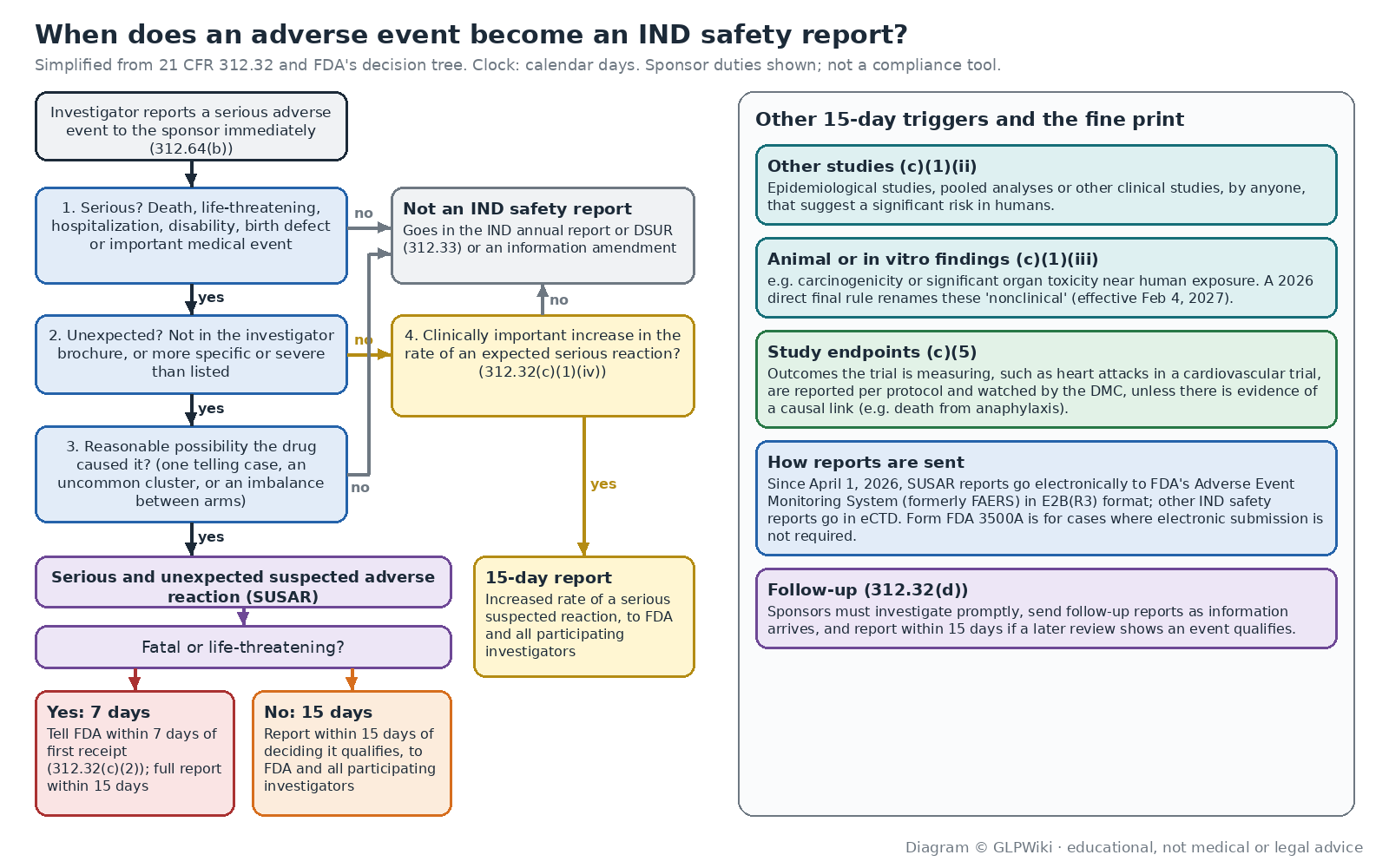
- Trigger 1, serious and unexpected suspected adverse reactions (312.32(c)(1)(i)): the sponsor reports these only when there is evidence suggesting a causal link, such as a single occurrence of an uncommon event strongly associated with drugs (angioedema, liver injury, Stevens-Johnson syndrome), one or more occurrences of an event uncommon in the exposed population (for example, tendon rupture), or an aggregate analysis showing events occur more often in the drug group than in a control group.
- Trigger 2, findings from other studies (312.32(c)(1)(ii)): epidemiological studies, pooled analyses or other clinical studies, whether or not run by the sponsor or under an IND, that suggest a significant risk in humans.
- Trigger 3, findings from animal or in vitro testing (312.32(c)(1)(iii)): such as mutagenicity, teratogenicity, carcinogenicity or significant organ toxicity at or near expected human exposure. A direct final rule published September 22, 2026 (91 FR 59988) substitutes the term 'nonclinical' for 'animal' testing in this and related sections, effective February 4, 2027; FDA says the rule adds no new requirements.
- Trigger 4, increased rate of serious suspected adverse reactions (312.32(c)(1)(iv)): any clinically important increase in the rate of a serious suspected adverse reaction over the rate listed in the protocol or investigator brochure.
The 7-day and 15-day clocks
IND safety reports must go to FDA and to all participating investigators, meaning every investigator to whom the sponsor is providing the drug under any of its INDs or under any investigator's IND, as soon as possible and no later than 15 calendar days after the sponsor determines that the information qualifies for reporting. Each report must identify all previous IND safety reports about similar suspected adverse reactions and analyze the significance of the new one in light of them. FDA's guidance gives the example that a report of pulmonary embolism should look back at earlier reports of other clotting events such as deep vein thrombosis.
There is a faster clock for the most alarming cases. For any unexpected fatal or life-threatening suspected adverse reaction, the sponsor must notify FDA as soon as possible and no later than 7 calendar days after its initial receipt of the information. The full report to FDA and investigators still follows within the 15-day framework. ICH E2A, the international standard behind these timelines, describes the same pattern: notification within 7 calendar days of first knowledge, followed by as complete a report as possible within 8 additional days.
Note the different starting points. The 7-day clock starts when the sponsor first receives the information. The 15-day clock starts when the sponsor determines the information qualifies, which is why FDA expects sponsors to review safety information promptly rather than letting cases sit. If FDA asks for additional data, the sponsor has 15 calendar days to provide it.
The duties continue after the first report. Under 312.32(d), the sponsor must promptly investigate all safety information it receives, submit relevant follow-up information as a 'Followup IND Safety Report' as soon as it is available, and, if a later investigation shows that an event not originally judged reportable does qualify, report it within 15 calendar days of that determination.
One more provision is easy to miss. Under 312.32(e), submitting a safety report does not by itself mean the sponsor or FDA has concluded that the drug caused the event. Readers who encounter an IND safety report, for example in litigation or a FOIA release, should read it as a signal that met reporting criteria, not as proof of causation.
Aggregate analysis, anticipated events and study endpoints
Many serious events in a GLP-1 outcome trial are things that happen anyway in the population being studied: heart attacks, strokes, heart failure hospitalizations, kidney events, deaths. A single heart attack in a 66-year-old with diabetes and coronary disease tells you almost nothing about the drug. Only a comparison of rates between groups can. The 2010 rule recognized this by making aggregate analysis one route to a reportable suspected adverse reaction, and FDA's December 2025 guidance, Sponsor Responsibilities: Safety Reporting Requirements and Safety Assessment for IND and Bioavailability/Bioequivalence Studies, explains how sponsors should do it.
The guidance recommends a written safety surveillance plan that names who reviews safety data and who may see unblinded information, sets up regular review of all serious adverse events, and lists the anticipated serious adverse events for the study population that the sponsor does not plan to report individually. Those anticipated events are then monitored in aggregate, sometimes with prespecified triggers for unblinding, and an IND safety report is filed when the comparison suggests a causal association. The guidance encourages sponsors to document all aggregate analyses and their reasoning, whether or not a report results.
Study endpoints get special treatment. Under 312.32(c)(5), outcomes the trial is designed to measure, such as mortality or major morbidity, are reported to FDA as the protocol describes and ordinarily are not filed as individual IND safety reports. Otherwise every primary endpoint event in a cardiovascular trial would generate a report, and the trial's blinding would be at risk. The exception: if there is evidence suggesting a causal relationship for a serious and unexpected event, such as death from anaphylaxis, it must be reported as a SUSAR even if it also counts toward an endpoint like all-cause mortality.
This is where the two systems meet most directly. Endpoint events and anticipated events are exactly what a DMC watches by arm. FDA's 2024 draft DMC guidance says that, consistent with 312.32(d)(1), a sponsor must investigate a DMC recommendation related to such safety events as potentially reportable, and if the sponsor concludes there is a reasonable possibility that an increased rate of serious events was caused by the drug, it must submit the finding and its support, which could include the DMC report, to FDA as a serious and unexpected suspected adverse reaction.
Investigators, IRBs and what reaches participants
The reporting chain starts at the trial site. Under 21 CFR 312.64(b), an investigator must immediately report to the sponsor any serious adverse event, whether or not it seems drug related and including events already listed in the protocol or investigator brochure, with an assessment of whether there is a reasonable possibility the drug caused it. Serious events that are study endpoints are reported as the protocol specifies unless there is evidence of a causal link, in which case they go to the sponsor immediately. Nonserious adverse events are recorded and reported on the protocol's timetable.
Information then flows back out. Under 312.55(b), the sponsor must keep every participating investigator informed of new observations about the drug, especially adverse effects, and IND safety reports are one of the required channels. Investigators in turn must promptly report to their IRB all unanticipated problems involving risks to subjects or others, under 312.66. FDA finalized a companion guidance in December 2025, Investigator Responsibilities: Safety Reporting for Investigational Drugs and Devices, to help investigators decide what goes to sponsors and what goes to IRBs.
Not every IND safety report is an unanticipated problem that an IRB must act on. HHS's Office for Human Research Protections makes a similar point in its 2007 guidance on unanticipated problems: only a small subset of adverse events are unanticipated problems requiring IRB reporting, generally those that are unexpected, related or possibly related to the research, and suggest participants are at greater risk than previously known. When a safety finding is important enough, the usual consequences are a revised investigator brochure, an updated consent form and, for people already enrolled, new information that may affect their willingness to continue. GLPWiki's informed consent and IRB guide explains how those consent updates work.
How safety reports and periodic reports are filed
The regulation allows IND safety reports in narrative form, on Form FDA 3500A or in an electronic format FDA can process, and allows foreign cases on a CIOMS I form. In practice the format is now set by electronic submission requirements. FDA's guidance Providing Regulatory Submissions in Electronic Format: IND Safety Reports, announced in the Federal Register on April 1, 2024, made electronic submission of serious and unexpected suspected adverse reaction reports under 312.32(c)(1)(i) mandatory 24 months later.
Since April 1, 2026, those reports must go electronically to FDA's Adverse Event Monitoring System (AEMS) database, the new name for the FDA Adverse Event Reporting System (FAERS), using ICH E2B(R3) data standards, either by database-to-database transmission or through the Safety Reporting Portal. Noncommercial INDs, including investigator-sponsored and expanded access INDs, are exempt. Other IND safety reports, those based on other studies, nonclinical findings or an increased rate of occurrence, go in eCTD format. FDA's MedWatch page notes that Form 3500A is used only when electronic submission is not required.
Beyond expedited reports, sponsors file periodic summaries. Under 21 CFR 312.33, an IND annual report is due within 60 days of the anniversary of the IND going into effect. It must include, among other things, a summary of the most frequent and most serious adverse experiences by body system, a summary of all IND safety reports submitted during the year, a list of participants who died with the cause of death, and a list of those who dropped out because of an adverse experience. Many sponsors instead submit the Development Safety Update Report described in ICH E2F, which FDA and EU regulators consider can take the place of the US annual report and the EU annual safety report.
Two newer international documents shape what data are collected. ICH E6(R3), the revised Good Clinical Practice guideline FDA issued as final guidance in September 2025, emphasizes quality by design and proportionate, risk-based oversight. ICH E19 describes when sponsors of certain late-stage or post-approval trials, typically where a drug's safety profile is already well characterized, may collect some safety data selectively. Selective collection changes what gets recorded but does not change the expedited reporting duties for events that qualify.
How trial halts and safety signals become public
Several different events can stop or change a trial, and they look similar in headlines. A DMC can recommend that a sponsor stop for benefit, harm or futility, as with FLOW. A sponsor can decide on its own, for safety, scientific or business reasons, to stop a study; under 21 CFR 312.56(d), a sponsor that determines its drug presents an unreasonable and significant risk must discontinue the affected investigations, notify FDA, all IRBs and all investigators who have ever participated, and do so within 5 working days of that determination. And FDA can impose a clinical hold under 21 CFR 312.42, ordering a delay or suspension of a study, for example when participants are or would be exposed to an unreasonable and significant risk of illness or injury.
Readers usually learn about these events through channels that do not carry the underlying data. Publicly traded sponsors often disclose material trial decisions in press releases and securities filings, as Novo Nordisk did for FLOW. ClinicalTrials.gov records are updated with a new status, and for terminated studies a reason the study stopped. Investigators and IRBs receive letters, and consent forms change. Months later come conference presentations, the peer-reviewed paper and, for approved drugs, label changes and FDA review documents.
Individual IND safety reports are generally not something readers can look up. They go to FDA and to investigators, and their effects show up indirectly: a revised investigator brochure, a protocol amendment, a new consent paragraph, a clinical hold, or a section of the eventual approval review. That is very different from postmarketing reporting after approval, where anyone can submit a MedWatch report and public dashboards summarize reports, as GLPWiki's FAERS and MedWatch guide explains.
A reader's checklist for trial-stopped and safety-signal news
When a GLP-1 or obesity trial is reported as stopped, paused or changed, or when a new risk is said to have emerged during development, these questions help sort out what actually happened.
- Who made the call: an independent DMC recommendation, a sponsor decision, or an FDA clinical hold? Each has a different meaning and a different paper trail.
- Was it prespecified? Look for wording such as 'prespecified interim analysis' or 'met prespecified criteria', and check whether the protocol or registry describes interim analyses.
- Benefit, harm or futility? 'Stopped early' alone does not tell you which. Early stops for benefit can overstate the effect, especially with few events.
- How many events? Large event counts, as in FLOW's hundreds of primary outcome events, make an early result more trustworthy than a stop after a handful.
- Is the sponsor still blinded? Announcements made before close-out often disclose only the fact of stopping, not the numbers.
- Is the 'safety signal' a single case, an aggregate imbalance, or an animal or laboratory finding? IND safety reports cover all three, and they carry very different weight.
- Is it an endpoint event? Heart attacks or deaths in a cardiovascular outcome trial are usually counted as endpoints and assessed by the DMC, not filed one by one as safety reports.
- Check the registry and the paper: the ClinicalTrials.gov record (including its DMC field and any 'why stopped' text), the published methods on interim monitoring, and, for approved drugs, the label's Warnings and Precautions and Adverse Reactions sections.
What this guide cannot tell you
DMC deliberations, closed-session minutes and individual IND safety reports are confidential, so nothing here can tell you what any particular committee saw, debated or decided beyond what sponsors and journals have published. Descriptions of trials are limited to their registry records, public announcements and peer-reviewed results. FDA's 2024 DMC guidance is still a draft, and FDA guidances are nonbinding recommendations unless they cite a legal requirement; individual trials may use different, agreed approaches.
This guide also does not cover device trials, which follow parallel rules for unanticipated adverse device effects, non-US reporting rules in detail, or postmarketing safety reporting after approval except where it intersects. It says nothing about whether any GLP-1 medicine is right for any person.
Scope, disclaimer and review date
This guide is general educational information about how clinical trial data monitoring committees and US IND safety reporting work. It is not medical advice, legal advice or a regulatory compliance opinion, and it does not recommend or rate any product, company, study, investigator or clinician. It contains no dosing information. Decisions about any medicine belong with a licensed clinician who knows your history. Questions about obligations under these rules belong with FDA or a qualified professional.
Trial figures are quoted from the cited ClinicalTrials.gov records, company filings and peer-reviewed papers; regulatory text is quoted from the eCFR and FDA guidance current at the time of review. Check the originals for full context. Last reviewed: November 20, 2026.
Frequently asked questions
- What is a data monitoring committee (DMC or DSMB)?
- It is a small independent group, usually specialist clinicians and at least one biostatistician, that reviews unblinded interim safety and efficacy data from an ongoing trial and recommends whether it should continue, change or stop. FDA's 2006 guidance and 2024 draft guidance describe how DMCs should be set up and run. The sponsor, not the DMC, makes the final decision.
- Are DMCs required by law?
- Usually not. FDA regulations explicitly require an independent data monitoring committee only for emergency research conducted under the exception from informed consent (21 CFR 50.24). For other trials FDA recommends a DMC, and strongly recommends one when participants face risk of serious outcomes such as heart attack, stroke or death. NIH policy requires DSMBs for NIH-supported multi-site trials involving potential risk.
- Why was the FLOW semaglutide kidney trial stopped early?
- In October 2023 Novo Nordisk said it would stop FLOW on the recommendation of the trial's independent data monitoring committee, which concluded that a prespecified interim analysis met criteria for stopping early for efficacy. The company said it remained blinded to the results until trial completion. The 2024 paper reported a 24% lower risk of the primary kidney and cardiovascular composite with semaglutide compared with placebo.
- Does the drug company see the results while the trial is running?
- In a well-run blinded trial with a DMC, no. The sponsor's trial team sees only pooled, blinded data. An independent statistician prepares unblinded reports for the DMC's closed sessions, and the sponsor receives a recommendation rather than comparative results. A separate sponsor safety team may unblind specific serious adverse events for safety reporting, but FDA says it should not see efficacy data.
- What is an IND safety report?
- It is a report a sponsor must send to FDA and all participating investigators under 21 CFR 312.32 when safety information meets one of four triggers: a serious and unexpected suspected adverse reaction, a significant risk found in other studies, a significant risk found in animal or laboratory testing, or a clinically important increase in the rate of a serious suspected adverse reaction. Submitting one does not mean anyone has concluded the drug caused the event.
- What are the 7-day and 15-day reporting deadlines?
- Qualifying IND safety reports must reach FDA and all participating investigators within 15 calendar days after the sponsor determines the information qualifies. Unexpected fatal or life-threatening suspected adverse reactions must be reported to FDA within 7 calendar days of the sponsor's first receipt of the information. Follow-up information must be sent as soon as it is available.
- What does SUSAR mean?
- SUSAR stands for suspected unexpected serious adverse reaction, a widely used international term. FDA's regulation calls it a serious and unexpected suspected adverse reaction: an event that is serious, not listed (or not at that severity or specificity) in the investigator brochure, and for which there is evidence suggesting the drug caused it.
- Can I look up IND safety reports or DMC minutes?
- Generally not. IND safety reports go to FDA and to investigators, and DMC closed-session materials are confidential. The public usually learns about these processes through company announcements, ClinicalTrials.gov status updates, consent form changes, published papers and, after approval, FDA review documents and label changes. Postmarketing reports submitted through MedWatch are a different system with public dashboards.
SOURCES
- 0121 CFR 312.32 – IND safety reporting— eCFR
- 0221 CFR 312.33 – Annual reports— eCFR
- 0321 CFR 312.31 – Information amendments— eCFR
- 0421 CFR 312.3 – Definitions and interpretations— eCFR
- 0521 CFR 312.55 – Informing investigators— eCFR
- 0621 CFR 312.56 – Review of ongoing investigations— eCFR
- 0721 CFR 312.64 – Investigator reports— eCFR
- 0821 CFR 312.66 – Assurance of IRB review— eCFR
- 0921 CFR 312.42 – Clinical holds and requests for modification— eCFR
- 1021 CFR 50.24 – Exception from informed consent requirements for emergency research— eCFR
- 1121 CFR 56.108 – IRB functions and operations— eCFR
- 12Investigational New Drug Safety Reporting Requirements for Human Drug and Biological Products and Safety Reporting Requirements for Bioavailability and Bioequivalence Studies in Humans (final rule, 75 FR 59935, Sept. 29, 2010)— Federal Register
- 13Nonclinical Testing Terminology (direct final rule, 91 FR 59988, Sept. 22, 2026)— Federal Register
- 14Establishment and Operation of Clinical Trial Data Monitoring Committees (guidance, March 2006)— FDA
- 15Use of Data Monitoring Committees in Clinical Trials (draft guidance, February 2024)— FDA
- 16Use of Data Monitoring Committees in Clinical Trials – draft guidance PDF— FDA
- 17Use of Data Monitoring Committees in Clinical Trials; draft guidance availability notice (Feb. 13, 2024)— Federal Register
- 18Sponsor Responsibilities – Safety Reporting Requirements and Safety Assessment for IND and BA/BE Studies (guidance, December 2025)— FDA
- 19Sponsor Responsibilities – Safety Reporting Requirements and Safety Assessment (guidance PDF)— FDA
- 20Investigator Responsibilities – Safety Reporting for Investigational Drugs and Devices (guidance, December 2025)— FDA
- 21IND Application Reporting: IND Safety Reports— FDA
- 22Providing Regulatory Submissions in Electronic Format: IND Safety Reports (guidance)— FDA
- 23Providing Regulatory Submissions in Electronic Format: IND Safety Reports; guidance availability notice (Apr. 1, 2024)— Federal Register
- 24Electronic Submission of IND Safety Reports Technical Conformance Guide— FDA
- 25FDA Adverse Event Monitoring System (AEMS) Electronic Submissions— FDA
- 26MedWatch Forms for FDA Safety Reporting (Forms FDA 3500 and 3500A)— FDA
- 27E2A Clinical Safety Data Management: Definitions and Standards for Expedited Reporting— FDA (ICH)
- 28E2F Development Safety Update Report— FDA (ICH)
- 29E6(R3) Good Clinical Practice (final guidance, September 2025)— FDA (ICH)
- 30E9 Statistical Principles for Clinical Trials— FDA (ICH)
- 31E19 A Selective Approach to Safety Data Collection in Specific Late-Stage Pre-Approval or Post-Approval Clinical Trials— FDA (ICH)
- 32Adaptive Design Clinical Trials for Drugs and Biologics (guidance, 2019)— FDA
- 33Type 2 Diabetes Mellitus: Evaluating the Safety of New Drugs for Improving Glycemic Control (draft guidance, March 2020)— FDA
- 34NIH Policy for Data and Safety Monitoring (NOT-98-084, 1998)— NIH
- 35Guideline on Data Monitoring Committees— European Medicines Agency
- 36Reviewing and Reporting Unanticipated Problems Involving Risks to Subjects or Others and Adverse Events (2007 guidance)— HHS OHRP
- 37ClinicalTrials.gov Protocol Registration Data Element Definitions— ClinicalTrials.gov (NLM)
- 38LEADER (NCT01179048) study record— ClinicalTrials.gov
- 39SUSTAIN-6 (NCT01720446) study record— ClinicalTrials.gov
- 40PIONEER 6 (NCT02692716) study record— ClinicalTrials.gov
- 41SELECT (NCT03574597) study record— ClinicalTrials.gov
- 42FLOW (NCT03819153) study record— ClinicalTrials.gov
- 43SOUL (NCT03914326) study record— ClinicalTrials.gov
- 44SURPASS-CVOT (NCT04255433) study record— ClinicalTrials.gov
- 45Novo Nordisk will stop the once-weekly injectable semaglutide kidney outcomes trial, FLOW, based on interim analysis (Form 6-K, Oct. 10, 2023)— U.S. SEC (EDGAR)
- 46Marso SP et al. Liraglutide and Cardiovascular Outcomes in Type 2 Diabetes (LEADER). N Engl J Med 2016— PubMed
- 47Marso SP et al. Semaglutide and Cardiovascular Outcomes in Patients with Type 2 Diabetes (SUSTAIN-6). N Engl J Med 2016— PubMed
- 48Husain M et al. Oral Semaglutide and Cardiovascular Outcomes in Patients with Type 2 Diabetes (PIONEER 6). N Engl J Med 2019— PubMed
- 49Lincoff AM et al. Semaglutide and Cardiovascular Outcomes in Obesity without Diabetes (SELECT). N Engl J Med 2023— PubMed
- 50Perkovic V et al. Effects of Semaglutide on Chronic Kidney Disease in Patients with Type 2 Diabetes (FLOW). N Engl J Med 2024— PubMed
- 51McGuire DK et al. Oral Semaglutide and Cardiovascular Outcomes in High-Risk Type 2 Diabetes (SOUL). N Engl J Med 2025— PubMed
- 52Nicholls SJ et al. Cardiovascular Outcomes with Tirzepatide versus Dulaglutide in Type 2 Diabetes (SURPASS-CVOT). N Engl J Med 2025— PubMed
- 53O'Brien PC, Fleming TR. A multiple testing procedure for clinical trials. Biometrics 1979— PubMed
- 54Reboussin DM et al. Computations for group sequential boundaries using the Lan-DeMets spending function method. Control Clin Trials 2000— PubMed
- 55Montori VM et al. Randomized trials stopped early for benefit: a systematic review. JAMA 2005— PubMed
- 56Bassler D et al. Stopping randomized trials early for benefit and estimation of treatment effects. JAMA 2010— PubMed
- 57Fleming TR et al. Monitoring clinical trials: issues and controversies regarding confidentiality. Stat Med 2002— PubMed
- 58Fleming TR et al. Data Monitoring Committees: Current issues. Clin Trials 2018— PubMed
- 59Calis KA et al. Recommendations for data monitoring committees from the Clinical Trials Transformation Initiative. Clin Trials 2017— PubMed
- 60Lewis RJ et al. Enhancing the Scientific Integrity and Safety of Clinical Trials: Recommendations for Data Monitoring Committees. JAMA 2016— PubMed
EDUCATIONAL REFERENCE ONLY · Not medical advice. Nothing here diagnoses, treats, cures or prevents any disease, and nothing here is a dosing recommendation. Consult a licensed clinician before any treatment decision.