Cardiovascular outcomes trials literacy: how GLP-1 heart-outcome trials are designed, analyzed and turned into label indications

Semaglutide, liraglutide, dulaglutide and tirzepatide now carry label indications to reduce the risk of heart attack, stroke or cardiovascular death in certain adults. Those indications rest on cardiovascular outcomes trials (CVOTs): huge, years-long, event-driven studies that count adjudicated heart events rather than pounds lost. This guide explains why FDA began expecting CVOTs for diabetes drugs in December 2008 and what its 1.8 and 1.3 risk margins meant, how noninferiority differs from superiority, what MACE composites and blinded adjudication committees are, how time-to-first-event hazard ratios, total-event analyses and testing hierarchies work, why SELECT kept going after its interim analysis crossed a stopping boundary, how the active-controlled SURPASS-CVOT used a 1.05 margin, and how a CVOT result becomes a Section 1 indication and a Section 14 table. Educational only: no doses, no treatment advice and no product recommendations.
UPDATED 24 NOV 2026 · 38 MIN READ
KEY TAKEAWAYS
- A cardiovascular outcomes trial (CVOT) randomizes thousands of people and follows them for years to count clinical events such as cardiovascular death, heart attack and stroke. It answers a different question from a weight-loss or blood-sugar trial: does the medicine change hard heart outcomes, and does it at least not make them worse?
- FDA's December 2008 diabetes guidance asked sponsors to show that the upper bound of the two-sided 95% confidence interval for cardiovascular risk was below 1.8 before approval, and below 1.3 (generally through a postmarketing trial if needed) to rule out an unacceptable increase. FDA withdrew that guidance in March 2020 and replaced it with a draft focused on the size and makeup of the overall safety database.
- Noninferiority and superiority are different claims. ELIXA (lixisenatide) and EXSCEL (exenatide) met noninferiority but not superiority; LEADER (liraglutide), Harmony Outcomes (albiglutide), REWIND (dulaglutide), AMPLITUDE-O (efpeglenatide), SELECT (semaglutide) and SOUL (oral semaglutide) showed fewer major adverse cardiovascular events (MACE) than placebo.
- Most GLP-1 CVOTs use 3-point MACE (cardiovascular death, nonfatal myocardial infarction, nonfatal stroke) analyzed as time to first event with a Cox proportional hazards model. Events are confirmed by a blinded, independent adjudication committee, and the trial ends when a prespecified number of confirmed events has accrued.
- A hazard ratio is a relative measure. In SELECT, MACE occurred in 6.5% of the semaglutide group versus 8.0% of the placebo group over a mean follow-up of about 40 months (hazard ratio 0.80); the absolute difference, the event rate per 100 patient-years and the follow-up time are needed to understand size.
- Testing hierarchies decide which secondary results are confirmed. In SELECT, cardiovascular death was first in the hierarchy and did not reach significance (hazard ratio 0.85, 95% CI 0.71 to 1.01), so the lower all-cause death estimate was not counted as statistically significant under the prespecified plan, and the Wegovy label says so in its footnotes.
- SURPASS-CVOT compared tirzepatide with dulaglutide, which already had a proven cardiovascular benefit. It met noninferiority against a 1.05 margin (hazard ratio 0.92, 95.3% CI 0.83 to 1.01) but not superiority. FDA approved a Mounjaro cardiovascular risk-reduction indication on August 27, 2026.
- A CVOT becomes a label indication through a supplemental application reviewed by FDA. Read Section 1 for exactly whom the indication covers, Section 14 for the trial table and its footnotes, and the Drugs@FDA approval package for the reviewers' reasoning. Indications differ by product and population, so one product's result does not transfer automatically to another.
Why heart-outcome trials became part of the GLP-1 story
Most people first meet GLP-1 medicines through numbers about blood sugar or body weight. A glycated hemoglobin (HbA1c) change or a percentage weight change can be measured in a few months in a few hundred or a few thousand people. But the outcomes that matter most to many patients and clinicians, such as dying from heart disease, having a heart attack or having a stroke, are rarer and take years to accumulate. Measuring them requires a different kind of study: the cardiovascular outcomes trial, usually shortened to CVOT.
CVOTs now sit behind some of the most consequential lines in GLP-1 labeling. Victoza (liraglutide), Ozempic (semaglutide injection), Trulicity (dulaglutide) and Rybelsus (oral semaglutide) carry indications to reduce the risk of major adverse cardiovascular events in certain adults with type 2 diabetes. On March 8, 2024, FDA approved Wegovy (semaglutide) to reduce the risk of cardiovascular death, heart attack and stroke in adults with established cardiovascular disease and either obesity or overweight, calling it the first weight-loss medication with that kind of indication. On August 27, 2026, FDA approved a Mounjaro (tirzepatide) supplement adding a similar risk-reduction indication for adults with type 2 diabetes at high cardiovascular risk, based on a trial against another GLP-1 medicine rather than placebo.
Those headlines compress a lot of design and statistics. Was the trial built to show the medicine was not harmful, or that it was beneficial? Which events counted, and who decided whether an event really was a heart attack? How long were people followed, and how many stopped the study drug? Was the result for the first event only, or for every event? Which secondary results were formally tested? This guide explains how to answer those questions from primary documents: the FDA guidances that shaped CVOTs, the trial publications indexed in PubMed, the ClinicalTrials.gov records, the FDA review packages on Drugs@FDA and the current labels on DailyMed.
It builds on GLPWiki's guides to clinical studies in labeling, data monitoring committees, trial registration, FDA review documents and estimands, and on the labeled indication expansions guide, which tracks which products gained which indications. This guide focuses on how the trials themselves work. It is educational only. It does not say who should take any medicine, compare products for any individual, or give doses.
What a cardiovascular outcomes trial is, and how it differs from an efficacy trial
A CVOT is a randomized, usually double-blind trial whose primary endpoint is a clinical cardiovascular event rather than a laboratory value or a body measurement. Participants are randomly assigned to the study medicine or a comparator, almost always on top of their usual care, and are followed until enough events have happened to answer the question with the planned precision. Because heart attacks, strokes and cardiovascular deaths are uncommon in any single year, CVOTs are large. LEADER randomized 9,340 people, REWIND 9,901, SOUL 9,650, SURPASS-CVOT 13,299 and SELECT 17,604.
Three features set CVOTs apart from the shorter weight-loss and glucose trials that support initial approvals. First, they enroll people at elevated cardiovascular risk on purpose, because only a higher-risk population generates enough events in a reasonable time. Second, they run for years: median follow-up was about 3.8 years in LEADER, 5.4 years in REWIND and 49.5 months in SOUL. Third, they are usually event-driven, meaning the trial is designed to stop when a target number of confirmed primary events has accrued rather than at a fixed calendar date.
The comparator matters. Most GLP-1 CVOTs compared the medicine with placebo, both added to standard care such as blood pressure, cholesterol and glucose management that investigators could adjust during the trial. SURPASS-CVOT instead compared tirzepatide with dulaglutide, an active medicine already shown in REWIND to reduce cardiovascular events. An active-controlled CVOT asks a harder question and needs different statistics, covered below.
Background therapy also matters. In SURPASS-CVOT, the Mounjaro label reports that 86% of participants were taking statins and 83% antiplatelet therapy at baseline. A CVOT result therefore describes the added effect of the study medicine on top of contemporary care in the enrolled population, not the effect of the medicine instead of other treatments.
December 2008: why FDA started expecting CVOTs for diabetes drugs
In the mid-2000s, questions about whether some glucose-lowering drugs might increase cardiovascular risk came to a head. A 2007 meta-analysis of 42 trials of rosiglitazone in the New England Journal of Medicine reported an odds ratio for myocardial infarction of 1.43 (95% CI 1.03 to 1.98) compared with control. The analysis was debated, but the episode exposed a gap: a diabetes drug could be approved on HbA1c without a reliable estimate of its effect on heart outcomes.
FDA's Endocrinologic and Metabolic Drugs Advisory Committee met on July 1 and 2, 2008 to discuss cardiovascular assessment. In December 2008 FDA issued final guidance, 'Diabetes Mellitus — Evaluating Cardiovascular Risk in New Antidiabetic Therapies to Treat Type 2 Diabetes', announced in the Federal Register on December 19, 2008, for immediate implementation.
The guidance had several parts. Sponsors should set up an independent cardiovascular endpoints committee to adjudicate cardiovascular events prospectively and blind to treatment across phase 2 and phase 3 trials. Development programs should enroll higher-risk patients, such as older people and those with more advanced disease or some kidney impairment, so that enough events would occur. And sponsors should plan a meta-analysis of cardiovascular events across their controlled trials.
The numerical heart of the guidance was a pair of risk margins. Before submitting an application, the sponsor should show that the upper bound of the two-sided 95% confidence interval for the estimated cardiovascular risk ratio was less than 1.8. If the upper bound was between 1.3 and 1.8 and the overall benefit-risk supported approval, a postmarketing trial would generally be needed to show that the upper bound was less than 1.3. If the premarketing data already put the upper bound below 1.3, a postmarketing cardiovascular trial generally might not be necessary. The guidance also warned that a point estimate of 1.5 would not be reassuring even if the upper bound were below 1.8.
In plain terms, 1.8 ruled out roughly an 80% relative increase in risk and 1.3 ruled out a 30% increase. These were safety thresholds: they asked whether a drug could be shown not to be meaningfully harmful, not whether it was helpful. Most GLP-1 CVOTs that followed were designed around them, and several then turned out to show benefit as well.
Noninferiority versus superiority: reading the margin and the confidence interval
A noninferiority test asks whether a new treatment is not worse than the comparator by more than a prespecified margin. For a hazard ratio of the study drug versus control, noninferiority with a margin of 1.3 is shown when the entire 95% confidence interval lies below 1.3. The point estimate can be above 1.0 and the trial can still meet noninferiority, as long as the upper bound clears the margin. FDA's 2016 guidance on non-inferiority clinical trials and primers in the medical literature explain why the margin and the precision of the estimate, not the point estimate alone, decide the result.
A superiority test asks whether the treatment reduces risk. For a hazard ratio, superiority is usually shown when the upper bound of the confidence interval is below 1.0, with a correspondingly small P value. Many CVOTs tested noninferiority first and then, if it was met, tested superiority, a fixed sequence that protects the overall false-positive rate.
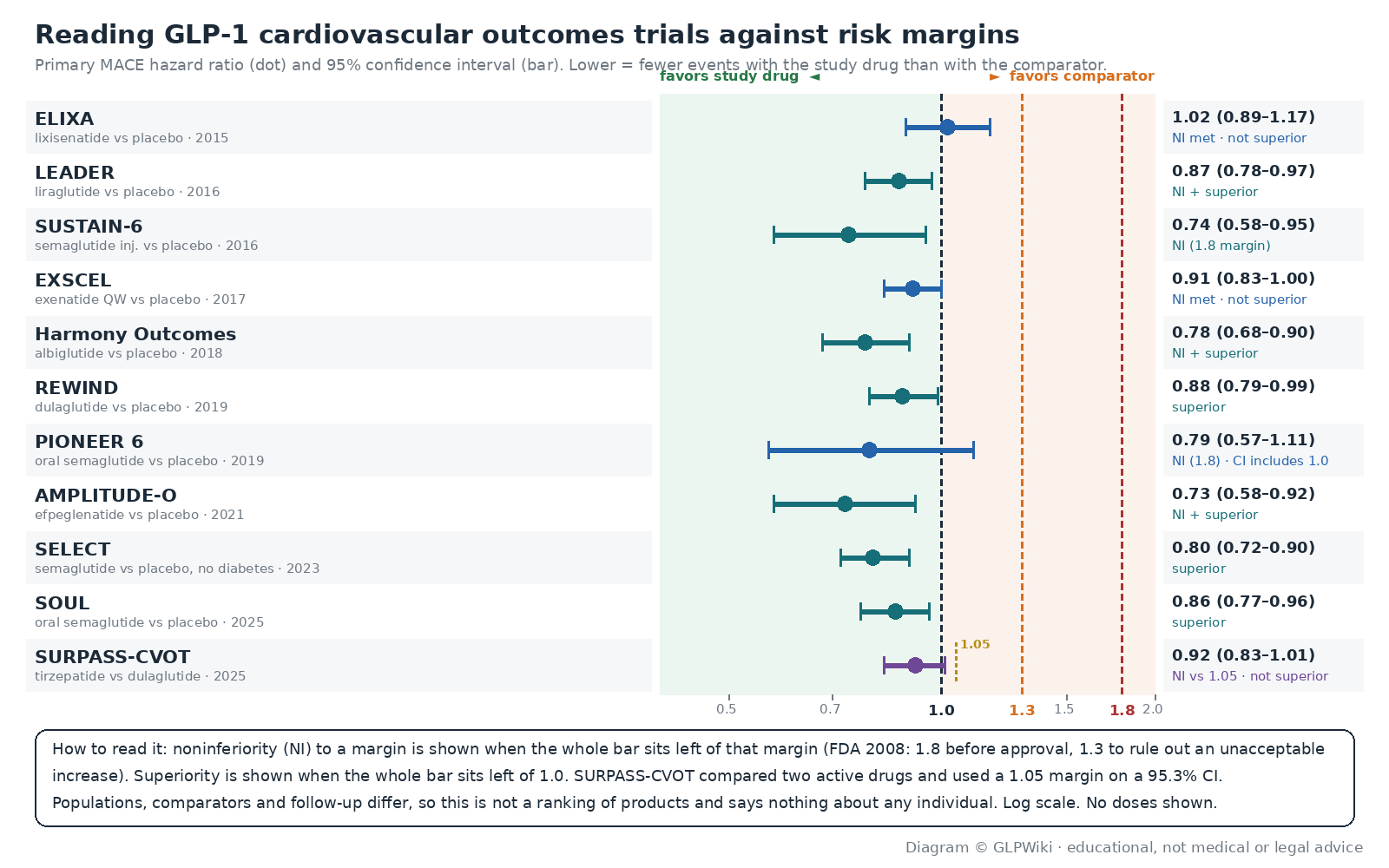
The GLP-1 trials show the full range of outcomes. ELIXA, in people with type 2 diabetes after a recent acute coronary syndrome, found a primary-event hazard ratio of 1.02 (95% CI 0.89 to 1.17) for lixisenatide: noninferior (upper bound below 1.3) but not superior. EXSCEL, testing once-weekly exenatide in 14,752 people, found a hazard ratio of 0.91 (95% CI 0.83 to 1.00): noninferior, but superiority was not shown (P=0.06). LEADER found 0.87 (95% CI 0.78 to 0.97) for liraglutide, with P<0.001 for noninferiority and P=0.01 for superiority.
Trials conducted before approval were often sized only for the 1.8 margin. SUSTAIN-6 (injectable semaglutide in 3,297 people) and PIONEER 6 (oral semaglutide in 3,183 people) both used 1.8. SUSTAIN-6 reported a hazard ratio of 0.74 (95% CI 0.58 to 0.95) with P<0.001 for noninferiority. PIONEER 6 reported 0.79 (95% CI 0.57 to 1.11): it ruled out excess risk relative to the 1.8 margin, but the interval also included 1.0, so it did not by itself show benefit. A larger follow-on trial, SOUL, was later run to test superiority for oral semaglutide.
Two habits help. Always read the margin from the methods section or the ClinicalTrials.gov record before reading the result. And look at the whole interval: an interval of 0.57 to 1.11 is compatible with a sizable reduction and with a modest increase, which is why such a result is described as reassuring about safety rather than proof of benefit.
MACE: what goes into the composite, and why the definition matters
MACE stands for major adverse cardiovascular events. In most GLP-1 CVOTs it means 3-point MACE: death from cardiovascular causes, nonfatal myocardial infarction and nonfatal stroke. LEADER, SUSTAIN-6, EXSCEL, REWIND, PIONEER 6, SELECT and SOUL all used a version of this composite as the primary endpoint. SURPASS-CVOT used cardiovascular death, myocardial infarction or stroke.
Some trials used broader composites. ELIXA's primary endpoint added hospitalization for unstable angina to the three classic components, a so-called 4-point MACE. The ongoing SURMOUNT-MMO trial of tirzepatide in obesity uses a five-component composite of all-cause death, nonfatal myocardial infarction, nonfatal stroke, coronary revascularization and heart failure events. Broader composites accumulate events faster, but they mix outcomes of very different severity.
Composites are useful because they increase the number of events and therefore statistical power. Their weakness is that a result can be driven mainly by the least serious or most common component. A systematic review in the BMJ found that cardiovascular trials often had composites whose components differed widely in importance and in treatment effect. When you read a MACE result, look at the component table: in SELECT, for example, FDA's clinical review, summarizing the data monitoring committee's minutes, notes that the significant interim result was driven by nonfatal myocardial infarction, with no significant effect on cardiovascular death at that point.
Definitions vary outside trials too. A systematic review of observational studies using administrative data found that only 5 of 58 studies (8.6%) matched the traditional 3-point MACE definition used in randomized trials. When an observational study or a press release says 'MACE', check which events and which definitions were used before comparing it with a CVOT.
Watch the words 'fatal or nonfatal'. The MACE composite counts nonfatal heart attacks and strokes, because a fatal one is already counted as cardiovascular death. Secondary tables often report 'fatal or nonfatal myocardial infarction' separately, which is a different count. The Wegovy and Mounjaro labels list both kinds of rows, and their numbers are not interchangeable.
Who decides whether an event happened: blinded adjudication committees
Whether a hospitalization was a heart attack, or a death was cardiovascular, is not always obvious from a site report. CVOTs therefore use a clinical events committee (CEC), also called an endpoint or event adjudication committee: independent clinicians who review standardized source documents, blinded to treatment assignment, and decide whether each suspected event meets the protocol definition. FDA's 2008 diabetes guidance specifically called for prospective, blinded adjudication of cardiovascular events.
Standard definitions help make events comparable. FDA established the Standardized Data Collection for Cardiovascular Trials Initiative in 2009, and the resulting '2017 Cardiovascular and Stroke Endpoint Definitions for Clinical Trials', published in Circulation and the Journal of the American College of Cardiology in 2018, give uniform definitions for events such as cardiovascular death, myocardial infarction, stroke and heart failure events. A Cardiac Safety Research Consortium white paper from an FDA-cosponsored think tank describes best practices for CEC charters.
In trial reports you will see phrases such as 'EAC-confirmed' or 'adjudication-confirmed'. FDA's clinical review of the Wegovy cardiovascular supplement states that 1,270 first MACE in SELECT were confirmed by the external adjudication committee. The SURPASS-CVOT design paper says the trial would continue until at least 1,615 participants had an adjudication-confirmed MACE component, and the SOUL design paper targets 1,225 first adjudication-confirmed MACE.
Adjudication reduces noise and protects against biased classification, but it does not remove every problem. Deaths with unknown cause are often classified as cardiovascular by convention, which is why FDA reviewers sometimes run sensitivity analyses for possible cardiovascular-death misclassification, as the SELECT clinical review describes.
Event-driven design: why the number of events matters more than the number of people
The statistical precision of a hazard ratio depends mainly on the number of events, not the number of participants. A trial of 10,000 low-risk people with few events tells you less than a trial of 5,000 high-risk people with many. CVOTs therefore fix a target number of primary events in advance, calculated from the effect size they want to detect or rule out, the desired power and the significance level, and then enroll and follow enough people to reach it.
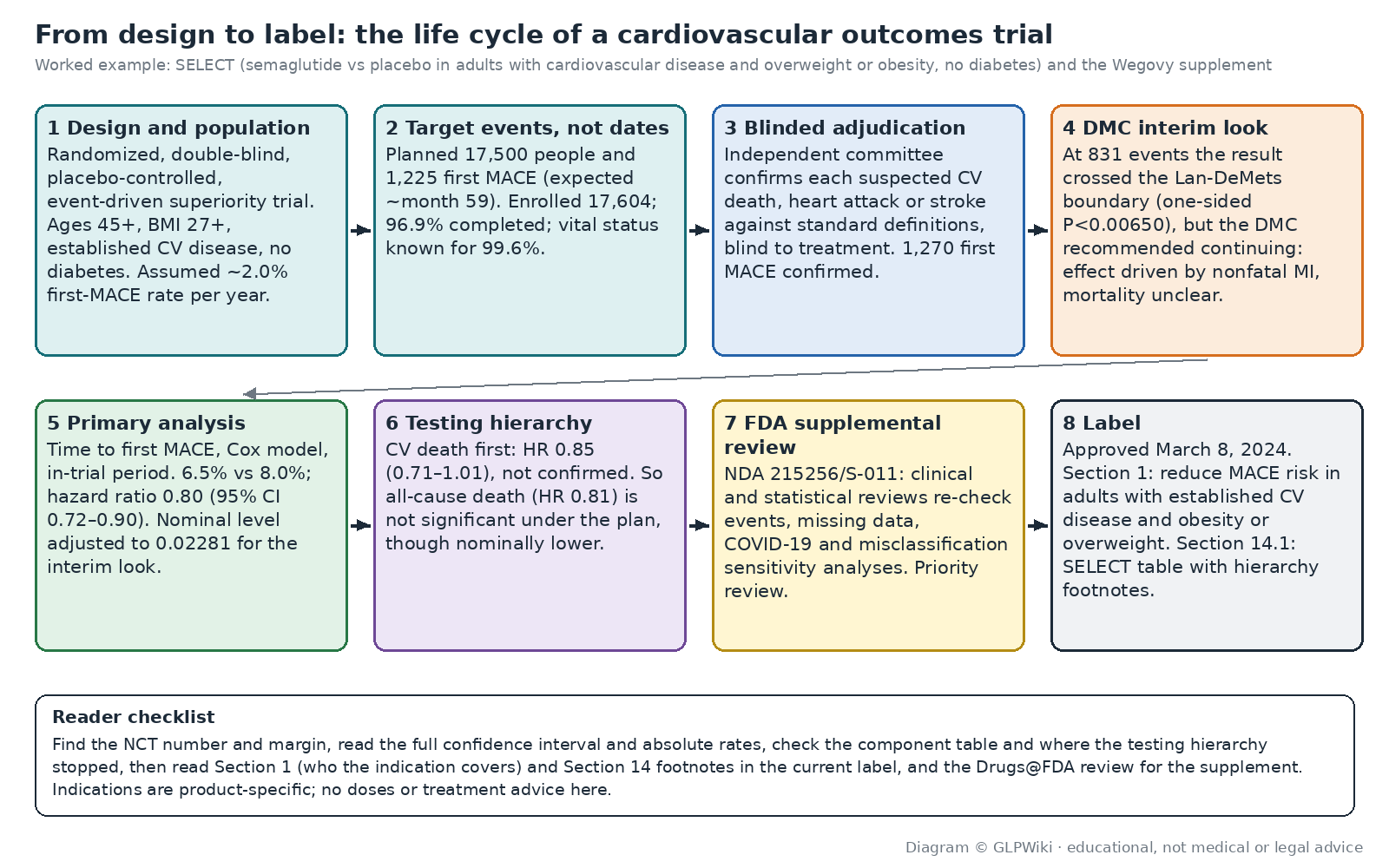
FDA's clinical review of SELECT shows how the planning works. The sponsor assumed an annual first-MACE rate of about 2.0% (1.8% with semaglutide and 2.2% with placebo), planned to randomize 17,500 adults 1:1 and expected the 1,225 planned first MACE to accrue at about month 59. The trial was designed to close when the target number of primary events was reached. In the end it enrolled 17,604 people; the review reports that 96.9% completed the trial and vital status was available for 99.6%.
Other trials show variations. Harmony Outcomes was designed to stop once 611 primary events and a median follow-up of at least 1.5 years had accrued, which happened on November 8, 2017; median follow-up was 1.6 years. SOUL ran until 1,225 first adjudication-confirmed MACE had occurred, with a median follow-up of 49.5 months. SURPASS-CVOT targeted at least 1,615 participants with a confirmed MACE component.
Because the stopping point is defined by events, follow-up length varies between trials and between participants. Someone randomized early may be followed for five years and someone randomized late for three. That is one reason why trial reports present Kaplan-Meier curves and incidence rates per 100 person-years rather than only a single percentage.
High retention matters as much in a CVOT as anywhere. A missing outcome in a mortality-driven trial is particularly problematic, so sponsors work hard to determine vital status even for people who stop the study drug or leave active follow-up. The Mounjaro label reports that 98% of SURPASS-CVOT participants had a complete primary-endpoint assessment and 99.7% had vital status established.
Time to first event, hazard ratios and Kaplan-Meier curves
Most CVOT primary analyses are time-to-first-event analyses. For each participant, the clock starts at randomization and stops at the first qualifying event. People without an event are censored at the end of their observation time. The groups are compared with a Cox proportional hazards model, which produces a hazard ratio: roughly, the ratio of the instantaneous event rate in the treatment group to that in the control group, averaged over follow-up. A hazard ratio of 0.80 means the event rate was about 20% lower in relative terms.
Labels say this explicitly. The Wegovy Section 14 table notes that time to first event was analyzed in a Cox proportional hazards model with treatment as a factor, and that for patients with multiple events only the first counted toward the composite. The Mounjaro table notes Cox models with treatment as a factor, stratified for SGLT2 inhibitor use.
A Kaplan-Meier curve plots the cumulative percentage of people with a first event over time in each group. Curves that separate early and keep separating suggest an effect that begins soon and persists; curves that overlap for a long time and separate late suggest a delayed effect. The numbers at risk printed under the curve show how many participants were still being followed at each time; when those numbers fall, the right-hand end of the curve becomes less precise.
Two observation windows often appear. In SELECT, FDA's review describes an 'in-trial' period from randomization to the last trial day regardless of whether the person was still taking the study drug, and an 'on-treatment' period limited to times when the person had recently taken it. The primary analysis used the in-trial period, which is closer to an intention-to-treat comparison of randomized groups. On-treatment analyses answer a different question and are usually supportive. GLPWiki's estimands guide explains why the choice of observation window changes what a number means.
Competing risks are a further subtlety. Someone who dies of cancer can no longer have a heart attack. In a time-to-first-event analysis of nonfatal events, death from other causes is a competing risk, and methods for analyzing outcomes in that setting are described in the cardiology statistics literature. For a reader, the key point is that a component such as nonfatal myocardial infarction can be affected by changes in other kinds of death, so component results should be read with care.
First events versus total events, and other ways to summarize composites
A time-to-first-event analysis ignores everything that happens after a person's first event. If someone has a nonfatal heart attack and later dies of cardiovascular causes, only the heart attack counts toward the primary endpoint. That is statistically convenient, but it can understate the total burden of disease.
Total-event (recurrent-event) analyses count first and subsequent events. A prespecified SOUL analysis published in 2026 counted 683 total 3-point MACE (579 first and 104 subsequent) with oral semaglutide versus 791 (668 first and 123 subsequent) with placebo, a mean ratio of 0.86 (95% CI 0.76 to 0.97). Statistical reviews of recurrent-event methods in heart failure trials explain why such analyses need models that account for the correlation between events in the same person.
Another approach is the win ratio, proposed in 2012, which compares participants in pairs and ranks outcomes by clinical priority, for example death before hospitalization. It is designed to give more weight to more serious events than a simple first-event composite does.
Neither total-event analyses nor win ratios replace the prespecified primary analysis. When a press release or a later paper emphasizes total events, check whether that analysis was prespecified, whether it was part of the formal testing hierarchy and how it compares with the first-event result.
Interim analyses and data monitoring committees: the SELECT example
Long CVOTs are watched by an independent data monitoring committee (DMC) that reviews unblinded results at prespecified times and can recommend stopping early for clear benefit, for harm or for futility. To keep the overall false-positive rate under control, interim looks use stopping boundaries, often derived from a Lan-DeMets alpha spending function, which require much stronger evidence at an interim analysis than at the final one.
FDA's review of the Wegovy cardiovascular supplement gives an unusually detailed view of this process. SELECT had one planned interim analysis when two-thirds of the planned primary events (817) had accrued. Based on 831 observed events, the primary MACE result met the prespecified Lan-DeMets stopping boundary of a one-sided P value below 0.00650 and an applicant-defined hazard ratio boundary of 0.80 or lower. Yet the DMC did not recommend stopping.
According to the DMC minutes summarized in FDA's review, the committee noted that the interim result was driven by nonfatal myocardial infarction, with no significant effect on cardiovascular death; that an apparent imbalance in COVID-19 deaths might be affecting all-cause mortality; and that another year of follow-up would narrow the confidence interval for all-cause death, help clarify the effect on nonfatal stroke and inform future analyses. The trial continued to its planned end, and the final analysis adjusted the nominal significance level to 0.02281 using the alpha spending function.
Other GLP-1 trials did stop early. FLOW, a kidney-outcomes trial of semaglutide in people with type 2 diabetes and chronic kidney disease, was stopped after a prespecified interim analysis, with a median follow-up of 3.4 years. Trials stopped early for benefit can overestimate the size of an effect because they halt when results happen to be favorable, so reviewers look closely at the number of events and the consistency of components.
GLPWiki's data monitoring committees guide explains DMC charters, information firewalls and stopping guidelines in more detail.
Confirmatory secondary endpoints and testing hierarchies
CVOTs usually have one primary endpoint and a short list of confirmatory secondary endpoints tested in a fixed order. Each later endpoint is formally tested only if every earlier one was statistically significant. This hierarchy controls the familywise type I error rate, as described in FDA's 2022 guidance on multiple endpoints. Results outside the hierarchy are reported with nominal P values or confidence intervals but are not confirmed findings.
SELECT shows why this matters. Cardiovascular death was the first confirmatory secondary endpoint. Its hazard ratio was 0.85 (95% CI 0.71 to 1.01), so superiority was not confirmed. All-cause death came next in the hierarchy; its hazard ratio was 0.81 (95% CI 0.71 to 0.93), but because the earlier endpoint failed, the Wegovy label footnote states that it was not statistically significant based on the prespecified testing hierarchy. FDA's clinical review describes the all-cause mortality reduction as 'nominally significant'. Fatal or nonfatal myocardial infarction (hazard ratio 0.72) and fatal or nonfatal stroke (0.89) were outside the hierarchy.
SOUL shows the same caution. According to the NEJM report, the confirmatory secondary outcomes, beginning with a five-point composite of major kidney disease events, did not differ significantly between oral semaglutide and placebo. A significant primary result does not carry the secondary outcomes with it.
LEADER's report states that no adjustments for multiplicity were performed for its prespecified exploratory outcomes. Its lower rates of cardiovascular death (hazard ratio 0.78) and death from any cause (0.85) are important findings, but readers should check in the paper and the label which tier each result belongs to before treating it as confirmed in the same way as the primary result.
Label tables mark these tiers with footnotes such as 'not controlled for family-wise type I error rate' or 'not included in the prespecified testing hierarchy'. Reading the footnotes is one of the simplest ways to avoid overstating a secondary result.
Relative versus absolute effects: putting a hazard ratio in context
A hazard ratio describes relative change. Its practical meaning depends on how common the events are. In SELECT, a primary event occurred in 569 of 8,803 people (6.5%) with semaglutide and 701 of 8,801 (8.0%) with placebo over a mean follow-up of 39.8 months; FDA's review expresses this as 2.0 versus 2.5 first MACE per 100 patient-years of observation. In LEADER, the primary outcome occurred in 13.0% versus 14.9% over a median of 3.8 years. In SOUL, the figures were 12.0% versus 13.8%, or 3.1 versus 3.7 events per 100 person-years, over a median of 49.5 months.
The same relative reduction translates into different absolute differences in populations with different baseline risk. A trial enrolling people with recent acute coronary syndrome, such as ELIXA, has a much higher event rate than one enrolling people with risk factors only. That is one reason why absolute numbers from one trial cannot be applied directly to people unlike those enrolled.
Absolute differences are sometimes turned into a number needed to treat, the number of people who would need treatment for a given time for one fewer event. Statisticians recommend reporting such figures with confidence intervals and the time frame they refer to. A number needed to treat without a time frame and an interval is incomplete.
Also note the denominator. The SURPASS-CVOT paper analyzed a modified intention-to-treat population of 6,586 tirzepatide and 6,579 dulaglutide participants after excluding 134 people who did not meet inclusion criteria, while the Mounjaro label table uses 6,647 per group of randomized and treated participants. Both report a hazard ratio of 0.92, but the counts differ slightly. Small differences like this between papers, labels and registry results are common and usually reflect different analysis sets.
Active-comparator CVOTs: SURPASS-CVOT and the 1.05 margin
Once several GLP-1 receptor agonists had shown cardiovascular benefit, a placebo-controlled CVOT in people with type 2 diabetes and established cardiovascular disease became harder to justify for a new incretin medicine. SURPASS-CVOT instead randomized 13,299 people with type 2 diabetes and atherosclerotic cardiovascular disease to tirzepatide or dulaglutide, the comparator that had shown a reduction in MACE in REWIND.
The design paper states that the primary analysis was noninferiority for time to first MACE with an upper confidence limit below 1.05, which would 'also confirm superiority vs a putative placebo'. The logic is indirect: because dulaglutide's benefit versus placebo was already estimated, showing that tirzepatide was no more than 5% worse than dulaglutide supports the inference that tirzepatide would also have beaten placebo. Such 'putative placebo' reasoning depends on assumptions that the earlier trial's effect applies to the new trial's population and conditions, a constancy assumption discussed in FDA's non-inferiority guidance.
The result: a primary event occurred in 801 (12.2%) of the tirzepatide group and 862 (13.1%) of the dulaglutide group, a hazard ratio of 0.92 with a 95.3% confidence interval of 0.83 to 1.01. Noninferiority was met (P=0.003 in the paper; the label reports P=0.007 for its analysis set); superiority was not (P=0.09). The unusual 95.3% interval reflects the trial's prespecified allocation of its overall significance level.
The Mounjaro label adds that superiority to dulaglutide was not established, and lists all-cause death (hazard ratio 0.84, 95% CI 0.75 to 0.94) with a footnote that it was not controlled for family-wise type I error. FDA's August 27, 2026 approval letter for supplement S-044 describes the new indication: to reduce the risk of major adverse cardiovascular events in adults with type 2 diabetes who are at high risk for these events. The letter notes that the diabetic retinopathy warning was also updated based on SURPASS-CVOT.
When you read an active-comparator CVOT, ask three questions: what margin was used and why, what is known about the comparator's own effect versus placebo, and whether the trial tested superiority as a separate step.
The first obesity CVOT: SELECT and the Wegovy indication
Before SELECT, GLP-1 CVOTs enrolled people with type 2 diabetes, because they were run to meet diabetes-drug expectations. SELECT was designed as a superiority trial of semaglutide versus placebo in people aged 45 or older with established cardiovascular disease and a body-mass index of 27 or higher, but without diabetes. Its design paper described it as the first CVOT to evaluate superiority in MACE reduction for an anti-obesity medicine in such a population.
Established cardiovascular disease meant prior myocardial infarction, prior stroke or peripheral arterial disease, as the Wegovy label describes. The primary endpoint was time to first 3-point MACE. The hazard ratio was 0.80 (95% CI 0.72 to 0.90). Adverse events leading to permanent discontinuation of the study drug occurred in 16.6% of the semaglutide group and 8.2% of the placebo group, mainly gastrointestinal. A separate safety paper reported fewer serious adverse events with semaglutide than with placebo (33.4% versus 36.4%) and more gallbladder-related disorders (2.8% versus 2.3%).
A prespecified analysis of the 4,286 participants (24.3%) with a history of heart failure at enrollment reported hazard ratios for MACE of 0.72 in that subgroup, with no significant interaction with heart failure status. Subgroup analyses like this are informative but are not separate confirmatory trials.
FDA approved the Wegovy cardiovascular indication on March 8, 2024, under supplement S-011 to NDA 215256, after a priority review. The approval package on Drugs@FDA contains the clinical and statistical reviews quoted in this guide, including the event-rate assumptions, the interim-analysis discussion and the missing-data sensitivity analyses. The label's Section 1 now lists the cardiovascular indication first, and Section 14.1 contains the SELECT table with its testing-hierarchy footnotes.
Notice what the indication does and does not cover. It applies to adults with established cardiovascular disease and either obesity or overweight, which mirrors SELECT's population. SELECT did not enroll people without established cardiovascular disease, so it does not by itself answer questions about primary prevention.
From trial result to label: Section 1, Section 14 and the approval package
A positive CVOT does not change a label automatically. The sponsor submits a supplemental application with the full clinical study report and datasets. FDA reviewers re-analyze the data, check adjudication, missing data and sensitivity analyses, and decide what, if anything, the label should say. The outcome can be a new indication, new Section 14 data without a new indication, safety-section changes, or a combination.
Indication wording follows the trial population closely. Victoza's indication covers adults with type 2 diabetes and established cardiovascular disease, reflecting LEADER. Trulicity's covers adults with type 2 diabetes who have established cardiovascular disease or multiple cardiovascular risk factors, reflecting REWIND, which enrolled people with either a previous cardiovascular event or cardiovascular risk factors. Rybelsus and Mounjaro, based on SOUL and SURPASS-CVOT, use the phrase 'at high risk for these events'. Wegovy's covers adults with established cardiovascular disease and either obesity or overweight.
A CVOT can also add safety information. SUSTAIN-6 found more diabetic retinopathy complications with semaglutide than placebo (hazard ratio 1.76, 95% CI 1.11 to 2.78), and semaglutide labeling describes this adjudicated finding. In the dipeptidyl peptidase-4 inhibitor class, SAVOR-TIMI 53 found noninferiority for MACE but more hospitalizations for heart failure with saxagliptin (hazard ratio 1.27), showing that CVOTs can reveal non-ischemic risks.
To read a CVOT-based indication well: open the current label on DailyMed, read Section 1 for the exact population, read the Section 14 table and its footnotes, then open the Drugs@FDA approval package or letter for the supplement to see the reviewers' discussion. GLPWiki's guides to the Indications and Usage section, the Clinical Studies section, label version tracking and FDA review documents walk through each step.
Remember that indications are product-specific. A result for injectable semaglutide in SUSTAIN-6 did not automatically give oral semaglutide a cardiovascular indication; SOUL was needed. Compounded or unapproved products have no FDA-approved indications at all, regardless of any trial of an approved product with the same active ingredient.
Beyond MACE: kidney and heart failure outcome trials
Outcome trials now go beyond classic MACE. FLOW tested semaglutide in 3,533 people with type 2 diabetes and chronic kidney disease using a primary composite of major kidney disease events, including kidney failure, a sustained large drop in kidney function and kidney or cardiovascular death. The hazard ratio was 0.76 (95% CI 0.66 to 0.88). Major cardiovascular events were a confirmatory secondary outcome (hazard ratio 0.82, 95% CI 0.68 to 0.98).
SUMMIT tested tirzepatide in 731 people with heart failure with preserved ejection fraction and obesity. Its two primary endpoints were a composite of adjudicated cardiovascular death or worsening heart-failure events, and a change in a symptom and function questionnaire score. The composite occurred in 9.9% versus 15.3% (hazard ratio 0.62, 95% CI 0.41 to 0.95). Cardiovascular deaths alone were few (8 versus 5), with a very wide interval (hazard ratio 1.58, 95% CI 0.52 to 4.83), which illustrates why a small number of events cannot settle a component question either way.
These trials use the same toolkit as MACE CVOTs: adjudicated events, time-to-first-event analyses, interim monitoring and testing hierarchies. They also show how outcome trials can support indications outside the original diabetes or weight-management setting. GLPWiki's labeled indication expansions guide tracks those product-specific indications.
Meta-analyses and class effects: what pooling can and cannot show
With many GLP-1 CVOTs completed, researchers have pooled them. A 2019 meta-analysis of seven trials with 56,004 participants (ELIXA, LEADER, SUSTAIN-6, EXSCEL, Harmony Outcomes, REWIND and PIONEER 6) estimated a 12% reduction in MACE (hazard ratio 0.88, 95% CI 0.82 to 0.94). A 2021 update adding AMPLITUDE-O, for eight trials and 60,080 participants, estimated a 14% reduction (hazard ratio 0.86, 95% CI 0.80 to 0.93), with no significant heterogeneity across the subgroups examined.
Pooled estimates are useful for understanding a drug class, but they do not replace product-specific evidence. The trials differed in molecule, formulation, population, background therapy, follow-up and endpoint definition. ELIXA enrolled people shortly after an acute coronary syndrome; REWIND enrolled many without prior cardiovascular disease; SELECT enrolled people without diabetes. Regulators grant indications product by product, based on each product's own trials.
Cross-trial comparison has the same pitfalls described in GLPWiki's estimands guide. A smaller hazard ratio in one trial than another does not mean one medicine is better. Only a randomized head-to-head trial, such as SURPASS-CVOT, compares two medicines directly, and even then it answers the question only for the population and conditions studied.
How regulators rethought CVOTs: the 2018 advisory committee, the 2020 draft and EMA
By 2018, many CVOTs required under the 2008 guidance had been completed. None had found an increase in ischemic cardiovascular events, and several had found reductions. Commentaries in Diabetes Care in 2016 and 2018 asked whether a large cardiovascular safety trial for every new diabetes drug was still the best use of time and resources, and how future trials could be made more efficient and clinically useful. FDA's Endocrinologic and Metabolic Drugs Advisory Committee met on October 24 and 25, 2018 to reconsider the guidance. Asked whether an unacceptable increase in cardiovascular risk should be excluded for all new glucose-lowering drugs regardless of any signal, members voted 10 yes and 9 no. The minutes record that members lacked consensus on the specific 1.8 and 1.3 thresholds, but that a majority favored replacing the two-step approach, for example with a single premarketing expectation, and supported broadening assessments beyond classic MACE, such as heart failure.
In March 2020 FDA withdrew the December 2008 guidance and published draft guidance, 'Type 2 Diabetes Mellitus: Evaluating the Safety of New Drugs for Improving Glycemic Control', announced in the Federal Register on March 10, 2020. Instead of fixed cardiovascular margins, the draft recommends a larger and more representative safety database: at least 4,000 patient-years of exposure in phase 3, at least 1,500 patients exposed for at least one year and 500 for at least two years, and at least 500 patients with stage 3 or 4 chronic kidney disease, 600 with established cardiovascular disease and 600 older than 65 (ideally at least 1,200 with at least one of these conditions). It keeps rigorous collection and adjudication of cardiovascular events and independent safety monitoring.
The European Medicines Agency took a related path. Its revised diabetes guideline (CPMP/EWP/1080/00 Rev. 2, effective January 1, 2024) refers cardiovascular safety assessment to a 2016 reflection paper on the assessment of cardiovascular safety profiles of medicinal products, and expects the development program to characterize cardiovascular safety adequately, particularly for new mechanisms of action or drug classes whose cardiovascular profile is not yet established.
In practice, many recent GLP-1 and incretin CVOTs are no longer driven mainly by the 2008 safety margins. They are designed to show benefit, or to support new indications, in populations such as people with obesity but without diabetes.
Ongoing incretin outcome trials to watch, and how to follow them
Several large outcome trials of newer incretin medicines are registered on ClinicalTrials.gov. SURMOUNT-MMO is testing tirzepatide versus placebo in about 15,000 adults with obesity or overweight without diabetes (15,374 actual enrollment on the record), using a five-component primary composite that includes all-cause death; its record lists an estimated primary completion in October 2027. REDEFINE 3 is testing CagriSema, a cagrilintide and semaglutide combination, against placebo in 7,101 people with cardiovascular disease, using 3-point MACE.
TRIUMPH-Outcomes (NCT06383390) is evaluating retatrutide versus placebo in adults with obesity, with a cardiovascular composite and a kidney composite as primary outcomes, an estimated 10,000 participants and an estimated primary completion in February 2029. ATTAIN-Outcomes (NCT07241390) is evaluating orforglipron versus placebo in adults with atherosclerotic cardiovascular disease and/or chronic kidney disease, with an estimated 7,140 participants and estimated primary completion in August 2031.
Registry entries can change, and estimated dates are not promises. No outcome results for these trials are reported here, and nothing in this guide predicts them. To follow a trial, save its NCT number, watch the record's history of changes and results section, and read the primary publication and any FDA review package when they appear. GLPWiki's ClinicalTrials.gov and trial registration guides explain how.
A reader's workflow for any CVOT result
Use these steps whenever you meet a claim that a GLP-1 or related medicine 'cuts heart attacks' or 'is safe for the heart'.
- Identify the trial and its NCT number, then open the ClinicalTrials.gov record and the primary publication in PubMed.
- Check the comparator (placebo or an active drug) and the population (diabetes or not, established cardiovascular disease or risk factors only, recent acute coronary syndrome or stable disease).
- Find the primary hypothesis and margin: noninferiority at 1.8, 1.3 or another margin, superiority, or both in sequence.
- Read the exact primary endpoint (3-point, 4-point or broader composite) and whether events were adjudication-confirmed.
- Read the hazard ratio with its full confidence interval, then the absolute percentages, the event rates per 100 person-years and the follow-up time.
- Check the component table and whether one component drives the result.
- Check the testing hierarchy: which secondary endpoints were confirmatory, where the sequence stopped, and which results are nominal or exploratory.
- Note discontinuation of the study drug, retention and vital-status completeness.
- For label claims, read Section 1 and Section 14 of the current label on DailyMed and the supplement's approval letter or package on Drugs@FDA.
- Do not transfer results to other products, formulations, compounded or unapproved versions, or to populations the trial did not enroll.
Common misreadings of CVOT results
These errors appear often in news coverage, marketing and social media.
- 'Noninferior means equally good.' It means not worse than the comparator by more than the margin. ELIXA and EXSCEL met noninferiority without showing benefit.
- 'A hazard ratio of 0.80 means 20% of people were protected.' It is a relative reduction in the event rate. In SELECT the absolute difference over about 40 months was 6.5% versus 8.0%.
- 'It reduced deaths.' Check whether death was a confirmed endpoint. In SELECT, the all-cause death estimate came after the point where the formal testing hierarchy stopped.
- 'The interim result means the trial was stopped.' SELECT crossed its interim boundary, but the DMC recommended continuing.
- 'All GLP-1 medicines have the same heart benefit.' Indications are product-specific, trials differ, and some trials did not show superiority.
- 'A head-to-head noninferiority result proves the new drug is better.' SURPASS-CVOT met noninferiority versus dulaglutide; superiority was not established.
- 'A heart benefit in a CVOT means the medicine is right for me.' Trial results describe average effects in enrolled populations; individual decisions belong with a licensed clinician using the current label.
- 'Compounded versions have the same indication.' FDA-approved indications apply only to the approved products named in the labeling.
Scope, disclaimer and review date
This guide explains how cardiovascular outcomes trials of GLP-1 and related incretin medicines are designed, analyzed, regulated and reflected in FDA labeling. It is educational only. It does not provide doses, schedules, titration, injection or device instructions, treatment recommendations, product comparisons for any individual, or predictions about ongoing trials. Trial results describe groups of enrolled participants, not any particular person. Decisions about any medicine should be made with a licensed clinician using the current FDA-approved labeling.
Sources include FDA guidance documents and Federal Register notices, FDA advisory committee materials, Drugs@FDA approval packages and letters, DailyMed labeling, EMA guidelines, ClinicalTrials.gov records, and peer-reviewed trial publications and methods papers indexed in PubMed, all listed below.
Last reviewed: November 24, 2026.
Frequently asked questions
- What is a cardiovascular outcomes trial (CVOT)?
- A large randomized trial, usually lasting years, whose primary endpoint is clinical cardiovascular events such as cardiovascular death, heart attack and stroke. It tests whether a medicine increases, does not increase, or reduces those events compared with placebo or another medicine, on top of usual care.
- What do FDA's 1.8 and 1.3 numbers mean?
- FDA's December 2008 diabetes guidance asked sponsors to show that the upper bound of the 95% confidence interval for cardiovascular risk was below 1.8 before approval and below 1.3 to rule out an unacceptable increase, generally through a postmarketing trial if needed. FDA withdrew that guidance in March 2020 and replaced it with a draft focused on the safety database.
- What is MACE?
- Major adverse cardiovascular events. In most GLP-1 trials it is 3-point MACE: cardiovascular death, nonfatal myocardial infarction and nonfatal stroke, analyzed as time to the first of these events. Some trials use broader composites that add events such as unstable angina hospitalization, revascularization or heart failure.
- Does noninferior mean the drug works as well as the comparator?
- No. It means the drug was shown not to be worse by more than a prespecified margin. A separate superiority test is needed to show benefit. ELIXA and EXSCEL met noninferiority versus placebo but did not show superiority.
- Why did SELECT continue after its interim analysis crossed the stopping boundary?
- FDA's review says the data monitoring committee noted that the interim result was driven by nonfatal heart attacks with no significant effect on cardiovascular death, that COVID-19 deaths might be affecting mortality comparisons, and that another year would sharpen estimates. It recommended continuing, and the trial ran to its planned end.
- Did semaglutide reduce deaths in SELECT?
- Cardiovascular death was the first confirmatory secondary endpoint and did not reach statistical significance (hazard ratio 0.85, 95% CI 0.71 to 1.01). The all-cause death estimate was lower, but under the prespecified testing hierarchy it is not counted as statistically significant, as the Wegovy label notes.
- How did tirzepatide get a cardiovascular indication without a placebo-controlled trial?
- SURPASS-CVOT compared tirzepatide with dulaglutide, which had already shown cardiovascular benefit, and met noninferiority against a 1.05 margin (hazard ratio 0.92, 95.3% CI 0.83 to 1.01). FDA reviewed the supplement and approved a Mounjaro indication for adults with type 2 diabetes at high cardiovascular risk on August 27, 2026.
- Where can I check a CVOT-based indication myself?
- Open the current label on DailyMed and read Section 1 (who the indication covers) and Section 14 (the trial table and footnotes). Then check Drugs@FDA for the supplement's approval letter or review package, and the trial's ClinicalTrials.gov record and primary publication. Decisions about any medicine belong with a licensed clinician.
SOURCES
- 01Guidance for Industry on Diabetes Mellitus—Evaluating Cardiovascular Risk in New Antidiabetic Therapies to Treat Type 2 Diabetes; Availability (Federal Register, December 19, 2008)— Federal Register
- 02Diabetes Mellitus — Evaluating Cardiovascular Risk in New Antidiabetic Therapies to Treat Type 2 Diabetes (guidance, December 2008; withdrawn March 2020) – archived FDA PDF— U.S. Food and Drug Administration (via Internet Archive)
- 03Summary Minutes of the Endocrinologic and Metabolic Drugs Advisory Committee Meeting, October 24–25, 2018— U.S. Food and Drug Administration
- 04Endocrinologic and Metabolic Drugs Advisory Committee, October 24–25, 2018: Discussion and voting questions— U.S. Food and Drug Administration
- 05Type 2 Diabetes Mellitus: Evaluating the Safety of New Drugs for Improving Glycemic Control (draft guidance, March 2020)— U.S. Food and Drug Administration
- 06Type 2 Diabetes Mellitus: Evaluating the Safety of New Drugs for Improving Glycemic Control – draft guidance PDF— U.S. Food and Drug Administration
- 07Type 2 Diabetes Mellitus: Evaluating the Safety of New Drugs for Improving Glycemic Control; Draft Guidance for Industry; Availability (Federal Register, March 10, 2020)— Federal Register
- 08Non-Inferiority Clinical Trials to Establish Effectiveness (guidance, November 2016)— U.S. Food and Drug Administration
- 09Non-Inferiority Clinical Trials to Establish Effectiveness – guidance PDF— U.S. Food and Drug Administration
- 10Multiple Endpoints in Clinical Trials (final guidance, October 2022)— U.S. Food and Drug Administration
- 11Establishment and Operation of Clinical Trial Data Monitoring Committees (guidance, March 2006)— U.S. Food and Drug Administration
- 12Use of Data Monitoring Committees in Clinical Trials (draft guidance, February 2024)— U.S. Food and Drug Administration
- 13E9 Statistical Principles for Clinical Trials (guidance, 1998)— U.S. Food and Drug Administration
- 14E9(R1) Statistical Principles for Clinical Trials: Addendum: Estimands and Sensitivity Analysis in Clinical Trials (final guidance, May 2021)— U.S. Food and Drug Administration
- 15FDA Approves First Treatment to Reduce Risk of Serious Heart Problems Specifically in Adults with Obesity or Overweight (press announcement, March 8, 2024)— U.S. Food and Drug Administration
- 16Wegovy (semaglutide) NDA 215256/S-011 approval package (cardiovascular indication, SELECT; approved March 8, 2024)— Drugs@FDA
- 17Drugs@FDA: Wegovy (NDA 215256) product overview— Drugs@FDA
- 18Mounjaro (tirzepatide) NDA 215866/S-044 and S-045 supplement approval letter (SURPASS-CVOT; August 27, 2026)— Drugs@FDA
- 19Mounjaro (tirzepatide) prescribing information approved with S-044/S-045 (Section 14.6, SURPASS-CVOT)— Drugs@FDA
- 20Drugs@FDA: Mounjaro (NDA 215866) product overview— Drugs@FDA
- 21Drugs@FDA: Victoza (NDA 022341) product overview— Drugs@FDA
- 22Drugs@FDA: Ozempic (NDA 209637) product overview— Drugs@FDA
- 23Drugs@FDA: Trulicity (BLA 125469) product overview— Drugs@FDA
- 24Drugs@FDA: Rybelsus (NDA 213051) product overview— Drugs@FDA
- 25WEGOVY (semaglutide) injection – current prescribing information— DailyMed (NLM)
- 26OZEMPIC (semaglutide) injection – current prescribing information— DailyMed (NLM)
- 27VICTOZA (liraglutide) injection – current prescribing information— DailyMed (NLM)
- 28TRULICITY (dulaglutide) injection – current prescribing information— DailyMed (NLM)
- 29RYBELSUS (oral semaglutide) tablets – current prescribing information— DailyMed (NLM)
- 30MOUNJARO (tirzepatide) injection – current prescribing information— DailyMed (NLM)
- 31openFDA drug labeling API (structured label sections)— U.S. Food and Drug Administration
- 32Guideline on clinical investigation of medicinal products in the treatment or prevention of diabetes mellitus (CPMP/EWP/1080/00 Rev. 2, effective January 1, 2024)— European Medicines Agency
- 33Guideline on clinical investigation of medicinal products in the treatment or prevention of diabetes mellitus, Revision 2 – PDF— European Medicines Agency
- 34Reflection paper on assessment of cardiovascular safety profile of medicinal products (EMA/CHMP/50549/2015)— European Medicines Agency
- 35LEADER (liraglutide) – NCT01179048— ClinicalTrials.gov
- 36SUSTAIN 6 (semaglutide injection) – NCT01720446— ClinicalTrials.gov
- 37SELECT (semaglutide, obesity without diabetes) – NCT03574597— ClinicalTrials.gov
- 38SOUL (oral semaglutide) – NCT03914326— ClinicalTrials.gov
- 39SURPASS-CVOT (tirzepatide vs dulaglutide) – NCT04255433— ClinicalTrials.gov
- 40REWIND (dulaglutide) – NCT01394952— ClinicalTrials.gov
- 41EXSCEL (once-weekly exenatide) – NCT01144338— ClinicalTrials.gov
- 42ELIXA (lixisenatide) – NCT01147250— ClinicalTrials.gov
- 43PIONEER 6 (oral semaglutide) – NCT02692716— ClinicalTrials.gov
- 44Harmony Outcomes (albiglutide) – NCT02465515— ClinicalTrials.gov
- 45AMPLITUDE-O (efpeglenatide) – NCT03496298— ClinicalTrials.gov
- 46FLOW (semaglutide kidney outcomes) – NCT03819153— ClinicalTrials.gov
- 47SUMMIT (tirzepatide in HFpEF with obesity) – NCT04847557— ClinicalTrials.gov
- 48SURMOUNT-MMO (tirzepatide morbidity and mortality in obesity) – NCT05556512— ClinicalTrials.gov
- 49REDEFINE 3 (CagriSema cardiovascular outcomes) – NCT05669755— ClinicalTrials.gov
- 50TRIUMPH-Outcomes (retatrutide cardiovascular and kidney outcomes) – NCT06383390— ClinicalTrials.gov
- 51ATTAIN-Outcomes (orforglipron cardiovascular outcomes) – NCT07241390— ClinicalTrials.gov
- 52Marso SP et al. Liraglutide and Cardiovascular Outcomes in Type 2 Diabetes. N Engl J Med. 2016 (PMID 27295427)— PubMed
- 53Marso SP et al. Design of the liraglutide effect and action in diabetes: evaluation of cardiovascular outcome results (LEADER) trial. Am Heart J. 2013 (PMID 24176437)— PubMed
- 54Marso SP et al. Semaglutide and Cardiovascular Outcomes in Patients with Type 2 Diabetes. N Engl J Med. 2016 (PMID 27633186)— PubMed
- 55Lincoff AM et al. Semaglutide and Cardiovascular Outcomes in Obesity without Diabetes. N Engl J Med. 2023 (PMID 37952131)— PubMed
- 56Ryan DH et al. Semaglutide Effects on Cardiovascular Outcomes in People With Overweight or Obesity (SELECT) rationale and design. Am Heart J. 2020 (PMID 32916609)— PubMed
- 57Kushner RF et al. Safety profile of semaglutide versus placebo in the SELECT study: a randomized controlled trial. Obesity (Silver Spring). 2025 (PMID 39948761)— PubMed
- 58Deanfield J et al. Semaglutide and cardiovascular outcomes in patients with obesity and prevalent heart failure: a prespecified analysis of the SELECT trial. Lancet. 2024 (PMID 39181597)— PubMed
- 59Pfeffer MA et al. Lixisenatide in Patients with Type 2 Diabetes and Acute Coronary Syndrome. N Engl J Med. 2015 (PMID 26630143)— PubMed
- 60Holman RR et al. Effects of Once-Weekly Exenatide on Cardiovascular Outcomes in Type 2 Diabetes. N Engl J Med. 2017 (PMID 28910237)— PubMed
- 61Hernandez AF et al. Albiglutide and cardiovascular outcomes in patients with type 2 diabetes and cardiovascular disease (Harmony Outcomes): a double-blind, randomised placebo-controlled trial. Lancet. 2018 (PMID 30291013)— PubMed
- 62Gerstein HC et al. Dulaglutide and cardiovascular outcomes in type 2 diabetes (REWIND): a double-blind, randomised placebo-controlled trial. Lancet. 2019 (PMID 31189511)— PubMed
- 63Husain M et al. Oral Semaglutide and Cardiovascular Outcomes in Patients with Type 2 Diabetes. N Engl J Med. 2019 (PMID 31185157)— PubMed
- 64Gerstein HC et al. Cardiovascular and Renal Outcomes with Efpeglenatide in Type 2 Diabetes. N Engl J Med. 2021 (PMID 34215025)— PubMed
- 65McGuire DK et al. Oral Semaglutide and Cardiovascular Outcomes in High-Risk Type 2 Diabetes. N Engl J Med. 2025 (PMID 40162642)— PubMed
- 66McGuire DK et al. Effects of oral semaglutide on cardiovascular outcomes in individuals with type 2 diabetes and established atherosclerotic cardiovascular disease and/or chronic kidney disease: Design and baseline characteristics of SOUL, a randomized trial. Diabetes Obes Metab. 2023 (PMID 36945734)— PubMed
- 67Marx N et al. First and Subsequent Major Cardiovascular Events With Oral Semaglutide in High-Risk Type 2 Diabetes: A Secondary Analysis of the SOUL Randomized Clinical Trial. JAMA Cardiol. 2026 (PMID 43013292)— PubMed
- 68Nicholls SJ et al. Cardiovascular Outcomes with Tirzepatide versus Dulaglutide in Type 2 Diabetes. N Engl J Med. 2025 (PMID 41406444)— PubMed
- 69Nicholls SJ et al. Comparison of tirzepatide and dulaglutide on major adverse cardiovascular events in participants with type 2 diabetes and atherosclerotic cardiovascular disease: SURPASS-CVOT design and baseline characteristics. Am Heart J. 2024 (PMID 37758044)— PubMed
- 70Perkovic V et al. Effects of Semaglutide on Chronic Kidney Disease in Patients with Type 2 Diabetes. N Engl J Med. 2024 (PMID 38785209)— PubMed
- 71Packer M et al. Tirzepatide for Heart Failure with Preserved Ejection Fraction and Obesity. N Engl J Med. 2025 (PMID 39555826)— PubMed
- 72Lam CSP et al. Tirzepatide for reduction of morbidity and mortality in adults with obesity: rationale and design of the SURMOUNT-MMO trial. Obesity (Silver Spring). 2025 (PMID 40545827)— PubMed
- 73Kristensen SL et al. Cardiovascular, mortality, and kidney outcomes with GLP-1 receptor agonists in patients with type 2 diabetes: a systematic review and meta-analysis of cardiovascular outcome trials. Lancet Diabetes Endocrinol. 2019 (PMID 31422062)— PubMed
- 74Sattar N et al. Cardiovascular, mortality, and kidney outcomes with GLP-1 receptor agonists in patients with type 2 diabetes: a systematic review and meta-analysis of randomised trials. Lancet Diabetes Endocrinol. 2021 (PMID 34425083)— PubMed
- 75Nissen SE et al. Effect of rosiglitazone on the risk of myocardial infarction and death from cardiovascular causes. N Engl J Med. 2007 (PMID 17517853)— PubMed
- 76Scirica BM et al. Saxagliptin and cardiovascular outcomes in patients with type 2 diabetes mellitus. N Engl J Med. 2013 (PMID 23992601)— PubMed
- 77Hicks KA et al. 2017 Cardiovascular and Stroke Endpoint Definitions for Clinical Trials. Circulation. 2018 (PMID 29483172)— PubMed
- 78Hicks KA et al. 2017 Cardiovascular and Stroke Endpoint Definitions for Clinical Trials. J Am Coll Cardiol. 2018 (PMID 29495982)— PubMed
- 79Seltzer JH et al. Centralized adjudication of cardiovascular end points in cardiovascular and noncardiovascular pharmacologic trials: a report from the Cardiac Safety Research Consortium. Am Heart J. 2015 (PMID 25641528)— PubMed
- 80Bosco E et al. Major adverse cardiovascular event definitions used in observational analysis of administrative databases: a systematic review. BMC Med Res Methodol. 2021 (PMID 34742250)— PubMed
- 81Ferreira-González I et al. Problems with use of composite end points in cardiovascular trials: systematic review of randomised controlled trials. BMJ. 2007 (PMID 17403713)— PubMed
- 82Pocock SJ et al. The win ratio: a new approach to the analysis of composite endpoints in clinical trials based on clinical priorities. Eur Heart J. 2012 (PMID 21900289)— PubMed
- 83Rogers JK et al. Analysing recurrent hospitalizations in heart failure: a review of statistical methodology, with application to CHARM-Preserved. Eur J Heart Fail. 2014 (PMID 24453096)— PubMed
- 84Austin PC et al. Introduction to the Analysis of Survival Data in the Presence of Competing Risks. Circulation. 2016 (PMID 26858290)— PubMed
- 85Altman DG Confidence intervals for the number needed to treat. BMJ. 1998 (PMID 9804726)— PubMed
- 86Kaul S et al. Good enough: a primer on the analysis and interpretation of noninferiority trials. Ann Intern Med. 2006 (PMID 16818930)— PubMed
- 87Mauri L et al. Challenges in the Design and Interpretation of Noninferiority Trials. N Engl J Med. 2017 (PMID 28976859)— PubMed
- 88Cefalu WT et al. Cardiovascular Outcomes Trials in Type 2 Diabetes: Where Do We Go From Here? Reflections From a Diabetes Care Editors' Expert Forum. Diabetes Care. 2018 (PMID 29263194)— PubMed
- 89Smith RJ et al. Evaluating the Cardiovascular Safety of New Medications for Type 2 Diabetes: Time to Reassess?. Diabetes Care. 2016 (PMID 27208377)— PubMed
EDUCATIONAL REFERENCE ONLY · Not medical advice. Nothing here diagnoses, treats, cures or prevents any disease, and nothing here is a dosing recommendation. Consult a licensed clinician before any treatment decision.