Clinical investigator inspections and BIMO literacy: how FDA checks clinical trial sites, what a Form 483 and NAI/VAI/OAI mean, and how investigators are disqualified or debarred

Every large GLP-1 or obesity drug trial runs at dozens or hundreds of clinical sites, and FDA cannot watch them all. Its Bioresearch Monitoring (BIMO) program sends investigators to a sample of sites to check that participants were protected and that the data sent to FDA match the original records. This guide explains what clinical investigators must do, how sites are picked and inspected, what a Form FDA 483 and the NAI, VAI and OAI classifications mean, how FDA escalates from letters to disqualification, how debarment differs, how to read the clinical inspection paragraph in a GLP-1 approval review, and what the public lookup tools can and cannot tell you. It is educational only: no doses, no treatment advice and no legal advice.
UPDATED 16 NOV 2026 · 29 MIN READ
KEY TAKEAWAYS
- FDA created the Bioresearch Monitoring (BIMO) program in 1977 to protect research participants, verify that clinical data submitted to FDA are accurate and reliable, and check compliance with the rules for running studies. Clinical investigator inspections follow Compliance Program 7348.811.
- A drug trial's clinical investigator must follow the protocol and the signed Form FDA 1572, obtain informed consent, keep accurate case histories and drug accountability records, report serious adverse events to the sponsor immediately, and let FDA inspect and copy the records (21 CFR 312.60 to 312.68).
- Inspections tied to a marketing application compare the data the sponsor submitted with the site's source documents and case report forms. They are normally announced in advance, and FDA reviews only a sample of sites: six sites covering 8.4% of participants for tirzepatide's SURMOUNT-1 and SURMOUNT-2 weight-management trials.
- A Form FDA 483 lists an inspector's observations at the end of an inspection. It is not FDA's final word. The FDA center later classifies the inspection as NAI (no action indicated), VAI (voluntary action indicated) or OAI (official action indicated).
- In fiscal year 2024 FDA reported 609 final-classified clinical investigator inspections: 484 NAI, 110 VAI and 15 OAI. The most common observations were failure to follow the protocol, inadequate case histories, adverse event reporting, investigational product accountability and informed consent problems.
- Escalation runs from an untitled letter to a warning letter to a notice proposing disqualification. Under 21 CFR 312.70 an investigator who repeatedly or deliberately breaks the rules or submits false information can be found ineligible to receive investigational products, and their data can be re-examined.
- Debarment is different. Under section 306 of the FD&C Act it follows certain criminal convictions and bars a person from working in any capacity for anyone with an approved or pending drug application. Disqualification, debarment and HHS research-misconduct actions sit on separate public lists.
- Public tools are partial. CBER's clinical investigator inspection list covers only CBER-reviewed products, CDER's BMIS shows who was listed on Form 1572s but not inspection results, and an absence from a list proves nothing. Approval reviews on Drugs@FDA summarize the inspections behind each approval.
Why trial-site inspections matter for GLP-1 readers
When FDA approves a GLP-1 or obesity medicine, the decision rests on a handful of large randomized trials. Those trials are not run in one place. ClinicalTrials.gov lists 118 locations in 10 countries for SURMOUNT-1 (NCT04184622), the 2,539-participant trial behind tirzepatide's weight-management approval, and 75 locations in 8 countries for SURMOUNT-2 (NCT04657003). The orforglipron trials ATTAIN-1 (NCT05869903) and ATTAIN-2 (NCT05872620) list 138 and 136 locations. At each site a local doctor, the clinical investigator, enrolls participants, gives the study drug, records what happens and sends the data to the sponsor.
The published result is only as good as those site records. If people were enrolled who did not meet the criteria, if adverse events went unrecorded, or if numbers were copied wrongly or invented, the pooled data can mislead. FDA's main tool for checking this at the source is the inspection of clinical investigators, carried out under its Bioresearch Monitoring (BIMO) program.
Readers meet the results of this system in several places: news stories about a Form 483 or a warning letter to a research site, the 'Clinical Inspections' paragraph in an FDA approval review, the confidentiality section of a consent form that says FDA may inspect your records, and public lists of disqualified or debarred people. This guide explains how to read each of them without over- or under-reading what they say.
It is the oversight companion to three existing GLPWiki guides. The ClinicalTrials.gov guide covers registry records, the IND and expanded access guide covers how investigational drugs are studied under FDA rules, and the informed consent and IRB guide covers the participant's side. The FDA warning letters and import alerts guide covers inspections of manufacturers, compounders and online sellers; this guide is about inspections of the people who run clinical trials.
What the Bioresearch Monitoring (BIMO) program is
FDA established BIMO in 1977. According to the agency's compliance program for clinical investigators, it has three objectives: protect the rights, safety and welfare of people in FDA-regulated clinical studies; verify the accuracy and reliability of clinical study data submitted to FDA in support of research or marketing applications; and assess compliance with FDA's regulations for running clinical studies, including those on informed consent and ethical review.
BIMO is wider than clinical sites. Its inspections cover clinical investigators, sponsors, sponsor-investigators, monitors and contract research organizations (CROs), institutional review boards (IRBs), nonclinical (animal) laboratories under Good Laboratory Practice rules, bioavailability and bioequivalence studies, and postmarketing adverse drug experience and REMS reporting. Each area has its own compliance program. Clinical investigators and sponsor-investigators are covered by Compliance Program (CP) 7348.811, sponsors and CROs by CP 7348.810, and IRBs by CP 7348.809.
Two parts of FDA share the work. Field investigators do the on-site inspections. They used to belong to the Office of Regulatory Affairs (ORA); on October 1, 2024 FDA renamed and restructured that office as the Office of Inspections and Investigations (OII). The product centers, such as the Center for Drug Evaluation and Research (CDER) and the Center for Biologics Evaluation and Research (CBER), issue the inspection assignments, decide the final classification and send any regulatory letters. In CDER that role sits with the Office of Scientific Investigations (OSI), whose reviewer writes the clinical inspection summary for a new drug application.
Some documents you will meet still use the older names. CP 7348.811, implemented on July 22, 2020, refers throughout to ORA, and annual BIMO metrics slides describe who conducted the inspections in each fiscal year. The underlying rules did not change with the reorganization.
What a clinical investigator must do
FDA defines the investigator as the individual who actually conducts a clinical investigation, meaning the person under whose immediate direction the drug is given to a subject; if a team runs the study, the investigator is the responsible leader of that team (21 CFR 312.3). A sponsor-investigator both starts and conducts a study and carries the duties of both roles. The investigator's core duties for drug studies are in 21 CFR 312.60 to 312.69.
- General responsibilities (312.60): run the study according to the signed investigator statement, the investigational plan and the regulations; protect the rights, safety and welfare of subjects; control the investigational drug; and obtain informed consent under 21 CFR Part 50.
- Records (312.62): keep adequate records of the drug's disposition (dates, quantities and use by subjects) and adequate and accurate case histories, which include case report forms and supporting data such as signed consent forms and medical records. The case history must document that consent was obtained before participation. Records are kept for 2 years after approval for that indication, or 2 years after the investigation is discontinued and FDA is notified.
- Reports (312.64): report any serious adverse event to the sponsor immediately, with an assessment of whether the drug may have caused it; record nonserious adverse events and report them on the protocol's timetable; provide a final report; and give the sponsor accurate financial disclosure information under 21 CFR Part 54, updated during the study and for 1 year after.
- IRB review (312.66): make sure an IRB that meets 21 CFR Part 56 reviews and approves the study, promptly report changes and unanticipated problems involving risks to subjects or others, and make no changes without IRB approval except to remove apparent immediate hazards.
- Inspection (312.68): on request, let an authorized FDA employee access, copy and verify the records. Subject names need not be disclosed unless particular cases need closer study or there is reason to believe the records do not represent actual cases or results.
Form FDA 1572: the investigator's signed commitments
Before taking part in a study under an IND, each investigator signs a Statement of Investigator, Form FDA 1572, and gives it to the sponsor (21 CFR 312.53(c)). The form lists the investigator's qualifications, the sites and laboratories used, the IRB, and the sub-investigators. It also contains commitments: to run the study according to the protocol and change it only after notifying the sponsor (except to protect subjects), to personally conduct or supervise the investigation, to inform subjects that the drug is being used for investigational purposes and to obtain consent and IRB review, to report adverse events, to read the investigator's brochure, to make sure associates and staff understand their obligations, and to keep records and make them available for inspection.
FDA's 2010 frequently asked questions on the 1572 describe it as an agreement signed by the investigator to provide certain information to the sponsor and to comply with FDA regulations. FDA does not require the form itself to be submitted to the agency, but many sponsors do because it gathers in one place information they must submit anyway. Inspection reports often cite the 1572 because it is the investigator's own written promise.
Delegation, supervision and the sponsor's duty to monitor
Investigators delegate many tasks to coordinators, nurses and sub-investigators, but they cannot delegate responsibility. FDA's 2009 guidance on investigator responsibilities says investigators should delegate only to qualified, trained staff, keep a list of who does what, and supervise the study actively. Failure to supervise is a recurring theme in FDA enforcement letters and in published analyses of disqualification proceedings.
Sponsors have their own duties. Under 21 CFR 312.56 a sponsor must monitor every investigation under its IND. A sponsor that finds an investigator not complying with the 1572, the investigational plan or the regulations must promptly either secure compliance or stop shipping drug to that investigator, end the investigator's participation and notify FDA. Under 312.58 the sponsor must also let FDA inspect its records. The international good clinical practice guideline ICH E6, whose third revision (E6(R3)) FDA issued as final guidance in 2025, describes these sponsor and investigator roles and promotes risk-based quality management and monitoring.
Why and how a site gets inspected
FDA describes three broad reasons for a clinical investigator inspection. Most are tied to a marketing application: when a sponsor asks FDA to approve a drug, the review division and OSI pick sites from the pivotal trials to check the data before a decision. Others are surveillance inspections of ongoing studies. A third group are for-cause inspections, triggered by concerns such as a complaint, a sponsor's report of noncompliance, unusual data patterns or problems found elsewhere.
The mix has long been dominated by data audits. A review of all 9,481 inspections on CDER's clinical investigator inspection list from July 1977 through 2009 found that 88% were data audits (to verify data) and 12% were for cause, and that inspections averaged about 350 a year in the last decade of that period.
FDA does not publish a formula for picking sites, but its compliance program and approval reviews show the kinds of factors centers weigh: sites that enrolled many participants or drove the efficacy result, sites with unusual results or many protocol deviations, the investigator's past inspection history, and the need to cover each pivotal trial. Approval reviews often say what share of trial participants the inspected sites covered. For tirzepatide's weight-management application the inspected sites accounted for 8.4% of participants in SURMOUNT-1 and SURMOUNT-2.
What happens during an inspection
Under CP 7348.811, clinical investigator inspections are normally announced in advance unless the assignment says otherwise. The FDA investigator keeps the gap between first contact and the start of the inspection short, and must report any attempt to delay it by more than ten business days without good reason. Before arriving, the investigator reviews the assignment, the protocol and background materials sent by the center, such as case report forms and data line listings.
For an application-driven inspection, the core of the work is a three-way comparison: the data the sponsor submitted to FDA, the case report forms the site sent to the sponsor, and the site's source documents, such as clinic notes, lab reports, dosing logs and signed consent forms. For surveillance or for-cause inspections of ongoing studies, the comparison may be only between source documents and case report forms, because the sponsor has not yet submitted data.
Inspectors also look at how the study was run: who obtained consent and when, whether each participant met the eligibility criteria, whether visits and tests were done as the protocol required, whether adverse events were recorded and reported, how the study drug was stored, dispensed and accounted for, who was delegated which tasks and whether they were trained, IRB approvals and correspondence, electronic record systems, and financial disclosure. They interview the investigator and staff.
Remote regulatory assessments
FDA can also assess some entities remotely, for example by requesting records in advance of or instead of an inspection under section 704(a)(4) of the FD&C Act, which the Food and Drug Omnibus Reform Act of 2022 amended and required FDA to address in guidance. FDA finalized its guidance on remote regulatory assessments (RRAs) in June 2025. The FY 2024 BIMO metrics count RRAs separately from inspections: completed clinical investigator RRAs fell from 15 in FY 2020 and 35 in FY 2021 (the pandemic years) to 7, 2 and 0 in FY 2022 to FY 2024. RRA outcomes use their own labels that FDA treats as equivalent to NAI, VAI and OAI.
Form FDA 483 and the inspection report
At the end of an inspection the FDA investigator holds a close-out discussion. If they observed conditions that in their judgment may violate the regulations, they issue a Form FDA 483, Inspectional Observations, listing them. A 483 records the investigator's observations. It is not FDA's final determination that the site broke the law, and many inspections end with no 483 at all.
Within three business days of finishing, the FDA investigator sends the center a preliminary summary and a copy of any 483. The investigator then writes an Establishment Inspection Report (EIR), a detailed narrative with exhibits. The site may respond in writing to the 483, and a prompt, specific response with corrective actions is taken into account. The center reviews the EIR, the 483, the response and the application data, and decides the final classification. If the center disagrees with the field office's recommended classification, it consults the field staff first.
Because the same word, inspection, covers both the visit and the final decision, news reports often mix up a 483 with the outcome. Reading a 483 tells you what an investigator noticed on site. The classification letter, and any warning letter, tells you what the center concluded.
NAI, VAI and OAI: what the classifications mean
Every BIMO inspection ends with one of three final classifications. CP 7348.811 defines them for clinical investigators.
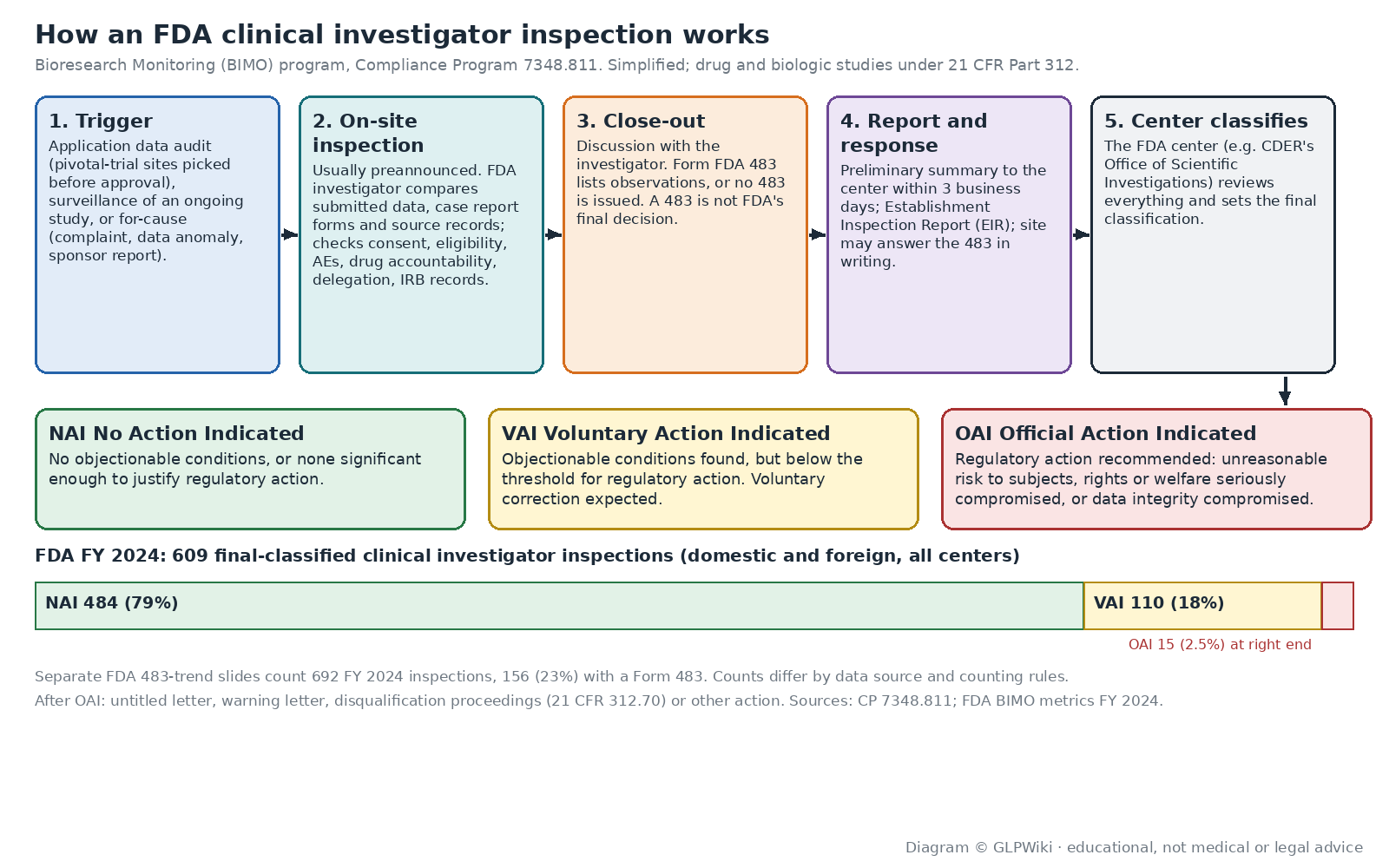
- NAI, No Action Indicated: no objectionable conditions or practices were found, or their significance does not justify further regulatory action.
- VAI, Voluntary Action Indicated: objectionable conditions or practices were found, but FDA is not prepared to take or recommend regulatory action because they do not meet the threshold. FDA's letter may still identify significant issues and expect prompt voluntary correction.
- OAI, Official Action Indicated: objectionable conditions or practices were found and regulatory action should be recommended, because their scope, severity or pattern shows that subjects were or would be exposed to an unreasonable and significant risk of illness or injury, that subjects' rights, safety or welfare were or would be seriously compromised, or that data integrity or reliability is or has been compromised.
What the numbers show
FDA publishes annual BIMO inspection metrics. In fiscal year 2024 it reported 609 final-classified clinical investigator inspections, domestic and foreign, across its centers: 395 for CDER, 114 for CBER, 89 for the device center and 11 for veterinary medicine. Of those, 484 were NAI (79%), 110 were VAI (18%) and 15 were OAI (2.5%). In FY 2023 the totals were 681 inspections, 536 NAI, 136 VAI and 9 OAI; in FY 2020, 544 inspections with 5 OAI.
A separate FDA slide set on FY 2024 clinical investigator 483 trends counted 692 inspections, of which 156 (23%) ended with a Form 483. The counts differ from the classification table because they come from different data pulls and counting rules, and FDA notes that center-provided metrics may differ from other inspection data on its website. The main message is consistent: most inspected sites receive no 483, and only a small fraction are classified OAI.
Those shares describe inspected sites, not all sites. Application-driven inspections cover a sample, and for-cause inspections are aimed at sites where problems are already suspected, so the OAI rate is not an estimate of how often trial sites break the rules. Older data were less favorable: the 1977 to 2009 review found no deficiencies in only 11.2% of data audits and 5% of for-cause inspections, with 3.9% classified as needing official action.
What inspectors most often find
FDA's FY 2024 slides on clinical investigator 483 observations group the findings into five themes, each tied to a regulation:
- Protocol compliance (312.60): consent not obtained as the investigational plan required, such as revised consent not obtained or not obtained before screening or dosing; participants enrolled who did not meet inclusion criteria or met exclusion criteria; prohibited or unrecorded concomitant medications; missed or late adverse event reports; and missed, incorrect or out-of-window visits, assessments and lab tests.
- Accurate and adequate case histories (312.62(b)): source records missing, incomplete or inconsistent with what was reported to the sponsor.
- Failure to report adverse events to the sponsor promptly (312.64(b)).
- Investigational product accountability records (312.62(a)): records that do not show how much drug was received, dispensed, returned or destroyed.
- IRB-related failures (312.66): changes made or problems not reported to the IRB as required.
What published analyses add
Analyses by FDA staff and outside researchers show the same pattern over time. A cross-sectional analysis of BIMO citations from 2007 to 2015 counted 3,281 inspections that received a Form 483. About one third of violations related to adherence to investigational procedures, followed by informed consent and study records; sponsor-investigators averaged 4.41 citations per inspection compared with 2.21 for clinical investigators alone. The rate of 483 issuance fell over the period even as inspections increased.
The 1977 to 2009 review found the most frequently cited deficiencies were failure to follow the investigational plan (34% of inspections), inadequate informed consent (28%) and inadequate or inaccurate records (27%). A comparison of 49 sites and sponsors inspected by both FDA and the European Medicines Agency found about 90% agreement on protocol compliance deficiencies at clinical sites.
Most findings are about process, not fraud: a missed lab test, a late signature, a dosing log that does not reconcile. They matter because the trial's conclusions assume the protocol was followed. A smaller number of cases involve falsification, and those drive the most serious actions described below.
From letters to disqualification: how FDA escalates
After classification the center sends the investigator a letter. For NAI it may simply say that no objectionable conditions justifying action were found. For VAI it may list significant issues and expect voluntary correction. For OAI the center chooses among the actions listed in CP 7348.811, often in this order of severity:
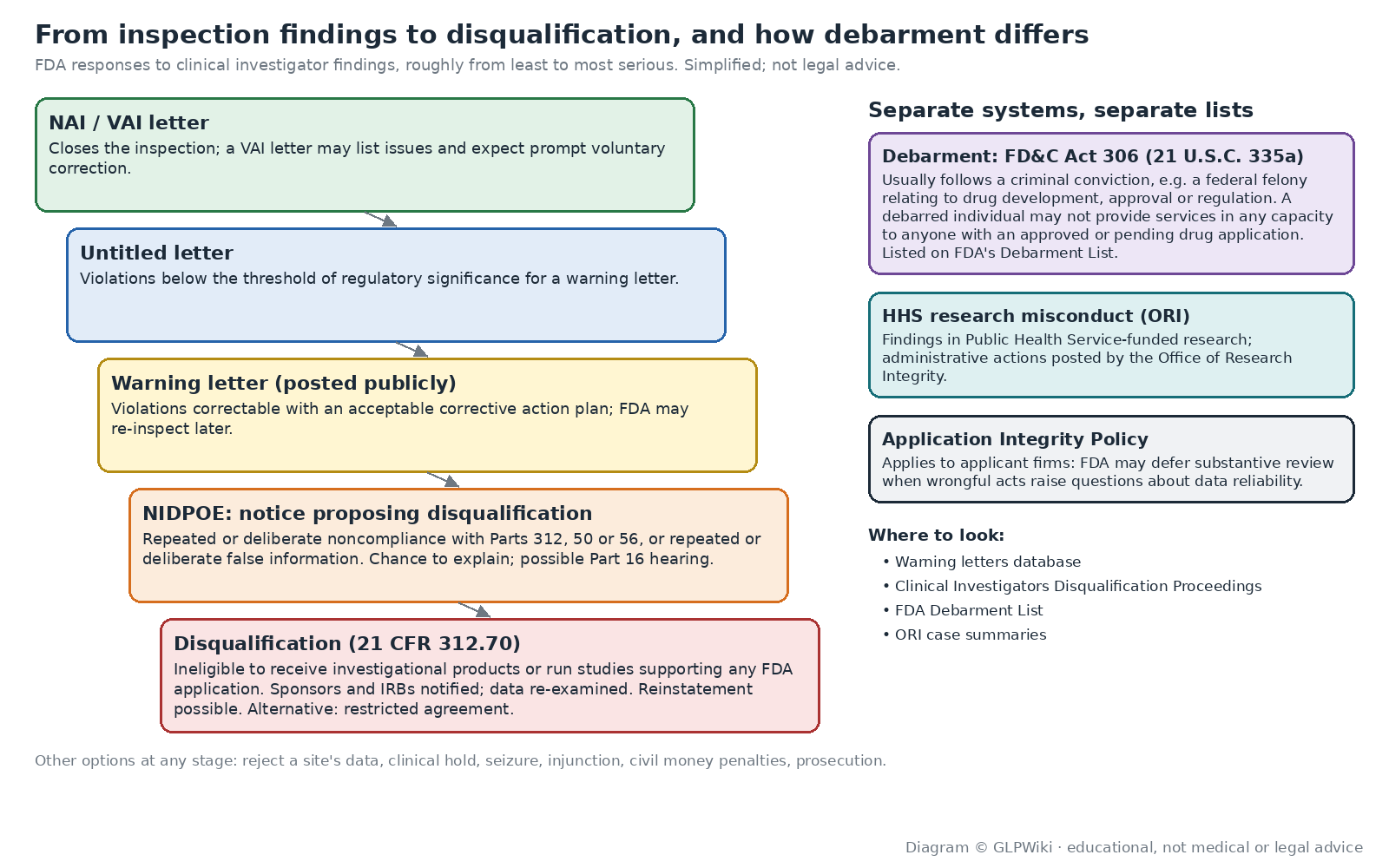
- Untitled letter: for violations that do not meet the threshold of regulatory significance for a warning letter.
- Warning letter: for violations that can be corrected by specific action, such as an acceptable corrective action plan that is likely to prevent recurrence. Warning letters are posted publicly. FDA describes a warning letter as informal and advisory: it communicates the agency's position but does not commit FDA to enforcement action. After one, centers periodically check whether the investigator is running other studies and may re-inspect.
- Notice of Initiation of Disqualification Proceedings and Opportunity to Explain (NIDPOE): when the findings meet the OAI criteria and suggest the investigator repeatedly or deliberately failed to comply with Part 312, 50 or 56, or repeatedly or deliberately submitted false information to FDA or the sponsor.
- Other actions: rejection of a site's data, a clinical hold on a study, seizure of investigational product, injunction, civil money penalties, and criminal prosecution under the FD&C Act or federal criminal statutes on false statements, conspiracy and fraud. FDA may also re-inspect, inspect the sponsor, IRB or other sites, or refer the matter to other agencies.
How disqualification works (21 CFR 312.70)
If FDA has information that an investigator repeatedly or deliberately failed to comply with Part 312, 50 or 56, or repeatedly or deliberately submitted false information in a required report, CDER or CBER sends written notice and offers the investigator a chance to explain in writing or at an informal conference. If the explanation is accepted, the proceeding ends. If it is not, the investigator is offered a regulatory hearing under 21 CFR Part 16 before a presiding officer, and the Commissioner decides.
A disqualified investigator is not eligible to receive investigational products and may not conduct any clinical investigation that supports an application for a research or marketing permit for any FDA-regulated product, from drugs and devices to dietary supplement claims and tobacco products. FDA notifies the investigator, the sponsors of studies they were named in and the IRBs involved. Every application containing that investigator's data is then examined. If the remaining data cannot support the conclusion that it is reasonably safe to continue an investigation, FDA can terminate the IND, and if they cannot justify a product's continued approval, FDA can move to withdraw it. An investigator can later be reinstated after giving adequate assurances.
FDA can also offer a restricted agreement when it believes a lesser sanction will protect public health. A restricted investigator may still receive investigational products but only under the agreement's restrictions. FDA's disqualification page notes that older records used the phrase 'totally restricted' to mean disqualified, which is not the same as 'restricted'.
Published analyses suggest these steps are rare. Of 6,375 domestic inspections of researchers from 2007 to 2015, 360 had significant violations and 194 led to published regulatory actions; lack of supervision and submission of false information were cited more often in disqualification notices. An FDA analysis of 2,248 good clinical practice letters found 104 (4.6%) were OAI letters, 95 of them to clinical investigators, mostly after for-cause inspections. About 70% of those investigators were no longer running FDA-regulated trials at follow-up; follow-up inspections of the 27 who continued found 16 NAI and 11 VAI, and no OAI.
Debarment, research misconduct and application integrity
Debarment comes from a different law. Section 306 of the FD&C Act (21 U.S.C. 335a) requires or allows FDA to debar firms and individuals, typically after a conviction. For example, it requires debarment of an individual convicted of a federal felony for conduct relating to the development or approval of any drug product or otherwise relating to the regulation of drug products. A debarred individual may not provide services in any capacity to a person that has an approved or pending drug product application. FDA's public debarment list gives each person's effective date, term (many are permanent) and Federal Register citation.
Disqualification and debarment can apply to the same person but are not the same thing. Disqualification is an administrative finding about clinical investigation conduct that bars receiving test articles and running studies that support FDA applications. Debarment follows a conviction or other statutory grounds and bars working for drug applicants in any capacity. They are listed separately.
Two other systems sit alongside them. The HHS Office of Research Integrity handles research misconduct in Public Health Service-funded research and posts administrative actions on its own website. FDA's Application Integrity Policy applies to applicants: when FDA finds a pattern of wrongful acts such as fraud or untrue statements that raises significant questions about the reliability of an application's data, it can defer substantive scientific review of that firm's applications until the problem is addressed.
Reading the clinical inspection paragraph in a GLP-1 approval review
FDA's review documents on Drugs@FDA usually include a short section titled 'Clinical Inspections' or a summary of the OSI consult. Three recent GLP-1 examples show what they contain and what to look for.
- Wegovy (semaglutide), 2021 review: the original assignment was to inspect five sites covering two of the phase 3 trials (trials 4375 and 4376). The review states that the COVID-19 pandemic limited on-site inspections, and three planned inspections could not be done before the action date. Two sites were inspected. One had discussion items about adverse event reporting, concomitant medications, protocol deviations, drug storage and documentation, which were not expected to affect analyses; neither received a Form 483. OSI concluded that the findings supported the validity of the data.
- Zepbound (tirzepatide), weight-management review: OSI inspected six sites covering SURMOUNT-1 and SURMOUNT-2, accounting for 8.4% of enrolled participants, and found no significant deficiencies. It concluded the data from those sites were verifiable and the trials appeared adequately conducted.
- Foundayo (orforglipron), 2026 multidisciplinary review: OSI was consulted to inspect four domestic clinical investigators across ATTAIN-1 and ATTAIN-2 and found no significant regulatory violations; the data from those sites were verifiable.
How to read these paragraphs
Note the size of the sample. Six sites out of 193 listed location entries in SURMOUNT-1 and SURMOUNT-2, or four domestic sites in two trials that list 274 locations between them, is a deliberate spot-check, not a census. It works alongside other controls: the sponsor's own monitoring and audits, central statistical checks for unusual data patterns, and the review team's analyses of results by site and region.
Note what was not done. The Wegovy review is unusually explicit that three planned inspections were not completed before the decision. Reviews also state whether foreign sites were inspected, whether sponsor or CRO inspections were done, and whether any site's data were excluded or analyzed with and without that site.
Note the wording of the conclusion. Phrases such as 'the data generated by these sites are verifiable' or 'appear acceptable in support of the proposed indication' are about data reliability at the inspected sites. They are not a finding about the drug's benefits or risks, which come from the rest of the review and the label.
Public tools for looking up investigators and sites
Several FDA and HHS pages can be searched by name. Each answers a narrower question than people expect.
- CBER Clinical Investigator Inspection List: names, addresses, inspection dates and NAI/VAI/OAI classifications for inspections of investigators in studies reviewed by CBER (biologics such as vaccines, blood products and cell and gene therapies), for inspections closed after 1989, updated quarterly. It does not cover most GLP-1 medicines, which CDER reviews.
- Bioresearch Monitoring Information System (BMIS): CDER's file of clinical investigators, CROs and IRBs named on Form 1572s or 1571s submitted to CDER since October 1, 2008, updated quarterly. It shows that someone was listed on a study submission, not whether they were inspected or what was found, and FDA says it is not a comprehensive list.
- Warning letters database: FDA posts warning letters, including those to clinical investigators, sponsors and IRBs, often with redactions.
- Clinical Investigators Disqualification Proceedings database: investigators who are or have been subject to disqualification actions, with status (disqualified, restricted, restrictions removed, not disqualified, reinstated) and links to notices and decisions when available.
- FDA Debarment List and IRB Restrictions/Disqualification page: separate lists for debarred persons and firms and for IRBs that received restriction letters or disqualification actions.
- BIMO inspection metrics and 483 trend slides: annual aggregate counts by center, entity type and classification, and the most common observations.
- Freedom of Information Act requests: EIRs, 483s and classification letters can be requested; released copies are usually redacted.
Cautions when searching
Names repeat, spellings vary and addresses change, so a match needs to be confirmed against the site address and dates. A listing is not a verdict: a disqualification proceeding may have ended in 'not disqualified', restrictions may have been removed, and an investigator may have been reinstated. Being absent from every list usually means only that a site was never inspected or that the records are held by a center that does not post them. An NAI result is not an endorsement either; it describes what was checked during one inspection.
ClinicalTrials.gov lists study locations and contacts but does not show inspection results. To connect the two, readers have to match site names from the registry with FDA documents themselves, keeping the cautions above in mind.
What inspections cannot guarantee
Inspections are snapshots of a sample of sites, usually after the trial has ended. Advance notice is the norm for clinical investigators, and records review can miss problems that left no paper trail. FDA's inspection coverage of foreign sites, which enroll a large share of participants in global GLP-1 programs, depends on travel, staffing and cooperation, and the pandemic years show how quickly planned inspections can fall through.
Findings also travel poorly into the medical literature. A 2015 study identified 57 published trials in which an FDA inspection found significant problems, including falsification or submission of false information in 22 of them. Only 3 of the 78 resulting publications (4%) mentioned the problems, and no corrections, retractions or expressions of concern followed. Statisticians have argued that central statistical monitoring, which looks for implausible data patterns across sites, catches some fraud that on-site checks miss.
Guidance also changes. FDA withdrew its 2010 information sheet on inspections of clinical investigators in December 2025, so older summaries that cite it may be out of date; the regulations and the compliance program remain the primary references. Rules discussed here are U.S. rules. Other regulators, such as the European Medicines Agency, run their own good clinical practice inspections, and FDA can accept foreign studies not run under an IND only if they followed good clinical practice and FDA can validate the data through an on-site inspection if it deems that necessary (21 CFR 312.120).
Reader checklist: questions to ask about an inspection record
Use these questions when you see a news story, letter or review mentioning a trial-site inspection. They are for understanding documents, not for judging individuals or making medical decisions.
- Is this a Form 483 (observations), a classification (NAI, VAI or OAI), a warning letter, a disqualification proceeding or a debarment? Each is a different step with a different meaning.
- Who was inspected: a clinical investigator, a sponsor-investigator, a sponsor or CRO, an IRB or a manufacturer? The rules and consequences differ.
- Why was it inspected: application data audit, surveillance or for cause?
- Which regulations are cited (for example 312.60, 312.62, 312.64, 312.66), and do the findings concern participant protection, data reliability or both?
- Did the site respond, and did FDA accept the corrective actions? Is there a later inspection with a different outcome?
- For an approval review: how many sites were inspected, what share of participants they covered, whether any planned inspections were not done, and whether any data were excluded.
- If you find a name on a list, have you confirmed it is the same person and checked the current status of the action?
Scope, disclaimer and review date
This guide is educational. It explains how U.S. FDA oversight of clinical trial sites works and how to read the related public records. It is not medical advice, does not recommend any medicine, study, site or investigator, and gives no dosing information. It is not legal advice; anyone facing an inspection or enforcement action should consult qualified counsel. Statistics are taken from the cited FDA documents and studies as of the review date and may be revised. GLPWiki sells nothing and links to no vendors.
Last reviewed: November 16, 2026.
Frequently asked questions
- What is FDA's Bioresearch Monitoring (BIMO) program?
- BIMO is FDA's program, started in 1977, for inspecting the people and organizations involved in research on FDA-regulated products, including clinical investigators, sponsors, CROs, IRBs and laboratories. Its aims are to protect research participants, verify the reliability of data submitted to FDA, and check compliance with the rules.
- Does a Form FDA 483 mean a trial site broke the law?
- No. A Form 483 lists an FDA investigator's observations at the end of an inspection. It is not FDA's final determination. The FDA center later classifies the inspection as NAI, VAI or OAI after reviewing the inspection report and any response from the site.
- What do NAI, VAI and OAI mean?
- NAI (No Action Indicated) means no objectionable conditions, or none significant enough for action. VAI (Voluntary Action Indicated) means problems were found but do not meet the threshold for regulatory action. OAI (Official Action Indicated) means FDA should recommend regulatory action because of serious risks to subjects or compromised data.
- How many clinical trial sites does FDA inspect?
- FDA's FY 2024 BIMO metrics report 609 final-classified clinical investigator inspections across its centers, 395 of them for CDER. For a single drug application FDA usually inspects a small sample of sites; for tirzepatide's weight-management approval it was six sites covering 8.4% of participants in two pivotal trials.
- What happens when a clinical investigator is disqualified?
- Under 21 CFR 312.70, a disqualified investigator cannot receive investigational products or run studies that support applications for any FDA-regulated product. FDA notifies sponsors and IRBs, re-examines applications that used the investigator's data, and can terminate an IND or move to withdraw an approval if the remaining data are inadequate.
- How is debarment different from disqualification?
- Disqualification is an administrative finding about how someone ran clinical investigations. Debarment under section 306 of the FD&C Act usually follows a criminal conviction and bars the person from providing services in any capacity to anyone with an approved or pending drug application. The two are listed on separate FDA pages.
- Can I look up whether my study doctor has been inspected?
- Partly. CBER's inspection list covers investigators in CBER-reviewed studies, FDA posts warning letters and disqualification proceedings, and debarred persons are listed. Most GLP-1 studies are reviewed by CDER, whose public BMIS file shows who was listed on study forms but not inspection results. Absence from a list proves little.
- Does a clean inspection mean a drug is safe and effective?
- No. An inspection checks whether a site followed the rules and whether its records support the submitted data. Whether a drug's benefits outweigh its risks is decided from the full body of evidence in FDA's review and is described in the approved label.
SOURCES
- 01FDA Compliance Program 7348.811: Clinical Investigators and Sponsor-Investigators (implemented July 22, 2020)— U.S. Food and Drug Administration
- 02FDA Compliance Program 7348.810: Sponsors, Contract Research Organizations and Monitors— U.S. Food and Drug Administration
- 03Bioresearch Monitoring Program (BIMO) Compliance Programs— U.S. Food and Drug Administration
- 04BIMO Inspection Metrics (annual slides and 483 observation trends)— U.S. Food and Drug Administration
- 05Bioresearch Monitoring (BIMO) Metrics – FY 2024— U.S. Food and Drug Administration
- 06FY 2024 Clinical Investigator FDA 483 Observation Trends— U.S. Food and Drug Administration
- 07FDA modernization: unified Human Foods Program and new model for field operations (ORA renamed OII, Oct 1, 2024)— U.S. Food and Drug Administration
- 0821 CFR 312.3 – Definitions and interpretations (investigator, sponsor-investigator)— eCFR
- 0921 CFR 312.53 – Selecting investigators and monitors (Form FDA 1572 commitments)— eCFR
- 1021 CFR 312.56 – Review of ongoing investigations (sponsor monitoring)— eCFR
- 1121 CFR 312.58 – Inspection of sponsor's records and reports— eCFR
- 1221 CFR 312.60 – General responsibilities of investigators— eCFR
- 1321 CFR 312.62 – Investigator recordkeeping and record retention— eCFR
- 1421 CFR 312.64 – Investigator reports— eCFR
- 1521 CFR 312.66 – Assurance of IRB review— eCFR
- 1621 CFR 312.68 – Inspection of investigator's records and reports— eCFR
- 1721 CFR 312.70 – Disqualification of a clinical investigator— eCFR
- 1821 CFR 312.120 – Foreign clinical studies not conducted under an IND— eCFR
- 1921 CFR Part 54 – Financial disclosure by clinical investigators— eCFR
- 2021 CFR Part 16 – Regulatory hearing before the Food and Drug Administration— eCFR
- 21Information Sheet Guidance: Frequently Asked Questions – Statement of Investigator (Form FDA 1572) (May 2010)— U.S. Food and Drug Administration
- 22Guidance: Investigator Responsibilities – Protecting the Rights, Safety, and Welfare of Study Subjects (October 2009)— U.S. Food and Drug Administration
- 23E6(R3) Good Clinical Practice (GCP) – final guidance— U.S. Food and Drug Administration
- 24Conducting Remote Regulatory Assessments – Questions and Answers (final guidance)— U.S. Food and Drug Administration
- 25OII Withdrawn Guidance (incl. 2010 information sheet on FDA inspections of clinical investigators, withdrawn 2025/12)— U.S. Food and Drug Administration
- 26Clinical Investigations Compliance & Enforcement— U.S. Food and Drug Administration
- 27Clinical Investigators – Disqualification Proceedings— U.S. Food and Drug Administration
- 28Clinical Investigator Status (Biologics) and Clinical Investigator Inspection List— U.S. Food and Drug Administration (CBER)
- 29Bioresearch Monitoring Information System (BMIS)— U.S. Food and Drug Administration (CDER)
- 30Warning Letters— U.S. Food and Drug Administration
- 31FDA Debarment List (Drug Product Applications)— U.S. Food and Drug Administration
- 32Institutional Review Boards – Restrictions Imposed Letters and Disqualification Proceedings— U.S. Food and Drug Administration
- 33Application Integrity Policy— U.S. Food and Drug Administration
- 3421 U.S.C. 335a – Debarment, temporary denial of approval, and suspension (FD&C Act section 306)— Office of the Law Revision Counsel / GovInfo
- 35Case Summaries (research misconduct findings and administrative actions)— HHS Office of Research Integrity
- 36Wegovy (semaglutide) NDA 215256 – Summary Review (2021), Clinical Inspections section— U.S. Food and Drug Administration (Drugs@FDA)
- 37Zepbound (tirzepatide) NDA 217806 – Summary Review, Clinical Inspections section— U.S. Food and Drug Administration (Drugs@FDA)
- 38Foundayo (orforglipron) NDA 220934 – Multidisciplinary Review (2026), Office of Scientific Investigations— U.S. Food and Drug Administration (Drugs@FDA)
- 39SURMOUNT-1: tirzepatide in participants with obesity or overweight (NCT04184622)— ClinicalTrials.gov
- 40SURMOUNT-2: tirzepatide in type 2 diabetes with obesity or overweight (NCT04657003)— ClinicalTrials.gov
- 41ATTAIN-1: orforglipron in adults with obesity or overweight (NCT05869903)— ClinicalTrials.gov
- 42ATTAIN-2: orforglipron in adults with obesity or overweight and type 2 diabetes (NCT05872620)— ClinicalTrials.gov
- 43Morgan-Linnell SK, Stewart DJ, Kurzrock R. U.S. FDA inspections of clinical investigators: overview of results from 1977 to 2009. Clin Cancer Res 2014 (PMID 24737548)— PubMed
- 44Garmendia CA, Epnere K, Bhansali N, et al. Research deviations in FDA-regulated clinical trials: cross-sectional analysis of FDA inspection citations. Ther Innov Regul Sci 2018 (PMID 29714561)— PubMed
- 45Garmendia CA, Bhansali N, Madhivanan P. Research misconduct in FDA-regulated clinical trials: analysis of warning letters and disqualification proceedings. Ther Innov Regul Sci 2018 (PMID 29714564)— PubMed
- 46Jung M, Swann RM, Anantha MS, et al. An FDA analysis of inspected entities after receiving Official Action Indicated letters for GCP violations. Ther Innov Regul Sci 2021 (PMID 34101151)— PubMed
- 47Sellers JW, Mihaescu CM, Ayalew K, et al. Descriptive analysis of GCP inspection findings from FDA and EMA. Ther Innov Regul Sci 2022 (PMID 35610469)— PubMed
- 48Rogers CA, Ahearn JD, Bartlett MG. Data integrity in the pharmaceutical industry: BIMO inspections and warning letters FY2007–2018. Ther Innov Regul Sci 2020 (PMID 32096103)— PubMed
- 49Buchmeier AD. US Food and Drug Administration clinical investigator inspections. Semin Oncol Nurs 2020 (PMID 32253049)— PubMed
- 50Seife C. Research misconduct identified by the US FDA: out of sight, out of mind, out of the peer-reviewed literature. JAMA Intern Med 2015 (PMID 25664866)— PubMed
- 51George SL, Buyse M. Data fraud in clinical trials. Clin Investig (Lond) 2015 (PMID 25729561)— PubMed
- 52Buyse M, George SL, Evans S, et al. The role of biostatistics in the prevention, detection and treatment of fraud in clinical trials. Stat Med 1999 (PMID 10611617)— PubMed
EDUCATIONAL REFERENCE ONLY · Not medical advice. Nothing here diagnoses, treats, cures or prevents any disease, and nothing here is a dosing recommendation. Consult a licensed clinician before any treatment decision.