Clinical investigator financial disclosure literacy: what 21 CFR Part 54 and Forms FDA 3454 and 3455 require, how FDA reads conflicts of interest in GLP-1 approval reviews, and how Open Payments and NIH rules differ

The doctors who run GLP-1 and obesity drug trials are sometimes also paid speakers, consultants or shareholders of the company that makes the drug. FDA does not ban those ties. Instead, its financial disclosure rule, 21 CFR Part 54, makes the company that applies for approval either certify that its trial investigators had no reportable financial interests or disclose them, so FDA reviewers can judge whether money could have biased the data. This guide explains what has to be disclosed and at what dollar thresholds, how Forms FDA 3454 and 3455 work, how FDA weighs the information, what the financial disclosure paragraphs in the Wegovy, Zepbound and Foundayo reviews say, and how this differs from the NIH conflict-of-interest rules, CMS Open Payments, consent forms and journal disclosures. It is educational only: no doses, no treatment advice and no legal advice.
UPDATED 19 NOV 2026 · 28 MIN READ
KEY TAKEAWAYS
- 21 CFR Part 54 exists because an investigator's money ties to a trial's outcome or sponsor are a recognized source of bias. It does not forbid those ties. It requires the company applying for approval to certify their absence or disclose them so FDA can judge how reliable the data are.
- Four kinds of interest must be disclosed: pay that could be higher for a favorable result; a proprietary interest in the product, such as a patent or royalty; equity in the sponsor (any amount if the company is private, more than $50,000 if it is publicly traded); and other significant payments from the sponsor of more than $25,000, such as honoraria, consulting retainers or research grants, not counting the cost of running the study.
- The rule counts interests held while the investigator is doing the study and for one year after it ends. 'Clinical investigator' means listed investigators and subinvestigators who treat or evaluate participants, plus their spouses and dependent children.
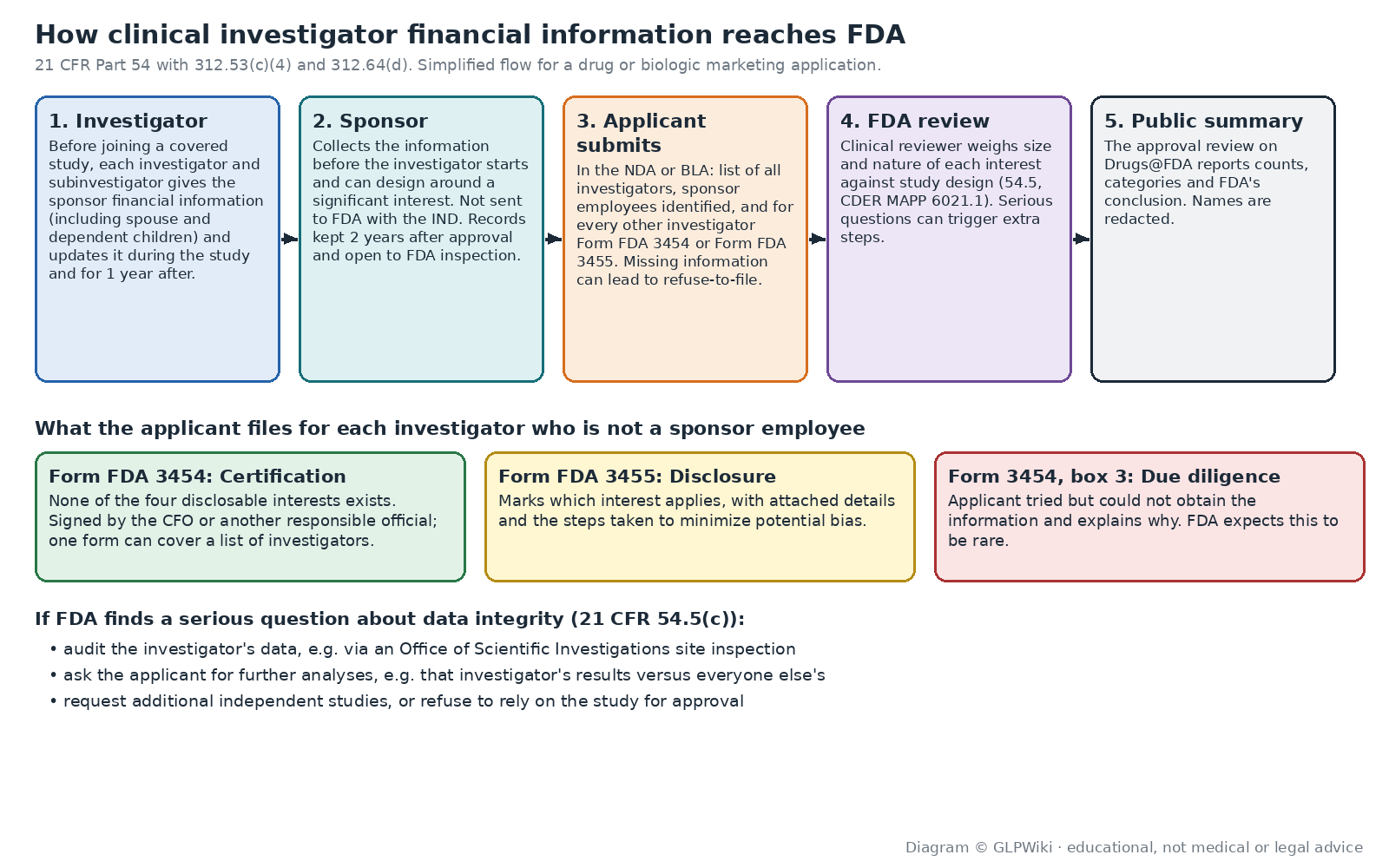
- Investigators must give the trial sponsor their financial information before taking part (21 CFR 312.53(c)(4), 312.64(d)) and update it. The information is not sent to FDA with the IND. It reaches FDA only in the marketing application, on Form FDA 3454 (certification of no disclosable interests) or Form FDA 3455 (disclosure with details and steps taken to minimize bias).
- FDA weighs the size and nature of each interest against the study design. Randomization, blinding, many investigators and objective endpoints protect against bias. If concerns are serious, FDA can audit the investigator's data, ask for extra analyses or new studies, or refuse to rely on the study.
- Approval reviews on Drugs@FDA summarize the result. In tirzepatide's SURMOUNT-1, 7 of 700 investigators (1%) had disclosable interests; in orforglipron's ATTAIN-1, 8 of 692 did, at sites enrolling 140 of 3,127 participants. FDA concluded in each case that these were unlikely to affect the trial results.
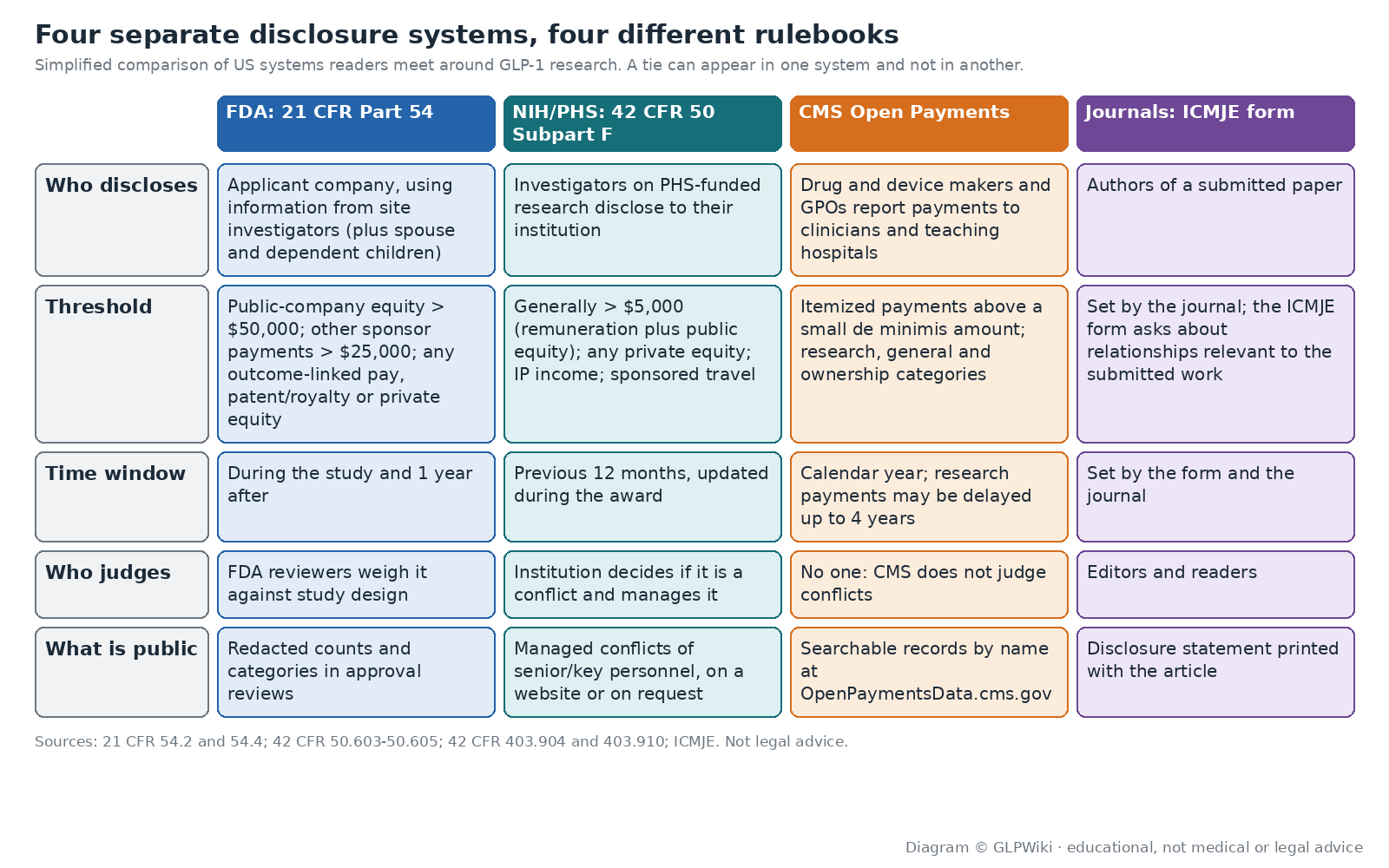
- Part 54 is one of several separate systems. NIH-funded researchers follow 42 CFR Part 50 Subpart F, with a $5,000 threshold and institution-level review. CMS Open Payments publishes industry payments to US physicians and teaching hospitals: $13.18 billion for 2024, of which $8.52 billion was research payments. Journals use the ICMJE disclosure form.
- A disclosure is information, not proof of bias, and the absence of one is not proof of independence. Thresholds, definitions, timing and what is made public all differ between systems. Read each record for what it actually covers.
Why investigators' financial ties matter for GLP-1 readers
Large GLP-1 and obesity drug trials are run by hundreds of clinical investigators at hundreds of sites. FDA's review of tirzepatide for weight management lists 700 investigators in SURMOUNT-1 alone and 410 in SURMOUNT-2. Orforglipron's ATTAIN-1 and ATTAIN-2 listed 692 and 659. Many of these doctors are experienced obesity and diabetes specialists, and specialists are exactly the people drug companies also hire as consultants, advisory board members and paid speakers.
FDA's regulation explains why this matters in its first section. 'One potential source of bias in clinical studies is a financial interest of the clinical investigator in the outcome of the study,' 21 CFR 54.1 says, whether because of the way payment is arranged (for example a royalty), because the investigator owns a patent on the product, or because the investigator holds equity in the sponsor. An investigator who stands to gain from a favorable result could, consciously or not, enroll or evaluate participants differently, or record borderline findings differently.
FDA's answer is disclosure rather than prohibition. Its financial disclosure rule makes the company that applies for approval tell FDA about specific financial ties between the study sponsor and the investigators, so reviewers can weigh them alongside the study design and the results of site inspections. Readers meet the output of this system in the 'Financial Disclosure' paragraph of an FDA approval review, and they meet related but different systems in CMS Open Payments, university conflict-of-interest pages, consent forms and journal disclosure statements.
This guide is the money-and-bias companion to the GLPWiki guides on clinical investigator inspections and BIMO, informed consent and IRBs, and how to read a peptide study. The FDA advisory committee guide covers a different topic that also uses the word 'conflict': the conflict-of-interest screening and waivers for outside experts who advise FDA at public meetings.
The rule: 21 CFR Part 54 in brief
FDA published the final rule 'Financial Disclosure by Clinical Investigators' on February 2, 1998 (63 FR 5233), amended it on December 31, 1998, and it took effect on February 2, 1999. The rule added Part 54 to Title 21 and made matching changes to the rules for drug, biologic and device applications. A new drug application, for example, 'must contain a financial certification or disclosure statement or both as required by part 54' (21 CFR 314.50(k)); biologics license applications carry the same requirement (21 CFR 601.2).
Part 54 applies to 'covered clinical studies'. These are studies in humans that the applicant or FDA relies on to show that the product is effective, plus any study in which a single investigator makes a significant contribution to the demonstration of safety (21 CFR 54.2(e)). In general it does not include phase 1 tolerance studies, pharmacokinetic studies, most clinical pharmacology studies, large open safety studies at many sites, treatment protocols or parallel track protocols. For a GLP-1 obesity drug, the covered studies are typically the randomized phase 3 trials, such as STEP for semaglutide, SURMOUNT for tirzepatide and ATTAIN for orforglipron.
'Clinical investigator' has a narrow meaning here: 'only a listed or identified investigator or subinvestigator who is directly involved in the treatment or evaluation of research subjects', and it 'also includes the spouse and each dependent child of the investigator' (21 CFR 54.2(d)). A site's principal investigator and the subinvestigators who see participants are covered. Dollar thresholds apply to the combined interests of the investigator, spouse and dependent children, according to FDA's 2013 guidance.
The 'sponsor of the covered clinical study' is 'the party supporting a particular study at the time it was carried out' (21 CFR 54.2(h)). FDA's guidance points out that this is not the same as the IND sponsor and that a study can have more than one: for example, one company that designed and ran the trial, a second that paid for it and a third that supplied the drug free of charge.
The four kinds of interest that must be disclosed, and the thresholds
Part 54 does not ask for an investigator's entire financial life. It lists four categories of interest or arrangement, defined in 21 CFR 54.2 and repeated on Form FDA 3455. All of them are about the sponsor of the covered study or the product being tested.
- Compensation affected by the outcome (54.2(a)): pay that 'could be higher for a favorable outcome than for an unfavorable outcome', such as a bonus for a positive result, payment in the form of equity in the sponsor, or compensation tied to sales of the product such as a royalty. No dollar threshold applies.
- Proprietary interest in the tested product (54.2(c)): 'property or other financial interest in the product including, but not limited to, a patent, trademark, copyright or licensing agreement'. No dollar threshold applies.
- Significant equity interest in the sponsor (54.2(b)): any ownership interest, stock options or other interest whose value cannot be readily determined from public prices (generally, stakes in privately held companies), or any equity in a publicly traded company that exceeds $50,000, while the investigator is carrying out the study and for 1 year after it is completed.
- Significant payments of other sorts (54.2(f)): payments from the sponsor to the investigator or the institution 'to support activities of the investigator' with a monetary value of more than $25,000, 'exclusive of the costs of conducting the clinical study or other clinical studies' — for example a grant to fund ongoing research, equipment, retainers for ongoing consultation or honoraria — during the study and for 1 year after completion. FDA's guidance calls these SPOOS and describes the $25,000 as cumulative.
What falls outside the definitions
Three limits are easy to miss. First, the ordinary per-participant or per-site payments that cover the cost of running the trial are excluded from 'significant payments of other sorts'. Being paid by the sponsor to conduct the study is not, by itself, a disclosable interest unless the amount depends on the outcome. Second, the thresholds are high: $50,000 for public-company stock and more than $25,000 for other payments. An investigator could hold $40,000 of a large drug maker's shares and receive $20,000 in speaking fees and still have nothing to disclose under Part 54. Third, the window covers the study period plus one year after completion, not the years before the study began. Payments that ended well before the trial started are not captured.
FDA's guidance asks for detail when something is disclosed. Its own example of a complete disclosure lists 'stock valued at $77,000, speaking fees of $7,500, consulting fees of $22,000, and a grant of $125,000', together with the steps taken to minimize bias. On stock-price swings, the guidance says investigators should report equity 'when the investigator becomes aware that the holding has exceeded the threshold' rather than every fluctuation above and below $50,000.
Form FDA 3454, Form FDA 3455 and the due diligence box
For each covered study, the applicant must give FDA a list of all clinical investigators and identify which of them are full-time or part-time employees of the sponsor (21 CFR 54.4). Sponsor employees are not certified or disclosed one by one; their employment is itself the disclosure. For every other investigator, the applicant must submit one of three things.
- Form FDA 3454, Certification: the applicant certifies that none of the four kinds of disclosable interest or arrangement exists. It is signed by the chief financial officer or another responsible corporate official, and a single form can carry an attached list of all the investigators it covers (54.4(a)(1)).
- Form FDA 3455, Disclosure: for each investigator who does have a disclosable interest, the form marks which of the four categories applies and attaches the details plus 'a description of steps taken to minimize the potential bias of clinical study results' (54.4(a)(3)).
- The due diligence option (box 3 on Form FDA 3454): if the applicant tried but could not get the information, for example because an investigator left the study and could not be found, it certifies that it acted with due diligence and explains why. FDA's guidance says it expects this to be 'rare'.
What happens if the information is missing
FDA 'may refuse to file' a marketing application that lacks the required certification or disclosure, or the due diligence certification (21 CFR 54.4(c)). Under CDER's internal procedure for reviewers, MAPP 6021.1 (first issued June 2017 and revised October 2024), the regulatory project manager checks at filing that the information is on the correct forms and asks the applicant for anything missing.
The applicant must also keep complete records of the disclosable payments and interests for 2 years after the application is approved, and let FDA inspect and copy them (21 CFR 54.6). FDA's guidance says it is FDA policy to review the financial disclosure information that investigators gave the sponsor during a Bioresearch Monitoring (BIMO) inspection of the sponsor.
Before and during the trial: what investigators and sponsors must do
Financial disclosure starts long before FDA sees anything. Under the IND rules, a drug sponsor must obtain from each investigator 'sufficient accurate financial information to allow the sponsor to submit complete and accurate certification or disclosure statements required under part 54' before the investigator takes part, and must get a commitment that the investigator will 'promptly update this information if any relevant changes occur during the course of the investigation and for 1 year following the completion of the study' (21 CFR 312.53(c)(4)). The investigator has the matching duty under 21 CFR 312.64(d). Device studies have parallel rules (21 CFR 812.43(c)(5) and 812.110(d)).
This information is not submitted to FDA with the IND. FDA's guidance says IND and IDE sponsors are not required to send it in their applications, only to collect it before investigators start, and that FDA 'strongly encourages' sponsors of non-IND studies to collect it up front as well. The reason for collecting early is practical: if the sponsor knows about a significant interest before the trial starts, it can design around it, for example by having someone without the interest assess the endpoints.
The investigator's other duties do not change because of a financial tie. They still have to follow the protocol and the signed Form FDA 1572, obtain informed consent, keep accurate records and report adverse events, and they can still be inspected by FDA. The GLPWiki guide on clinical investigator inspections covers those duties and how BIMO checks them.
How FDA weighs a disclosed interest
21 CFR 54.5 tells reviewers what to consider. FDA 'may consider both the size and nature of a disclosed financial interest (including the potential increase in the value of the interest if the product is approved) and steps that have been taken to minimize the potential for bias.' It also takes the study design into account: designs 'that utilize such approaches as multiple investigators (most of whom do not have a disclosable interest), blinding, objective endpoints, or measurement of endpoints by someone other than the investigator may adequately protect against any bias created by a disclosable financial interest.'
In practice this means a disclosure in a large, randomized, double-blind trial with an objective endpoint such as measured body weight or HbA1c usually carries less weight than the same disclosure in a small, open-label study with a subjective endpoint assessed by the investigator. A single site's data are a small part of a multinational trial, and blinding makes it hard for an investigator to steer results toward one arm even if they wanted to.
If FDA decides that an investigator's financial interests 'raise a serious question about the integrity of the data', 54.5(c) lists what it can do: audit the data from that investigator, ask the applicant for further analyses (for example, whether the investigator's results differ from the rest or change the overall outcome), ask for additional independent studies, or refuse to treat the study as a basis for approval.
Inside CDER's review procedure
MAPP 6021.1 describes how CDER's Office of New Drugs puts this into practice. The clinical reviewer follows the financial disclosure section of the review template, checks that certifications or disclosures cover every investigator in every covered study, documents the size and nature of what was disclosed, and records the steps that reduce bias, 'through study design (e.g., methods of blinding, method of evaluation, randomization), through the number of clinical investigators and study sites (thus minimizing the effect of any particular investigator), and substantiation or lack of substantiation of study results.'
If serious questions arise, for instance if 'data from the investigator are more favorable than that from other investigators', the reviewer can ask the Office of Scientific Investigations to consider inspecting that site, request extra analyses from the applicant, or take the other steps in 54.5(c). This is where financial disclosure and BIMO inspections connect: a disclosure can help decide which sites FDA visits.
Reading the financial disclosure paragraph in GLP-1 approval reviews
FDA's approval packages on Drugs@FDA include a short financial disclosure assessment for each covered study. Personal details are redacted, usually marked '(b) (6)', so the public version shows counts, categories and sometimes amounts, but not names. Three recent obesity approvals show what the paragraph looks like.
Wegovy (semaglutide), NDA 215256, 2021
The summary review says the applicant reported disclosable financial interests for eight clinical studies, including the four phase 3 trials. In Trial 4373 (STEP 1, NCT03548935), 17 of 614 investigators had a disclosable interest; in Trial 4374, 14 of 677; in Trial 4375, 12 of 293; in Trial 4376, 8 of 359; and in Trial 4153, 1 of 327. Three other trials had none. One investigator in each of Trials 4374 and 4376 was a sponsor employee. The review notes that the counts overlap, because one investigator can appear in several trials, and concludes that the proportions of investigators with interests, of sites with such an investigator and of patients enrolled at those sites 'were small'.
Zepbound (tirzepatide), NDA 217806, 2023
In SURMOUNT-1 (NCT04184622), 7 of 700 investigators (1%) had disclosable interests, and in SURMOUNT-2 (NCT04657003), 3 of 410 (0.7%). The cross-discipline team leader wrote that the clinical reviewer 'concluded that the disclosures were unlikely to affect the outcome of the trials, and I agree.'
Foundayo (orforglipron), NDA 220934, 2026
The multidisciplinary review reproduces the applicant's disclosure table for each pivotal trial. For ATTAIN-1 (NCT05869903) it lists 692 investigators, no sponsor employees, 8 with disclosable interests on Form FDA 3455 (5 for significant payments of other sorts and 3 for significant equity in the sponsor; none for outcome-linked pay or proprietary interests) and no due diligence certifications. Those eight US sites enrolled 140 of the 3,127 randomized participants. The redacted detail describes, without names, items such as a promotional speaker paid about $66,625 a year, speaker fees and honoraria in the tens of thousands of dollars, and equity holdings in the applicant above $50,000.
For ATTAIN-2 (NCT05872620), 6 of 659 investigators (fewer than 1%) had disclosable interests (5 significant payments, 1 equity), all in the United States, at sites that enrolled about 2.5% (42 of 1,613) of randomized participants. FDA's assessment for both trials was that the potential conflicts 'do not raise significant concerns' because the contribution of those sites was small and 'the trial design (randomized, blinded, with objective endpoints) minimized potential bias.'
How to read these paragraphs
Look for four numbers: total investigators, how many had disclosable interests, how many were sponsor employees, and how many participants were enrolled at those sites. Then look for the category breakdown and FDA's stated reason for its conclusion, which usually rests on 54.5(b): many sites, blinding and objective endpoints. A finding that disclosures were 'unlikely to affect' results is a judgment about data reliability for that application. It is not a statement that the investigators had no other industry ties, and it says nothing about anyone's prescribing or about whether the drug is right for a particular person.
What oversight reviews found, and the rule's known gaps
The roughly 1% disclosure rate in the GLP-1 reviews is typical. In January 2009 the HHS Office of Inspector General (OIG) reviewed the financial forms for all 118 marketing applications FDA approved in fiscal year 2007. Of 29,691 clinical investigators listed, 206 (1%) disclosed at least one financial interest.
The same report found weaknesses. FDA could not tell whether sponsors had submitted information for every investigator, because it had no complete list to check against. Forty-two percent of approved applications were missing financial information: 23% lacked a form or required attachment, and in 28% the sponsor had used the due diligence exemption. FDA reviewers did not document any review of financial information for 31% of applications, and for 20% of applications with disclosed interests neither FDA nor the sponsor recorded any action to reduce bias. OIG recommended that FDA check completeness against a full investigator list, tighten the due diligence guidance and add financial information to inspections.
FDA responded with a revised draft guidance in May 2011 and the final guidance in February 2013, which addresses the OIG report directly, and later with the MAPP review procedure. The dollar thresholds in the regulation have not changed since 1998. Readers should keep the design limits in mind: the $50,000 and $25,000 thresholds are fixed dollar amounts set in 1998, payments before the study period are outside the window, and the disclosures reach FDA only after the trial is over.
A different system: NIH and PHS conflict-of-interest rules
Research funded by NIH and other Public Health Service agencies follows a separate regulation, 42 CFR Part 50 Subpart F, 'Promoting Objectivity in Research', with a parallel rule for contracts in 45 CFR Part 94. HHS last revised it in a final rule published August 25, 2011 (76 FR 53256). Most pivotal GLP-1 trials are paid for by the manufacturer, so Part 54 is the rule that governs their FDA submissions. PHS rules matter for academic GLP-1 research, such as government-funded comparative trials.
The PHS rule differs from Part 54 in several ways. Its threshold is much lower: a 'significant financial interest' generally exists when remuneration from a publicly traded entity in the previous twelve months plus the value of equity in it exceeds $5,000; for non-public entities, more than $5,000 of remuneration or any equity at all; and intellectual property counts once it produces income (42 CFR 50.603). It covers interests related to the investigator's 'institutional responsibilities', not just the sponsor of one study, and investigators must also disclose sponsored travel. NIH's guidance adds that foreign financial interests must be disclosed as well.
Responsibility sits with the institution rather than an FDA reviewer. The university's designated official decides whether a disclosed interest is related to the funded research and could 'directly and significantly affect' it, in which case it is a financial conflict of interest (FCOI) that needs a management plan. The institution must report FCOIs to the funding agency before spending funds and within 60 days of finding a new one (42 CFR 50.604 and 50.605), train investigators at least every four years, and post its FCOI policy publicly.
Two features are especially useful to readers. For senior or key personnel, the institution must make information about a managed FCOI publicly accessible on a website or by written response within five business days, including the investigator's name, title and role, the entity involved, the nature of the interest and its approximate value in dollar ranges. And when an institution finds noncompliance, it must complete a retrospective review within 120 days to determine whether the research was biased, and file a mitigation report if it was (42 CFR 50.605).
Open Payments: what drug companies report paying US clinicians
CMS Open Payments, created by section 6002 of the Affordable Care Act (Social Security Act section 1128G, 42 U.S.C. 1320a-7h, often called the Physician Payments Sunshine Act), is the only one of these systems that publishes searchable payment records by name. Drug, biologic and device manufacturers and group purchasing organizations report payments and other transfers of value to covered recipients: physicians and teaching hospitals, and, since data collected in 2021 under the SUPPORT Act, physician assistants, nurse practitioners and several other advanced practice clinicians. CMS publishes the data each year by June 30, after a review and dispute window for the people named.
Records fall into three categories: general payments (such as consulting fees, speaking fees, food and travel), research payments, and ownership or investment interests held by physicians or their immediate family. CMS's Fiscal Year 2025 report to Congress says that for Program Year 2024, reporting entities reported $13.18 billion: $3.33 billion in general payments, $8.52 billion in research payments and $1.34 billion in ownership or investment interests. CMS's site lists $14.67 billion in 17.07 million published records for Program Year 2025.
Research payment records name the research entity and the principal investigators and may optionally include the ClinicalTrials.gov identifier and context (42 CFR 403.904(f)). Payments made under a research agreement for a new drug or a new use of an existing drug can be held back from publication until FDA approves the product or four calendar years after payment, whichever comes first (42 CFR 403.910). So research payments for a GLP-1 candidate still in trials may not be visible yet.
Open Payments answers a different question from Part 54. It shows money from manufacturers to clinicians, whether or not the clinician is a trial investigator, and CMS says it 'does not comment on what relationships may be beneficial or potential conflicts of interest'. Studies using the data illustrate both its reach and its limits. In 2015 about 48% of US physicians were reported to have received industry payments totaling $2.4 billion (Tringale and colleagues, 2017). A 2026 analysis of research payments to physician principal investigators from 2016 to 2022 found $33.9 billion, 78.5% of it paid through organizations that are not themselves covered recipients, and noted that the records do not separate research expenses from compensation to the physician. Research linking small industry-paid meals to higher prescribing of the promoted brand (DeJong and colleagues, 2016) concerns prescribing, not trial data, and showed association rather than cause and effect.
Consent forms, IRBs and journal disclosures
FDA's list of required elements of informed consent in 21 CFR 50.25 does not include the investigator's financial interests, and neither does the Common Rule. Whether a consent form mentions them depends on the institution, the IRB and the sponsor. HHS guidance from 2004 on financial relationships in human subjects research, which still reflects OHRP's general thinking, suggests that investigators consider including information about financial relationships in the consent document and, where a conflict could influence the consent discussion, having someone without the conflict obtain consent. The World Medical Association's Declaration of Helsinki, revised in October 2024, says potential participants must be informed of 'sources of funding' and 'any potential conflicts of interest'.
IRBs have their own conflict rule: no member may take part in the initial or continuing review of a project in which the member has a conflicting interest, except to provide information requested by the IRB (21 CFR 56.107(e); 45 CFR 46.107(d) is similar). The GLPWiki informed consent and IRB guide covers how to read a consent form in detail.
Research on participants' reactions is limited. In a 2008 randomized vignette trial with 470 people, financial disclosures did not substantially change willingness to join a hypothetical trial overall, but people told the investigator held equity were less willing and less trusting than those told the institution received per-participant payments (Weinfurt and colleagues).
Journal disclosures
Published trial reports carry author disclosures, usually collected on the International Committee of Medical Journal Editors (ICMJE) form. The ICMJE recommendations describe conflicts as arising when 'professional judgment concerning a primary interest (such as patients' welfare or the validity of research) may be influenced by a secondary interest (such as financial gain)' and note that perceptions of conflict matter too. These statements cover the authors of the paper, not every site investigator, and they follow journal rules rather than Part 54's thresholds and time windows. A review by Dunn and colleagues (2016) described conflicts of interest as under-reported, inconsistently described and hard to access, and argued for public registries.
Evidence on outcomes is consistent in direction. A 2003 systematic review in JAMA (Bekelman and colleagues) found a pooled odds ratio of 3.60 for pro-industry conclusions in industry-sponsored research. A 2017 Cochrane review of 75 papers (Lundh and colleagues) found that industry-sponsored drug and device studies more often had favorable efficacy results (risk ratio 1.27) and favorable conclusions (1.34), a bias not explained by standard risk-of-bias assessments. A 2017 BMJ study of 195 trials (Ahn and colleagues) found that 58% of principal investigators had financial ties to industry, and that a tie was associated with a positive result after adjusting for funding source (odds ratio 3.57). These are associations across many studies; they do not show that any particular trial is biased.
A reader's checklist for financial disclosure records
Whatever record you are reading, these questions help you avoid over- or under-reading it.
- Which system is this? FDA Part 54 (approval reviews), PHS/NIH (institution FCOI pages), CMS Open Payments, a consent form or a journal disclosure each use different definitions and thresholds.
- Who is covered? Part 54 covers site investigators and subinvestigators plus spouses and dependent children; Open Payments covers named clinicians and teaching hospitals; journal forms cover the paper's authors.
- Which money counts? Part 54 excludes the cost of running the study and ignores interests below $50,000 in public-company stock or $25,000 in other payments.
- Which time window? Part 54 counts the study period plus one year; PHS looks at the previous twelve months; Open Payments is reported by calendar year and research payments can be delayed up to four years.
- How many and how much? In an approval review, compare the number of investigators with disclosures to the total, and the participants at those sites to the total enrolled.
- What protects against bias? Check whether the trial was randomized and blinded, used objective endpoints, and had many sites, which is what FDA's conclusion usually relies on.
- What did FDA do? Look for audits, extra analyses or inspections of a disclosing site, and read the clinical inspection paragraph next to the financial one.
- What is not shown? Names are redacted in reviews, below-threshold ties are not listed, and an empty record does not prove there were no ties.
What this guide cannot tell you
Financial disclosure records tell you about specific relationships under specific rules. They cannot tell you whether a particular investigator acted improperly, whether a particular trial's results are right or wrong, or whether a medicine is suitable for you. Disclosed interests are legal and common, and FDA's conclusion in the GLP-1 reviews above was that they did not undermine the data. Conversely, the absence of a disclosure does not mean independence, because of the thresholds, time windows and gaps described here.
Rules change. The thresholds and procedures described here reflect the regulations, guidance and data pages as they stood on the review date. Check the current eCFR text, FDA guidance and CMS pages before relying on a detail.
Scope, disclaimer and review date
This guide is general educational information about how US clinical investigator financial disclosure and related transparency systems work. It is not medical advice, legal advice or a compliance opinion, and it does not recommend or rate any product, company, study, investigator or clinician. It contains no dosing information. Decisions about any medicine belong with a licensed clinician who knows your history. Questions about obligations under these rules belong with the relevant agency or a qualified professional.
Figures are quoted from the cited FDA approval reviews, HHS OIG and CMS reports and peer-reviewed studies; check the originals for full context. Last reviewed: November 19, 2026.
Frequently asked questions
- What is 21 CFR Part 54?
- It is FDA's financial disclosure rule for clinical investigators, in effect since February 2, 1999. A company applying for approval of a drug, biologic or device must list the investigators in its covered clinical studies and, for each one who is not a sponsor employee, certify on Form FDA 3454 that no disclosable financial interests existed or disclose them on Form FDA 3455.
- What financial interests have to be disclosed to FDA?
- Four kinds: pay that could be higher for a favorable result; a proprietary interest in the product such as a patent or royalty; equity in the sponsor (any amount in a private company, more than $50,000 in a public one); and other sponsor payments of more than $25,000 beyond the cost of running the study, such as honoraria, consulting retainers or research grants. The window is the study period plus one year.
- What is the difference between Form FDA 3454 and Form FDA 3455?
- Form FDA 3454 is a certification that the listed investigators had none of the disclosable interests, or, using its third box, that the applicant tried with due diligence but could not obtain the information. Form FDA 3455 is a disclosure for an investigator who did have an interest, with attached details and a description of the steps taken to minimize bias.
- Does a disclosed financial interest mean a trial is biased?
- No. Disclosure gives FDA information to weigh. FDA considers the size and nature of the interest and the study design; randomization, blinding, objective endpoints and many investigators limit any one person's influence. If concerns are serious, FDA can audit that investigator's data or ask for more analyses.
- What did FDA find for Zepbound and Foundayo?
- In tirzepatide's SURMOUNT-1, 7 of 700 investigators (1%) had disclosable interests, and in SURMOUNT-2, 3 of 410. In orforglipron's ATTAIN-1, 8 of 692 investigators did, at sites enrolling 140 of 3,127 participants, and in ATTAIN-2, 6 of 659. FDA concluded that these were unlikely to affect the trial results.
- Is Open Payments the same as FDA financial disclosure?
- No. CMS Open Payments publishes payments that drug and device makers report making to US physicians, teaching hospitals and certain other clinicians, whether or not they are trial investigators. Part 54 disclosures go to FDA in a marketing application and appear publicly only as redacted summaries in approval reviews.
- How are NIH-funded researchers' conflicts handled?
- Under 42 CFR Part 50 Subpart F. Investigators disclose significant financial interests above a generally $5,000 threshold to their institution, which decides whether a conflict exists, manages it, reports it to the funding agency and makes information on managed conflicts of senior or key personnel publicly accessible.
- Will a consent form tell me about my study doctor's financial ties?
- Sometimes. FDA's required consent elements do not include investigators' financial interests, so it depends on the institution, IRB and sponsor. HHS guidance suggests considering it, and the Declaration of Helsinki says participants should be told about funding sources and potential conflicts. You can always ask the study team.
SOURCES
- 0121 CFR Part 54 – Financial disclosure by clinical investigators— eCFR
- 0221 CFR 54.1 – Purpose— eCFR
- 0321 CFR 54.2 – Definitions (disclosable interests and thresholds)— eCFR
- 0421 CFR 54.4 – Certification and disclosure requirements— eCFR
- 0521 CFR 54.5 – Agency evaluation of financial interests— eCFR
- 0621 CFR 54.6 – Recordkeeping and record retention— eCFR
- 0721 CFR 312.53 – Selecting investigators and monitors (financial information, (c)(4))— eCFR
- 0821 CFR 312.64 – Investigator reports (financial disclosure reports, (d))— eCFR
- 0921 CFR 314.50 – Content and format of an NDA (financial certification or disclosure, (k))— eCFR
- 1021 CFR 601.2 – Applications for biologics licenses— eCFR
- 1121 CFR 812.43 – Selecting investigators and monitors (devices)— eCFR
- 1221 CFR 812.110 – Specific responsibilities of investigators (devices)— eCFR
- 1321 CFR 50.25 – Elements of informed consent— eCFR
- 1421 CFR 56.107 – IRB membership (member conflicting interest, (e))— eCFR
- 1545 CFR 46.107 – IRB membership (Common Rule)— eCFR
- 16Financial Disclosure by Clinical Investigators – Final rule, 63 FR 5233 (February 2, 1998)— Federal Register
- 17Financial Disclosure by Clinical Investigators – Final rule; amendments, effective February 2, 1999 (December 31, 1998)— Federal Register
- 18Financial Disclosure by Clinical Investigators – Guidance page (docket FDA-1999-D-0742)— U.S. Food and Drug Administration
- 19Guidance for Clinical Investigators, Industry, and FDA Staff: Financial Disclosure by Clinical Investigators (February 2013)— U.S. Food and Drug Administration
- 20Form FDA 3454 – Certification: Financial Interests and Arrangements of Clinical Investigators— U.S. Food and Drug Administration
- 21Form FDA 3455 – Disclosure: Financial Interests and Arrangements of Clinical Investigators— U.S. Food and Drug Administration
- 22IND Forms and Instructions (Forms FDA 1571, 1572, 3454, 3455)— U.S. Food and Drug Administration
- 23CDER MAPP 6021.1 R.1 – NDAs/BLAs: Financial Disclosure (June 2017; revised October 2024)— U.S. Food and Drug Administration
- 24The Food and Drug Administration's Oversight of Clinical Investigators' Financial Information (OEI-05-07-00730, January 2009)— HHS Office of Inspector General
- 25Wegovy (semaglutide) NDA 215256 – Summary Review (2021), Financial Disclosure section— U.S. Food and Drug Administration (Drugs@FDA)
- 26Zepbound (tirzepatide) NDA 217806 – Summary Review, Financial Disclosure section— U.S. Food and Drug Administration (Drugs@FDA)
- 27Foundayo (orforglipron) NDA 220934 – Multidisciplinary Review (2026), Section 19.2 Financial Disclosure— U.S. Food and Drug Administration (Drugs@FDA)
- 28STEP 1: semaglutide in adults with overweight or obesity (NCT03548935, NN9536-4373)— ClinicalTrials.gov
- 29SURMOUNT-1: tirzepatide in participants with obesity or overweight (NCT04184622)— ClinicalTrials.gov
- 30SURMOUNT-2: tirzepatide in type 2 diabetes with obesity or overweight (NCT04657003)— ClinicalTrials.gov
- 31ATTAIN-1: orforglipron in adults with obesity or overweight (NCT05869903)— ClinicalTrials.gov
- 32ATTAIN-2: orforglipron in adults with obesity or overweight and type 2 diabetes (NCT05872620)— ClinicalTrials.gov
- 3342 CFR Part 50 Subpart F – Promoting Objectivity in Research— eCFR
- 3442 CFR 50.603 – Definitions (significant financial interest)— eCFR
- 3542 CFR 50.604 – Responsibilities of Institutions regarding Investigator financial conflicts of interest— eCFR
- 3642 CFR 50.605 – Management and reporting of financial conflicts of interest— eCFR
- 37Responsibility of Applicants for Promoting Objectivity in Research for Which PHS Funding Is Sought – Final rule, 76 FR 53256 (August 25, 2011)— Federal Register
- 38Financial Conflict of Interest (FCOI) policy and key definitions— National Institutes of Health, Grants & Funding
- 39What is Open Payments?— Centers for Medicare & Medicaid Services
- 40Open Payments – Natures of Payment— Centers for Medicare & Medicaid Services
- 41Open Payments – Law and Policy (ACA section 6002, SUPPORT Act changes)— Centers for Medicare & Medicaid Services
- 42Open Payments Report to Congress, Fiscal Year 2025 (Program Year 2024 data)— Centers for Medicare & Medicaid Services
- 4342 U.S.C. 1320a-7h – Transparency reports and reporting of physician ownership or investment interests— Legal Information Institute, Cornell Law School
- 4442 CFR 403.904 – Reports of payments or other transfers of value to covered recipients— eCFR
- 4542 CFR 403.910 – Delayed publication for payments under product research or development agreements— eCFR
- 46Financial Relationships and Interests in Research Involving Human Subjects: Guidance for Human Subject Protection (2004)— U.S. Department of Health and Human Services (OHRP)
- 47WMA Declaration of Helsinki – Ethical Principles for Medical Research Involving Human Participants (October 2024)— World Medical Association
- 48Author Responsibilities – Disclosure of Financial and Non-Financial Relationships and Activities, and Conflicts of Interest— International Committee of Medical Journal Editors
- 49ICMJE Disclosure of Interest form— International Committee of Medical Journal Editors
- 50Bekelman JE, Li Y, Gross CP. Scope and impact of financial conflicts of interest in biomedical research: a systematic review. JAMA. 2003;289(4):454-465.— PubMed
- 51Lundh A, Lexchin J, Mintzes B, Schroll JB, Bero L. Industry sponsorship and research outcome. Cochrane Database Syst Rev. 2017;2:MR000033.— PubMed
- 52Ahn R, Woodbridge A, Abraham A, et al. Financial ties of principal investigators and randomized controlled trial outcomes: cross sectional study. BMJ. 2017;356:i6770.— PubMed
- 53Weinfurt KP, Hall MA, Friedman JY, et al. Effects of disclosing financial interests on participation in medical research: a randomized vignette trial. Am Heart J. 2008;156(4):689-697.— PubMed
- 54Weinfurt KP, Hall MA, King NM, et al. Disclosure of financial relationships to participants in clinical research. N Engl J Med. 2009;361(9):916-921.— PubMed
- 55Dunn AG, Coiera E, Mandl KD, Bourgeois FT. Conflict of interest disclosure in biomedical research: a review of current practices, biases, and the role of public registries in improving transparency. Res Integr Peer Rev. 2016;1:1.— PubMed
- 56Tringale KR, Marshall D, Mackey TK, et al. Types and distribution of payments from industry to physicians in 2015. JAMA. 2017;317(17):1774-1784.— PubMed
- 57Su ZT, Hammadeh Z, Galansky LB, et al. Distribution of industry-sponsored research payments to US physician principal investigators. PLoS One. 2026;21(9):e0358886.— PubMed
- 58DeJong C, Aguilar T, Tseng CW, et al. Pharmaceutical industry-sponsored meals and physician prescribing patterns for Medicare beneficiaries. JAMA Intern Med. 2016;176(8):1114-1122.— PubMed
EDUCATIONAL REFERENCE ONLY · Not medical advice. Nothing here diagnoses, treats, cures or prevents any disease, and nothing here is a dosing recommendation. Consult a licensed clinician before any treatment decision.