Informed consent and IRB literacy: how to read a clinical trial consent form, what institutional review boards do, and how FDA's rules compare with the Common Rule

Anyone who answers an ad for a GLP-1 or obesity drug study will be handed a consent form, often 20 pages or more, and told that an institutional review board (IRB) approved it. This guide explains what U.S. law requires that form to contain (21 CFR 50.25), what an IRB is and must do (21 CFR Part 56), how FDA's rules differ from the Common Rule (45 CFR 46), how to read the risk, cost, payment, injury and withdrawal sections, and how a consent document differs from a ClinicalTrials.gov record, using real GLP-1 trial examples. Educational only: no doses, no medical advice, no legal advice and no recommendation to join or avoid any study.
UPDATED 15 NOV 2026 · 27 MIN READ
KEY TAKEAWAYS
- Informed consent is a process, not a signature. Under 21 CFR 50.20 it needs time to consider, understandable language, minimal coercion or undue influence, and no language waiving your legal rights.
- For FDA-regulated trials, 21 CFR 50.25 lists eight basic consent elements (purpose and procedures, risks, benefits, alternatives, confidentiality, injury, contacts, voluntariness) and six additional elements used when appropriate, such as extra costs.
- Consent forms for applicable clinical trials must include a fixed statement that a description of the trial will be available on ClinicalTrials.gov (21 CFR 50.25(c)). The registry record and the consent document are different things: the record is a public summary; the consent form is the IRB-approved, site-specific agreement.
- An IRB has at least five members, including a scientist, a nonscientist and an unaffiliated member (21 CFR 56.107). It can approve, modify or disapprove a study, re-reviews it at least yearly, and can suspend or terminate approval.
- U.S. IRBs that review FDA-regulated studies must register with HHS and renew every three years (21 CFR 56.106). Registration is not an endorsement: OHRP says it does not mean the IRB has been found to comply or to have the right expertise.
- FDA's Parts 50 and 56 and the HHS Common Rule (45 CFR 46) overlap but are not identical. The Common Rule has required a key-information summary at the start of consent forms since January 21, 2019; FDA proposed the same requirement in 2022, and its harmonization rule is not yet final.
- Payment for taking part is a recruitment incentive, not a benefit, according to FDA. Reimbursement for travel is treated differently from payment, and FDA accepts a small completion bonus that is not coercive.
- You can leave a study at any time without penalty or loss of benefits you are otherwise entitled to (21 CFR 50.25(a)(8)). Under FDA rules, data collected before you withdraw stay in the study database, and a good consent form says so.
Why consent and IRB literacy matters for GLP-1 readers
GLP-1 and obesity medicines are among the most actively studied drugs in the world. A search of ClinicalTrials.gov on November 15, 2026 returned 1,510 study records that list semaglutide, tirzepatide or liraglutide as an intervention, and newer molecules such as retatrutide and orforglipron have their own trial programs. Many of those studies recruit through ads, clinic flyers and social media. The first formal document a volunteer meets is the consent form, and the first oversight body whose name appears on it is usually an institutional review board.
Readers often assume an IRB approval means a study is safe, that a payment is a benefit, or that signing gives up the right to leave or to sue. None of those is how the rules work. Knowing what each section must say, and what an IRB does and does not do, makes it easier to ask the study team the right questions.
This guide is the human-protection companion to two existing GLPWiki guides. The ClinicalTrials.gov guide explains how to read trial registry records, and the IND and expanded access guide explains how investigational drugs are studied and accessed under FDA rules. Here the focus is the person in the study: the consent process, the IRB that oversees it, and the documents you can read before deciding.
Two rulebooks: FDA's Parts 50 and 56 and the Common Rule
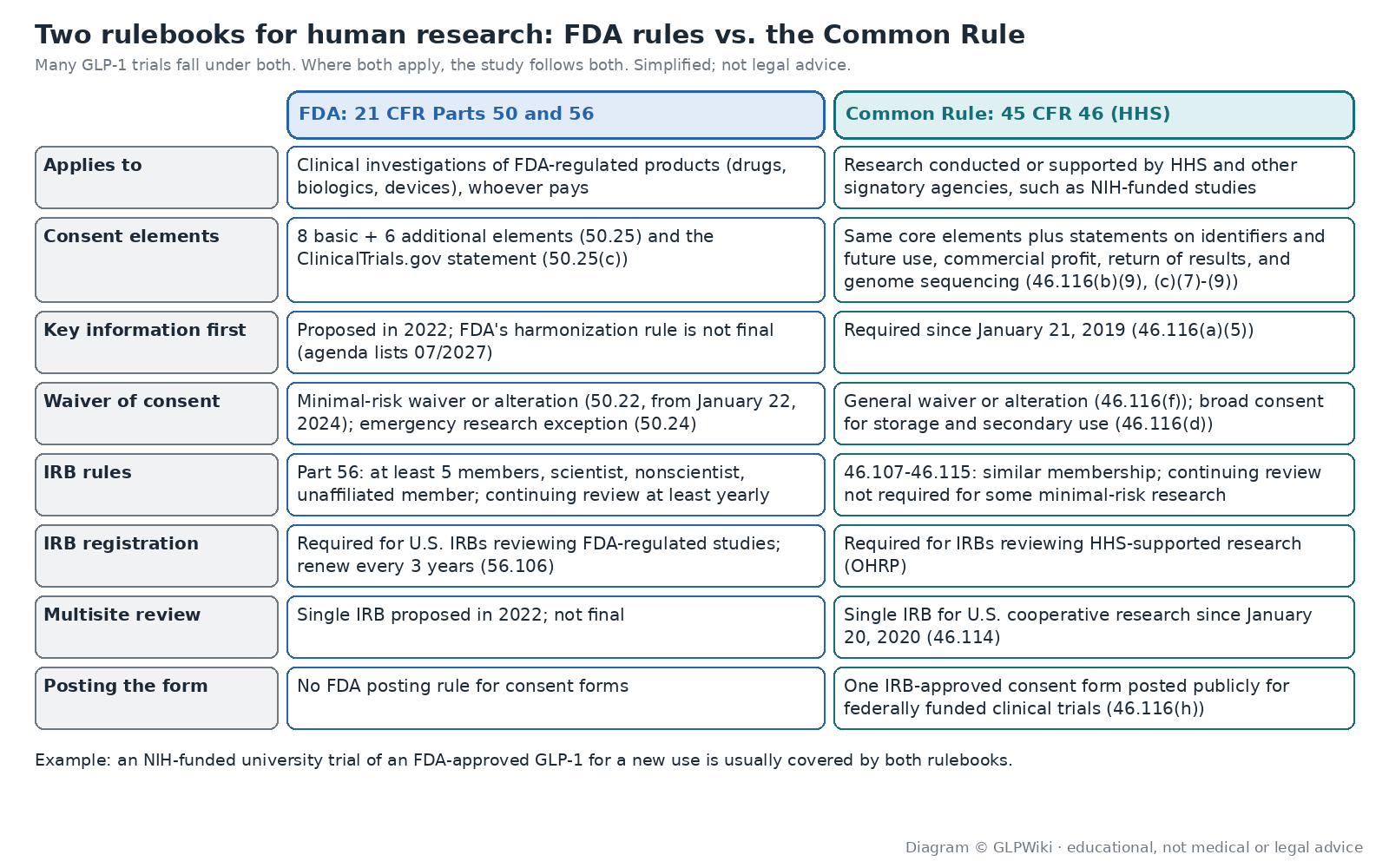
U.S. human-research protections come from two overlapping sets of federal rules. FDA's rules, 21 CFR Part 50 (protection of human subjects, including informed consent) and 21 CFR Part 56 (institutional review boards), apply to clinical investigations of products FDA regulates, such as drugs, biologics and devices, whoever pays for the study (21 CFR 50.1). The Federal Policy for the Protection of Human Subjects, known as the Common Rule and codified for HHS at 45 CFR 46 subpart A, applies to research conducted or supported by HHS and the other signatory departments and agencies, such as studies funded by the National Institutes of Health.
Both trace back to the 1979 Belmont Report's three principles: respect for persons, beneficence and justice. HHS notes that FDA is not considered a Common Rule agency because its regulations differ, but that the 21st Century Cures Act requires FDA to harmonize with the Common Rule where permitted by law.
Many GLP-1 studies fall under both rulebooks at once. An NIH-funded university trial testing an approved GLP-1 medicine for a new use is FDA-regulated because it studies a drug, and Common Rule research because federal money supports it. When both apply, the study must meet both.
What has changed recently
The Common Rule was substantially revised in 2017. Its general compliance date was January 21, 2019, and its single-IRB requirement for U.S. cooperative research took effect on January 20, 2020 (45 CFR 46.101(l)). On September 28, 2022 FDA proposed two rules to harmonize with it, one on human-subject protections and IRBs and one on single-IRB review. Neither is final as of this review: the federal regulatory agenda projects final action in July 2027 for the first (a long-term action) and December 2026 for the second.
One piece of harmonization is already in force. FDA's final rule of December 21, 2023 added 21 CFR 50.22, effective January 22, 2024, which lets an IRB waive or alter informed consent for FDA-regulated clinical investigations that involve no more than minimal risk, if the IRB finds and documents five criteria. That exception is designed for studies such as some records-based research, not for drug-treatment trials where people receive an investigational product.
What informed consent requires beyond a signature
The core rule for FDA-regulated studies is 21 CFR 50.20. Except for narrow exceptions, no investigator may involve a person in research unless the investigator has obtained the legally effective informed consent of that person or their legally authorized representative. The rule then sets four conditions on how consent is sought: there must be sufficient opportunity to consider whether to take part; the circumstances must minimize the possibility of coercion or undue influence; the information must be in language understandable to the person; and no consent, oral or written, may include exculpatory language that waives or appears to waive the subject's legal rights or releases the investigator, sponsor or institution from liability for negligence. The Common Rule (45 CFR 46.116(a)) adds that people must get the information a reasonable person would want, with a chance to discuss it.
FDA's August 2023 informed consent guidance, which replaced its 1998 "Guide to Informed Consent," stresses that consent is often wrongly viewed as synonymous with signing the form. It describes consent as adequate information, help understanding it, time to ask questions and consider, voluntary agreement, and continued information as the study goes on. HHS's FAQs add that the process begins with the first contact, including a flyer or advertisement.
Investigators are personally responsible. Under 21 CFR 312.60, a drug investigator must obtain the informed consent of each person to whom the drug is administered, in accordance with Part 50, and must protect the rights, safety and welfare of the people in their care.
How consent is documented
Under 21 CFR 50.27, consent is normally documented with a written consent form approved by the IRB and signed and dated by the subject or the legally authorized representative at the time of consent, and a copy must be given to the person signing. FDA's guidance recommends giving a copy of the signed form, although the rule requires only a copy. There are two formats. The long form contains all the required elements and may be read aloud, but the person must have the chance to read it before signing. The short form states that the elements were presented orally; it requires a witness to the oral presentation and an IRB-approved written summary, and the subject receives copies of both.
For people who do not read English well, FDA recommends that IRBs approve procedures ensuring qualified translations and available interpreters. The guidance also covers low literacy, disabilities, impaired consent capacity and electronic consent.
The required elements of a consent form (21 CFR 50.25)
Section 50.25(a) lists eight basic elements that must be given to every subject in an FDA-regulated study. Section 50.25(b) lists six additional elements that must be given "when appropriate." A typical consent form for a drug trial covers all of them under plain-language headings, and the diagram below shows where each usually sits.
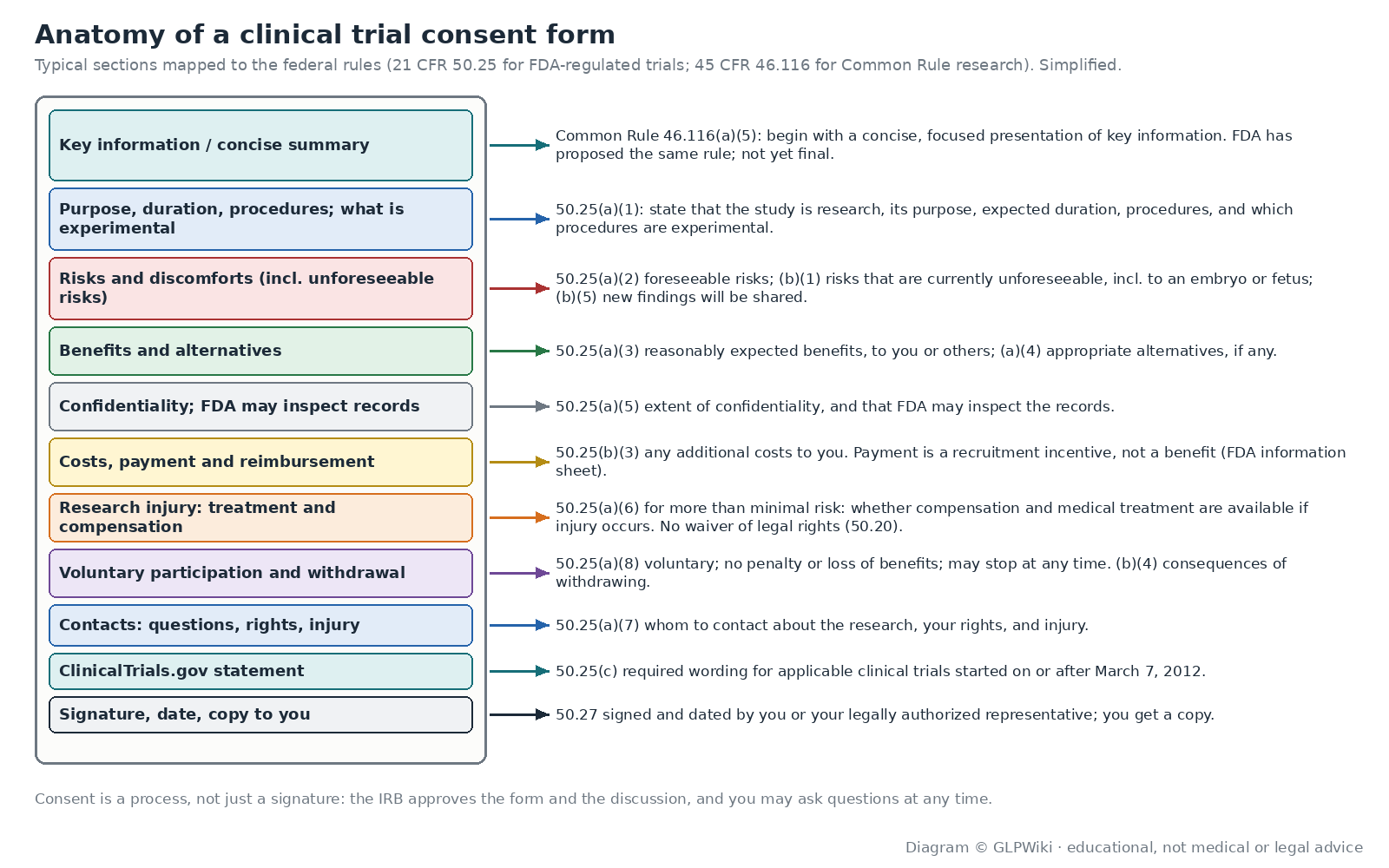
- Research, purpose, duration and procedures (50.25(a)(1)): a statement that the study involves research, why it is being done, how long participation lasts, what will happen, and which procedures are experimental.
- Risks and discomforts (50.25(a)(2)): any reasonably foreseeable risks or discomforts.
- Benefits (50.25(a)(3)): any benefits to the subject or to others that may reasonably be expected. Many forms say plainly that you may not benefit directly.
- Alternatives (50.25(a)(4)): appropriate alternative procedures or treatments, if any, that might be advantageous.
- Confidentiality (50.25(a)(5)): how far records that identify you will be kept confidential, including that FDA may inspect the records.
- Injury (50.25(a)(6)): for research involving more than minimal risk, whether any compensation and medical treatment are available if injury occurs, what they consist of, or where to get more information.
- Contacts (50.25(a)(7)): whom to contact with questions about the research, about your rights as a research subject, and in the event of a research-related injury.
- Voluntariness (50.25(a)(8)): participation is voluntary, refusing involves no penalty or loss of benefits you are otherwise entitled to, and you may stop at any time without penalty or loss of benefits.
- Additional elements when appropriate (50.25(b)): risks that are currently unforeseeable, including to an embryo or fetus; circumstances in which the investigator may end your participation without your consent; additional costs to you; consequences of withdrawing and how to stop in an orderly way; a promise to share significant new findings that may affect your willingness to continue; and the approximate number of subjects.
- ClinicalTrials.gov statement (50.25(c)): for applicable clinical trials, a fixed statement that "A description of this clinical trial will be available on http://www.ClinicalTrials.gov, as required by U.S. Law," that the site will not include information that can identify you, and that at most it will include a summary of the results. FDA's guidance says this applies to applicable clinical trials initiated on or after March 7, 2012; the statement is not required in a child's assent document.
Extra elements under the Common Rule
The Common Rule's list in 45 CFR 46.116(b) and (c) mirrors FDA's and adds four items often seen in NIH-funded forms: whether de-identified information or biospecimens may be used for future research without further consent; whether biospecimens may be used for commercial profit and whether you will share in it; whether clinically relevant results will be returned to you; and whether whole genome sequencing will or might be done. FDA's own rule does not currently require those four statements, although an IRB may require additional information when it judges it would meaningfully add to subject protection (21 CFR 56.109(b)).
Neither rulebook overrides state or local laws that require more disclosure for consent to be legally effective (21 CFR 50.25(d); 45 CFR 46.116(i)).
The key information section and why forms are hard to read
Since January 21, 2019, consent for Common Rule research must begin with "a concise and focused presentation of the key information that is most likely to assist a prospective subject or legally authorized representative in understanding the reasons why one might or might not want to participate in the research," organized to facilitate comprehension, and the form as a whole must not merely provide lists of isolated facts (45 CFR 46.116(a)(5)). FDA's 2022 proposed rule would add identical language to Part 50, and FDA and OHRP issued a joint draft guidance in March 2024 on key information and facilitating understanding. It recommends that the key information section generally be no more than a few pages and includes a sample key information section for a hypothetical trial. Draft guidance is not binding.
In practice this section often appears under headings such as "Concise Summary" or "Key Information." A 2023 study of 102 consent forms posted on ClinicalTrials.gov found identifiable key information sections in 76, averaging about 10% of the full form's length. Their readability grade level was not notably different from the rest of the form, and most covered a subset of the basic consent elements.
Readability is a long-standing problem. A 2003 New England Journal of Medicine study of 114 U.S. medical school IRB websites found that the sample text in IRB consent templates averaged a 10.6 grade level on the Flesch-Kincaid scale, exceeding the IRBs' own stated readability standards by 2.8 grade levels on average. A 2021 analysis of the consent documents for four large COVID-19 vaccine trials found they averaged 8,333 words, about 35 minutes to read, and all exceeded grade 9 language complexity; the authors showed a document of fewer than 3,000 words at a grade 7 to 8 reading level was possible.
Reading the risk, cost, payment, injury and voluntariness sections
The examples below come from a real posted consent form, the University of North Carolina's NIH-funded Phase 2 study of semaglutide for alcohol use disorder (ClinicalTrials.gov NCT05520775), version dated February 9, 2023. It illustrates structure only; the study is completed.
Risks, new findings and the unknown
The risk section must describe foreseeable risks (50.25(a)(2)) and, when appropriate, currently unforeseeable risks, including to an embryo or fetus (50.25(b)(1)). For GLP-1 studies it usually separates side effects of the study drug, discomforts from study procedures such as blood draws, and risks of anything else the protocol requires. The UNC form's concise summary lists examples from all three groups, including medication side effects such as nausea.
Two related promises matter later. Under 50.25(b)(5), the form must say, when appropriate, that significant new findings that may affect your willingness to continue will be shared. FDA's guidance gives examples such as an unexpected adverse event or an adverse event occurring more often or more severely than stated.
Benefits, alternatives and the therapeutic misconception
Research answers a question; it is not individualized care. FDA's guidance says forms should explain research-only procedures such as protocol-driven rather than individualized dosing, randomized assignment, blinding and receiving a placebo. In 1987 Appelbaum and colleagues described the "therapeutic misconception": even participants who understand randomization and placebos often believe the protocol was designed to benefit them personally. A 2015 meta-analysis of 103 studies found that only 52.1% of participants understood randomization and 53.3% understood placebo, compared with about 75% who understood that they could withdraw at any time. Reading the benefits and alternatives sections together is one way to keep the difference between research and treatment clear.
Costs to you
Section 50.25(b)(3) requires disclosure of any additional costs that may result from participation. FDA's guidance says that beyond direct study costs it may be appropriate to identify indirect costs such as time off from work, child or elder care and transportation, and to describe the protocol in enough detail, such as the number and length of visits, for a person to estimate them. The UNC form, for example, notes possible transportation costs.
Payment and reimbursement
FDA's information sheet on payment and reimbursement says paying research subjects is common and generally acceptable, but that payment "is not considered a benefit"; it is a recruitment incentive and should not be weighed against risks. FDA does not consider reimbursement for travel and associated costs such as parking and lodging to raise undue-influence concerns. Payment should accrue as the study progresses rather than depend entirely on completion, and a small completion bonus is acceptable if it is not so large that it unduly induces people to stay when they would otherwise withdraw. The IRB reviews the amount, method and timing of payment.
The UNC form shows what this looks like in practice: it states that participants are paid in cash, lists a total possible amount of $1,000 broken down by study visit and task, and includes a $100 completion bonus paid at the final visit. Legal scholars Largent and Fernandez Lynch have described the rules on payment as offering relatively little concrete direction.
Research injury and exculpatory language
For studies with more than minimal risk, the form must say whether compensation and medical treatment are available if injury occurs (50.25(a)(6)). It does not have to promise either. Many academic forms say the institution will not pay for research injuries. The UNC form says the researcher will help you get medical care but that the university has not set aside funds to pay for research injuries or the related care, which will be billed to you or your insurer, and then states that signing does not give up your right to seek payment or your other rights.
That last sentence reflects 21 CFR 50.20's ban on exculpatory language. FDA's guidance gives examples that cannot appear in a consent form, such as "I waive any possibility of compensation, including any right to sue for injuries," and examples that are acceptable, such as a statement that you do not give up any legal rights by taking part.
Voluntariness, withdrawal and your data
The form must say that participation is voluntary, that refusing involves no penalty or loss of benefits, and that you may stop at any time (50.25(a)(8)). FDA's guidance says language that limits the right to decline or withdraw must not be used, and that if special procedures are needed to withdraw safely, the form must explain them (50.25(b)(4)). The investigator may also end your participation for reasons the form must describe when appropriate (50.25(b)(2)).
Withdrawal does not erase what was already collected. FDA's guidance says that for drug and device studies under an IND or IDE, data collected up to the time of withdrawal must remain in the study database, because removing them would undermine the study's scientific validity and safety analysis. FDA recommends that consent documents tell subjects this, and the UNC form does so in its withdrawal section.
Confidentiality
The confidentiality section must say how far identifying records will be kept confidential and that FDA may inspect the records (50.25(a)(5)). NIH-funded forms often also describe a Certificate of Confidentiality, which limits compelled disclosure of identifiable research information; the UNC form explains its certificate and its stated exceptions, such as reporting required by law. A confidentiality section is a description of protections, not a guarantee of anonymity.
What an IRB is and what it must do (21 CFR Part 56)
Under 21 CFR 56.103, a clinical investigation that requires prior submission to FDA, such as a drug study under an IND, may not begin unless an IRB that meets Part 56 has reviewed and approved it, and it must remain under continuing IRB review. FDA may refuse to consider data from a study that lacked IRB review. The investigator must assure that a compliant IRB is responsible for initial and continuing review, report all changes and unanticipated problems to the IRB, and make no changes without IRB approval except to eliminate apparent immediate hazards (21 CFR 312.66).
Who sits on an IRB
Section 56.107 requires at least five members with varying backgrounds and enough expertise and diversity to promote respect for the board's advice. An IRB may not consist entirely of members of one profession. It must include at least one member whose primary concerns are scientific, at least one whose primary concerns are nonscientific, and at least one member who is not otherwise affiliated with the institution and is not an immediate family member of someone who is. No member may take part in reviewing a project in which they have a conflicting interest, except to provide requested information. FDA's IRB FAQs confirm that a clinical investigator may be an IRB member but may not take part in reviewing their own study.
How decisions are made
Except under expedited review, proposals are reviewed at convened meetings where a majority of members are present, including at least one nonscientist, and approval requires a majority of those present (21 CFR 56.108(c)). The IRB may approve, require modifications to, or disapprove research, must explain a disapproval in writing, and must conduct continuing review at intervals appropriate to the risk but not less than once per year (21 CFR 56.109). It also has the authority to observe, or have a third party observe, the consent process. Expedited review by the chair or designated members is limited to listed minimal-risk categories and minor changes (21 CFR 56.110).
Before approving, the IRB must determine that all of the criteria in 21 CFR 56.111 are met:
- Risks to subjects are minimized, using procedures consistent with sound research design.
- Risks are reasonable in relation to anticipated benefits, if any, and the importance of the knowledge expected.
- Selection of subjects is equitable, with particular attention to vulnerable populations.
- Informed consent will be sought from each prospective subject or their legally authorized representative as Part 50 requires.
- Informed consent will be appropriately documented as 50.27 requires.
- Where appropriate, the research plan makes adequate provision for monitoring the data to ensure subject safety.
- Where appropriate, there are adequate provisions to protect privacy and maintain confidentiality.
Oversight after approval
Unanticipated problems involving risks and serious or continuing noncompliance must be reported promptly to the IRB, institutional officials and FDA (21 CFR 56.108(b)). An IRB may suspend or terminate approval of research not conducted as required or associated with unexpected serious harm, and must report its reasons to FDA (21 CFR 56.113). It keeps records including approved consent documents and minutes showing attendance, actions and votes (21 CFR 56.115).
An IRB is not a data monitoring committee, which many large GLP-1 trials also have to review unblinded safety data; ClinicalTrials.gov shows this in a yes/no "Data Monitoring Committee" field. The IRB protects participants' rights and welfare; it does not run the study or guarantee its safety.
IRB registration, local and central IRBs
Since 2009, each IRB in the United States that reviews clinical investigations regulated by FDA under an IND or IDE, or studies intended to support FDA applications, must register at an HHS-maintained site (21 CFR 56.106). Registration lists the institution, the IRB's contacts and chair, its approximate number of active FDA-regulated protocols and the product types it reviews. It must occur before the IRB begins reviewing such studies and be renewed every three years, and some changes must be reported within 30 or 90 days.
IRBs that review HHS-supported research register with HHS's Office for Human Research Protections (OHRP), and OHRP's public database lists registered IRB organizations and IRBs registered with OHRP only, with both OHRP and FDA, or with FDA only. OHRP is explicit that registration does not mean it has determined the IRB reviews research in accordance with the regulations, or that the IRB has the competence or expertise to review a particular project; it means the required registration information was provided.
An IRB need not belong to the study site: FDA's IRB FAQs note that institutions without an IRB may use an outside IRB, and independent IRBs are common. FDA's guidance on centralized IRB review describes how multicenter trials can use a single central IRB for many sites, with local IRBs either relying on it or keeping some responsibilities. Under the Common Rule, U.S. institutions engaged in federally supported cooperative research must rely on a single IRB for the U.S. portion, with limited exceptions (45 CFR 46.114); FDA's equivalent single-IRB rule is still proposed.
Children, representatives and exceptions
Consent rules change for children, and several GLP-1 studies have enrolled adolescents. Under Part 50 subpart D, parents' or guardians' permission is required, and the IRB must determine that adequate provisions are made for soliciting the child's assent when the child is capable of providing it, taking into account age, maturity and psychological state (21 CFR 50.55). Assent means "a child's affirmative agreement to participate"; mere failure to object is not assent (21 CFR 50.3(n)). For studies with more than minimal risk that offer the prospect of direct benefit, the IRB must also find that the risk is justified by the anticipated benefit and that the balance is at least as favorable as available alternatives (21 CFR 50.52). FDA's pediatric ethics guidance describes these safeguards.
For example, the University of Minnesota's completed Phase 2 study of lifestyle counseling and medication for adolescent weight management (NCT04873245) enrolled participants aged 12 to 17 and has its consent form posted on ClinicalTrials.gov.
Adults who cannot consent for themselves may take part only through a legally authorized representative, defined as an individual or body authorized under applicable law to consent on the person's behalf (21 CFR 50.3(l)); who qualifies depends on state law. Two narrow exceptions allow research without prospective individual consent: the minimal-risk waiver in 50.22 and the emergency research exception in 50.24, which requires that subjects face a life-threatening situation, cannot consent because of their condition, among other safeguards documented by the IRB and an independent physician. Neither applies to a typical obesity or diabetes drug trial.
ClinicalTrials.gov record vs. the consent document
A ClinicalTrials.gov record and a consent form describe the same study for different audiences. The registry record is a public summary from the sponsor or investigator: design, arms, eligibility, outcomes, sponsor, locations, status, oversight fields such as FDA-regulated drug and data monitoring committee, and later results. The consent document is the IRB-approved agreement used at a site: visits, procedures, risks, costs, payment, injury terms, confidentiality, withdrawal and contacts, often with site-specific language.
Consent forms are usually not public. ClinicalTrials.gov allows a document section where a responsible party can upload the protocol, statistical analysis plan and informed consent form. Among the 1,510 semaglutide, tirzepatide or liraglutide records found on November 15, 2026, the registry's own filter returned 33 with a posted consent form, mostly from academic investigators. Lilly's SURMOUNT-1 tirzepatide trial (NCT04184622), for example, has a posted protocol and statistical analysis plan but no consent form.
For clinical trials conducted or supported by a federal department or agency, the Common Rule requires one IRB-approved consent form used to enroll subjects to be posted on a publicly available federal website after recruitment closes and no later than 60 days after the last study visit (45 CFR 46.116(h)), and OHRP publishes instructions for meeting that requirement. Some NIH-funded GLP-1 studies, such as the UNC semaglutide study (NCT05520775) and the GRADE diabetes comparative effectiveness study (NCT01794143), which included liraglutide, show an "Informed Consent Form" document on ClinicalTrials.gov. FDA's rules contain no equivalent posting requirement.
How to use the two together
A posted consent form is one historical version; forms change during a study and differ between sites. The registry shows eligibility and arms but not payment, costs or injury terms, and neither document replaces the consent discussion. The ClinicalTrials.gov guide explains each record field.
What research shows about understanding consent
Consent forms meet legal requirements more reliably than they achieve understanding. The 2015 meta-analysis of 103 studies covering 135 cohorts found that pooled understanding ranged from 75.8% for the freedom to withdraw down to about 52% to 53% for randomization and placebo, that 54.9% of participants could name at least one risk, and that understanding had not increased over 30 years. A 2021 systematic review of 14 studies similarly found low comprehension of placebo, randomization and risks.
Some interventions help. A 2004 JAMA systematic review found that extended discussion with a study team member was among the more effective approaches, while multimedia and enhanced forms showed mixed results. A 2013 meta-analysis of 54 interventions found significant improvements for enhanced consent forms and extended discussions, and no negative effect on satisfaction or enrollment. Emanuel, Wendler and Grady have argued that consent is neither necessary nor sufficient on its own: ethical research also needs value, validity, fair subject selection, a favorable risk-benefit ratio, independent review and respect for participants.
Limits of this guide
Regulations describe minimum content, not quality, and do not set payment amounts or injury coverage. Few GLP-1 trial records include a consent form, posted forms are single versions, and IRB minutes are not public. Rules outside the United States are beyond this guide's scope.
Reader checklist: questions to ask about a consent form
These educational questions follow the required elements; the study team should answer them before you sign.
- Which rules apply? Is the drug FDA-regulated, and is the study federally funded? The ClinicalTrials.gov record's oversight and sponsor fields help.
- Is there a key information or concise summary section, and does it explain why someone might or might not want to join?
- What exactly is experimental, and is there a placebo or randomization? What does the form say about alternatives?
- What are the foreseeable risks, and how will new findings be shared?
- What will it cost me, including travel, time and routine care billed to insurance? How and when is payment made, and is any part tied to completion?
- What happens if I am injured: who pays for treatment, and whom do I call?
- How do I withdraw, what happens to my data and samples, and can the investigator end my participation?
- Which IRB approved the study, and how can I contact it about my rights? Is the form's version date current?
Scope, disclaimer and review date
This guide is educational. It explains U.S. informed consent and IRB rules using federal regulations, FDA and HHS guidance, ClinicalTrials.gov records and peer-reviewed research. It is not medical advice, not legal advice and not a recommendation to join, avoid or evaluate any particular study or medicine. It contains no doses or treatment instructions. Consent forms quoted here are used only to illustrate structure. Regulations and guidance change; check the current eCFR text, FDA guidance and the study team for anything that affects a real decision.
Last reviewed: November 15, 2026.
Frequently asked questions
- Does IRB approval mean a clinical trial is safe?
- No. IRB approval means the board found that risks are minimized and reasonable in relation to anticipated benefits, that subject selection is equitable, and that consent will be properly sought and documented (21 CFR 56.111). All research carries risk, and the IRB continues to review the study at least once a year.
- Does signing a consent form give up my right to sue?
- No. Federal rules ban exculpatory language that waives or appears to waive a subject's legal rights or releases the investigator, sponsor or institution from liability for negligence (21 CFR 50.20). A form may say that the study will not pay for injuries, but not that you give up your rights.
- Can I leave a study after I sign?
- Yes. Participation is voluntary and you may stop at any time without penalty or loss of benefits you are otherwise entitled to (21 CFR 50.25(a)(8)). The form should explain any steps needed to stop safely. Under FDA rules, data collected before withdrawal remain in the study database.
- Is payment for joining a trial considered a benefit?
- No. FDA says payment is a recruitment incentive, not a benefit to be weighed against risks. Reimbursement for travel and lodging is treated differently, and FDA accepts a small completion bonus if it is not coercive. The IRB reviews payment amounts and timing.
- What is the difference between the Common Rule and FDA's consent rules?
- FDA's Parts 50 and 56 cover studies of FDA-regulated products; the Common Rule (45 CFR 46) covers federally funded research. They share core consent elements, but the Common Rule adds a required key-information summary and four extra disclosures. FDA proposed harmonizing in 2022; that rule is not yet final.
- Why does my consent form mention ClinicalTrials.gov?
- For applicable clinical trials, 21 CFR 50.25(c) requires a fixed statement that a description of the trial will be available on ClinicalTrials.gov, that the site will not include information that can identify you, and that at most it will include a summary of the results.
- Who is on an IRB?
- At least five members with varied backgrounds, including at least one scientist, one nonscientist and one person not otherwise affiliated with the institution. No IRB may consist entirely of one profession, and members with a conflicting interest may not take part in reviewing that study (21 CFR 56.107).
- Can I read a trial's consent form before contacting the study?
- Sometimes. Federally funded trials must post one IRB-approved consent form on a public federal website after recruitment closes, and some appear in ClinicalTrials.gov's document section. Most industry trials do not post them, so the study team is usually the source.
SOURCES
- 0121 CFR 50.1 – Scope (protection of human subjects)— eCFR
- 0221 CFR 50.3 – Definitions (minimal risk, legally authorized representative, assent)— eCFR
- 0321 CFR 50.20 – General requirements for informed consent— eCFR
- 0421 CFR 50.22 – Exception from informed consent for minimal risk clinical investigations— eCFR
- 0521 CFR 50.24 – Exception from informed consent requirements for emergency research— eCFR
- 0621 CFR 50.25 – Elements of informed consent— eCFR
- 0721 CFR 50.27 – Documentation of informed consent— eCFR
- 0821 CFR 50.52 – Pediatric investigations with greater than minimal risk and prospect of direct benefit— eCFR
- 0921 CFR 50.55 – Parental permission and child assent— eCFR
- 1021 CFR 56.103 – Circumstances in which IRB review is required— eCFR
- 1121 CFR 56.106 – IRB registration— eCFR
- 1221 CFR 56.107 – IRB membership— eCFR
- 1321 CFR 56.108 – IRB functions and operations— eCFR
- 1421 CFR 56.109 – IRB review of research— eCFR
- 1521 CFR 56.110 – Expedited review procedures— eCFR
- 1621 CFR 56.111 – Criteria for IRB approval of research— eCFR
- 1721 CFR 56.113 – Suspension or termination of IRB approval— eCFR
- 1821 CFR 56.115 – IRB records— eCFR
- 1921 CFR 312.60 – General responsibilities of investigators— eCFR
- 2021 CFR 312.66 – Assurance of IRB review— eCFR
- 2145 CFR 46.101 – Common Rule applicability and compliance dates— eCFR
- 2245 CFR 46.114 – Cooperative research (single IRB)— eCFR
- 2345 CFR 46.116 – General requirements for informed consent (Common Rule)— eCFR
- 24Informed Consent: Guidance for IRBs, Clinical Investigators, and Sponsors (August 2023)— U.S. Food and Drug Administration
- 25Key Information and Facilitating Understanding in Informed Consent (draft guidance)— U.S. Food and Drug Administration
- 26Payment and Reimbursement to Research Subjects (information sheet)— U.S. Food and Drug Administration
- 27Institutional Review Boards Frequently Asked Questions (information sheet)— U.S. Food and Drug Administration
- 28Using a Centralized IRB Review Process in Multicenter Clinical Trials (guidance)— U.S. Food and Drug Administration
- 29Exception from Informed Consent Requirements for Emergency Research (guidance)— U.S. Food and Drug Administration
- 30Ethical Considerations for Clinical Investigations of Medical Products Involving Children (guidance)— U.S. Food and Drug Administration
- 31IRB Waiver or Alteration of Informed Consent for Minimal Risk Clinical Investigations (final rule, Dec 21, 2023)— Federal Register
- 32Protection of Human Subjects and Institutional Review Boards (proposed rule, Sep 28, 2022)— Federal Register
- 33Institutional Review Boards; Cooperative Research (proposed rule, Sep 28, 2022)— Federal Register
- 34Federal Policy for the Protection of Human Subjects (revised Common Rule, Jan 19, 2017)— Federal Register
- 35Unified Agenda 0910-AI07: Protection of Human Subjects and IRBs— Reginfo.gov (OMB/OIRA)
- 36Unified Agenda 0910-AI08: Institutional Review Boards; Cooperative Research— Reginfo.gov (OMB/OIRA)
- 37Federal Policy for the Protection of Human Subjects ('Common Rule')— HHS Office for Human Research Protections
- 38The Belmont Report— HHS Office for Human Research Protections
- 39Informed Consent FAQs— HHS Office for Human Research Protections
- 40Informed Consent Posting (45 CFR 46.116(h))— HHS Office for Human Research Protections
- 41IRB Registration— HHS Office for Human Research Protections
- 42Search registered IRB organizations and IRBs (OHRP database)— HHS Office for Human Research Protections
- 43NCT05520775 – Semaglutide for Alcohol Use Disorder (UNC; consent form posted)— ClinicalTrials.gov
- 44NCT05520775 informed consent form (version Feb 9, 2023)— ClinicalTrials.gov
- 45NCT04873245 – Lifestyle Counseling and Medication for Adolescent Weight Management— ClinicalTrials.gov
- 46NCT01794143 – GRADE: A Comparative Effectiveness Study of Major Glycemia-lowering Medications for Treatment of Type 2 Diabetes— ClinicalTrials.gov
- 47NCT04184622 – SURMOUNT-1: Tirzepatide in Participants With Obesity or Overweight— ClinicalTrials.gov
- 48Tam NT et al. Participants' understanding of informed consent in clinical trials over three decades: systematic review and meta-analysis. Bull World Health Organ. 2015— PubMed
- 49Pietrzykowski T, Smilowska K. The reality of informed consent: empirical studies on patient comprehension, systematic review. Trials. 2021— PubMed
- 50Flory J, Emanuel E. Interventions to improve research participants' understanding in informed consent for research: a systematic review. JAMA. 2004— PubMed
- 51Nishimura A et al. Improving understanding in the research informed consent process: a systematic review of 54 interventions. BMC Med Ethics. 2013— PubMed
- 52Paasche-Orlow MK et al. Readability standards for informed-consent forms as compared with actual readability. N Engl J Med. 2003— PubMed
- 53Emanuel EJ, Boyle CW. Assessment of length and readability of informed consent documents for COVID-19 vaccine trials. JAMA Netw Open. 2021— PubMed
- 54Gelinas L et al. Characterization of key information sections in informed consent forms posted on ClinicalTrials.gov. J Clin Transl Sci. 2023— PubMed
- 55Appelbaum PS et al. False hopes and best data: consent to research and the therapeutic misconception. Hastings Cent Rep. 1987— PubMed
- 56Largent EA, Fernandez Lynch H. Paying research participants: regulatory uncertainty, conceptual confusion, and a path forward. Yale J Health Policy Law Ethics. 2017— PubMed
- 57Emanuel EJ, Wendler D, Grady C. What makes clinical research ethical? JAMA. 2000— PubMed
EDUCATIONAL REFERENCE ONLY · Not medical advice. Nothing here diagnoses, treats, cures or prevents any disease, and nothing here is a dosing recommendation. Consult a licensed clinician before any treatment decision.