IND and expanded access literacy: how investigational drugs reach people through trials, clinical holds, compassionate use and Right to Try, and why investigational GLP-1 medicines are not sold

Before a GLP-1 or obesity medicine is approved, the only lawful ways for a person to receive it in the United States run through FDA's investigational new drug (IND) system: a clinical trial, an expanded access ("compassionate use") request, or the narrower federal Right to Try pathway. This guide explains what an IND is, the 30-day wait and clinical holds, what the trial phases and end-of-phase-2 meetings mean, how the three kinds of expanded access work, how Right to Try differs, how to read an expanded access record on ClinicalTrials.gov (using Lilly's retatrutide record as the example), and why none of these routes involves buying an investigational drug online. Educational only: no doses, no treatment advice, no product picks and no legal advice.
UPDATED 14 NOV 2026 · 28 MIN READ
KEY TAKEAWAYS
- An investigational new drug application (IND) is the FDA filing that lets an unapproved drug be given to people in a clinical investigation (21 CFR Part 312). It is not an approval and it is not a license to sell.
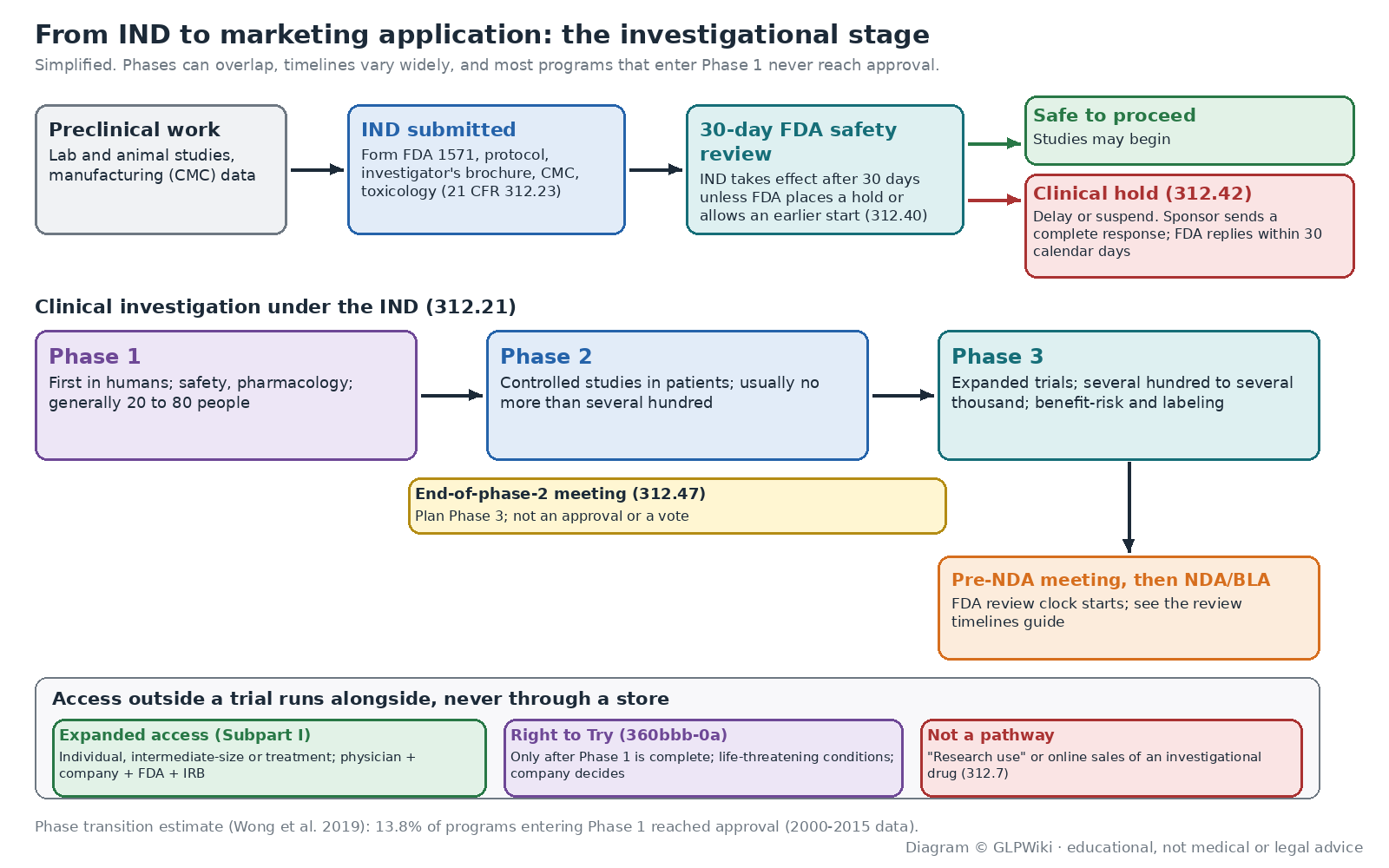
- An IND goes into effect 30 days after FDA receives it unless FDA places it on clinical hold or lets it start earlier (21 CFR 312.40). A clinical hold delays or suspends a study; FDA must answer a sponsor's complete response to a hold within 30 calendar days (21 CFR 312.42).
- Phase 1, 2 and 3 describe the purpose and size of studies, not a promise of approval. One large analysis estimated that 13.8% of drug development programs that enter Phase 1 eventually reach approval.
- Expanded access, often called compassionate use, is a regulated way for patients with a serious or immediately life-threatening condition and no comparable alternative to receive an investigational drug outside a trial. It comes in three sizes: individual patient (including emergency), intermediate-size population, and treatment IND or protocol (21 CFR 312.305 to 312.320).
- Expanded access needs a licensed physician, the company's agreement to supply the drug, FDA authorization, informed consent and IRB review. FDA cannot make a company provide its drug, and FDA allows the vast majority of requests it receives to proceed.
- The federal Right to Try Act (May 30, 2018; 21 U.S.C. 360bbb-0a) is a separate, narrower path for patients with a life-threatening condition who have exhausted approved options and cannot join a trial. FDA does not review or approve Right to Try requests; the company still decides.
- On ClinicalTrials.gov, an expanded access record has its own study type and status values (Available, No longer available, Temporarily not available, Approved for marketing). An "Available" record is not an approval, a sign-up page or a supply source.
- Investigational drugs may not be commercially distributed or promoted as safe or effective (21 CFR 312.7). An investigational GLP-1 sold as a "research" vial is not expanded access, not Right to Try and not part of any IND.
Why this matters for GLP-1 readers
Every approved GLP-1 or obesity medicine was once an investigational drug. Semaglutide, tirzepatide and orforglipron all spent years in clinical trials under INDs before FDA approved them, and newer molecules such as retatrutide are still in that stage. Headlines about these drugs often blur the stages together. A Phase 3 result gets described as if the drug were available, a company's compassionate use program gets described as a way to "get" the drug, and online sellers use words like "research" and "trial-grade" to suggest a legitimacy they do not have.
The legal structure is simpler than the headlines suggest. In the United States, an unapproved new drug can lawfully reach a person in three ways: as a participant in a clinical investigation conducted under an IND; through FDA's expanded access program, which also runs on IND paperwork; or through the federal Right to Try pathway, which skips FDA review of the individual request but still depends on a drug that is under an active IND and on the company agreeing to provide it. All three routes run through a physician and the drug's sponsor. None of them is a retail channel.
This guide explains each piece in turn and shows how to read the public records. It builds on the approved-vs-investigational status guide and the ClinicalTrials.gov guide, and it sits alongside the FDA review timelines guide, which picks up the story once a marketing application is submitted. Nothing here is advice about whether any person should seek an investigational drug; that is a conversation for a patient and their own clinician.
What an IND is, and what it is not
Under 21 CFR 312.20, a sponsor must submit an IND before it conducts a clinical investigation with an investigational new drug, and it may not begin the investigation until the IND is in effect. FDA describes the IND as the means by which a sponsor obtains an exemption from the federal law that otherwise prohibits shipping an unapproved drug across state lines. In practice it is a large file: the cover sheet (Form FDA 1571), an investigational plan, an investigator's brochure, study protocols, chemistry, manufacturing and controls information, pharmacology and toxicology data, and any previous human experience (21 CFR 312.23).
FDA's IND page divides INDs into commercial and research (non-commercial) categories and describes three common types. An investigator IND is submitted by a physician who both initiates and conducts a study. An emergency use IND lets FDA authorize use of an experimental drug in an emergency that does not allow time for a normal submission. A fourth, the treatment IND, is part of expanded access and is covered below.
Three things an IND is not are worth stating plainly. It is not an approval: the drug's safety and effectiveness have not been established, which is the reason it is being studied. It is not a public document: under 21 CFR 312.130, FDA will not disclose that an IND exists unless it has already been publicly disclosed or acknowledged, which is why readers usually see an IND indirectly, through a ClinicalTrials.gov record or a company press release. And it is not permission to sell. Section 312.7 bars sponsors and investigators from commercially distributing or test marketing an investigational drug and from representing in a promotional context that it is safe or effective for the use under investigation, while still allowing the full exchange of scientific information.
When an approved drug needs an IND
A study of an already-marketed drug can be exempt from the IND rules, but only if every condition in 21 CFR 312.2(b) is met: the study is not meant to support a new indication or a significant labeling or advertising change, it does not use a route, dosage level or population that significantly increases risk, and it follows the IRB, informed consent and promotion rules. This is why many academic studies of approved GLP-1 medicines in new populations still carry an IND, and why "FDA-regulated drug" appears on their ClinicalTrials.gov records.
The 30-day wait and clinical holds
Under 21 CFR 312.40, an IND goes into effect 30 days after FDA receives it, unless FDA notifies the sponsor that the proposed studies are on clinical hold, or earlier if FDA says the studies may begin. The sponsor may not give the drug to people, and may not ship it to investigators, until then. In everyday regulatory language, a study that clears this window is "safe to proceed." Those 30 days are a safety review of the first proposed study, not an evaluation of whether the drug works.
A clinical hold is "an order issued by FDA to the sponsor to delay a proposed clinical investigation or to suspend an ongoing investigation" (21 CFR 312.42). When a proposed study is on hold, no one may be given the drug. When an ongoing study is put on hold, no new participants may start, and people already enrolled are generally taken off the drug unless FDA specifically allows them to continue in the interest of their safety. A hold can cover one study or every study under the IND.
Grounds for a hold
For a Phase 1 study, the grounds include that participants would be exposed to an unreasonable and significant risk of illness or injury, that the investigators are not qualified, that the investigator's brochure is misleading, erroneous or materially incomplete, or that the IND lacks enough information to assess risk. For Phase 2 and 3 studies, FDA can also hold a study whose protocol is "clearly deficient in design to meet its stated objectives." Separate grounds apply to expanded access protocols and to studies that are not designed to be adequate and well-controlled; for example, FDA can hold them if they interfere with enrollment in a controlled trial or if supply is too limited to run both.
How a hold ends
FDA's procedures say the agency will usually try to discuss and resolve a deficiency with the sponsor before issuing a hold, unless participants face immediate and serious risk. The hold order is typically issued by or on behalf of the review division director and explains the deficiencies. The sponsor answers with a complete response, and FDA must reply in writing within 30 calendar days, either removing or maintaining the hold. A company announcing that a hold was "lifted" is reporting that outcome. The announcement does not mean the drug was found effective.
How often holds happen
Published FDA analyses give a sense of scale. In a review of CDER's experience from 2005 to 2014, Jarow and colleagues reported that 7.9% of commercial investigational drug development programs were placed on clinical hold at some point. An FDA analysis of new commercial oncology INDs found that fewer than 10% went on hold or were withdrawn within the 30-day safety review, mostly for clinical deficiencies, followed by product quality and nonclinical issues, and that holds were concentrated in first-in-human studies and sponsors with limited regulatory experience. Those figures come from particular periods and divisions and should not be read as the odds for any specific drug.
Trial phases and the meetings between them
21 CFR 312.21 divides the clinical investigation of a previously untested drug into three phases that are "in general" sequential but may overlap. Phase 1 is the first introduction into humans, often in healthy volunteers, focused on metabolism, pharmacology and side effects, and "generally in the range of 20 to 80" participants. Phase 2 studies are controlled studies in people with the condition, usually involving "no more than several hundred" participants, to evaluate effectiveness and short-term risks. Phase 3 studies are expanded controlled and uncontrolled trials of "several hundred to several thousand" participants that gather the evidence needed to judge the overall benefit-risk relationship and to write labeling.
Obesity programs often run far larger than those minimums. Lilly's retatrutide program on ClinicalTrials.gov, for instance, includes a series of Phase 3 TRIUMPH studies, several already marked Completed and others Active, not recruiting, each record flagged as studying an FDA-regulated drug. A completed Phase 3 trial is a milestone, but the drug remains investigational until FDA approves a marketing application.
End-of-phase-2 and pre-NDA meetings
Section 312.47 describes formal meetings between sponsors and FDA. The end-of-phase-2 meeting is meant "to determine the safety of proceeding to Phase 3, to evaluate the Phase 3 plan and protocols" and to identify what else a marketing application will need. Pre-NDA meetings near the end of Phase 3 discuss how data will be presented. Companies sometimes mention these meetings in investor updates. They are planning conversations. They are not approvals or votes, and their minutes are generally not public.
Why most investigational drugs never reach the pharmacy
Using more than 400,000 trial records for over 21,000 compounds from 2000 to 2015, Wong, Siah and Lo estimated phase transition probabilities of 66.4% from Phase 1 to Phase 2, 58.3% from Phase 2 to Phase 3 and 59.0% from Phase 3 to approval, or 13.8% overall from Phase 1 to approval. Rates differed widely by therapeutic area. The point for readers is not the exact number but the direction: being "in trials," even late-stage trials, is not the same as being on track for approval, and promising early results are common among drugs that later fail.
Expanded access (compassionate use): the three sizes
FDA describes expanded access, "sometimes called compassionate use," as a potential pathway for a patient with a serious or immediately life-threatening disease or condition to gain access to an investigational medical product for treatment outside of clinical trials when no comparable or satisfactory alternative therapy is available. The rules are in Subpart I of Part 312, which applies when "the primary purpose is to diagnose, monitor, or treat a patient's disease or condition" rather than to answer a research question.
Before FDA can authorize any kind of expanded access, it must find all three criteria in 21 CFR 312.305(a): the patient or patients have a serious or immediately life-threatening condition with no comparable or satisfactory alternative; the potential benefit justifies the potential risks, and those risks are not unreasonable in the context of the condition; and providing the drug will not interfere with clinical investigations that could support its approval. The regulation defines a serious condition as one "associated with morbidity that has substantial impact on day-to-day functioning" and an immediately life-threatening one as a stage of disease in which death is reasonably likely within months or premature death is likely without early treatment.
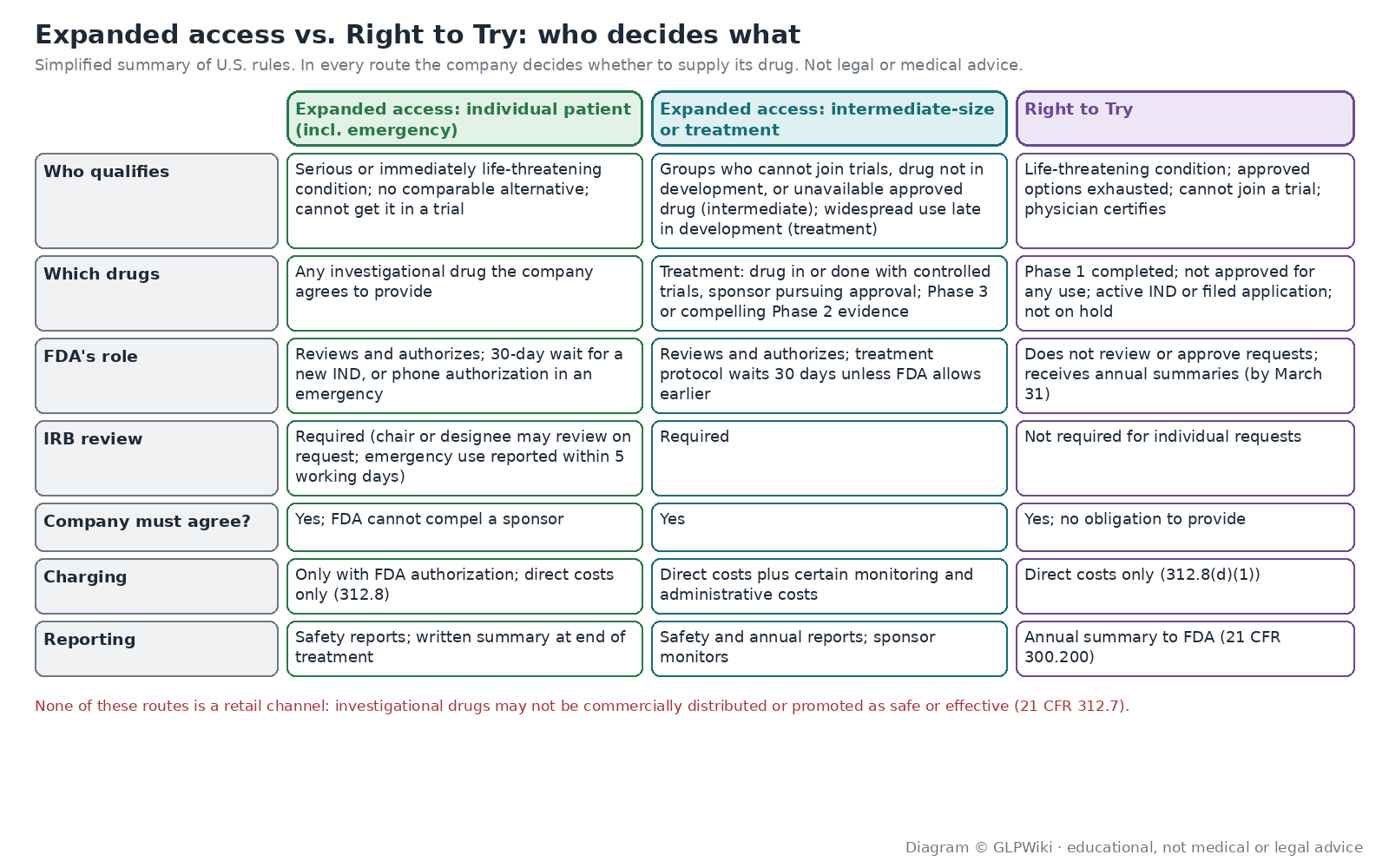
Individual patient, including emergency use (312.310)
The smallest category covers one patient treated by a licensed physician. In addition to the general criteria, the physician must determine that the probable risk from the investigational drug is not greater than the probable risk from the disease, and FDA must determine that the patient cannot get the drug under another IND or protocol. Treatment is generally limited to a single course for a specified duration unless FDA expressly authorizes more; FDA's 2026 questions-and-answers guidance explains that it can authorize extended or chronic treatment when the course is well defined, but it does not usually authorize expanded access for an unspecified duration.
In an emergency, FDA can authorize use by telephone before any written submission, and treatment can begin on that authorization. The written submission must follow within 15 working days, and if there was no time for prior IRB approval, the emergency use must be reported to the IRB within 5 working days (21 CFR 56.104(c)). For non-emergency single-patient requests, physicians can use the shorter Form FDA 3926 instead of the full IND forms; FDA's 3926 guidance also explains that a physician can request that review by the IRB chairperson or a designated member substitute for a full convened-board review.
Intermediate-size population (312.315)
This category covers a group smaller than a typical treatment protocol. The regulation lists three situations: the drug is not being developed, for example because the disease is too rare to run a trial; the drug is being studied but these patients cannot join the trial because they do not meet the criteria, enrollment is closed or no site is reachable; or the drug is an approved product that is unavailable, for example because of a shortage or a marketing problem. FDA may ask a sponsor to consolidate many similar single-patient requests into one intermediate-size protocol.
Treatment IND or treatment protocol (312.320)
The largest category is for widespread treatment use. FDA must find that the drug is being studied in a controlled trial designed to support approval for that use, or that all trials are complete, and that the sponsor is actively pursuing marketing approval with due diligence. The evidence bar is higher than for single patients: for a serious condition, "sufficient clinical evidence of safety and effectiveness," ordinarily Phase 3 data but possibly compelling Phase 2 data. Treatment protocols tend to appear late in development, as described in the timing research below.
Protocol versus new IND
Any of the three can be submitted either as a new IND, often by the treating physician, or as a protocol added to the company's existing IND. FDA's categories page notes the practical difference: a new individual-patient IND has a 30-day waiting period unless FDA allows earlier treatment, whereas a single-patient protocol under an existing IND has no 30-day wait but must be received by FDA and approved by an IRB before treatment begins. A treatment protocol may not begin until 30 days after FDA receives it, or earlier on FDA notice.
Who has to agree: physician, company, FDA and IRB
FDA's patient page is direct about this: even if a patient meets the legal criteria, "the licensed physician, the Institutional Review Board (IRB), and the company all need to agree that expanded access is appropriate" for the patient to receive the product. Each party has a distinct role.
- The licensed physician decides whether to pursue the request, files or coordinates the paperwork, obtains informed consent, oversees treatment and reports adverse events. Under 312.305(c), that physician is treated as an investigator, or as a sponsor-investigator if they hold the IND, with the matching responsibilities.
- The company decides whether to supply the drug. FDA's 2026 guidance answers the question "Can FDA require a sponsor to provide expanded access to its drug?" with a single word: "No." Supply, manufacturing capacity and the needs of ongoing trials all factor into a company's decision. When a physician uses their own IND, the company usually provides a letter of authorization that lets FDA refer to its IND for manufacturing and safety information.
- FDA reviews the request against the criteria in 312.305 and the category rules. Under 21 U.S.C. 360bbb-0, a company must post its expanded access policy publicly once a drug enters Phase 2 or 3, or within 15 days of a breakthrough therapy, fast track or regenerative medicine advanced therapy designation, whichever comes first. FDA treats each request as its own clinical situation and may deny one even when similar requests were allowed, for example because of a different stage of disease or a new safety signal.
- The IRB reviews the use to protect the patient, including the consent document. FDA's September 2023 IRB guidance explains how IRBs can review single-patient requests efficiently, including through a chairperson or designated member when the physician requests that waiver.
What the numbers show about expanded access
FDA publishes yearly counts of expanded access submissions. For fiscal year 2023, CDER reported receiving 1,326 single-patient non-emergency INDs and allowing 1,318 to proceed, and receiving and allowing 634 single-patient emergency INDs. The same table shows 18 intermediate-size INDs received (16 allowed) and one treatment IND (allowed), plus additional expanded access protocols under existing INDs. FDA counts submissions it allowed to proceed; the table does not show how many requests a company declined before anything reached FDA, or how patients fared.
Peer-reviewed analyses by FDA staff point the same way. Jarow and colleagues found that CDER received more than 1,000 expanded access applications a year from 2005 to 2014, mostly single-patient, and allowed 99.7% to proceed. They also found that only 0.2% of commercial development programs were placed on clinical hold because of adverse events seen in expanded access patients. A second FDA analysis of 321 regulatory decisions from 2010 to 2016 found no negative approval decision based on adverse events reported under expanded access, and only one instance in which expanded access safety events alone led to potentially adverse labeling. FDA's guidance says the agency does not intend to deny, delay or refuse approval, or to place an IND on hold, based solely on an adverse event in expanded access.
Timing matters too. A Yale cross-sectional study identified 92 FDA-approved drugs and biologics that had expanded access programs registered on ClinicalTrials.gov before approval. The median pre-approval availability was 10 months, and 69.6% of those programs began within six months before or after the company submitted its marketing application. In other words, large company-run access programs usually open near the end of development, when the evidence is strongest, not early on when the hype is loudest.
Right to Try: a separate federal pathway
The Trickett Wendler, Frank Mongiello, Jordan McLinn, and Matthew Bellina Right to Try Act of 2017, signed into law on May 30, 2018 as Public Law 115-176, added section 561B to the Federal Food, Drug, and Cosmetic Act (21 U.S.C. 360bbb-0a). FDA describes it as "one way for patients who have been diagnosed with life-threatening diseases or conditions who have tried all approved treatment options and who are unable to participate in a clinical trial to access certain investigational treatment options."
Eligibility is defined on both sides. The patient must have been diagnosed with a life-threatening disease or condition, have exhausted approved treatment options and be unable to take part in a trial of the drug, as certified by a physician in good standing who is not compensated directly by the manufacturer for the certification, and must give written informed consent. The drug must have completed a Phase 1 trial, must not be approved or licensed for any use, must be the subject of an application filed with FDA or of an active IND for a trial intended to form the primary basis of an effectiveness claim, and must still be in active development and not on clinical hold.
What Right to Try changes and what it does not
Drugs provided in compliance with the law are exempt from several requirements, including the IND rules in Part 312 and the informed consent and IRB rules in Parts 50 and 56. However, the promotion and commercial distribution limits of 312.7 and the direct-cost limit on charging in 312.8(d)(1) still apply. FDA does not review or approve Right to Try requests, and individual requests do not need IRB approval. FDA's role is limited to receiving and posting information, including annual summaries that manufacturers must submit by March 31 each year under 21 CFR 300.200. The law also limits liability for those who provide drugs in compliance with it, and for companies that decide not to provide one.
What does not change is that the company decides. FDA's Right to Try page says companies "are responsible for determining whether to make their products available." Nothing in the law obliges a company to supply its drug, and the pathway applies only to life-threatening conditions, a narrower group than the serious-or-life-threatening standard used for expanded access.
How much it is used
FDA's consolidated Right to Try annual summary is short. For each reporting period, it counts eligible drugs whose clinical outcome data were used to determine safety (zero in every period), drugs for which a sponsor requested such use (zero in every period), and drugs whose outcome data were not used in any marketing application review: 12 for May 2018 through 2022, 4 for 2023, 5 for 2024 and 6 for 2025. These are counts of products, not of patients, but they show how small the pathway is next to the thousands of expanded access requests FDA handles each year. Before the federal law passed, a review by clinical research administrators noted that FDA allowed more than 99% of expanded access requests in every category and that drug company cooperation was essential, and argued that helping physicians meet expanded access requirements was a better approach than bypassing FDA oversight. Right to Try does not change the fact that the company must agree to supply its drug.
Reading an expanded access record on ClinicalTrials.gov
ClinicalTrials.gov registers expanded access programs as their own study type, separate from interventional and observational studies. Instead of recruitment statuses, these records use four expanded access status values: Available, No longer available, Temporarily not available and Approved for marketing. A record also lists which expanded access types it covers: individual patients, intermediate-size population or treatment IND/protocol.
A GLP-1 example shows how to read one. Record NCT07629401, "Pre-approval Expanded Access of Retatrutide (LY3437943)," was first posted on June 5, 2026 by Eli Lilly and Company. It is an expanded access record covering individual patients only, and its status was Available when we checked it for this guide. The record describes retatrutide as an investigational GLP-1/GIP/glucagon triple receptor agonist and describes the intended population as adults with severe obesity who have at least two serious or life-threatening obesity-related complications, whose obesity is refractory to the best approved therapy, and who cannot join an ongoing retatrutide or comparable trial. It also says that requests must be started by the treating physician, that patients and caregivers should go through their physician rather than contacting the company, and that availability depends on geography, product supply and individual eligibility assessment.
For contrast, NCT05183802, a treatment protocol for setmelanotide in Bardet-Biedl syndrome, now shows the status Approved for marketing, the status used once the drug is approved for the use. A third record, NCT04710056 for the investigational antibody mibavademab, lists all three expanded access types at once.
Four things an expanded access record does not mean
"Available" means the sponsor is accepting physician requests under the stated criteria. It does not mean any particular patient will qualify, that FDA has authorized any individual request, or that the drug is approved. The eligibility text is the company's screening summary, not medical guidance, and it can change. The record is not a supply source either: there is no ordering mechanism, and the drug moves only from the company to a physician after the required authorizations. Finally, do not rely on the "has expanded access" flag on interventional trial records. In the retatrutide example, the TRIUMPH-1 and TRIUMPH-6 trial records showed that flag as false when we checked, even though the separate expanded access record exists. Search by drug name with the expanded access study type instead.
A five-step reading method
First, confirm the study type is Expanded Access and note the NCT number. Second, read the status and the expanded access types. Third, read the sponsor and the description of who initiates requests; for company programs it is almost always the treating physician. Fourth, compare the eligibility text with the regulatory criteria above: serious or immediately life-threatening condition, no comparable alternative, unable to join a trial. Fifth, cross-check the drug's approval status on Drugs@FDA. As of November 14, 2026, Drugs@FDA had no record for retatrutide, which is consistent with its investigational status.
Why investigational GLP-1 medicines are not sold
Put together, the rules leave no lawful retail path for an investigational drug. The FD&C Act prohibits introducing an unapproved new drug into interstate commerce (21 U.S.C. 355(a)); the IND is the exemption that permits shipment to investigators. Section 312.7 bars commercial distribution, test marketing and promotional safety or effectiveness claims. When a sponsor is allowed to charge, in a trial or in expanded access, it needs FDA's prior written authorization and may recover only direct costs (plus certain monitoring and administrative costs for intermediate-size and treatment programs) under 312.8. Right to Try keeps the same direct-cost limit.
That is why a website, clinic or social media account offering an investigational GLP-1, whether labeled "research use only," "not for human consumption" or "compassionate supply," is not operating under any of these pathways. Expanded access starts with a physician's request to the company and an FDA authorization; Right to Try starts with a physician's certification and the company's agreement; trials start with enrollment at a study site under an IND. GLPWiki's guides on approved versus investigational status, compounded versus FDA-approved GLP-1 medicines and FDA warning letters and import alerts explain how to recognize these products and what FDA has said about them.
Limits and common misreadings
Several misreadings come up again and again. "FDA cleared the IND" means a study may begin, not that the drug is safe or effective. "The hold was lifted" means FDA accepted the sponsor's response on the cited deficiencies, not that the drug was vindicated. "Phase 3 complete" means a marketing application may follow, but FDA review, and sometimes an advisory committee, still lies ahead. A "compassionate use program" means a company is accepting physician requests under criteria, not that the drug is available to the public. And "Right to Try" is not a right to receive a drug; it is a pathway that a company may choose to use.
Public data are also limited. FDA's counts cover submissions it received, not requests companies turned down. ClinicalTrials.gov registration of expanded access programs depends on sponsors, and not every program is registered. Right to Try summaries count products, not patients, and include no outcome data. Company policies posted under 360bbb-0 describe processes and timelines, but they do not guarantee responses. Readers should treat all of these as partial views.
Reader checklist
Use these questions when you see news or marketing about an investigational GLP-1 or obesity drug.
- Is the drug approved for any use? Check Drugs@FDA and the label. If not, it is investigational, whatever a seller calls it.
- What stage is it in? Find the ClinicalTrials.gov records and read the phase and status of each study.
- Is there an expanded access record? Search ClinicalTrials.gov with the expanded access study type and read the status, types, sponsor and who initiates requests.
- Does the company post an expanded access policy? Companies must post one once Phase 2 or 3 begins. It must include a contact, the request procedure, general criteria and how long the company expects to take to acknowledge a request, and it does not guarantee access.
- Who is offering access? Lawful access comes through a physician working with the company and FDA (expanded access), a physician certification and company agreement (Right to Try), or trial enrollment. A shopping cart is none of these.
- Is anyone charging? Charging for an investigational drug requires FDA authorization and is limited to cost recovery; a markup or subscription is a red flag.
- Is the claim about safety or effectiveness promotional? Section 312.7 bars sponsors and investigators from promoting an investigational drug as safe or effective.
Scope, disclaimer and review date
This guide is educational. It explains how the U.S. IND, expanded access and Right to Try systems work, using public regulations, FDA guidance and data, ClinicalTrials.gov records and peer-reviewed research. It is not medical advice, not legal advice and not a recommendation to seek, use or avoid any investigational or approved drug. It contains no doses or treatment instructions. Expanded access and Right to Try decisions are made by patients with their own physicians, companies, IRBs and, for expanded access, FDA. Rules, guidance, record statuses and company programs change; check the linked primary sources for the current version. Other countries have different systems.
Last reviewed: November 14, 2026.
Frequently asked questions
- Is an IND an FDA approval?
- No. An IND allows an unapproved drug to be studied in people, or used under expanded access, once it is in effect. It goes into effect 30 days after FDA receives it unless FDA places it on clinical hold or allows it to begin earlier. Approval comes only after FDA reviews a marketing application.
- What does it mean when a study is put on clinical hold?
- FDA has ordered the sponsor to delay a proposed study or suspend an ongoing one, for reasons such as unreasonable risk to participants or missing safety information. No new participants may start the drug during a hold. The sponsor submits a complete response and FDA must reply within 30 calendar days.
- What is the difference between expanded access and compassionate use?
- They are the same thing. FDA's formal term is expanded access, and the agency notes it is sometimes called compassionate use. It covers individual patients (including emergencies), intermediate-size groups and treatment INDs or protocols.
- Can a patient ask a company or FDA directly for an investigational drug?
- Expanded access requests are made by a licensed physician, who works with the company and submits to FDA and an IRB. Company programs, such as the retatrutide expanded access record on ClinicalTrials.gov, ask patients to go through their treating physician. FDA cannot require a company to provide its drug.
- How is Right to Try different from expanded access?
- Right to Try is limited to life-threatening conditions and to drugs that have completed Phase 1 and remain under active development. FDA does not review individual requests, and IRB approval is not required. The company still decides whether to provide the drug, and charging is limited to direct costs.
- Does an "Available" expanded access record mean the drug is available to buy?
- No. It means the sponsor is accepting physician requests under the criteria in the record. Each request still needs the company's agreement and, for expanded access, FDA authorization, informed consent and IRB review. There is no ordering or retail mechanism.
- Are research-use-only vials of an investigational GLP-1 a form of compassionate use?
- No. Expanded access, Right to Try and clinical trials all supply drugs from the sponsor under IND rules, through a physician. Investigational drugs may not be commercially distributed, and products sold online as research chemicals are not part of any of these pathways.
- Can a company charge for an investigational drug under expanded access?
- Only with FDA's prior written authorization, and only to recover direct costs such as manufacturing, shipping and handling. For intermediate-size and treatment programs it may also recover certain monitoring and administrative costs. Associated medical care may not be covered by insurance.
SOURCES
- 0121 CFR 312.2 – Applicability (IND exemptions for marketed drugs)— eCFR
- 0221 CFR 312.7 – Promotion of investigational drugs— eCFR
- 0321 CFR 312.8 – Charging for investigational drugs under an IND— eCFR
- 0421 CFR 312.20 – Requirement for an IND— eCFR
- 0521 CFR 312.21 – Phases of an investigation— eCFR
- 0621 CFR 312.23 – IND content and format— eCFR
- 0721 CFR 312.40 – General requirements for use of an investigational new drug in a clinical investigation— eCFR
- 0821 CFR 312.42 – Clinical holds and requests for modification— eCFR
- 0921 CFR 312.47 – Meetings (end-of-phase 2 and pre-NDA)— eCFR
- 1021 CFR 312.130 – Availability for public disclosure of data and information in an IND— eCFR
- 1121 CFR 312.300 – Expanded access: general (scope and definitions)— eCFR
- 1221 CFR 312.305 – Requirements for all expanded access uses— eCFR
- 1321 CFR 312.310 – Individual patients, including for emergency use— eCFR
- 1421 CFR 312.315 – Intermediate-size patient populations— eCFR
- 1521 CFR 312.320 – Treatment IND or treatment protocol— eCFR
- 1621 CFR 56.104 – Exemptions from IRB requirement (emergency use reporting)— eCFR
- 1721 CFR 300.200 – Annual summary requirements under the Right to Try Act— eCFR
- 1821 U.S.C. 360bbb – Expanded access to unapproved therapies and diagnostics— Cornell LII
- 1921 U.S.C. 360bbb-0 – Expanded access policy required for investigational drugs— Cornell LII
- 2021 U.S.C. 360bbb-0a – Investigational drugs for use by eligible patients (Right to Try)— Cornell LII
- 2121 U.S.C. 355 – New drugs— Cornell LII
- 22Public Law 115-176 – Trickett Wendler, Frank Mongiello, Jordan McLinn, and Matthew Bellina Right to Try Act of 2017 (May 30, 2018)— GovInfo
- 23Investigational New Drug (IND) Application— FDA
- 24IND Application Procedures: Clinical Hold— FDA
- 25Expanded Access— FDA
- 26Expanded Access Categories for Drugs (Including Biologics)— FDA
- 27Expanded Access: How to Submit a Request (Forms)— FDA
- 28Expanded Access: Information for Patients— FDA
- 29Expanded Access: Information for Industry— FDA
- 30Expanded Access: Information for Institutional Review Boards (IRBs)— FDA
- 31Expanded Access: Keywords, Definitions, and Resources— FDA
- 32Expanded Access (Compassionate Use) Submission Data (FY 2019–2023)— FDA
- 33Guidance for Industry: Expanded Access to Investigational Drugs for Treatment Use – Questions and Answers (April 2026, Revision 2)— FDA
- 34Guidance for Industry: Individual Patient Expanded Access Applications – Form FDA 3926 (June 2016, updated October 2017)— FDA
- 35Guidance: IRB Review of Individual Patient Expanded Access Submissions for Investigational Drugs and Biological Products (September 2023)— FDA
- 36Learn About Expanded Access and Other Treatment Options— FDA
- 37Understanding Investigational Drugs— FDA
- 38Right to Try— FDA
- 39Right to Try Annual Reporting Summary— FDA
- 40Project Facilitate (oncology expanded access)— FDA
- 41Expanded Access Navigator— Reagan-Udall Foundation for the FDA
- 42NCT07629401 – Pre-approval Expanded Access of Retatrutide (LY3437943)— ClinicalTrials.gov
- 43NCT05929066 – TRIUMPH-1: A Study of Retatrutide (LY3437943) in Participants Who Have Obesity or Overweight— ClinicalTrials.gov
- 44NCT06859268 – TRIUMPH-6: Retatrutide in the maintenance of weight reduction— ClinicalTrials.gov
- 45NCT05183802 – An Expanded Access Protocol for Setmelanotide for Treatment of Bardet-Biedl Syndrome— ClinicalTrials.gov
- 46NCT04710056 – Compassionate Use or Expanded Access of Mibavademab— ClinicalTrials.gov
- 47ClinicalTrials.gov API: study data structure (expanded access fields)— ClinicalTrials.gov
- 48ClinicalTrials.gov API: enumerated values (Expanded Access Status)— ClinicalTrials.gov
- 49Drugs@FDA: FDA-Approved Drugs— FDA
- 50Jarow JP et al. Expanded Access of Investigational Drugs: The Experience of the Center of Drug Evaluation and Research Over a 10-Year Period. Ther Innov Regul Sci. 2016;50(6):705-709— PubMed
- 51Jarow JP, Moscicki R. Impact of Expanded Access on FDA Regulatory Action and Product Labeling. Ther Innov Regul Sci. 2017;51(6):787-789— PubMed
- 52Jarow JP et al. Overview of FDA's Expanded Access Program for Investigational Drugs. Ther Innov Regul Sci. 2017;51(2):177-179— PubMed
- 53Puthumana J et al. Availability of Investigational Medicines Through the US FDA's Expanded Access and Compassionate Use Programs. JAMA Netw Open. 2018;1(2):e180283— PubMed
- 54Holbein ME et al. Access to Investigational Drugs: FDA Expanded Access Programs or "Right-to-Try" Legislation? Clin Transl Sci. 2015;8(5):526-532— PubMed
- 55Manning ML et al. An FDA analysis of clinical hold deficiencies affecting investigational new drug applications for oncology products. Regul Toxicol Pharmacol. 2020;110:104511— PubMed
- 56Wong CH, Siah KW, Lo AW. Estimation of clinical trial success rates and related parameters. Biostatistics. 2019;20(2):273-286— PubMed Central
- 57Reddy NK, Subbiah V. Right to Try, expanded access use, Project Facilitate, and clinical trial reform. Ann Oncol. 2021;32(9):1083-1086— PubMed
EDUCATIONAL REFERENCE ONLY · Not medical advice. Nothing here diagnoses, treats, cures or prevents any disease, and nothing here is a dosing recommendation. Consult a licensed clinician before any treatment decision.