FDA advisory committee literacy: how to read AdComm notices, briefing documents, votes and minutes for GLP-1 and obesity medicines

When an FDA advisory committee meets about a weight-loss or diabetes medicine, headlines often treat the vote as the decision. It is not. An advisory committee, or "AdComm," is a panel of outside experts that FDA convenes under the Federal Advisory Committee Act to give advice in public; FDA alone makes the regulatory decision afterward. This guide explains what these committees are, how a meeting is announced in the Federal Register, what is in the FDA and sponsor briefing documents, how voting questions are written and cast, why votes are non-binding, where transcripts and minutes end up, and how to find the record of past GLP-1 and obesity-drug meetings such as liraglutide for weight management in 2014, semaglutide in 2017 and the ITCA 650 exenatide hearing in 2023. It is educational only: no doses, no treatment advice and no predictions about any pending product.
UPDATED 12 NOV 2026 · 24 MIN READ
KEY TAKEAWAYS
- An FDA advisory committee is a group of outside experts, plus consumer, patient and sometimes non-voting industry representatives, that gives FDA independent advice in a public meeting. Committees are governed by the Federal Advisory Committee Act (FACA), now codified at 5 U.S.C. chapter 10, and FDA's own rules in 21 CFR Part 14.
- Medicines for diabetes, obesity and other metabolic conditions usually go to the Endocrinologic and Metabolic Drugs Advisory Committee (EMDAC), one of about 19 human drug committees listed by FDA's drug center. Other committees, such as the Pharmacy Compounding Advisory Committee, cover different questions.
- FDA's regulation requires a Federal Register notice at least 15 days before a meeting, listing the committee, date, agenda, the time set aside for public comment and the contact person. FDA aims to post briefing materials no later than two business days before the meeting.
- Briefing documents come in two kinds: one written by FDA's review team and one written by the sponsor (the company). They often disagree, and reading both side by side is the fastest way to see what the real questions are.
- Votes are advice, not decisions. 21 CFR 14.5 says the Commissioner has sole discretion over any action. Studies of FDA's record find the agency's final action agrees with the committee most of the time, but not always.
- Since 2007, FD&C Act section 505(s) has required FDA either to refer a drug with a new active moiety to an advisory committee before approval or to explain in the action letter why it did not. Recent GLP-1 approval letters, such as those for Mounjaro (2022) and Foundayo (2026), contain that explanation.
- After a meeting, FDA posts the slides, the final questions, a transcript (FDA says generally within 90 days) and minutes certified by the committee chair. Older meeting pages are moved to web archives that FDA links from each committee's page.
- A favorable vote does not mean a product is approved, a negative vote does not mean it will be rejected, and none of this applies to compounded or "research use only" products, which are not FDA-approved.
Why advisory committees matter for GLP-1 readers
Few parts of FDA's work are as visible as an advisory committee meeting. The meetings are public and broadcast online, and the votes are easy to quote. Medicines in the incretin class have a long public history at these meetings: liraglutide for chronic weight management was discussed in 2014, semaglutide for type 2 diabetes in 2017, and an implantable exenatide pump called ITCA 650 was the subject of a formal hearing in 2023. Older weight-management drugs such as Contrave, Qsymia and lorcaserin also went before the committee, and in 2012 it discussed cardiovascular safety for obesity drugs as a whole.
Those meetings left a public record: Federal Register notices, briefing documents, slides, transcripts, minutes and, later, FDA's own review documents explaining what it did with the advice. Reading that record well is a useful skill for patients, clinicians, journalists and anyone trying to judge a news story. It helps to know what was actually asked, who voted, what the FDA reviewers worried about, and what the agency decided afterward.
This guide is about literacy, not prediction. It explains the machinery, shows real GLP-1 and obesity-drug examples, and points to primary sources. It does not forecast any vote or decision, and it does not evaluate whether any medicine is right for anyone. It complements GLPWiki's guides on approved versus investigational peptides, how to read FDA labeling, postmarketing requirements, ClinicalTrials.gov and compounding.
What an FDA advisory committee is
FDA describes its advisory committees as a way to get "independent expert advice" on scientific, technical and policy questions, such as whether an unapproved product is safe and effective. Members include physician-researchers, statisticians and other scientists, a consumer representative, often a patient representative chosen for a particular meeting and, on many committees, a non-voting industry representative. FDA's consumer update says the agency has about 50 technical and scientific advisory committees and panels in total.
The legal framework comes from the Federal Advisory Committee Act. FACA was recodified in 2022 as chapter 10 of title 5 of the U.S. Code. It defines an advisory committee as a committee, panel or similar group that an agency establishes or uses "to obtain advice or recommendations" and that is not made up entirely of full-time federal employees. FACA requires committee meetings to be open to the public, announced in the Federal Register, and documented with detailed minutes. It also requires that the records, transcripts and working papers made available to a committee be available for public inspection, subject to the Freedom of Information Act. Committees set up by an agency expire after two years unless renewed. For example, FDA published a renewal of EMDAC's charter on August 20, 2026, which runs to August 27, 2028.
FDA's own procedural rules are in 21 CFR Part 14, "Public Hearing Before a Public Advisory Committee." Part 14 sets out how meetings are noticed and run, which portions are open or closed, the role of the chair and the Designated Federal Officer, how minutes and transcripts are kept, and how members are qualified. Its most important sentence for readers is short: under 21 CFR 14.5(b), "The Commissioner has sole discretion concerning action to be taken and policy to be expressed on any matter considered by an advisory committee."
The Endocrinologic and Metabolic Drugs Advisory Committee (EMDAC)
FDA's drug center lists about 19 human drug advisory committees, organized mostly by therapeutic area. GLP-1 receptor agonists and other diabetes and obesity drugs usually go to EMDAC. FDA describes it as reviewing and evaluating data "concerning the safety and effectiveness of marketed and investigational human drug products for use in the treatment of endocrine and metabolic disorders." FDA's committee page lists a core of 11 voting members drawn from endocrinology, metabolism, epidemiology or statistics, and related fields, with a possible consumer-interest member and one non-voting industry member. The August 2026 renewal notice describes the charter more generally, as "a core of at least six voting members."
Standing members are often supplemented by temporary voting members chosen for a particular meeting. These may include a cardiologist, an ophthalmologist or an oncologist when the question needs that expertise. In the 2017 semaglutide meeting, for example, FDA's summary review notes that ophthalmologists on the panel weighed in on a diabetic retinopathy finding. Questions that cut across areas may be handled at a joint meeting of two committees, such as EMDAC with the Drug Safety and Risk Management Advisory Committee.
Other committees GLP-1 readers may encounter
Not every peptide-related meeting goes to EMDAC. The Pharmacy Compounding Advisory Committee advises FDA on which bulk drug substances may be used in compounding. On July 23 and 24, 2026, it discussed seven peptides nominated for the 503A bulks list: BPC-157, KPV, TB-500, MOTs-C, emideltide (DSIP), Semax and Epitalon. That discussion was about compounding policy, not about approving any product, and it is a good example of how a meeting's subject defines what its vote can mean. On October 30, 2026, HHS published a notice of availability of a draft interim enforcement discretion policy for certain peptide bulk substances in 503A compounding "while the list... is developed through rulemaking." The notice states that compounded drugs "are not FDA-approved."
FDA has also recently held "Expert Panels", roundtable discussions on topics such as hormone therapy in menopause, SSRIs in pregnancy and talc. FDA describes these as panels where "individual experts may offer their recommendations." They are a different format from the chartered advisory committees described in this guide. Check which format a news story is describing before comparing them.
When FDA convenes a committee, and when it does not
FDA's patient page says advisory committee meetings "can occur during any stage of the review process" and after a product is marketed, and that the decision to involve a committee "is usually at the discretion of the director of the review division." 21 CFR 14.171 lists the kinds of human prescription drugs that get high priority for committee review. They include investigational drugs that are potential therapeutic advances, pose significant safety hazards, "present narrow benefit-risk considerations requiring a close judgmental decision," have a novel delivery system, or are "the subject of major scientific or public controversy." Marketed drugs with an important new use or newly discovered safety hazards also qualify. Anyone may also petition FDA to send a specific matter to a committee (21 CFR 14.172), and FDA may grant or deny the request.
Congress added a transparency rule in 2007, through the Food and Drug Administration Amendments Act. Section 505(s) of the FD&C Act requires FDA to refer a drug with no previously approved active moiety (or a biologic with a new active ingredient) to an advisory committee before approval. If it does not, FDA must "provide in the action letter... a summary of the reasons why" it did not refer it. That is why recent GLP-1 approval letters contain an "Advisory Committee" heading. Mounjaro's May 2022 letter says it "was not referred to an FDA advisory committee because outside expertise was not necessary; there were no issues that would benefit from advisory committee discussion." Foundayo's April 2026 letter says there "were no controversial issues that would benefit from advisory committee discussion."
Researchers have documented that FDA uses committees less often than it once did. A review of human drug committees from 2010 to 2021 (Daval and colleagues, JAMA Health Forum, 2023) counted 409 meetings, falling from a high of 50 in 2012 to 18 in each of 2020 and 2021. Votes on initial approvals fell from 26 in 2012 to 8 in 2021. A companion analysis (Health Affairs, 2022) found that the share of newly approved drugs referred to a committee dropped from 55 percent to 6 percent per year over the same period. So the absence of an AdComm for a GLP-1 product is common. It is neither a red flag nor a seal of approval.
Anatomy of a meeting, step by step
Most product-specific drug meetings follow the same arc, set by Part 14, FACA and FDA guidance. The timeline below is simplified; individual meetings vary, and FDA posts changes on its Advisory Committee Calendar.
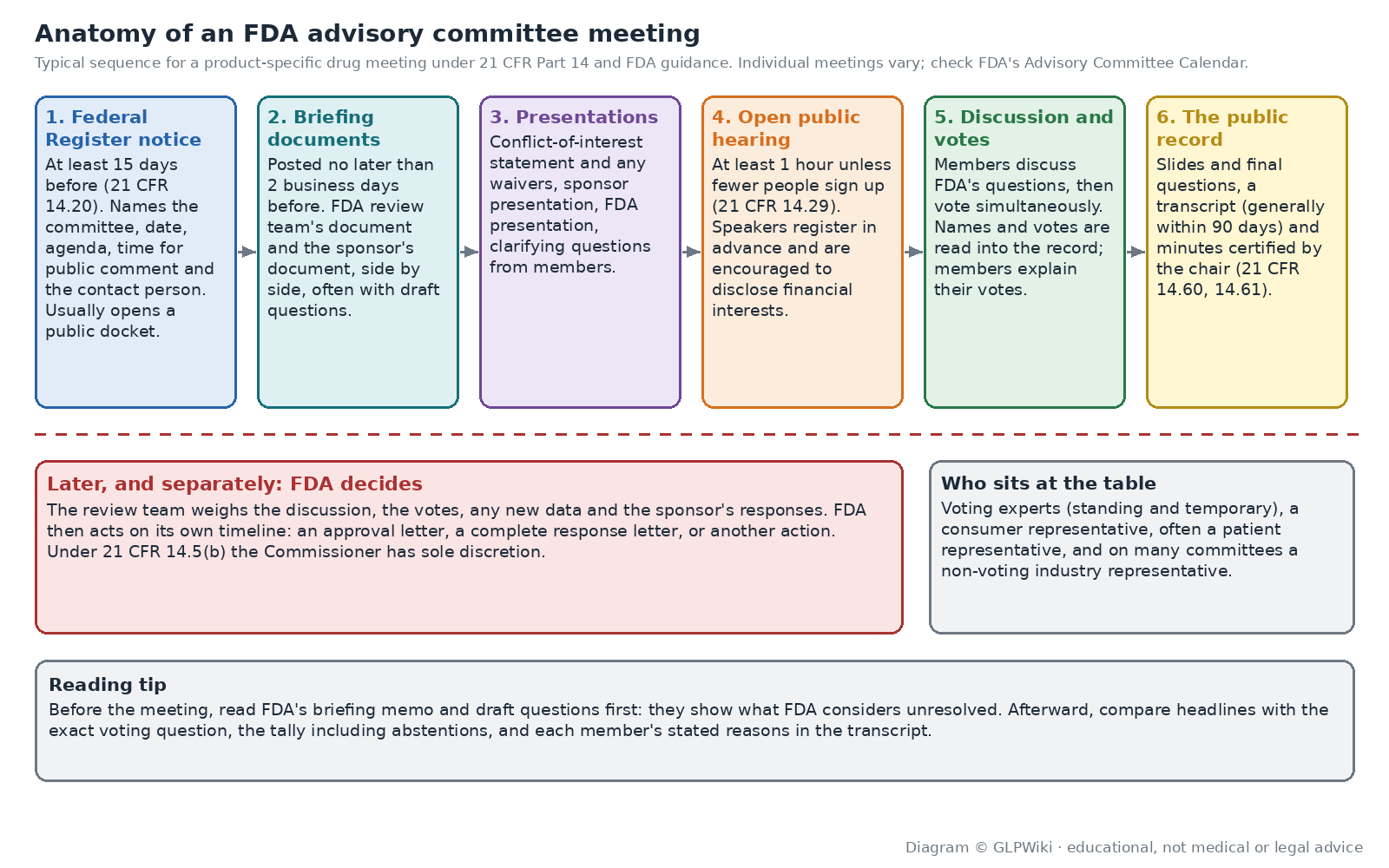
- Federal Register notice. Under 21 CFR 14.20, FDA publishes a notice at least 15 days before the meeting. It names the committee, gives the date, time and place, the general function of the committee, every agenda item and whether it is open or closed, the time reserved for public comment, and the Designated Federal Officer's contact details. The government-wide FACA rule (41 CFR 102-3.150) sets a lower floor of seven calendar days, but FDA's own regulation is stricter. Product notices usually also open a public docket on regulations.gov for written comments.
- Briefing materials. FDA intends to post a public version of the briefing materials "no later than two full business days" before the meeting, posting the FDA and sponsor documents together. FDA's guidance also says it intends to tell a sponsor about roughly 55 business days ahead that its product will be discussed.
- Opening and conflict-of-interest statement. The Designated Federal Officer reads a statement about members' financial interests and any waivers granted.
- Presentations. The sponsor presents its case, FDA's reviewers present their assessment, and committee members ask clarifying questions.
- Open public hearing. Every meeting includes a public comment period. Under 21 CFR 14.29 it lasts at least one hour unless fewer people want to speak. Speakers register in advance, and FDA encourages them to disclose relevant financial relationships.
- Discussion and voting questions. The committee discusses FDA's questions and then votes on those posed for a vote. Members explain their votes on the record.
- Afterward. FDA posts slides, the final questions, a transcript and minutes. FDA makes its regulatory decision later, on its own timeline.
Reading the Federal Register notice
The notice is the official starting gun and is easy to find. Search FederalRegister.gov for the committee name plus "Notice of Meeting." Each notice has a document number and a citation such as 79 FR 45198. The agenda paragraph is the part to read closely, because it states exactly what the committee will discuss: the application number, the sponsor and the proposed indication in FDA's words.
For example, the notice published August 4, 2014 (79 FR 45198) announced that on September 11, 2014 EMDAC would discuss NDA 206321, liraglutide for injection from Novo Nordisk, for chronic weight management in adults meeting stated body-mass-index criteria. The October 3, 2017 notice (82 FR 46068) announced an October 18, 2017 meeting on NDA 209637, semaglutide injection, "as an adjunct to diet and exercise to improve glycemic control in adults with type 2 diabetes mellitus." A February 2012 notice (77 FR 6567) shows a meeting with no product on the table: for two days, the committee discussed "the role of cardiovascular assessment in the preapproval and postapproval settings" for obesity drugs in general.
Notices also show unusual procedures. On August 24, 2023, FDA published two notices about ITCA 650, an exenatide implant from Intarcia Therapeutics. One was a standard meeting notice; the other was a "Notice of Alternative Form of Hearing" (88 FR 57958). It explained that FDA's drug center had proposed to refuse approval, that the company had asked for a hearing, and that FDA had granted a public hearing before EMDAC "in lieu of a formal evidentiary public hearing." Notices are also where cancellations and amendments appear. FDA's FAQ warns, however, that last-minute changes may reach the online calendar before they can be published in the Federal Register.
Briefing documents: FDA's version and the sponsor's
FDA's guidance on briefing materials explains that the package "usually contain[s] information prepared by us and/or the sponsor." Under section 10(b) of FACA, materials given to the committee must also be made available to the public, subject to FOIA exemptions for things like trade secrets. So for a product meeting there are usually two documents. One is FDA's briefing document, written by the review team and often hundreds of pages long. The other is the sponsor's briefing document, written by the company. The guidance tells sponsors that promotional or speculative statements "are inappropriate for inclusion," but the two documents still reflect different perspectives.
A practical reading order: start with FDA's introductory memo and the draft discussion and voting questions, which are often near the front. These show what FDA considers unresolved. Then read the efficacy and safety summaries in both documents and note where the numbers or framing differ. Two examples: the diabetic retinopathy finding for semaglutide was a central topic in 2017, and for ITCA 650 in 2023 FDA's drug center had raised concerns about acute kidney injury and about whether the implanted device delivered the drug consistently, which the company disputed.
Keep in mind what briefing documents are not. They are pre-decisional analyses, not FDA's conclusion, and they can be superseded by data that arrive later. FDA's 2014 summary review of Saxenda, for instance, cites its own briefing document for the nonclinical thyroid findings, but the final review also considered information obtained after the meeting.
Voting questions and how votes are cast
Not every meeting has a vote. FDA's 2008 guidance on voting procedures notes that votes "are typically not taken at meetings to discuss the development of a clinical trial design or the development of a guidance document." When there is a vote, FDA writes the question, and its exact wording matters. A typical approval question asks whether the available data show that benefits outweigh risks for a specific indication. Health Affairs researchers found "variability in the substance and wording of key voting questions" across meetings, so always read the question itself, not a headline's paraphrase.
The guidance recommends simultaneous voting, so that members do not influence one another in sequence. The guidance gives examples: a simultaneous show of hands, simultaneous "yes" or "no" cards, or written ballots cast at the same time. Afterward, "the names of the committee members and their respective votes should be read aloud" and made part of the public record. FDA notes that secret ballots "generally [are] not appropriate in the advisory committee context" because each expert's opinion "should be clearly understood and identified with that expert." Members then explain their votes, and those explanations are often more informative than the tally. Under 21 CFR 14.22(d), matters are decided by majority vote of voting members present, and any member may file a minority report.
Real examples show the format. At the 2014 liraglutide meeting there was a single voting question, whether the benefit-risk assessment was favorable for chronic weight management, considering the proposed REMS. According to FDA's summary review, 14 members voted yes and 1 voted no; the member voting no cited uncertainty about malignancy risk. At the 2017 semaglutide meeting the question was whether the efficacy and safety data supported approval for glycemic control in type 2 diabetes, and the vote was 16 yes, 0 no, 1 abstention. At the 2012 obesity cardiovascular meeting, according to FDA's later Saxenda review, the committee voted 17 to 6 that preapproval assessments should exclude some degree of cardiovascular risk for all chronic weight-management drugs.
Non-binding votes versus FDA's final decision
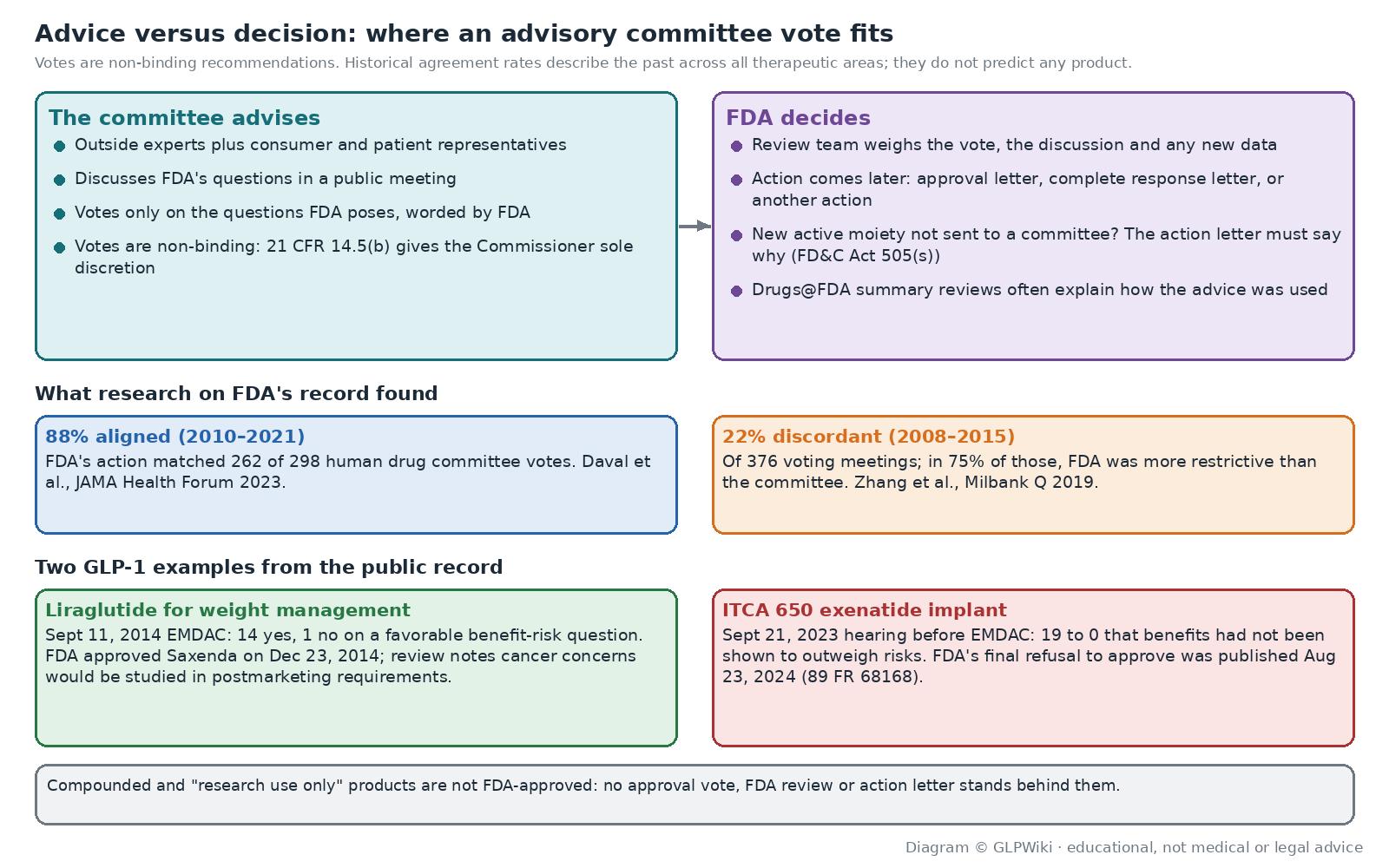
FDA states the principle plainly: committees "make non-binding recommendations to the FDA, which generally follows the recommendations but is not legally bound to do so." After the meeting, the review team weighs the discussion and votes alongside its own analysis, any new data and the sponsor's responses. The agency then takes an action, such as an approval letter, a complete response letter or, for marketed products, a safety-related action. That action may come weeks or months later.
The research literature measures how often the two line up. Zhang, Schwartz and Ross (Milbank Quarterly, 2019) examined 376 voting meetings from 2008 to 2015. They found that 22 percent of FDA's final actions were discordant with the committee's recommendation; in 75 percent of those cases FDA was more restrictive than the committee. Daval and colleagues (2023) found FDA's actions aligned with 262 of 298 votes (88 percent) from 2010 to 2021. Approval followed 97 percent of positive votes on initial approvals, and non-approval followed 67 percent of negative votes on initial approvals. These are historical averages across all therapeutic areas. They are not a way to forecast any individual product.
Two GLP-1 case studies
Liraglutide for weight management, 2014. After the 14 to 1 favorable vote, FDA's review team "discussed these recommendations at length and obtained additional data," according to the division director's summary review. FDA approved Saxenda in a letter dated December 23, 2014. The summary review says the thyroid cancer and breast cancer concerns discussed at the meeting would be addressed in labeling and "evaluated further in post-marketing requirements," a topic GLPWiki's postmarketing guide explains. The vote informed the decision but did not make it.
ITCA 650, 2023 to 2024. This case shows the other direction and an unusual procedure. FDA's drug center had issued two complete response letters (2017 and 2020) and then proposed to refuse approval. When FDA granted a hearing before EMDAC instead of a formal evidentiary hearing, it said it would treat the committee's votes and discussion as an initial decision under 21 CFR 12.120, and that both parties could file exceptions. The voting question asked whether the sponsor had "demonstrated that the benefits of the ITCA 650 drug-device combination product outweigh its risks" for type 2 diabetes. The committee voted 19 to 0 that it had not. FDA's final decision, published in the Federal Register on August 23, 2024 (89 FR 68168), refused approval after reviewing the full record. Because the hearing was an alternative to a formal evidentiary hearing, this was a special case. In ordinary meetings the vote has no such formal status.
Transcripts, minutes and the post-meeting record
Part 14 requires a record of each meeting. Under 21 CFR 14.61, FDA arranges for a transcript or recording of every portion. Transcripts of open portions become part of the public record, while those of closed portions stay confidential. FDA's Common Questions page says transcripts "are generally available within 90 days." Under 21 CFR 14.60, the Designated Federal Officer prepares detailed minutes. These record who attended, the materials considered, and "a complete and accurate description of matters discussed and conclusions reached," and the chair certifies their accuracy. 21 CFR 14.174 adds that the committee's advice on a drug is ordinarily delivered as a written report, which may simply be the approved minutes.
FDA's page for the September 21, 2023 EMDAC meeting shows a complete package. It includes the committee roster, webcast information, the FDA briefing document, the Intarcia briefing document, the final agenda, the final meeting roster, the final questions, both sets of slides, the transcript and the minutes. Many recent meetings also have a recorded webcast. When you compare a news report to the transcript, look for the exact wording of the question, each member's explanation of their vote, and any abstentions.
For conflicts of interest, 18 U.S.C. 208 generally bars federal employees, including special government employees serving on committees, from participating in matters affecting their financial interests unless a waiver is granted. Under 21 U.S.C. 379d-1, FDA must post on its website the type, nature and magnitude of the financial interests covered by any waiver, generally at least 15 days before the meeting. Peer-reviewed research has examined members' apparent conflicts of interest and the characteristics of public speakers at these meetings. Reading the waiver documents is part of reading the record.
How to find past GLP-1 and obesity-drug meetings
Records move over time, so use several entry points. The most reliable path combines FDA's committee pages, the Federal Register and Drugs@FDA review documents.
- Start at FDA's EMDAC page. It links meeting materials by year: current pages for 2023, 2024 and 2026, and archived copies for 2022 and earlier, hosted on web-archive services and linked directly from the FDA page. As of November 2026, FDA's 2026 EMDAC materials page says "No meetings are currently scheduled."
- Search the Federal Register by committee name and "Notice of Meeting" to get exact dates, agendas and docket numbers. Obesity and incretin examples include sibutramine (SCOUT trial results, September 15, 2010), Contrave (December 7, 2010), Qnexa, later Qsymia (July 15, 2010 and February 22, 2012), lorcaserin (May 10, 2012), cardiovascular assessment for obesity drugs (March 2012), Victoza's cardiovascular indication (June 20, 2017), liraglutide for weight management (September 11, 2014), semaglutide (October 18, 2017) and ITCA 650 (September 21, 2023).
- Use Drugs@FDA review documents for the outcome. Summary reviews often include an "Advisory Committee Meeting" section with the voting question, the tally and how the review team responded. For newer products, the approval letter states whether the application was referred and, if not, why.
- Use ClinicalTrials.gov to look up the trials discussed. For example, the SCALE Obesity and Prediabetes trial (NCT01272219) was central to the 2014 liraglutide meeting.
- Check FDA's Advisory Committee Calendar for upcoming meetings, and the public docket on regulations.gov for submitted comments.
What an advisory committee record cannot tell you
A vote is a snapshot of expert opinion on a specific question, on a specific day, based on the data then available. It is not a finding of fact and not FDA's decision. It does not cover uses, doses or populations outside the question asked. A favorable vote does not mean a product is approved, and an unfavorable vote does not mean it will be refused. The research above shows FDA has gone the other way in a meaningful minority of cases.
Committee records also say nothing about products that never went through FDA review. Compounded GLP-1 preparations and "research use only" peptides are not FDA-approved. No sponsor briefing document, FDA review or committee vote stands behind them. The Pharmacy Compounding Advisory Committee's 2026 peptide discussion concerned whether substances may be used in compounding under section 503A, which is a different question from whether a drug product is safe and effective for a use. Do not read it as an approval.
Finally, the absence of a meeting is not a signal either way. Section 505(s) only requires FDA to explain why it did not refer a new active moiety. Many approvals, including GLP-1 approvals for new indications of existing molecules, are never discussed before a committee.
A reader checklist for advisory committee headlines
When you see a story about an FDA panel and a GLP-1 or obesity medicine, these questions help separate the record from the spin:
- Which committee met, and was it a chartered advisory committee, a joint meeting, a hearing in place of a formal evidentiary hearing, or an FDA expert panel?
- What was the exact voting question, and what indication, population and product did it cover?
- What was the tally, including abstentions, and how did members explain their votes?
- What did FDA's briefing document flag as the main uncertainties, and how did the sponsor's document respond?
- Has FDA actually acted yet? Check Drugs@FDA for an approval letter, or later FDA statements, before treating a vote as an outcome.
- Are the transcript and minutes posted, and do they match the headline?
- Is the product FDA-approved at all, or is the story about compounded or research-use products, where an approval-style vote does not apply?
Scope, disclaimer and review date
This guide explains how FDA advisory committees and their public records work, using GLP-1 and obesity-drug meetings as examples. It is educational only. It does not give doses, treatment instructions, product recommendations, predictions about pending applications or meetings, or legal advice. Vote tallies are quoted from FDA documents and Federal Register notices; check the cited primary sources for the full context. Decisions about your own care belong with a licensed clinician and pharmacist, using the current FDA-approved labeling.
Last reviewed: November 12, 2026.
Frequently asked questions
- What is an FDA advisory committee, or AdComm?
- It is a panel of outside experts, usually with consumer and patient representatives and sometimes a non-voting industry representative, that FDA convenes to give independent advice in a public meeting. Committees operate under the Federal Advisory Committee Act and FDA's rules in 21 CFR Part 14.
- Is an advisory committee vote binding on FDA?
- No. FDA describes committee votes as non-binding recommendations, and 21 CFR 14.5 gives the Commissioner sole discretion over any action. Studies of FDA's record find its final action usually agrees with the committee, but FDA has gone the other way in a meaningful minority of cases.
- Which committee reviews GLP-1 and obesity medicines?
- Usually the Endocrinologic and Metabolic Drugs Advisory Committee (EMDAC). Temporary members with other expertise, such as cardiology or ophthalmology, may be added for a specific meeting, and some questions go to joint meetings with other committees.
- How far in advance are meetings announced?
- FDA's regulation (21 CFR 14.20) requires a Federal Register notice at least 15 days before a meeting, and FDA lists meetings on its Advisory Committee Calendar. FDA intends to post briefing materials no later than two business days before the meeting.
- What is the difference between the FDA and sponsor briefing documents?
- The FDA briefing document is the review team's pre-decisional analysis. The sponsor briefing document is the company's presentation of its data. Both are posted together. Reading them side by side, along with FDA's draft questions, shows where the open issues are.
- Why didn't my GLP-1 medicine have an advisory committee meeting?
- Most approvals do not get one. Section 505(s) of the FD&C Act requires FDA either to refer a drug with a new active moiety to a committee or to explain in the approval letter why it did not. Mounjaro's and Foundayo's approval letters, for example, give that explanation. Many approvals of new indications for existing molecules are never discussed at a meeting.
- Where can I find transcripts and minutes of past meetings?
- On the committee's FDA page, which links meeting materials by year, including archived pages for older meetings. FDA says transcripts are generally available within 90 days. Drugs@FDA summary reviews often summarize the vote and how FDA responded.
- Does a Pharmacy Compounding Advisory Committee vote mean a peptide is approved?
- No. That committee advises on which bulk substances may be used in compounding. Compounded drugs are not FDA-approved, and no committee vote on compounding is a finding that a product is safe and effective for a use.
SOURCES
- 01Advisory Committees (program home page)— FDA
- 02Advisory Committee Calendar— FDA
- 03Learn About FDA Advisory Committees— FDA
- 04Advisory Committees Give FDA Critical Advice and the Public a Voice (Consumer Update)— FDA
- 05Common Questions and Answers about FDA Advisory Committee Meetings— FDA
- 06Advisory Committee Laws, Regulations and Guidance— FDA
- 07Human Drug Advisory Committees— FDA
- 08Endocrinologic and Metabolic Drugs Advisory Committee (EMDAC)— FDA
- 092026 Meeting Materials, Endocrinologic and Metabolic Drugs Advisory Committee— FDA
- 10September 21, 2023 Meeting of the Endocrinologic and Metabolic Drugs Advisory Committee (ITCA 650): announcement and meeting materials— FDA
- 11Pharmacy Compounding Advisory Committee— FDA
- 12FDA Expert Panels— FDA
- 13Guidance: Voting Procedures for Advisory Committee Meetings (August 2008)— FDA
- 14Guidance: Advisory Committee Meetings — Preparation and Public Availability of Information Given to Advisory Committee Members (August 2008)— FDA
- 15Guidance: The Open Public Hearing at FDA Advisory Committee Meetings (May 2013)— FDA
- 16Guidance: Public Availability of Advisory Committee Members' Financial Interest Information and Waivers— FDA
- 1721 CFR Part 14 — Public Hearing Before a Public Advisory Committee— eCFR
- 1841 CFR 102-3.150 — Announcement of advisory committee meetings to the public— eCFR
- 195 U.S.C. 1001 — Definitions (Federal Advisory Committee Act)— Legal Information Institute, Cornell Law School
- 205 U.S.C. 1009 — Advisory committee procedures (FACA: open meetings, records, minutes)— Legal Information Institute, Cornell Law School
- 215 U.S.C. 1013 — Termination of advisory committees (FACA)— Legal Information Institute, Cornell Law School
- 2221 U.S.C. 355 — New drugs (FD&C Act section 505, including 505(s) referral to advisory committee)— Legal Information Institute, Cornell Law School
- 2321 U.S.C. 379d-1 — Conflicts of interest (FDA advisory committees)— Legal Information Institute, Cornell Law School
- 2418 U.S.C. 208 — Acts affecting a personal financial interest— Legal Information Institute, Cornell Law School
- 25Endocrinologic and Metabolic Drugs Advisory Committee; Renewal (91 FR 53876, August 20, 2026)— Federal Register
- 26EMDAC Notice of Meeting: liraglutide for chronic weight management, September 11, 2014 (79 FR 45198)— Federal Register
- 27EMDAC Notice of Meeting: semaglutide injection, October 18, 2017 (82 FR 46068)— Federal Register
- 28EMDAC Notice of Meeting: cardiovascular assessment for obesity drugs, March 28–29, 2012 (77 FR 6567)— Federal Register
- 29EMDAC Notice of Meeting: Qnexa (phentermine/topiramate), February 22, 2012 (76 FR 80948)— Federal Register
- 30EMDAC Notice of Meeting: Contrave (naltrexone/bupropion), December 7, 2010 (75 FR 64313)— Federal Register
- 31EMDAC Notice of Meeting: lorcaserin, May 10, 2012 (77 FR 16038)— Federal Register
- 32EMDAC Notice of Meeting: Meridia (sibutramine) SCOUT results, September 15, 2010 (75 FR 47821)— Federal Register
- 33EMDAC Notice of Meeting: Qnexa (phentermine/topiramate), July 15, 2010 (75 FR 32188)— Federal Register
- 34EMDAC Notice of Meeting: Victoza (liraglutide) cardiovascular indication, June 20, 2017 (82 FR 23251)— Federal Register
- 35EMDAC Notice of Alternative Form of Hearing: ITCA 650 (exenatide in DUROS device), September 21, 2023 (88 FR 57958)— Federal Register
- 36Final Decision on the Proposal To Refuse To Approve a New Drug Application for ITCA 650 (89 FR 68168, August 23, 2024)— Federal Register
- 37Pharmacy Compounding Advisory Committee; Notice of Meeting, July 23–24, 2026 (91 FR 20465)— Federal Register
- 38Enforcement Discretion Policy Regarding 503A Compounding Using Certain Peptide Bulk Drug Substances (91 FR 68526, October 30, 2026)— Federal Register
- 39Saxenda (liraglutide) NDA 206321 Summary Review for Regulatory Action, 2014 (PDF)— FDA
- 40Saxenda (liraglutide) NDA 206321 approval letter, December 23, 2014 (PDF)— FDA
- 41Ozempic (semaglutide) NDA 209637 Summary Review, 2017 (PDF)— FDA
- 42Mounjaro (tirzepatide) NDA 215866 approval letter, May 2022 (PDF)— FDA
- 43Foundayo (orforglipron) NDA 220934 approval letter, April 2026 (PDF)— FDA
- 44Drugs@FDA: FDA-Approved Drugs (search)— FDA
- 45Zhang AD, Schwartz JL, Ross JS. Association Between FDA Advisory Committee Recommendations and Agency Actions, 2008-2015. Milbank Q. 2019 (PMID 31304643)— PubMed
- 46Daval CJR et al. Association of Advisory Committee Votes With FDA Decision-Making on Prescription Drugs, 2010-2021. JAMA Health Forum. 2023 (PMID 37418270)— PubMed
- 47Daval CJR, Sarpatwari A, Kesselheim AS. Unwanted Advice? Negative Advisory Committee Votes for FDA-Approved Drugs. Health Aff. 2022 (PMID 35500185)— PubMed
- 48Xu J et al. Association of Appearance of Conflicts of Interest With Voting Behavior at FDA Advisory Committee Meetings. JAMA Intern Med. 2017 (PMID 28464118)— PubMed
- 49Rand LZ et al. Characteristics of Speakers at US FDA Advisory Committee Meetings on Drug Approval. JAMA Intern Med. 2026 (PMID 41284267)— PubMed
- 50SCALE Obesity and Prediabetes: liraglutide in non-diabetic adults with obesity or overweight (NCT01272219)— ClinicalTrials.gov
EDUCATIONAL REFERENCE ONLY · Not medical advice. Nothing here diagnoses, treats, cures or prevents any disease, and nothing here is a dosing recommendation. Consult a licensed clinician before any treatment decision.