FDA review timelines and expedited programs literacy: how to read PDUFA dates, priority review, vouchers, accelerated approval and action letters for GLP-1 and obesity medicines

GLP-1 news often comes with regulatory dates and labels attached: a "PDUFA date," "priority review," a "voucher" that promises a decision in weeks, or a "complete response letter." Each term has a specific meaning in FDA's drug review system, and none of them predicts approval. This guide explains how an application moves from submission to filing to an action letter, how the PDUFA VII review clocks are counted, what fast track, breakthrough therapy, priority review and accelerated approval actually do, how priority review vouchers and the Commissioner's National Priority Voucher pilot differ, what complete response letters are now that FDA publishes them, and how to read GLP-1 and obesity examples on Drugs@FDA. Educational only: no doses, no treatment advice and no predictions about pending applications.
UPDATED 13 NOV 2026 · 25 MIN READ
KEY TAKEAWAYS
- A "PDUFA date" is FDA's performance goal date for acting on an application, negotiated with industry in user-fee commitment letters. The current letter, PDUFA VII, covers fiscal years 2023 through 2027. It is a goal, not a legal deadline or a promise of approval.
- For a new molecular entity, the clock starts after a 60-day filing review: the standard goal is 10 months after that filing date (about 12 months from submission) and the priority goal is 6 months after it (about 8 months). For other original NDAs, the goals are 10 or 6 months from receipt.
- FDA decides within 60 days whether an application can be filed (21 CFR 314.101), and for new molecular entities it sends a "Day 74 letter" with filing issues and the planned timeline. A major amendment can extend the goal date by three months, once per review cycle.
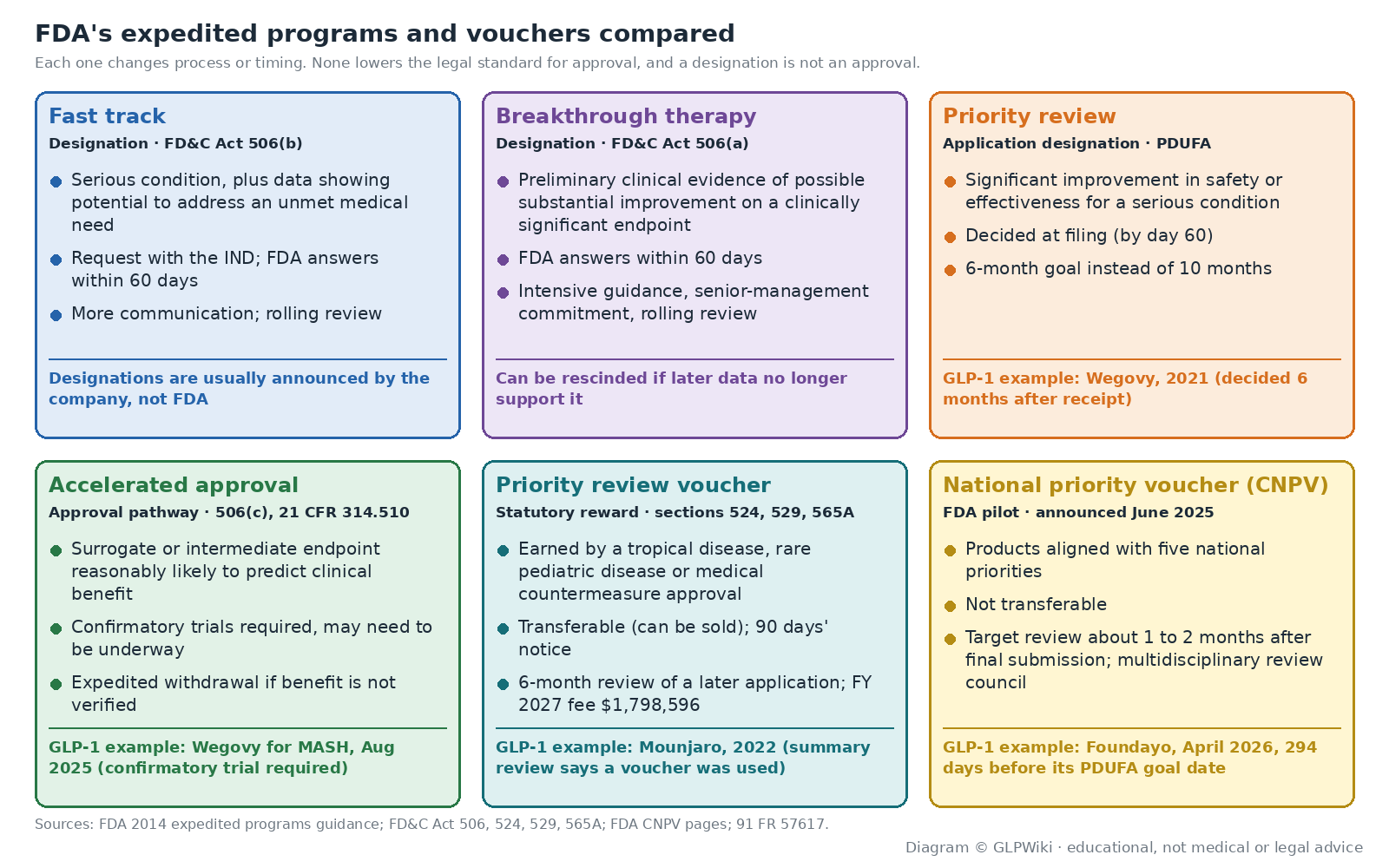
- Fast track, breakthrough therapy and priority review are designations; accelerated approval is an approval pathway. None of them lowers the legal standard for approval.
- Priority review vouchers are awarded under three statutory programs (tropical disease, rare pediatric disease and material threat medical countermeasure) and can be sold. A voucher turns a later application into a priority review, for an extra user fee.
- The Commissioner's National Priority Voucher (CNPV) pilot, announced in June 2025, is different: vouchers are not transferable, the target review is about one to two months after the final submission, and FDA says approval standards are unchanged.
- Every review cycle ends in an action letter: an approval letter (21 CFR 314.105) or a complete response letter (21 CFR 314.110) listing the deficiencies. Since July 2025 FDA has published complete response letters in a public openFDA dataset, and since September 2025 it has said it will release new ones promptly.
- Drugs@FDA shows each submission's action date, chemical type and review priority. Foundayo, for example, was approved under the CNPV pilot 294 days before its PDUFA goal date even though Drugs@FDA lists its review priority as "STANDARD."
Why review timelines get misread
Few FDA terms appear in news coverage as often as the "PDUFA date," and readers often assume a drug will be approved on that day. In fact, a PDUFA date is FDA's internal performance goal for taking an action, and the action can be an approval or a complete response letter that says the application cannot be approved in its current form. FDA can act before the date, and in some cases the date moves.
Expedited-program labels such as "fast track," "breakthrough therapy" or "priority review" cause similar confusion. Each describes a process feature, such as more meetings with FDA, submitting an application in pieces, or a shorter review goal. None of them is a finding that the product is safe or effective, and none of them lowers the evidence standard set by the Federal Food, Drug, and Cosmetic Act (FD&C Act).
This guide explains the vocabulary and where to check it: 21 CFR Part 314, section 506 of the FD&C Act, FDA guidance, the PDUFA VII commitment letter, Federal Register notices and Drugs@FDA. The GLP-1 examples are approved products with public records. This guide does not discuss or predict pending applications.
From submission to filing: the first 60 days and the Day 74 letter
A company seeking approval of a new drug submits a new drug application (NDA) under section 505(b) of the FD&C Act, or a biologics license application (BLA) for a biological product. Most GLP-1 medicines, including semaglutide, tirzepatide, liraglutide and orforglipron, have been approved through NDAs.
The first decision is about completeness, not effectiveness. Under 21 CFR 314.101(a), "within 60 days after FDA receives an NDA, the Agency will determine whether the NDA may be filed." Filing means FDA found the NDA "sufficiently complete to permit a substantive review." If FDA files the application, the filing date is "the date 60 days after the date FDA received the NDA." If the application is incomplete, FDA can refuse to file it and must explain why in writing. The company can then ask for an informal conference and, in some cases, have the application "filed over protest."
For new molecular entity (NME) NDAs and original BLAs, the PDUFA VII commitment letter adds a structured communication model it calls "the Program." Under the Program, FDA sends a "Day 74 letter" within 74 calendar days of receipt. That letter identifies filing review issues and includes the planned review timeline, the planned date of the internal mid-cycle review meeting and preliminary plans on whether to hold an advisory committee meeting. If the review division intends to conduct an expedited review, the Day 74 letter also tells the applicant that.
When a company announces that FDA has "accepted" an application and gives a goal date, that reflects filing: the application was complete enough to review, nothing more.
PDUFA goal dates: the 10-month and 6-month clocks
The Prescription Drug User Fee Act (PDUFA) was first enacted in 1992. Under it, companies pay user fees, and FDA agrees to review performance goals in a commitment letter that is renegotiated about every five years. The current letter, PDUFA Reauthorization Performance Goals and Procedures for Fiscal Years 2023 through 2027 (PDUFA VII), sets these goals for original applications. In each case, the goal is to "review and act on 90 percent" of applications within the stated time:
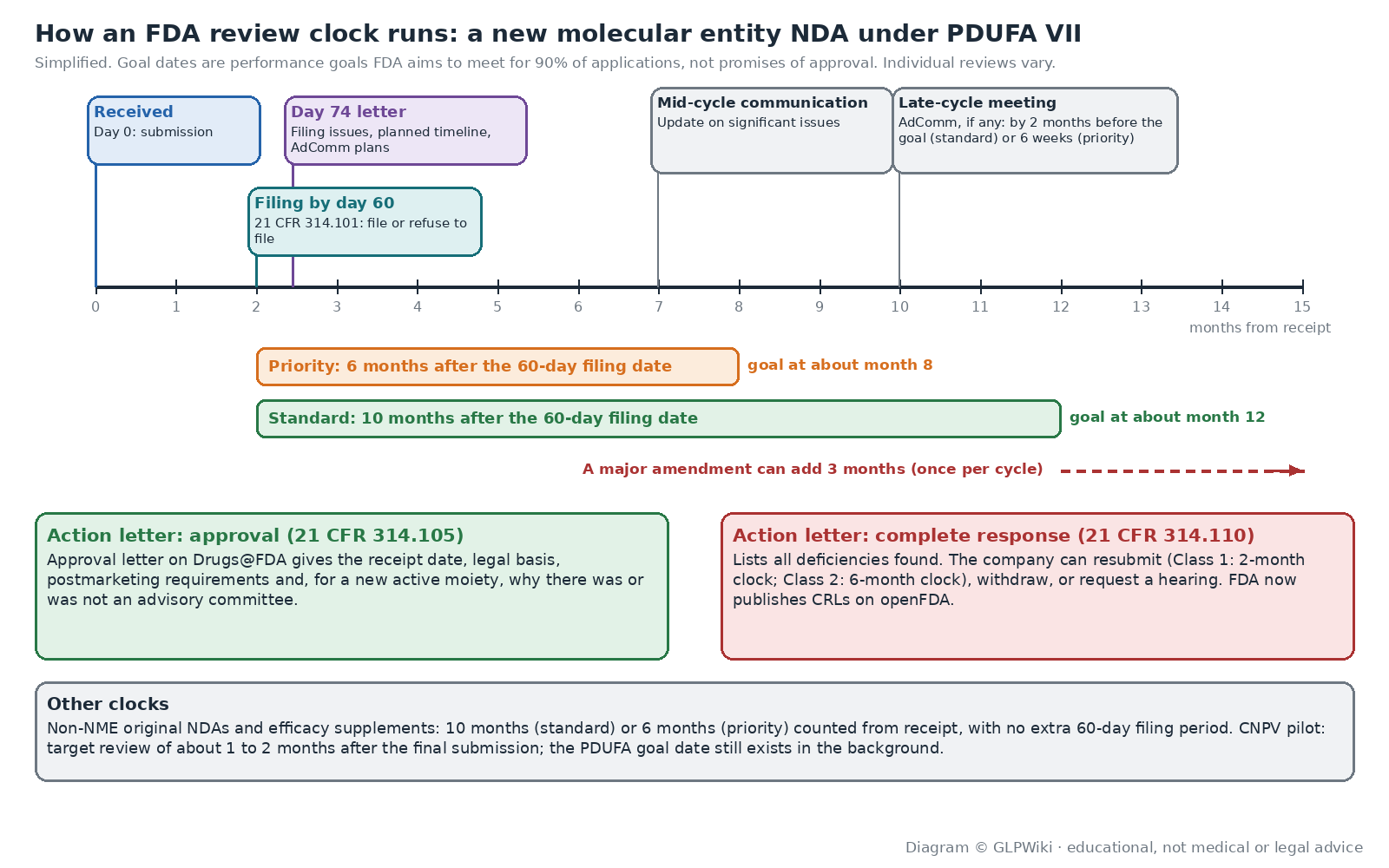
- Standard NME NDAs and original BLAs: within 10 months of the 60-day filing date, so about 12 months from submission.
- Priority NME NDAs and original BLAs: within 6 months of the 60-day filing date, so about 8 months from submission.
- Standard non-NME original NDAs: within 10 months of receipt.
- Priority non-NME original NDAs: within 6 months of receipt.
- Standard and priority efficacy supplements, which add a new indication or population to an approved product: 10 and 6 months from receipt.
- Resubmissions after a complete response letter: 2 months for a Class 1 resubmission and 6 months for a Class 2 resubmission.
What can move the date
The commitment letter allows one main kind of extension. "A major amendment to an original application, efficacy supplement, or resubmission of any of these applications, submitted at any time during the review cycle, may extend the goal date by three months." Examples include a major new clinical study report or a major re-analysis of submitted studies. "Only one extension can be given per review cycle." When a company announces that its PDUFA date has moved by three months, this is usually the reason.
Goals are not legal deadlines
PDUFA goals sit on top of an older statutory clock. Section 505(c) of the FD&C Act says that within 180 days after filing, "or such additional period as may be agreed upon," FDA shall approve the application or give notice of an opportunity for a hearing. FDA's regulation at 21 CFR 314.100 calls this the "initial review cycle" and allows it to be adjusted by agreement or by a major amendment. If FDA misses a goal date, the application is not approved or rejected automatically. It simply stays under review until FDA issues an action letter.
Milestones inside the review
For applications in the Program, the commitment letter also describes a mid-cycle communication on significant issues and a late-cycle meeting. If an advisory committee will meet, FDA intends to hold that meeting no later than 2 months (standard review) or 6 weeks (priority review) before the PDUFA goal date. Our FDA advisory committee literacy guide explains how those meetings work. These internal milestones are usually not public.
The four expedited programs: what each one actually changes
FDA's guidance Expedited Programs for Serious Conditions – Drugs and Biologics (May 2014) describes four programs. All four are tied to the idea of a serious condition and, for most of them, an unmet medical need. FDA defines an unmet medical need as "a condition whose treatment or diagnosis is not addressed adequately by available therapy." The guidance notes that one development program "may qualify for more than one expedited program." Three of the four are written into section 506 of the FD&C Act (21 U.S.C. 356). Priority review comes from the PDUFA framework.
Fast track designation
Fast track (FD&C Act section 506(b), added in 1997 and amended in 2012) is for a drug intended to treat a serious condition when nonclinical or clinical data "demonstrate the potential to address unmet medical need." A company can request it with its investigational new drug application (IND) or later, ideally no later than the pre-NDA meeting. FDA responds within 60 calendar days. Features include more frequent communication and "rolling review." Rolling review means the company "can submit completed sections" of the application before every section is finished. Section 506(d) requires the company to give a schedule for completing the application. Fast track can be rescinded if the product no longer meets the criteria.
Breakthrough therapy designation
Breakthrough therapy (section 506(a), added by the Food and Drug Administration Safety and Innovation Act of 2012, FDASIA) has a higher bar. Preliminary clinical evidence must indicate "that the drug may demonstrate substantial improvement on a clinically significant endpoint(s) over available therapies." FDA says whether the improvement is substantial "is a matter of judgment." Requests should ideally be made no later than the end-of-phase-2 meeting, and FDA responds within 60 days. Features include all fast track features, "intensive guidance on efficient drug development" and an "organizational commitment" involving senior FDA managers. This designation can also be rescinded.
Priority review designation
Priority review is assigned to an application (an original NDA or BLA, or an efficacy supplement), not to a development program. FDA's patient page says it is for drugs that, if approved, "would be significant improvements in the safety or effectiveness of the treatment, diagnosis, or prevention of serious conditions." It also explains that FDA's goal is "to take action on an application within 6 months (compared to 10 months under standard review)." FDA decides at the time of filing, within 60 days of receiving the application. The guidance lists other automatic routes to priority review, including an application "submitted with a priority review voucher." CDER's internal policy on review designations, MAPP 6020.3, applies the same test. It says the Priority (P) and Standard (S) designations "are mutually exclusive." Its examples of significant improvement include increased effectiveness, the elimination or substantial reduction of a treatment-limiting drug reaction, and "documented enhancement of patient compliance."
Accelerated approval
Accelerated approval is an approval pathway, not a designation. Under 21 CFR 314.510 and section 506(c), FDA may approve a drug for a serious condition based on an effect on "a surrogate endpoint that is reasonably likely ... to predict clinical benefit," or on an intermediate clinical endpoint. The company must then confirm the benefit in further studies. The Food and Drug Omnibus Reform Act of 2022 (FDORA) amended section 506(c). FDA may now require confirmatory studies to be underway before approval, and it can use expedited procedures to withdraw approval if a study fails to verify benefit or is not conducted with due diligence. Our postmarketing requirements and commitments literacy guide explains how those confirmatory studies are tracked. This guide does not repeat that material.
What none of them does
The programs change process and timing, not the standard. The guidance says drugs granted accelerated approval "must meet the same statutory standards for safety and effectiveness as those granted traditional approval." A designation means a product met the entry criteria at one point, not that it will be approved. Designations are usually announced by companies, not FDA. Our approved versus investigational peptides guide explains why a designated product is still investigational.
Priority review vouchers: a transferable ticket to a 6-month review
A priority review voucher (PRV) rewards one kind of approval with faster review of a different application. Ridley, Grabowski and Moe proposed the idea in Health Affairs in 2006 as an incentive for neglected-disease drugs. Congress created three voucher programs:
- Tropical disease vouchers (FD&C Act section 524, 21 U.S.C. 360n), created in 2007, for approvals of new products for listed tropical diseases. FDA keeps a program page for it.
- Rare pediatric disease vouchers (section 529, 21 U.S.C. 360ff), created in 2012. As amended in February 2026 (Pub. L. 119–75), the statute says FDA may not award these vouchers after September 30, 2029.
- Material threat medical countermeasure vouchers (section 565A, 21 U.S.C. 360bbb-4a), created in 2016, for certain countermeasures against chemical, biological, radiological and nuclear threats.
How a voucher works
The holder can use the voucher to get priority review for a later application, even one unrelated to the disease that earned it. The guidance's comparison table states that any application "submitted with a priority review voucher will be assigned a priority review." The voucher can be sold, and the statute contemplates transfers. The sponsor must notify FDA at least 90 days before submitting the application, and that notice is "a legally binding commitment to pay" an extra priority review user fee. FDA sets the fee each year in a Federal Register notice. For fiscal year 2027 (October 1, 2026 to September 30, 2027), the fee is $1,798,596 (91 FR 57617).
A voucher changes the review goal, not the evidence. The application still needs adequate and well-controlled studies, and it can still receive a complete response letter. Researchers have also asked whether the vouchers work as incentives. A 2019 Health Affairs study by Hwang and colleagues found that the rare pediatric disease voucher program "was not associated with a change in the rate of new pediatric drugs starting or completing clinical testing." A 2024 analysis by FDA staff (Mease and colleagues) reviewed the program's first ten years of designations.
A GLP-1 example
Drugs@FDA documents show at least one GLP-1 approval that used a voucher. The deputy division director's summary review for Mounjaro (tirzepatide, NDA 215866) states: "The applicant used a priority review voucher and the application was designated a priority review." The approval letter says the NDA was received on September 15, 2021. The summary review lists a PDUFA goal date of May 15, 2022, which is about eight months later, matching the priority clock for an NME. FDA approved it on May 13, 2022. Drugs@FDA shows the review priority as "PRIORITY" but does not show why. You need the review documents to tell a voucher from a designation.
The Commissioner's National Priority Voucher (CNPV) pilot
On June 17, 2025, FDA announced a different kind of voucher. Its press release said the Commissioner's National Priority Voucher would shorten review "from approximately 10-12 months to 1-2 months following a sponsor's final drug application submission." FDA's program page lists five national priorities a product can align with: public health crisis response, innovative breakthrough therapies, large unmet medical needs, onshoring and supply chain resilience, and affordability.
FDA lists these differences from older voucher programs:
- Timeline: an "ultra-fast" target of one to two months, compared with six months or more. FDA's FAQ describes a presubmission period of about 60 days, an abbreviated filing period and a target application review of about one to two months.
- Transfer: CNPVs are nontransferable, unlike statutory vouchers.
- Process: enhanced presubmission requests, rolling review, and a multidisciplinary "tumor board-style" discussion between the review team and senior agency leadership (the CNPV Review Council).
- Selection: vouchers come from internal nominations by FDA review divisions and from statements of interest submitted by sponsors. The FAQ says FDA expects vouchers to be used generally within two years.
- Standards: FDA says applications "will be subject to the same statutory and regulatory requirements for approval" and that "the approval decision remains with the relevant product Center." Its fact sheet adds that "receipt of a voucher does not impact the likelihood of approval."
Where GLP-1 medicines appear
FDA announced its first nine CNPV recipients on October 16, 2025. On November 6, 2025 it announced six more, bringing the total to 15. That second list included "Orforglipron for obesity and related health conditions" and "Wegovy for obesity and related health conditions." On March 19, 2026, FDA said it had approved a higher-dose Wegovy (semaglutide) injection "just 54 days after filing." It called this the fourth approval under the pilot.
On April 1, 2026, FDA approved Foundayo (orforglipron, NDA 220934) as the fifth approval under the pilot and the first new molecular entity. FDA's press release said it was "issued 50 days after filing — and 294 days before the application's PDUFA date of January 20, 2027." The approval letter gives January 20, 2026 as the date FDA received the NDA. The multidisciplinary review lists the review type as "Commissioner's National Priority Voucher (CNPV)" and a PDUFA goal date of January 20, 2027, which is the 12-month standard NME clock. Its effectiveness sections review the ATTAIN-1 (NCT05869903) and ATTAIN-2 trials. In other words, the PDUFA clock still ran in the background, but FDA acted far ahead of it. At the time, FDA said it had awarded 18 vouchers and issued six decisions. Our orforglipron and Foundayo literacy guide covers that approval in more detail.
FDA announced a public hearing on the pilot in the Federal Register on March 23, 2026 (91 FR 13849), seeking feedback on eligibility, voucher selection and review procedures, and amended the notice on April 23, 2026 (91 FR 21822). Program details may change, so check FDA's CNPV page. This guide makes no prediction about any product that holds a voucher.
Action letters: approval versus complete response
Each review cycle ends with an action letter. Under 21 CFR 314.105, FDA sends an approval letter when none of the grounds for refusing approval applies. Approval letters on Drugs@FDA begin with a sentence such as "Please refer to your new drug application (NDA) dated and received December 4, 2020," the best public source for the submission date, and also list postmarketing requirements and, for new active moieties, the advisory committee explanation required by section 505(s).
Under 21 CFR 314.110, FDA instead sends a complete response letter (CRL) when it "will not approve the application ... in its present form." The regulation says a CRL "will describe all of the specific deficiencies" FDA has identified and, "when possible," will recommend actions to fix them. FDA may issue a CRL without completing inspections or reviewing labeling if the data are inadequate. A CRL is not a final refusal. The company can resubmit, withdraw, or request an opportunity for a hearing. A resubmission starts a new review cycle: 2 months for a Class 1 resubmission or 6 months for a Class 2 resubmission. If the company takes none of these actions within one year, FDA may treat that as a request to withdraw the application.
FDA now publishes CRLs
For most of FDA's history, CRLs for unapproved products stayed confidential. A 2015 BMJ study by FDA staff (Lurie and colleagues) compared 61 CRLs with the companies' press releases. It found that "no press release was issued for 18% (11) of complete response letters" and that press release statements matched only 14% of the statements in the letters. Of seven CRLs that reported higher mortality in treated participants, only one press release mentioned it.
On July 10, 2025, FDA published more than 200 CRLs issued for applications submitted between 2020 and 2024 that were later approved. It posted them, redacted for trade secrets and confidential commercial information, in an openFDA dataset. On September 4, 2025, FDA said it would "release future complete response letters (CRLs) promptly after they are issued to sponsors." At the same time, it released 89 previously unpublished CRLs for pending or withdrawn applications, and it said that when it approves an application it will release all CRLs associated with it. In November 2026, the openFDA CRL dataset reported 458 records, last updated August 13, 2026. A text search we ran there for semaglutide, tirzepatide, liraglutide and exenatide returned no matches. That does not prove no such letter exists.
When you read a CRL, note the deficiency categories (clinical, safety, manufacturing, inspection, labeling) and FDA's recommended next steps, and compare them with the company's description.
Reading GLP-1 and obesity examples on Drugs@FDA
Drugs@FDA is FDA's database of approved drugs and their regulatory history. Each application's overview page lists the original approval and each supplement with an action date, a submission classification (the "chemical type" for originals, such as Type 1 for a new molecular entity) and a review priority. The glossary explains that "Chemical Type 1 is assigned to an active ingredient that has never before been marketed in the United States in any form." Linked letters, labels and reviews let you rebuild the timeline. Some obesity and diabetes examples:
- Saxenda (liraglutide, NDA 206321): original approval December 23, 2014, listed as Type 10 (a new indication submitted as a distinct NDA) with STANDARD review.
- Wegovy (semaglutide, NDA 215256): the approval letter refers to an NDA "dated and received December 4, 2020." The summary review lists a PDUFA goal date of June 4, 2021, and FDA approved it that day. That is exactly six months from receipt, which is the priority clock for a non-NME original NDA. Drugs@FDA lists it as PRIORITY and Type 10.
- Mounjaro (tirzepatide, NDA 215866): received September 15, 2021, listed as Type 1 with PRIORITY review using a priority review voucher, a PDUFA goal date of May 15, 2022, and approval on May 13, 2022.
- Zepbound (tirzepatide, NDA 217806): the summary review lists submission dates of "November 17, 2022; May 8, 2023 (rolling review)" and a PDUFA goal date of November 8, 2023. FDA approved it that day. Drugs@FDA lists it as PRIORITY.
- Wegovy MASH supplement (NDA 215256, supplement 24): the letter is headed "ACCELERATED APPROVAL." The sNDA was received February 19, 2025 and approved August 15, 2025, about six months later, under section 506(c), with a postmarketing requirement to complete the ongoing 240-week trial NN9931-4553 (ESSENCE, NCT04822181). FDA's Drugs@FDA data, downloadable through openFDA, list its review priority as PRIORITY.
- Wegovy higher-dose supplement (NDA 215256, supplement 29, March 19, 2026) and Foundayo (orforglipron, NDA 220934, April 1, 2026): both were CNPV pilot approvals, yet the Drugs@FDA data list both as STANDARD (the supplement's value appears in the openFDA Drugs@FDA dataset, since the overview page shows review priority only for original approvals). For Foundayo, the multidisciplinary review records the review type as CNPV. The Drugs@FDA field alone would not tell you a voucher was involved.
A step-by-step reading method
1. Find the application number on Drugs@FDA and open the overview. Note the action date, chemical type and review priority for the original approval or supplement you care about.
2. Open the approval letter. Its first sentence gives the submission and receipt dates. Its later sections state the legal basis (for example, accelerated approval under 506(c)), the advisory committee explanation and any postmarketing requirements.
3. Open the summary review or multidisciplinary review in the action package. The header table usually lists the submission date, the PDUFA goal date and the review type. The regulatory history section often explains vouchers, rolling submissions or designations.
4. Do the arithmetic. Compare receipt date, goal date and action date with the PDUFA VII clocks: 6 or 10 months from receipt for non-NMEs, and 8 or 12 months from receipt for NMEs. A three-month gap may mean a major amendment. A much shorter gap may mean a CNPV review.
What this record cannot tell you
Drugs@FDA covers approved applications. It does not list pending applications or designations, and review timelines say nothing about how well a medicine works for a particular person.
Limits and common misreadings
Common misreadings in GLP-1 news:
- "The PDUFA date is the approval date." It is the date by which FDA aims to act. The action may be a CRL, and FDA can act earlier.
- "Priority review means FDA thinks the drug is better." Priority review can come from a designation or simply from a purchased voucher. Either way, it is a decision about review resources made at filing, not a finding about the product.
- "Accelerated approval is a lesser approval." Accelerated approval is a full legal approval that comes with confirmatory obligations. FDA can withdraw it through expedited procedures if benefit is not verified.
- "A CRL means the drug is dead." Many products receive a CRL and are later approved after resubmission. FDA's first batch of published CRLs was entirely for later-approved products.
Compounded and research-use products
None of this applies to compounded GLP-1 preparations or products sold as "research use only." These are not reviewed through NDAs, have no PDUFA date, no designation and no action letter, and are not FDA-approved. Our compounded versus FDA-approved GLP-1 guide and our warning letters and import alerts guide explain what the public record looks like for those products.
How common expedited programs are
Expedited programs are now routine for new drugs. In a 2015 BMJ cohort study of 774 drugs approved from 1987 to 2014, Kesselheim and colleagues found that priority review (43%) was the most common program and accelerated approval (9%) the least common. A 2020 JAMA review by Darrow, Avorn and Kesselheim reported that in 2018, 81% (48 of 59) of new drugs benefited from at least one expedited program. These numbers describe FDA's history across all therapeutic areas. They are not forecasts for any GLP-1 or obesity product.
Reader checklist
Questions to ask about a timeline or expedited-program claim:
- Is the date a PDUFA goal date, an FDA action date, or a company estimate? Which source says so?
- Is this an NME (clock starts after the 60-day filing review) or a non-NME application or supplement (clock starts at receipt)?
- Is it standard or priority review, and was priority from a designation, a priority review voucher, or neither (for example, a CNPV review)?
- Is the claimed designation (fast track or breakthrough therapy) documented anywhere besides a press release?
- If FDA has acted, does Drugs@FDA show an approval letter, or does the openFDA CRL dataset show a complete response letter? What does the letter itself say?
- Is the product FDA-approved at all, or is the story about compounded or research-use products?
Scope, disclaimer and review date
This guide explains how FDA review timelines, expedited programs, vouchers and action letters work, using approved GLP-1 and obesity medicines as examples. It is educational only. It does not give doses, treatment instructions or product recommendations, it does not predict pending applications, goal dates or meetings, and it is not legal or regulatory advice. Dates and classifications are quoted from FDA letters, reviews, Drugs@FDA and Federal Register notices; check the cited sources, as programs such as the CNPV pilot can change. Decisions about your own care belong with a licensed clinician and pharmacist, using the current FDA-approved labeling.
Last reviewed: November 13, 2026.
Frequently asked questions
- What is a PDUFA date?
- It is FDA's goal date for taking action on an application under the user-fee performance goals Congress and industry agreed to. Under PDUFA VII (FY 2023–2027), the goal is to act on 90 percent of applications within the stated time. The action can be an approval or a complete response letter, and FDA can act before the date.
- How long is a standard versus a priority review?
- For new molecular entities, standard review aims for 10 months after the 60-day filing date (about 12 months from submission) and priority review for 6 months after it (about 8 months). For other original NDAs and for efficacy supplements, the goals are 10 or 6 months from receipt.
- What is the Day 74 letter?
- For new molecular entity NDAs and original BLAs in the PDUFA Program, FDA sends a letter within 74 calendar days of receipt identifying filing review issues, the planned review timeline, the planned mid-cycle meeting date and preliminary plans on whether to hold an advisory committee meeting.
- Can a PDUFA date change?
- Yes. A major amendment submitted during the review cycle, such as a major new study report or a major re-analysis, may extend the goal date by three months. Only one extension is allowed per review cycle. A resubmission after a complete response letter starts a new 2- or 6-month clock.
- What is the difference between fast track and breakthrough therapy?
- Both are designations for drugs for serious conditions. Fast track requires data showing the potential to address an unmet medical need. Breakthrough therapy requires preliminary clinical evidence of possible substantial improvement over available therapy on a clinically significant endpoint. Breakthrough therapy adds intensive FDA guidance and senior-management involvement. Both allow rolling review.
- What is a priority review voucher?
- A transferable voucher, awarded under the tropical disease, rare pediatric disease or medical countermeasure programs, that makes a later application a priority (6-month) review. The user must give FDA 90 days' notice and pay an extra fee, set at $1,798,596 for fiscal year 2027. Mounjaro's original NDA used one.
- How is the Commissioner's National Priority Voucher different?
- It is an FDA pilot announced in June 2025 for products aligned with national priorities. Vouchers are not transferable, the target review is about one to two months after the final submission, and a multidisciplinary council discusses each application. FDA says approval standards are unchanged and a voucher does not affect the likelihood of approval. Foundayo was approved under it in April 2026.
- What is a complete response letter, and where can I read one?
- It is the letter FDA sends when it will not approve an application in its present form, listing the deficiencies and, when possible, recommended fixes (21 CFR 314.110). The company can resubmit. Since 2025 FDA has published CRLs, redacted for confidential information, in a public openFDA dataset, and it said in September 2025 that it will release new ones promptly.
SOURCES
- 01PDUFA Reauthorization Performance Goals and Procedures, Fiscal Years 2023 Through 2027 (PDUFA VII commitment letter)— FDA
- 02Guidance for Industry: Expedited Programs for Serious Conditions – Drugs and Biologics (May 2014)— FDA
- 03Fast Track— FDA
- 04Breakthrough Therapy— FDA
- 05Priority Review— FDA
- 06Accelerated Approval— FDA
- 07Fast Track, Breakthrough Therapy, Accelerated Approval, Priority Review— FDA
- 08Accelerated Approval Program— FDA
- 09MAPP 6020.3: Review Designation Policy – Priority (P) and Standard (S)— FDA
- 1021 CFR 314.100 – Timeframes for reviewing applications and abbreviated applications— eCFR
- 1121 CFR 314.101 – Filing an NDA and receiving an ANDA— eCFR
- 1221 CFR 314.105 – Approval of an NDA and an ANDA— eCFR
- 1321 CFR 314.110 – Complete response letter to the applicant— eCFR
- 1421 CFR Part 314 Subpart H – Accelerated approval of new drugs for serious or life-threatening illnesses (314.510)— eCFR
- 1521 U.S.C. 355 – New drugs (FD&C Act section 505)— Legal Information Institute, Cornell Law School
- 1621 U.S.C. 356 – Expedited approval of drugs for serious or life-threatening diseases or conditions (FD&C Act section 506)— Legal Information Institute, Cornell Law School
- 1721 U.S.C. 360n – Priority review to encourage treatments for tropical diseases (FD&C Act section 524)— Legal Information Institute, Cornell Law School
- 1821 U.S.C. 360ff – Priority review to encourage treatments for rare pediatric diseases (FD&C Act section 529)— Legal Information Institute, Cornell Law School
- 1921 U.S.C. 360bbb-4a – Priority review to encourage treatments for agents that present national security threats (FD&C Act section 565A)— Legal Information Institute, Cornell Law School
- 20Tropical Disease Priority Review Voucher Program— FDA
- 21Fee Rate for Using a Priority Review Voucher in Fiscal Year 2027 (91 FR 57617)— Federal Register
- 22Commissioner's National Priority Voucher (CNPV) Pilot Program— FDA
- 23FAQs: Commissioner's National Priority Voucher Pilot Program— FDA
- 24The FDA Commissioner's National Priority Voucher Pilot Program (fact sheet)— FDA
- 25CNPV Town Hall Program Overview— FDA
- 26FDA to Issue New Commissioner's National Priority Vouchers to Companies Supporting U.S. National Interests (June 17, 2025)— FDA
- 27FDA Awards First-Ever National Priority Vouchers to Nine Sponsors (October 16, 2025)— FDA
- 28FDA Awards Second Batch of National Priority Vouchers (November 6, 2025)— FDA
- 29FDA Approves Fourth Product Under National Priority Voucher Program, Higher-Dose Semaglutide (March 19, 2026)— FDA
- 30FDA Approves First New Molecular Entity Under National Priority Voucher Program (April 1, 2026)— FDA
- 31Commissioner's National Priority Voucher (CNPV) Pilot Program; Public Hearing; Request for Comments (91 FR 13849)— Federal Register
- 32CNPV Pilot Program; Public Hearing; Request for Comments; Amendment (91 FR 21822)— Federal Register
- 33FDA Embraces Radical Transparency by Publishing Complete Response Letters (July 10, 2025)— FDA
- 34FDA Announces Real-Time Release of Complete Response Letters, Posts Previously Unpublished Batch of 89 (September 4, 2025)— FDA
- 35openFDA Complete Response Letters (CRL) API— openFDA (FDA)
- 36Drugs@FDA: FDA-Approved Drugs— FDA
- 37Drugs@FDA Glossary of Terms— FDA
- 38Wegovy (semaglutide) NDA 215256 approval letter, June 4, 2021— FDA
- 39Wegovy NDA 215256 summary review— FDA
- 40Wegovy NDA 215256/S-024 accelerated approval letter (MASH), August 15, 2025— FDA
- 41Mounjaro (tirzepatide) NDA 215866 approval letter, May 13, 2022— FDA
- 42Mounjaro NDA 215866 summary review— FDA
- 43Zepbound (tirzepatide) NDA 217806 approval letter, November 8, 2023— FDA
- 44Zepbound NDA 217806 summary review— FDA
- 45Foundayo (orforglipron) NDA 220934 approval letter, April 1, 2026— FDA
- 46Foundayo NDA 220934 multidisciplinary review and evaluation— FDA
- 47Drugs@FDA overview: NDA 215256 (Wegovy)— FDA
- 48Drugs@FDA overview: NDA 220934 (Foundayo)— FDA
- 49Drugs@FDA overview: NDA 206321 (Saxenda)— FDA
- 50Kesselheim AS, et al. Trends in utilization of FDA expedited drug development and approval programs, 1987-2014: cohort study. BMJ 2015— PubMed
- 51Darrow JJ, Avorn J, Kesselheim AS. FDA approval and regulation of pharmaceuticals, 1983-2018. JAMA 2020— PubMed
- 52Lurie P, et al. Comparison of content of FDA letters not approving applications for new drugs and associated public announcements from sponsors. BMJ 2015— PubMed
- 53Ridley DB, Grabowski HG, Moe JL. Developing drugs for developing countries. Health Aff 2006— PubMed
- 54Hwang TJ, et al. Impact of the priority review voucher program on drug development for rare pediatric diseases. Health Aff 2019— PubMed
- 55Mease C, et al. Analysis of the first ten years of FDA's rare pediatric disease priority review voucher program. Orphanet J Rare Dis 2024— PubMed
- 56ESSENCE: semaglutide in people with NASH/MASH (NCT04822181)— ClinicalTrials.gov
- 57ATTAIN-1: orforglipron in adults with obesity or overweight (NCT05869903)— ClinicalTrials.gov
- 58openFDA Drugs@FDA API (drugsfda endpoint: submission review priority and classification)— openFDA (FDA)
EDUCATIONAL REFERENCE ONLY · Not medical advice. Nothing here diagnoses, treats, cures or prevents any disease, and nothing here is a dosing recommendation. Consult a licensed clinician before any treatment decision.