Postmarketing requirements and commitments literacy: how to read FDA's PMR/PMC records for GLP-1 medicines

FDA approval is not the end of the evidence trail. Many GLP-1 medicines were approved with a list of studies the company must still run: a 15-year registry watching for medullary thyroid carcinoma, pediatric trials, pregnancy registries, a confirmatory outcomes trial for a liver indication, and a newer class-wide trial on stomach emptying before anesthesia. These are postmarketing requirements (PMRs) and commitments (PMCs), and FDA publishes their status. This guide explains where they come from, how to read an entry in FDA's database, what words like "pending," "delayed" and "fulfilled" actually mean, what the GLP-1 entries say as of FDA's October 2026 data file, and what these records cannot tell you. It is educational only: no doses, no treatment advice, and no ranking of any product or company.
UPDATED 11 NOV 2026 · 18 MIN READ
KEY TAKEAWAYS
- A postmarketing requirement (PMR) is a study or clinical trial a company must conduct after approval under a statute or regulation. A postmarketing commitment (PMC) is one the company agreed in writing to conduct but that is not legally required.
- PMRs come from four authorities: FDAAA section 505(o)(3) safety studies, deferred pediatric studies under the Pediatric Research Equity Act (PREA), confirmatory trials for accelerated approval, and Animal Rule studies.
- Under 505(o)(3), FDA must first find that routine adverse event reporting and FDA's active surveillance system are not sufficient, and must find that a study is not sufficient before requiring a clinical trial. Approval letters on Drugs@FDA spell these findings out.
- Companies report each open PMR and PMC to FDA every year, within 60 days of the approval anniversary (21 CFR 314.81 and 601.70). FDA posts verified status quarterly in a searchable database and a downloadable file, and publishes an annual performance report.
- Status words are defined against the original schedule: pending, ongoing, delayed, terminated and submitted are open; fulfilled and released are closed. Pending is on schedule, and delayed can still be with good cause.
- In FDA's October 2026 file, every liraglutide, dulaglutide, semaglutide, tirzepatide and orforglipron product approved on its own carries a 505(o)(3) medullary thyroid carcinoma registry of at least 15 years, and nearly all carry a class-wide trial on retained gastric contents and pulmonary aspiration risk.
- Wegovy's 2025 MASH indication was granted under accelerated approval, so a confirmatory 240-week outcomes trial is a PMR; FDA may withdraw the approval if that trial fails to verify clinical benefit or is not conducted with due diligence.
- A PMR is not a warning that a medicine is unsafe, and the database reports progress, not results. Compounded and research-use products have no approval, so they have no PMRs, no annual status reports and no public study trail at all.
Why postmarketing studies matter for GLP-1 readers
An approval decision is made on the evidence available at the time. Pre-approval trials are large but finite: they enroll mostly adults, run for a limited number of years, and are rarely big enough to detect uncommon harms such as a rare cancer. FDA therefore often approves a medicine together with a list of further studies, which the company must design, run and report on after the product is on the market.
For GLP-1 receptor agonists and related incretin medicines, that list is unusually visible. These drugs carry a boxed warning about thyroid C-cell tumors seen in rodents, are being studied in children and adolescents, are used by people who may become pregnant, have expanded into new indications, and are taken by many people who later need surgery or sedation. Each of those issues has generated postmarketing requirements that are public and searchable.
This guide is literacy about those records: what they are, which law created each kind, how to read FDA's database, and what the entries for GLP-1 medicines say. It complements GLPWiki's guides on label version tracking, Drug Safety Communications, MedWatch and FAERS, REMS, ClinicalTrials.gov and approved versus investigational peptides. It does not evaluate whether any medicine is right for anyone.
PMR versus PMC: the core distinction
FDA's introduction to the program draws one line that everything else depends on. Postmarketing requirements are "studies and clinical trials that sponsors are required to conduct under one or more statutes or regulations." Postmarketing commitments are "studies or clinical trials that a sponsor has agreed to conduct, but that are not required by a statute or regulation." FDA notes that it once used "commitment" for both, and changed its terminology because the law now treats the two differently.
The difference matters for consequences. Missing a 505(o)(3) milestone without good cause is a violation of the FD&C Act, and FDA's annual report lists enforcement tools for noncompliance, including civil money penalties and misbranding. A missed commitment carries no equivalent penalty, but section 506B requires the company to report on it every year, and FDA may publish a statement if an agreed study is not completed by its deadline.
Not every postmarketing study is public. FDA's database excludes commitments that involve proprietary information, such as chemistry, manufacturing and controls work. The public data cover clinical safety, clinical efficacy, clinical pharmacology and nonclinical toxicology studies, which are the ones companies must report on under 21 CFR 314.81(b)(2)(vii) and 601.70.
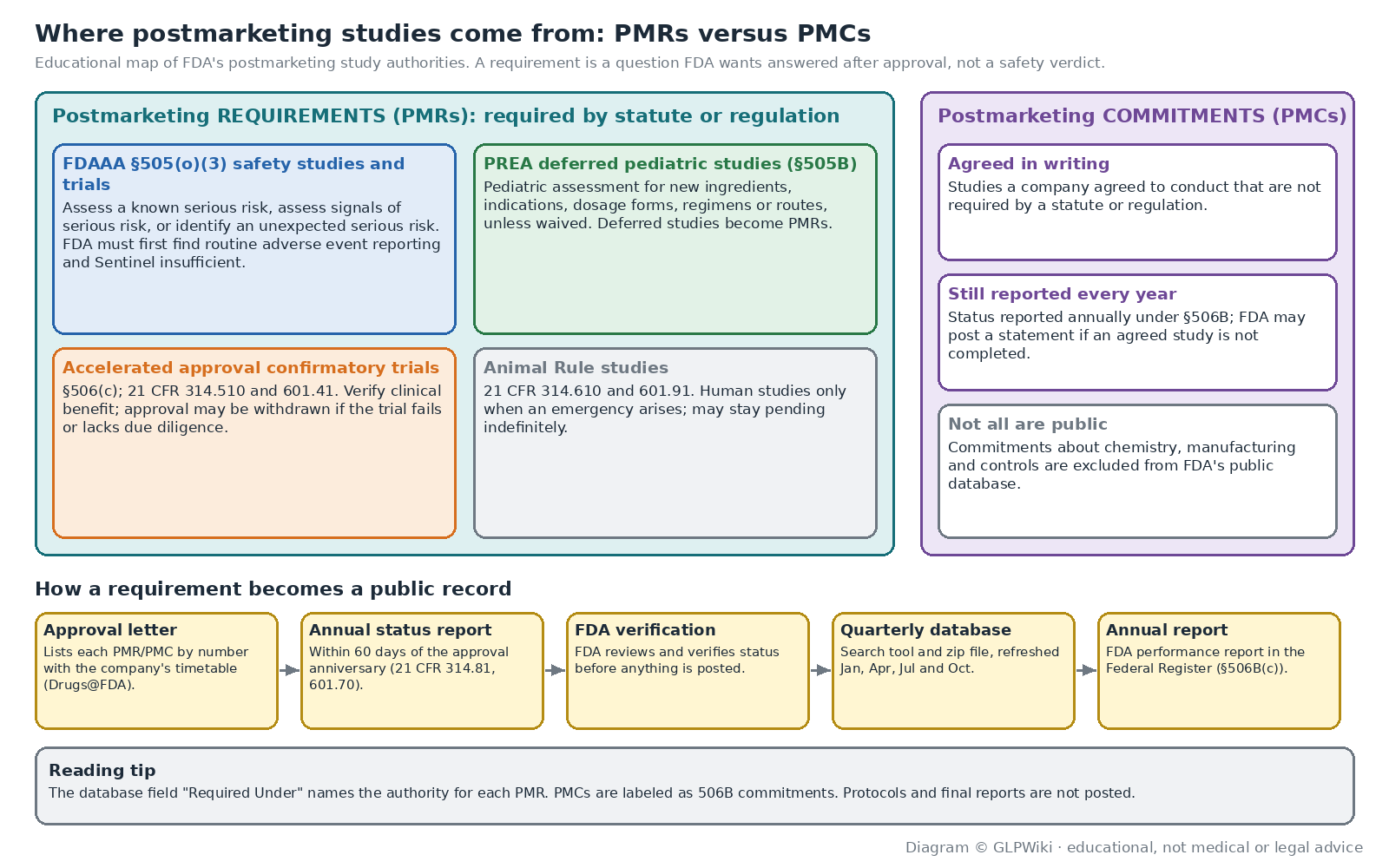
Where PMRs and PMCs appear in public records
The same requirement shows up in several places, each with a different level of detail:
- Approval letters on Drugs@FDA: the original source. Each letter lists PMRs and PMCs by number (for example, "3294-2"), quotes the statutory findings, and gives the company's timetable for final protocol, study completion and final report.
- FDA's searchable PMR/PMC database: search by product, active ingredient, applicant, application number, status or "Required Under" authority. It shows each requirement's text, current status, original final report date and, for delayed or terminated items and all pediatric studies, an explanation of status.
- The downloadable database file: the same public data as a zip file, refreshed around the end of January, April, July and October.
- FDA's annual Federal Register report: aggregate performance across all companies, published under section 506B(c).
- ClinicalTrials.gov: many required trials and registries are registered there, with design details, status and sometimes results.
- The label: when a PMR changes what is known, the result reaches the Prescribing Information through a labeling supplement, which GLPWiki's label version tracking guide explains.
How to read a database entry
FDA's FAQ explains each field. One record represents an application or supplement, with one or more requirements beneath it. The Requirement/Commitment Number matches the number in FDA's letters; it is not a ranking. A set number groups requirements issued together. Square brackets mean text was redacted under the Freedom of Information Act. Protocols and final reports are not posted; FDA says they can be requested from the company or through FOIA, and may be redacted.
The status field is where most misreadings happen. FDA defines each term, and the reference point is the original schedule, not a revised one:
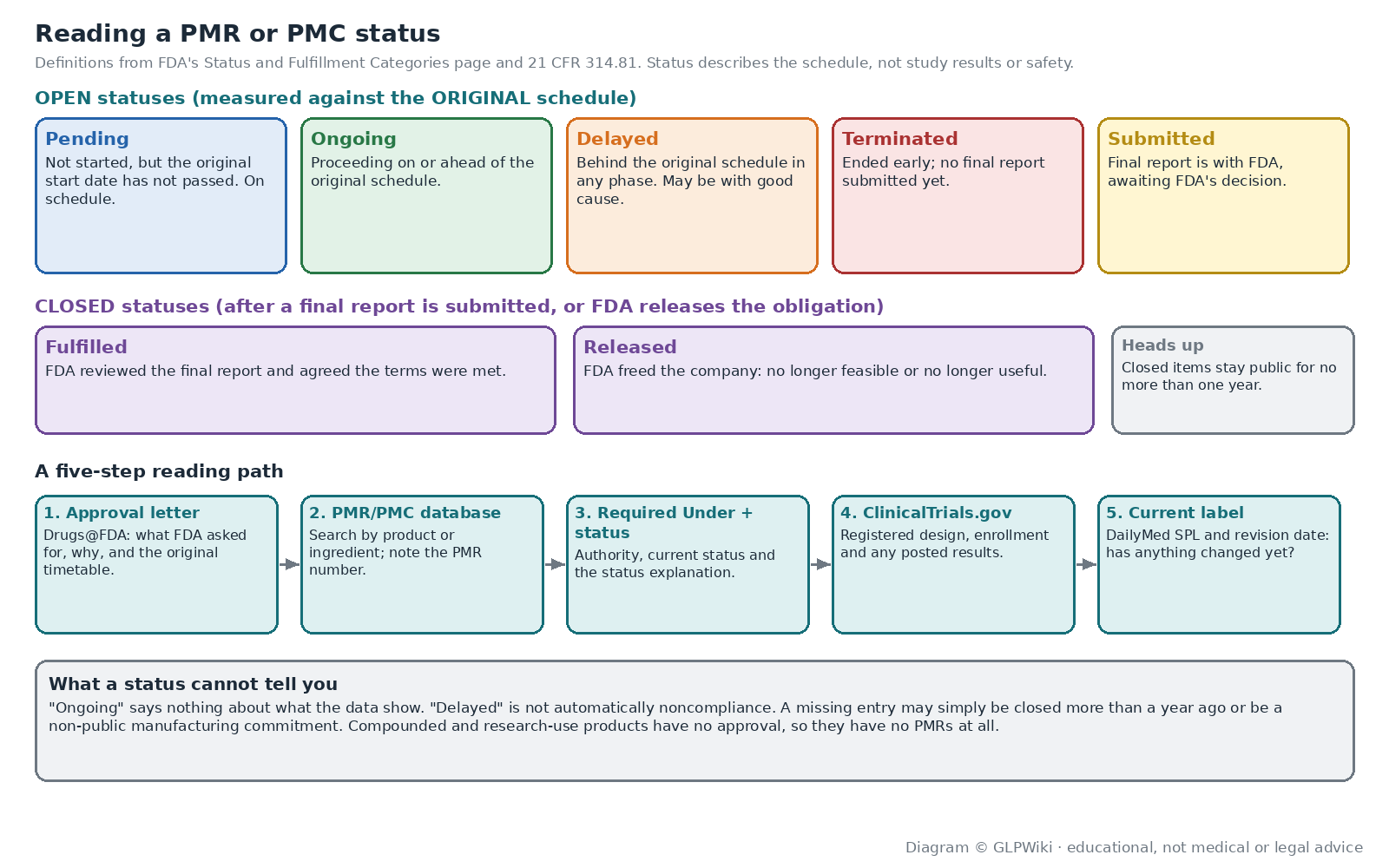
- Pending: not yet started, but the original start date has not passed. Pending is on schedule.
- Ongoing: proceeding according to, or ahead of, the original schedule.
- Delayed: behind the original schedule in any phase, from enrollment to final report. Delays may be justified; for 505(o)(3) studies, FDA decides whether there was good cause.
- Terminated: ended early, with no final report yet submitted.
- Submitted: a final report is with FDA, which has not yet decided whether the requirement is met.
- Fulfilled (closed): FDA reviewed the final report and agreed the terms were met.
- Released (closed): FDA freed the company from the obligation because the study is no longer feasible or would no longer provide useful information.
What the GLP-1 entries say (FDA data file of October 2026)
The examples below come from FDA's downloadable PMR/PMC file dated October 30, 2026, cross-checked against the original approval letters. They describe what studies are required and their reported status; they are not findings about safety or effectiveness, and statuses change every quarter.
A 15-year registry for medullary thyroid carcinoma
GLP-1 receptor agonists cause thyroid C-cell tumors in rodents; a 2010 study in Endocrinology linked this to GLP-1 receptors on rodent C-cells, and the human relevance has not been determined. Because medullary thyroid carcinoma (MTC) is rare, spontaneous reports cannot reveal whether its incidence changes. FDA's 2017 Ozempic approval letter says exactly that: analysis of spontaneous adverse events "will not be sufficient to assess a signal of a serious risk of medullary thyroid carcinoma," and neither will FDA's surveillance system.
The result is a registry-based case series of at least 15 years to monitor U.S. MTC incidence and identify any increase related to the medicine's introduction. The October 2026 file lists one for Victoza, Saxenda, Trulicity, Ozempic, the oral semaglutide tablets, Wegovy, Mounjaro, Zepbound and Foundayo. Original final report dates range from September 2026 for Victoza, the first, to August 2043 for Foundayo, the newest. Several companies share one surveillance program, registered on ClinicalTrials.gov as NCT01511393 and described in Thyroid in 2020; its sponsors include Novo Nordisk, Eli Lilly and AstraZeneca.
The statuses show why reading the explanation matters. The original liraglutide (Victoza), Saxenda and Trulicity registries are listed as delayed, but FDA's status explanations say early protocol milestones were missed amid discussions with FDA and that FDA determined there was good cause. The later registries are listed as ongoing or pending.
A class-wide trial on retained gastric contents
GLP-1 receptor agonist labels now carry a warning about pulmonary aspiration during general anesthesia or deep sedation; on Ozempic's DailyMed label it is Section 5.10. The October 2026 file shows a matching 505(o)(3) requirement for each liraglutide, dulaglutide, semaglutide, tirzepatide and orforglipron product it lists, including the insulin degludec and liraglutide combination: a clinical pharmacology trial using ultrasound to measure how temporarily withholding the drug, and fasting duration, affect retained gastric contents, to "inform potential recommendations to mitigate the serious risk of pulmonary aspiration." For most products the final report is due November 30, 2026; for Foundayo, approved in April 2026, it is due in 2029.
This is an example of FDA using one requirement across a class. Until those trials report and any label change is approved, the current label and the clinicians planning a procedure remain the sources for what to do; this page does not give peri-procedure instructions.
Pediatric studies under PREA
Most GLP-1 approvals for adults came with deferred pediatric studies. Ozempic's 2017 letter waived studies in children under 10 because too few have type 2 diabetes, and deferred a study in ages 10 to 17. Some have closed: the file records Mounjaro's pediatric type 2 diabetes study as fulfilled per an FDA letter of December 19, 2025 (the trial, SURPASS-PEDS, was published in The Lancet in 2025), and a Zepbound pediatric pharmacology study as fulfilled in May 2026. Others are ongoing, pending or, in one case, delayed after FDA issued a missed-milestone letter in July 2026. A fulfilled pediatric PMR does not by itself mean a pediatric indication exists; check the current label.
Pregnancy registries and lactation studies
Weight-management approvals for semaglutide, tirzepatide and orforglipron carry 505(o)(3) pregnancy requirements: a prospective pregnancy exposure registry plus a second study with a different design, such as claims or electronic health record data. Foundayo's 2026 letter also requires a milk-only lactation study and a long-term registry of children treated for obesity. These exist because pre-approval trials exclude pregnancy; Section 8 of the label summarizes what is known today.
Accelerated approval for MASH
In August 2025 FDA approved Wegovy for noncirrhotic metabolic dysfunction-associated steatohepatitis (MASH) with moderate to advanced fibrosis under accelerated approval, based on liver biopsy results from the ESSENCE trial (published in NEJM in 2025). The letter requires completion of the same 240-week trial (NCT04822181) to show benefit on a composite of progression to cirrhosis, hepatic decompensation, liver transplant and death, and warns that FDA may withdraw the approval if the trial fails or is not conducted with due diligence. The October 2026 file lists it as ongoing, with a final report due December 2029, and adds 505(o)(3) requirements to assess pancreatic safety and bone health in the same trial.
An older example that became famous
Victoza's 2010 approval letter required, under 505(o)(3), a randomized trial of major adverse cardiovascular events because antidiabetic medicines had raised cardiovascular safety questions. That requirement became the LEADER trial (NCT01179048), published in NEJM in 2016. Its results later reached the label through a supplement. It is a reminder that a PMR is a question FDA asked at approval, not an answer.
Annual reports and accountability
Every open PMR and PMC must be reported in an annual status report within 60 days of the anniversary of U.S. approval (21 CFR 314.81(b)(2)(vii) for NDAs; 601.70 for BLAs). The report must describe each study, its schedule and its current status with a brief explanation. For accelerated approval trials, section 506B(a)(2) adds reports about every 180 days.
FDA's FY2024 report, covering status as of September 30, 2024, gives a sense of scale. There were 402 companies with open PMRs or PMCs under 826 NDAs and BLAs. Of 750 annual status reports due, 78% arrived on time, 9% arrived late and 13% were expected but not received. Of 1,636 open PMRs, 70% were on schedule and 30% were off schedule (delayed or terminated); of 386 open PMCs, 80% were on schedule.
FDA cautions against over-reading these numbers. The report says year-to-year comparisons can mislead because the pool of open studies changes, and that its totals cannot be compared with database searches, which include only verified, publicly reportable items. FDA issued draft guidance in July 2023 on how it decides whether a company had good cause for missing a 505(o)(3) milestone.
Independent research adds context. A 2018 BMJ analysis of 437 PMRs for new drugs and biologics approved in 2009 to 2012 found descriptions were short (median 44 words), often too brief to characterize study designs, and that about a quarter of required prospective studies, registries and trials were not publicly disseminated.
What these records can and cannot tell you
PMR and PMC records are primary sources, but they answer a narrow question: what did FDA ask for, and is it on schedule?
- A PMR is not a safety verdict. Requiring an MTC registry reflects a rodent finding and a rare outcome, not a demonstrated human risk; the label states what is and is not known.
- Status is about schedule, not results. "Ongoing" says nothing about what the data show; results appear in final reports, publications, ClinicalTrials.gov and label changes.
- Delayed is not the same as noncompliant. Read the status explanation; FDA may have found good cause.
- Closed items disappear. Fulfilled and released items stay in the public database for no more than a year, so older requirements must be traced through approval letters.
- The public set is partial. Manufacturing commitments and unverified updates are excluded, and data are updated quarterly with a lag.
- Compounded, "research use only" and unapproved products have no approval, so they have no PMRs, no annual status reports and no required follow-up studies. The absence of a postmarketing trail is itself a difference from FDA-approved medicines.
A reader checklist for postmarketing headlines
When an article, ad or social post says FDA "ordered a study" or that a study is "overdue," these questions help:
- Is it a requirement (PMR) or a commitment (PMC)?
- Which authority is listed under "Required Under": 505(o)(3), PREA, accelerated approval or the Animal Rule?
- What does the approval or supplement letter say FDA was trying to learn?
- What is the current status, and what does the status explanation say?
- Is the study registered on ClinicalTrials.gov, and has it posted results?
- Has anything reached the label yet? Check the current DailyMed SPL and its revision date.
- Is the source FDA's own record, or someone's summary of it?
- For a question about your own treatment, the right next step is a licensed clinician or pharmacist; for a suspected side effect, FDA MedWatch.
Scope, disclaimer and review date
This page explains FDA postmarketing requirements and commitments: the authorities behind them, the public database and its status categories, annual reporting, FDA's FY2024 performance report, and the postmarketing studies FDA has required for GLP-1 and related incretin medicines as listed in FDA's October 30, 2026 data file and the cited approval letters. It does not provide doses, strengths, schedules, injection or device instructions, peri-procedure or fasting instructions, product or company recommendations, treatment advice, or legal counsel, and it does not rate any company's compliance. Nothing here says to start, stop or switch any medicine. Database statuses change quarterly, so check the linked primary sources for the current version.
Last reviewed: November 11, 2026.
Frequently asked questions
- What is the difference between a PMR and a PMC?
- A postmarketing requirement (PMR) is a study or clinical trial a company must conduct after approval under a statute or regulation, such as FDAAA section 505(o)(3), PREA or accelerated approval. A postmarketing commitment (PMC) is one the company agreed in writing to conduct but that is not legally required. Both are reported to FDA annually.
- Does a postmarketing requirement mean a GLP-1 medicine is unsafe?
- No. A PMR records a question FDA wants answered after approval, often about rare or long-term outcomes that pre-approval trials could not settle. For example, the MTC registries follow a rodent thyroid finding whose human relevance has not been determined. The label, not the existence of a PMR, describes known risks.
- Where can I look up the postmarketing studies for a specific medicine?
- Search FDA's Postmarketing Requirements and Commitments database by product or active ingredient, read the original approval letter on Drugs@FDA, and check ClinicalTrials.gov for the registered study. FDA's downloadable file contains the same public data and is refreshed quarterly.
- What does "delayed" mean in FDA's database?
- It means the study is behind its original schedule in some phase, such as enrollment or final report submission. It does not automatically mean the company broke the law: for 505(o)(3) studies FDA decides whether there was good cause, and the status explanation often says so.
- Why do GLP-1 medicines have a 15-year thyroid cancer registry?
- GLP-1 receptor agonists cause thyroid C-cell tumors in rodents, and medullary thyroid carcinoma is too rare for spontaneous adverse event reports to show a change in incidence. FDA therefore required registry-based case series of at least 15 years to monitor U.S. MTC incidence after each product's introduction.
- What happens if an accelerated approval confirmatory trial fails?
- Under section 506(c) and 21 CFR 314.510, FDA may withdraw the accelerated approval if the confirmatory trial fails to verify clinical benefit or is not conducted with due diligence. Wegovy's MASH approval letter states this condition for its 240-week outcomes trial.
- Do compounded or research-use GLP-1 products have postmarketing requirements?
- No. PMRs and PMCs attach to approved applications. Compounded drugs are not FDA-approved, and "research use only" products are not approved for human use, so there are no required postmarketing studies, annual status reports or public study records for them.
- Is this page advice about using any medicine?
- No. It explains how to read FDA's public postmarketing records. It does not give doses, treatment or procedure instructions, product recommendations, or legal advice. Questions about your own care belong with a licensed clinician and pharmacist.
SOURCES
- 01Postmarketing Requirements and Commitments: Introduction— FDA
- 02Postmarketing Requirements and Commitments: Frequently Asked Questions (FAQ)— FDA
- 03Postmarketing Requirements and Commitments: Status and Fulfillment Categories— FDA
- 04Search: Postmarketing Requirements and Commitments (searchable database)— FDA
- 05Postmarketing Requirements and Commitments: Downloadable Database File (data file dated October 30, 2026)— FDA
- 06Postmarketing Requirements and Commitments: Reports (annual Federal Register notices)— FDA
- 07FY 2024 Report on the Performance of Drugs and Biologics Firms in Conducting Postmarketing Requirements and Commitments (PDF)— FDA
- 0821 CFR 314.81 — Other postmarketing reports (annual report; status of postmarketing studies)— Government Publishing Office / eCFR
- 0921 CFR 601.70 — Annual progress reports of postmarketing studies (BLAs)— Government Publishing Office / eCFR
- 1021 CFR 314.510 — Accelerated approval based on a surrogate endpoint— Government Publishing Office / eCFR
- 1121 CFR 314.55 — Pediatric use information (waivers and deferrals)— Government Publishing Office / eCFR
- 1221 CFR 314.610 — Approval based on evidence of effectiveness from studies in animals— Government Publishing Office / eCFR
- 1321 U.S.C. 355 — New drugs (FD&C Act section 505, including 505(o)(3))— Legal Information Institute, Cornell Law School
- 1421 U.S.C. 355c — Research into pediatric uses (PREA, FD&C Act section 505B)— Legal Information Institute, Cornell Law School
- 1521 U.S.C. 356 — Expedited approval of drugs for serious conditions (section 506, accelerated approval)— Legal Information Institute, Cornell Law School
- 1621 U.S.C. 356b — Reports of postmarketing studies (section 506B)— Legal Information Institute, Cornell Law School
- 17Postmarketing Studies and Clinical Trials — Implementation of Section 505(o)(3) of the FD&C Act (draft guidance, October 2019) (PDF)— FDA
- 18Postmarketing Studies and Clinical Trials: Determining Good Cause for Noncompliance with Section 505(o)(3)(E)(ii) (draft guidance, July 2023)— FDA
- 19Accelerated Approval Program— FDA
- 20Pediatric Research Equity Act (PREA)— FDA
- 21FDA's Sentinel Initiative— FDA
- 22Drugs@FDA: FDA-Approved Drugs— FDA
- 23Victoza (liraglutide) NDA 022341 approval letter, January 2010 (PDF)— FDA
- 24Ozempic (semaglutide) NDA 209637 approval letter, December 2017 (PDF)— FDA
- 25Mounjaro (tirzepatide) NDA 215866 approval letter, May 2022 (PDF)— FDA
- 26Zepbound (tirzepatide) NDA 217806 approval letter, November 2023 (PDF)— FDA
- 27Wegovy (semaglutide) NDA 215256/S-024 accelerated approval letter for MASH, August 2025 (PDF)— FDA
- 28Foundayo (orforglipron) NDA 220934 approval letter, April 2026 (PDF)— FDA
- 29Ozempic (semaglutide) injection — current SPL (Section 5.10 Pulmonary Aspiration During General Anesthesia or Deep Sedation)— National Library of Medicine — DailyMed
- 30An Active Surveillance Program for Cases of Medullary Thyroid Carcinoma (NCT01511393)— ClinicalTrials.gov
- 31ESSENCE: semaglutide in MASH/NASH (NCT04822181)— ClinicalTrials.gov
- 32SURPASS-PEDS: tirzepatide in pediatric type 2 diabetes (NCT05260021)— ClinicalTrials.gov
- 33LEADER: liraglutide cardiovascular outcomes (NCT01179048)— ClinicalTrials.gov
- 34Hale PM et al. Medullary Thyroid Carcinoma Surveillance Study: A Case-Series Registry. Thyroid. 2020;30(10):1397-1398— PubMed
- 35Bjerre Knudsen L et al. GLP-1 receptor agonists activate rodent thyroid C-cells causing calcitonin release and C-cell proliferation. Endocrinology. 2010— PubMed
- 36Marso SP et al. Liraglutide and Cardiovascular Outcomes in Type 2 Diabetes (LEADER). N Engl J Med. 2016— PubMed
- 37Sanyal AJ et al. Phase 3 Trial of Semaglutide in Metabolic Dysfunction-Associated Steatohepatitis (ESSENCE). N Engl J Med. 2025— PubMed
- 38Hannon TS et al. Tirzepatide in children and adolescents with type 2 diabetes (SURPASS-PEDS). Lancet. 2025— PubMed
- 39Wallach JD et al. Postmarket studies required by the US FDA for new drugs and biologics approved between 2009 and 2012: cross sectional analysis. BMJ. 2018— PubMed
EDUCATIONAL REFERENCE ONLY · Not medical advice. Nothing here diagnoses, treats, cures or prevents any disease, and nothing here is a dosing recommendation. Consult a licensed clinician before any treatment decision.