Which version of an FDA label are you reading? Recent Major Changes, supplements, SrLC and DailyMed history

An FDA prescription label changes over its whole life. New warnings get added, old ones get removed, indications expand, and instructions for use get rewritten. So "what does the label say?" always comes with a second question: which version? This guide shows how to answer it with free public tools. It covers what Recent Major Changes in Highlights does and does not tell you, how supplements and approval letters on Drugs@FDA record each change, how FDA's Drug Safety-related Labeling Changes (SrLC) database indexes safety updates, and how DailyMed's set IDs, version numbers and dates fit together. The examples come from current GLP-1 labels. This page explains how label history is recorded. It does not summarize any product's current warnings or doses, and it is not medical advice.
UPDATED 29 OCT 2026 · 13 MIN READ
KEY TAKEAWAYS
- A label is a living document. After approval, the company changes it through supplements under 21 CFR 314.70 (drugs) or 601.12 (biologics). FDA can also require safety changes under section 505(o)(4) of the FD&C Act.
- Recent Major Changes (RMC) in Highlights, required by 21 CFR 201.57(a)(5), covers only five sections: Boxed Warning, Indications and Usage, Dosage and Administration, Contraindications, and Warnings and Precautions. Each entry gets a month/year date and must stay listed for at least one year. The changed text in the full Prescribing Information is marked with a vertical line, per 201.57(d)(9).
- RMC is a rolling window, not a history. A change to Adverse Reactions, Drug Interactions or Specific Populations never appears there, and older changes drop off.
- Drugs@FDA is the approval record. It lists the original approval and each supplement with its type (Labeling, Efficacy, Manufacturing and so on), the approval letter that says what changed, and a label PDF frozen at that action. FDA's glossary notes that supplement numbers are "usually, but not always, sequential."
- DailyMed shows the labeling currently in use as Structured Product Labeling (SPL). The set ID stays the same across versions. The version number rises with each posted SPL, and DailyMed separates the Published Date (when DailyMed posted it) from the Updated Date (the SPL's effective time).
- FDA's SrLC database lists safety-related labeling changes from January 2016 onward for NDAs and CDER-regulated BLAs. It covers the Boxed Warning, Contraindications, Warnings and Precautions, Adverse Reactions, Drug Interactions, Use in Specific Populations and patient labeling. It does not cover Indications or Dosage and Administration, and it does not cover generic (ANDA) labels.
- Removals are changes too. In January 2026 FDA asked the holders of three GLP-1 weight-management labels to remove the suicidal behavior and ideation warning. Those labels' Highlights now show the entry as "(Removed)" with a date.
- A good citation habit: record the product, the source you read, the "Revised:" date and, for DailyMed, the set ID and version number. Compounded and "research" products have none of these records, because they have no FDA-approved labeling to version.
Why label versions matter
GLPWiki's label-literacy series explains each part of FDA Prescribing Information (PI): the Highlights, the numbered sections from Indications (Section 1) to Patient Counseling (Section 17), and the patient labeling that comes with them. All of those guides assume you are reading the current label. In practice people often are not. A screenshot in a forum, a PDF saved years ago, a summary in an article, or a cached search result may reflect an older version.
That matters because modern labels change often. The Ozempic (semaglutide injection) label is a good example. It was first approved in December 2017. As of our check on October 29, 2026, its DailyMed page listed 19 published versions, and the openFDA copy of the Drugs@FDA data listed 15 approved supplements. Other GLP-1 labels have similar histories. Academic work shows this is normal for new drugs. In a cohort of 222 novel therapeutics approved from 2001 to 2010, 32% had a postmarket safety event, such as a new boxed warning, a safety communication or a withdrawal, during a median follow-up of 11.7 years (Downing et al., JAMA 2017). An FDA review of 22 new molecular entities approved in 2008 identified 189 new safety issues added to labeling over 10 years (Croteau et al., Drug Safety 2022).
This guide covers the version-tracking skill itself. It describes how changes are made, where each one is recorded, and how to tell which version you are looking at. It does not say what any label currently says about risks or dosing. For that, open the current label for the exact product.
How a label changes: supplements, CBEs and annual reports
Once a drug is approved, the application holder cannot simply edit the label. The rules for postapproval changes to NDA products are in 21 CFR 314.70. Biological products licensed under a BLA follow a parallel rule, 21 CFR 601.12(f). Semaglutide, tirzepatide and liraglutide products are marketed under NDAs. Dulaglutide (Trulicity), a larger Fc-fusion protein, is licensed under a BLA, so 601.12 applies to it. FDA's 2004 guidance Changes to an Approved NDA or ANDA explains the categories in plain language.
For labeling there are three main routes:
- Prior approval supplement (major change). Under 314.70(b)(2)(v), most labeling changes, any change to the Highlights content required by 201.57(a), and most Medication Guide changes need FDA approval before the revised labeling is distributed.
- "Changes being effected" supplement (often called CBE-0). Under 314.70(c)(6)(iii), the holder can put certain changes into effect when FDA receives the supplement, before approval. These include changes that "add or strengthen a contraindication, warning, precaution, or adverse reaction," strengthen statements about abuse, dependence or overdosage, or "add or strengthen an instruction about dosage and administration that is intended to increase the safe use of the drug product." They must reflect "newly acquired information," a term defined in 21 CFR 314.3 and clarified in FDA's 2008 final rule. Changes to Highlights are excluded from this route. FDA then reviews the supplement and can still reject it.
- Annual report (minor change). Under 314.70(d)(2)(x), "an editorial or similar minor change in labeling" can simply be reported in the annual report.
New indications and other supplements
Supplements can also add new indications or populations. Drugs@FDA classifies these as Efficacy supplements, and they often change Sections 1, 2, 6, 8 and 14 at the same time. Manufacturing (CMC) supplements sometimes touch storage or How Supplied text too.
FDA-required safety changes (section 505(o)(4))
Since 2007, section 505(o)(4) of the Federal Food, Drug, and Cosmetic Act has let FDA require labeling changes based on new safety information. Since 2018 that also includes "information related to reduced effectiveness." FDA sends a notification letter. Within 30 days the holder must either submit a supplement proposing the change or explain why it believes no change is warranted. If the two sides cannot agree after a discussion period, FDA can order the change. FDA's Safety Labeling Change Orders page describes this process. FDA's guidance on 505(o)(4) dates from July 2013, and a revised draft was issued in September 2025 that, as of this review, has not been finalized.
A real example, step by step
The pulmonary aspiration update to GLP-1 labels shows how one change leaves a trail through every public system. The steps below come from public FDA documents. We show them only to illustrate the record-keeping, not to summarize the safety content.
The figure below maps these steps onto the general pipeline, and the dated steps follow it.
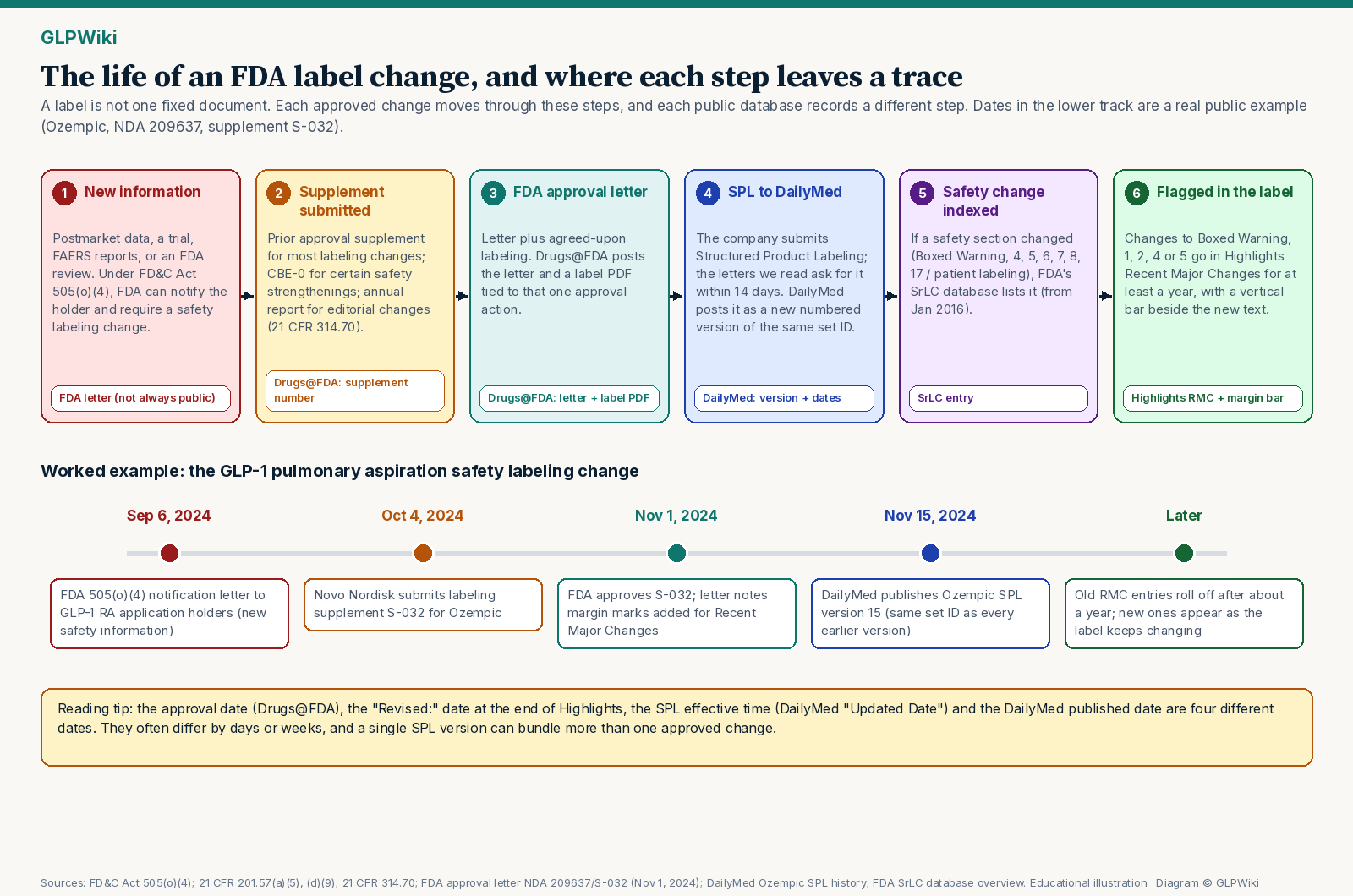
- September 6, 2024: FDA notification. The Ozempic approval letter for supplement S-032 refers to "our letter dated September 6, 2024, notifying you, under Section 505(o)(4) of the FDCA, of new safety information" for "glucagon-like peptide-1 receptor agonist (GLP-1 RA) products," about "the serious risk of pulmonary aspiration for patients undergoing elective surgeries or procedures requiring general anesthesia or deep sedation."
- October 4, 2024: supplement submitted. The same letter says the supplemental application was "dated and received October 4, 2024."
- November 1, 2024: approval. FDA approved S-032. The letter lists "minor editorial revisions," including "Margin marks added to the Prescribing Information to reflect Recent Major Changes," which are the vertical lines required by 201.57(d)(9). In the openFDA copy of the Drugs@FDA data, this supplement's review priority is recorded as "901 REQUIRED."
- Within 14 days: SPL submission. Like the other approval letters we read, it asks the company to submit the content of labeling in SPL format "no later than 14 days from the date of this letter." It notes that "The SPL will be accessible from publicly available labeling repositories."
- November 15, 2024: DailyMed version. DailyMed's version history for the Ozempic set ID shows version 15 published on November 15, 2024.
- Other GLP-1 labels. The 505(o)(4) letter went to GLP-1 RA application holders as a class. Victoza's current Highlights, for example, list "Pulmonary Aspiration During General Anesthesia or Deep Sedation (5.9)" under Recent Major Changes with the date 11/2024.
Recent Major Changes: what it is, and what it is not
Recent Major Changes is the label's built-in change log, but it is deliberately narrow. 21 CFR 201.57(a)(5) limits it to the sections in paragraphs (c)(1), (c)(2), (c)(3), (c)(5) and (c)(6): Boxed Warning, Indications and Usage, Dosage and Administration, Contraindications, and Warnings and Precautions. For each change, the heading (and subheading if appropriate), the section number and "the date (month/year) on which the change was incorporated in labeling" are listed in label order. The rule says a changed section "must be listed under this heading in Highlights for at least 1 year after the date of the labeling change and must be removed at the first printing subsequent to the 1 year period."
FDA's 2013 PLR implementation guidance adds practical detail:
- Entries follow the order of the full PI, "not ordered by dates of the changes."
- If a section changed more than once in the past 12 months, FDA recommends listing "only the newest date." Some labels list more than one date anyway. For example, Wegovy's current Highlights show two dates beside Indications and Usage.
- Deletions can be identified too. Saxenda's current Highlights list "Contraindications, Pregnancy (4) … (Removed) 05/2025" and a Section 5 warning marked "(Removed) 02/2026."
- Holders should review RMC whenever they submit a supplement and delete listings over a year old. Because removal happens "at the first printing" after a year, an entry can stay visible longer than 12 months if the label has not been reprinted.
Reading cautions
Three cautions apply when you read Recent Major Changes. Our Highlights guide explains the rest of Highlights, including the "Revised:" date and the limitation statement.
- No entry does not mean no change. Changes to Adverse Reactions (6), Drug Interactions (7), Use in Specific Populations (8), Clinical Pharmacology (12), patient labeling and other sections never appear in RMC.
- Old changes disappear. For anything older than about a year, use Drugs@FDA's supplement history or DailyMed's archived versions.
- The vertical bar is the detail. RMC tells you which section changed. The vertical line beside the text in the full PI tells you which words changed.
Drugs@FDA: the approval record
Drugs@FDA is FDA's public database of approved drugs and their approval history. For each application number (Ozempic is NDA 209637), it lists the original approval and every approved supplement. Each supplement shows:
- A supplement number (S-001, S-002 and so on). FDA's glossary says each supplemental application "is assigned a number which is usually, but not always, sequential." Approval order can differ from number order. For Ozempic, S-003 was approved after S-004.
- A supplement type or category, such as Labeling, Efficacy or Manufacturing (CMC). The openFDA Drugs@FDA dataset for Ozempic lists Labeling, Efficacy and Manufacturing supplements between 2019 and 2026.
- Documents, usually an approval letter and a label PDF, sometimes reviews. The letter is often the fastest way to learn what a supplement changed. Recent Ozempic letters describe, for example, an Instructions for Use update about pen-needle compatibility statements (S-038, June 2026) and a carton change removing a printed quick guide (S-044, August 2026).
Two cautions
- A Drugs@FDA label PDF is a snapshot. It shows labeling as approved with that action. It may not include changes from a later CBE supplement, or the company's later SPL. The approval letters themselves say the SPL must include "any labeling changes in pending 'Changes Being Effected' (CBE) supplements, as well as annual reportable changes not included in the enclosed labeling."
- The newest approval is not always the newest text you can read. A supplement approved in late August may not appear as a new DailyMed version for days or weeks, and some supplements, such as carton-only changes, may not change the PI at all.
DailyMed: set IDs, versions and two kinds of date
DailyMed, run by the National Library of Medicine, publishes labeling as submitted by companies in SPL format. Three identifiers matter:
- Set ID. One stable identifier for a labeling document across all its versions. Ozempic's DailyMed set ID has stayed the same since its first version in December 2017. Bookmark the set ID, not a version.
- Version number. This rises with each new SPL. Numbers can skip, so a label at "version 40" may show fewer than 40 published versions in its history. As of our check, Mounjaro's current SPL is version 40, while its DailyMed history lists 22 published versions.
- Dates. DailyMed's drug pages explain that the Published Date is "the date that a drug label is published on DailyMed for public view. This is distinct from Updated Date," which is "also known as Effective Time" and is "the label revision date included in the SPL." For Ozempic's current version 20, the SPL effective time is June 1, 2026, matching the approval date of supplement S-038. DailyMed's published date is June 10, 2026.
Archives, web services and which source to read
Each drug page has a View Labeling Archives link listing every published version with a download. DailyMed's public web services include an SPL history endpoint for each set ID, which is useful for researchers who track changes over time.
Because DailyMed reflects what the company submitted, it is usually the best place to read the full current text, including the Medication Guide and Instructions for Use. Drugs@FDA remains the record of what FDA approved and when. Our patient-labeling guide explains why the PI, Medication Guide and Instructions for Use can each carry their own revision date.
The SrLC database: safety changes since 2016
FDA's Drug Safety-related Labeling Changes (SrLC) database lists "updates to safety information in labeling for human prescription drugs regulated under NDAs and human prescription biological products regulated under BLAs," from January 2016 onward. According to FDA's overview page, it includes:
- changes from labeling and efficacy supplement approvals, whether initiated by the company or by FDA, and
- changes required under section 505(o)(4).
What SrLC covers
It covers safety information in the Boxed Warning, Contraindications, Warnings and Precautions, Adverse Reactions, Drug Interactions, Use in Specific Populations, and Patient Counseling Information / Patient Information / Medication Guide. You can search by drug name or by date range.
What SrLC does not cover
SrLC does not cover the items listed below. Safety changes from before January 2016 are on the MedWatch archive. Because SrLC catches changes to Sections 6, 7 and 8 that Recent Major Changes never shows, it is a useful complement to Highlights.
- Indications and Usage or Dosage and Administration (use Drugs@FDA for those),
- generic drugs approved under ANDAs,
- most CBER-regulated biologics, such as vaccines and blood products, or
- nonprescription drugs.
Putting the sources together
No single tool gives the whole story. Each answers a different question, as the figure and the question-by-question list below show.
FDA's FDALabel tool offers full-text search across tens of thousands of labels. openFDA provides the same label and Drugs@FDA data through APIs. openFDA itself warns: "Do not rely on openFDA to make decisions regarding medical care."
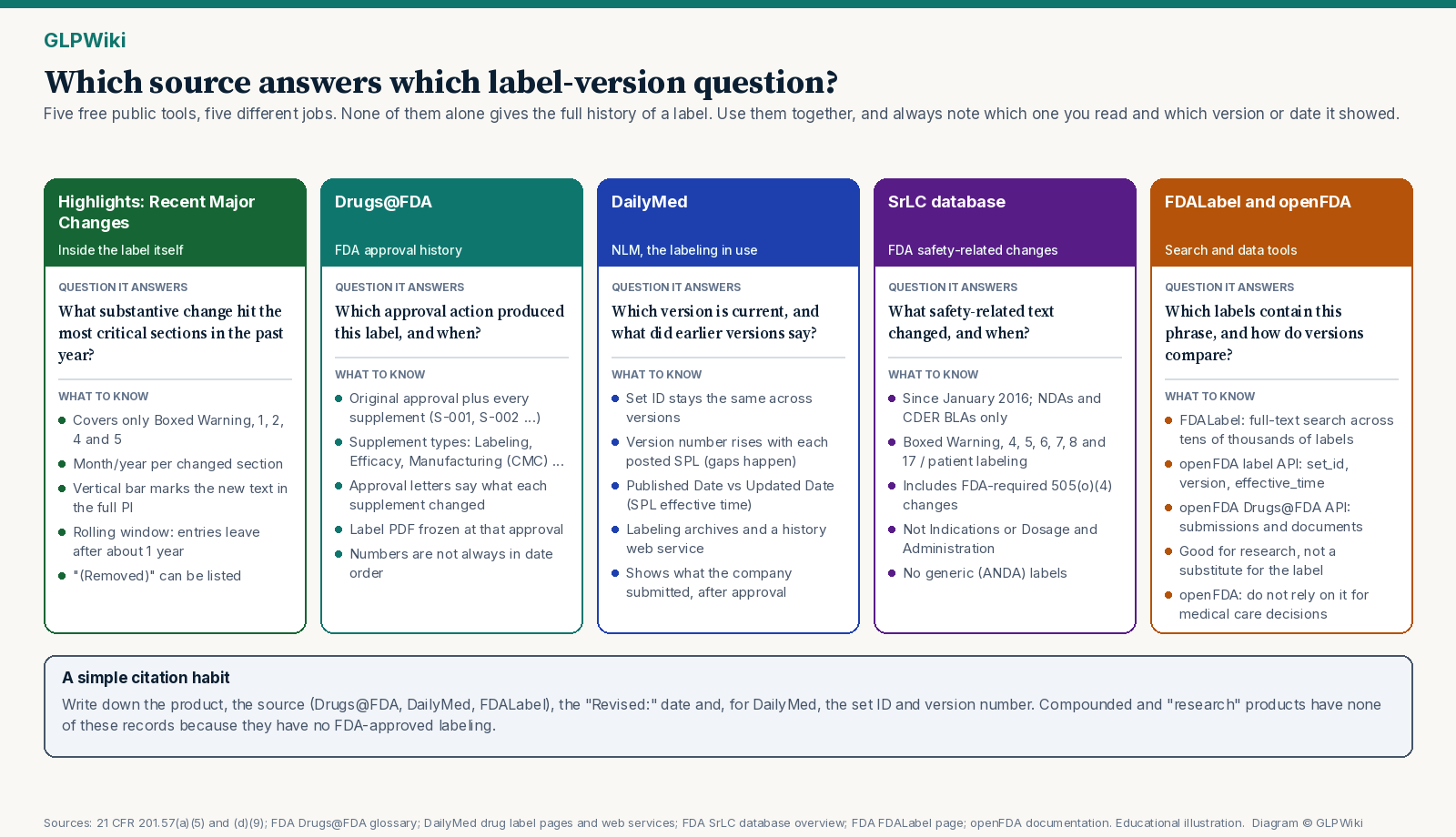
- What changed in the most critical sections over the past year? → Highlights → Recent Major Changes (Built into the label; vertical bars point to the new text)
- Which approval produced this label, and what did it change? → Drugs@FDA supplement history and letters (Official approval record, dated)
- What is the current full text, and what did earlier versions say? → DailyMed (set ID, version, archives) (Current SPL plus archived versions)
- Which safety sections changed, and when? → SrLC database (Indexed safety changes since 2016)
- Which labels contain a phrase, or how do versions compare? → FDALabel; openFDA label and Drugs@FDA APIs (Full-text search and structured fields (set_id, version, effective_time))
Generic, compounded and "research" products
Generics. A generic (ANDA) label must generally be the same as the reference listed drug's labeling, apart from permitted differences such as manufacturer details, under 21 CFR 314.94(a)(8)(iv). Generic labels are updated to follow the reference label, so they can lag it. SrLC does not index ANDA labels, so check the generic's own DailyMed page.
Compounded and "research" products. These have no FDA-approved labeling, so there is no Recent Major Changes, no supplement history, no SrLC entry and no versioned SPL from an approved application. FDA has warned about unapproved and compounded GLP-1 products and has reported dosing errors linked to compounded semaglutide. A vendor's "label" or PDF is not an FDA label, however official it looks. See our guide to compounded vs FDA-approved GLP-1s.
Common misreadings
Six misreadings come up again and again when people quote labels.
- "It's not in Recent Major Changes, so nothing changed." RMC covers five sections for about one year. Check SrLC and Drugs@FDA.
- "The Drugs@FDA PDF is the current label." It is the label as of that approval. Compare its date with DailyMed's current version.
- "Version 40 means 40 changes." Version numbers can skip, and one version can bundle several approved changes.
- "The Revised date is when FDA approved the change." It is the date of the most recent labeling revision. Approval dates, SPL effective times and DailyMed published dates can all differ.
- "A removed warning means the risk was found to be zero." A removal reflects FDA's review of the evidence for that labeling statement. Read FDA's communication and the current label for what it actually concluded. For example, FDA's January 2026 Drug Safety Communication explains its review behind the suicidal behavior and ideation removal for Saxenda, Wegovy and Zepbound.
- "Brand labels for the same molecule change together." Class-wide requests can arrive together, but each application is updated through its own supplement, and timing differs.
A five-step version check
Work through these five steps in order. Then write down what you read: product, source, date and version. Anyone checking your work later can then find the same text.
- Step 1: Identify the exact product. Brand, dosage form and application number. Different presentations of the same molecule can have different labels.
- Step 2: Open the current DailyMed page. Note the set ID, version number, Published Date and Updated Date, plus the "Revised:" date at the end of Highlights.
- Step 3: Read Recent Major Changes, then find the vertical bars in the full PI.
- Step 4: Check Drugs@FDA for the latest supplements and read their approval letters to learn what each changed.
- Step 5: Search SrLC for safety-section changes, especially Sections 6, 7 and 8, which RMC does not cover. If you are comparing with an older document, open DailyMed's labeling archives to read the matching version.
Scope, disclaimer and review date
GLPWiki is an educational resource. This guide explains how changes to FDA prescription drug labeling are recorded and how to identify which version of a label you are reading. It is not medical advice. It does not describe any product's current risks, doses or instructions, and it does not recommend for or against any treatment. Decisions about any medicine belong with a licensed clinician or pharmacist using the current FDA-approved labeling for the exact product. Database contents and label versions described here were checked on October 29, 2026 and will change. To report a suspected adverse reaction, contact the manufacturer or FDA MedWatch at 1-800-FDA-1088 or www.fda.gov/medwatch.
Last reviewed: October 29, 2026. Labels, supplements and database entries change often; verify with Drugs@FDA, DailyMed, the SrLC database, and your pharmacist or clinician.
Frequently asked questions
- What is Recent Major Changes in an FDA label?
- It is a heading in Highlights of Prescribing Information, required by 21 CFR 201.57(a)(5). It lists substantive changes in the past year to the Boxed Warning, Indications and Usage, Dosage and Administration, Contraindications, or Warnings and Precautions, each with a month/year date. The changed text in the full PI is marked with a vertical line.
- Why doesn't Recent Major Changes mention a new side effect I read about?
- Adverse Reactions (Section 6), Drug Interactions (7) and Use in Specific Populations (8) are not covered by Recent Major Changes. Check FDA's SrLC database and the Drugs@FDA approval letters instead.
- What is a DailyMed set ID?
- A stable identifier for one labeling document across all its versions. Each new SPL version keeps the same set ID and gets a higher version number. DailyMed's labeling archives list every published version.
- Why are there different dates on DailyMed?
- The Published Date is when DailyMed posted that version. The Updated Date, or effective time, is the revision date inside the SPL. The "Revised:" date in Highlights is the date of the most recent PI revision, and patient labeling can have its own dates.
- What is the SrLC database?
- FDA's Drug Safety-related Labeling Changes database. It lists safety-related labeling changes since January 2016 for NDA products and CDER-regulated BLA products, including changes FDA required under section 505(o)(4). It does not include generics, Indications, or Dosage and Administration changes.
- What is a 505(o)(4) safety labeling change?
- Section 505(o)(4) of the FD&C Act lets FDA require application holders to add new safety information, including information about reduced effectiveness, to labeling. The holder has 30 days to submit a supplement or a rebuttal, and FDA can order the change if they cannot agree.
- Is the label PDF on Drugs@FDA the current label?
- Not necessarily. It shows labeling as approved with one specific action. Later supplements, CBE changes and annual-report edits may have changed it since. Compare dates with the current DailyMed version.
- Do compounded GLP-1 products have label versions?
- No. Compounded and "research" products are not FDA-approved, so they have no FDA-approved labeling, no supplement history and no Recent Major Changes.
SOURCES
- 0121 CFR 201.57 — Specific requirements on content and format of labeling; (a)(5) Recent major changes, (a)(15) revision date, (d)(9) vertical line— eCFR
- 0221 CFR 314.70 — Supplements and other changes to an approved NDA; (b)(2)(v), (c)(6)(iii), (d)(2)(x)— eCFR
- 0321 CFR 601.12 — Changes to an approved application (biologics); (f) labeling changes— eCFR
- 0421 CFR 314.3 — Definitions, including "newly acquired information"— eCFR
- 0521 CFR 314.94 — Content and format of an ANDA; (a)(8)(iv) labeling same as reference listed drug— eCFR
- 0621 U.S.C. 355 (FD&C Act section 505), subsection (o)(4) Safety labeling changes— GovInfo, U.S. Code
- 07Safety Labeling Changes — Implementation of Section 505(o)(4) of the FD&C Act (guidance page; 2013 guidance and 2025 draft revision)— FDA
- 08Safety Labeling Changes — Implementation of Section 505(o)(4) (draft guidance full text, Sep 2025)— FDA
- 09Safety Labeling Change Orders (SLC procedures)— FDA
- 10Changes to an Approved NDA or ANDA (guidance, Apr 2004)— FDA
- 11Supplemental Applications Proposing Labeling Changes for Approved Drugs, Biologics, and Medical Devices (final rule), 73 FR 49603, Aug 22, 2008— Federal Register
- 12Labeling for Human Prescription Drug and Biological Products — Implementing the PLR Content and Format Requirements (guidance, Feb 2013), Recent Major Changes section— FDA
- 13Prescription Drug Labeling Resources— FDA
- 14Drug Safety-related Labeling Changes (SrLC) Database Overview— FDA
- 15Drug Safety-related Labeling Changes (SrLC) database— FDA
- 16Drugs@FDA: FDA-Approved Drugs— FDA
- 17Drugs@FDA Glossary of Terms (supplement, supplement number, supplement type)— FDA
- 18Drugs@FDA — OZEMPIC, NDA 209637 approval history— FDA
- 19NDA 209637/S-032 supplement approval letter (Ozempic; 505(o)(4) pulmonary aspiration labeling), Nov 1, 2024— FDA
- 20NDA 209637/S-038 supplement approval letter (Ozempic IFU update), Jun 2026— FDA
- 21NDA 209637/S-044 supplement approval letter (Ozempic carton labeling), Aug 2026— FDA
- 22FDA Requests Removal of Suicidal Behavior and Ideation Warning from GLP-1 RA Medications (Drug Safety Communication, Jan 13, 2026)— FDA
- 23OZEMPIC (semaglutide) injection — label page with version history and labeling archives— DailyMed
- 24WEGOVY (semaglutide) — Highlights, Recent Major Changes— DailyMed
- 25SAXENDA (liraglutide) — Highlights, Recent Major Changes including "(Removed)" entries— DailyMed
- 26VICTOZA (liraglutide) — Highlights, Recent Major Changes— DailyMed
- 27MOUNJARO (tirzepatide) — label page and version history— DailyMed
- 28ZEPBOUND (tirzepatide) — Highlights, Recent Major Changes— DailyMed
- 29DailyMed web services — SPL history by set ID (/services/v2/spls/{SETID}/history)— NLM
- 30Structured Product Labeling Resources— FDA
- 31FDALabel: Full-Text Search of Drug Product Labeling— FDA
- 32openFDA Drug Labeling API (set_id, version, effective_time fields)— FDA
- 33openFDA Drugs@FDA API (submissions and application documents)— FDA
- 34FDA alerts health care providers, compounders and patients of dosing errors associated with compounded injectable semaglutide products— FDA
- 35FDA's Concerns with Unapproved GLP-1 Drugs Used for Weight Loss— FDA
- 36Downing NS, et al. Postmarket Safety Events Among Novel Therapeutics Approved by the US FDA Between 2001 and 2010. JAMA. 2017;317(18):1854-1863— PubMed
- 37Croteau D, et al. Sources of Evidence Triggering and Supporting Safety-Related Labeling Changes: A 10-Year Longitudinal Assessment of 22 New Molecular Entities Approved in 2008 by the US FDA. Drug Saf. 2022;45(2):169-180— PubMed
EDUCATIONAL REFERENCE ONLY · Not medical advice. Nothing here diagnoses, treats, cures or prevents any disease, and nothing here is a dosing recommendation. Consult a licensed clinician before any treatment decision.