Drug Safety Communications literacy: how FDA announces new drug risks, and how a warning reaches the label

When FDA learns something new about a marketed medicine's risks, it may publish a Drug Safety Communication (DSC). This guide explains what a DSC is, how to read each section, how DSCs relate to FD&C Act 505(o)(4) safety labeling changes, Boxed Warnings, MedWatch safety alerts and REMS actions, where to find them, and what FDA actually said about GLP-1 medicines in 2013, 2024 and 2026. It is about reading regulatory records. It gives no doses or treatment advice and is not medical advice.
UPDATED 04 NOV 2026 · 16 MIN READ
KEY TAKEAWAYS
- A Drug Safety Communication is FDA's public notice about a new safety issue with a marketed medicine, written for both patients and health care professionals. FDA's index lists current DSCs from 2020 onward; older ones are archived.
- Current DSCs follow a fixed order: what FDA is doing, what the medicine is, what patients should do, what health care professionals should do, what FDA found, how to report side effects, and how to get updates.
- The action verb matters most. A DSC can announce an evaluation still in progress, a new or stronger warning, a Boxed Warning, a REMS change, the removal of a warning, or a request to withdraw a product.
- A DSC is a communication, not the legal change. Labeling changes happen through supplements, and since the 2007 FDA Amendments Act FDA can require them under FD&C Act 505(o)(4), with 30-day and 15-day clocks and, rarely, a formal safety labeling change order.
- A Boxed Warning is the most prominent warning in prescribing information (21 CFR 201.57(c)(1)). It can be based on serious animal toxicity, which is why long-acting GLP-1 labels such as Ozempic, Wegovy and Mounjaro carry a thyroid C-cell tumor box.
- For GLP-1 medicines, FDA issued an early communication on incretin drugs and the pancreas in March 2013, a preliminary DSC on suicidal thoughts in January 2024, and a January 13, 2026 DSC asking that suicidal behavior and ideation warnings be removed after reviewing 91 trials and a Sentinel study.
- Not every FDA safety notice is a DSC. FDA's July 2024 alert on dosing errors with compounded semaglutide was a compounding alert sent through MedWatch, and FAERS quarterly potential signals are not findings of cause.
- To check whether a DSC changed a label, look for the Recent Major Changes list in Highlights, the Drugs@FDA approval letter, or the Drug Safety-related Labeling Changes (SrLC) database.
What a Drug Safety Communication is
FDA's Drug Safety Communications page says DSCs "are intended to provide important information to patients and health care professionals about new safety issues with the medicines they are taking or prescribing so they can make more informed decisions about treatment." The same page explains why they exist: widespread or long-term use can uncover side effects that clinical trials did not, so FDA keeps monitoring approved drugs, may require changes to the prescribing information or Medication Guide, and "may also release a Drug Safety Communication."
Each DSC is a web page with a dated PDF copy, and many are also available in Spanish and Chinese and as an FDA Drug Safety Podcast. The index on fda.gov lists DSCs from January 2020 onward, newest first. Earlier DSCs are kept in an archived copy linked from that page.
DSCs are not frequent. The index shows roughly 4 to 10 per year since 2020, which is one reason each one tends to attract news coverage. A DSC usually covers a single product or a whole class, and it is written for two audiences at once.
Where DSCs sit among FDA's other safety notices
- Drug Safety Communications: FDA's formal notices about new safety issues with marketed medicines, listed on the DSC index.
- MedWatch safety alerts: the broader alert stream on the Medical Product Safety Information page, covering drugs, biologics, devices and more. DSCs are commonly also distributed as MedWatch alerts.
- Drug alerts and statements, and compounding alerts: other FDA notices, such as warnings about unapproved or compounded products.
- FAERS potential signals: quarterly lists of possible safety issues required by FD&C Act 505(k)(5). FDA states a listing does not mean it has found that the drug causes the risk.
- Recalls and Enforcement Reports: product-quality problems with specific lots. Our recall guide covers these.
Anatomy of a DSC: reading it section by section
Recent DSCs use the same headings in the same order. Knowing the order lets you find the part you need fast and keeps you from mistaking background for news.
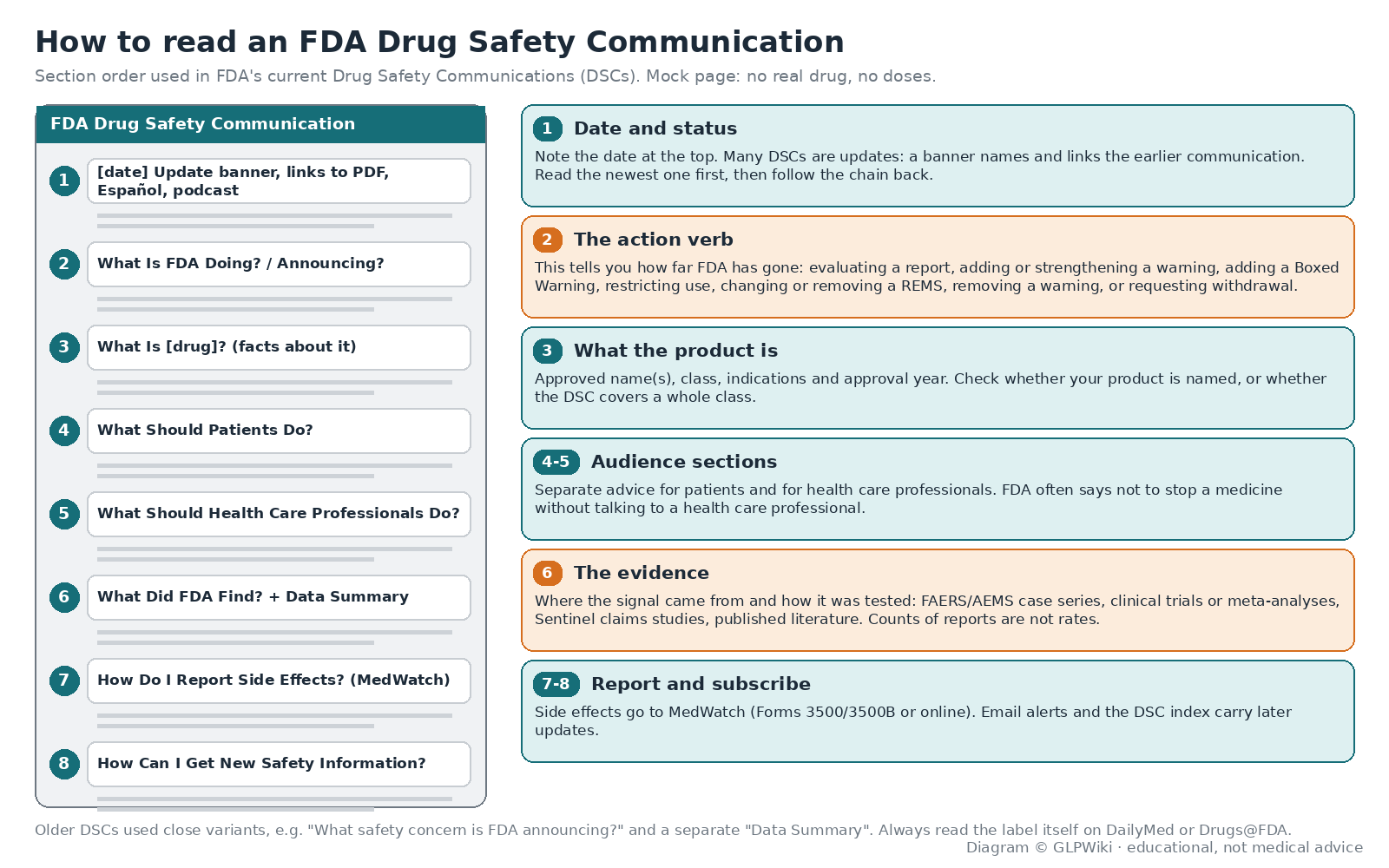
- Date and update banner. Many DSCs update an earlier one. The January 2026 GLP-1 DSC, for example, opens by saying it updates the January 2024 communication and links to it.
- What Is FDA Doing? (or Announcing?). The core of the DSC: the action and the product or class. Read the verb first.
- What Is [the drug]? Facts about the product: names, class, approved uses and approval history. Class DSCs may include a table of every affected product.
- What Should Patients Do? Plain-language advice. It often says not to stop a medicine without talking to a health care professional, and describes symptoms to report.
- What Should Health Care Professionals Do? Advice on counseling, monitoring or prescribing, tied to the updated labeling.
- What Did FDA Find? and Data Summary. The evidence: FAERS or AEMS case series, clinical trials, meta-analyses, Sentinel studies, published literature, and their limits.
- How Do I Report Side Effects? and How Can I Get New Safety Information? Links to MedWatch and to email alerts.
Reading the action: from "evaluating" to "withdrawal"
The headline verb tells you where FDA is in its process. Real DSCs from FDA's index show the range:
- Evaluating, no conclusion yet: the March 14, 2013 incretin communication said FDA "has not reached any new conclusions" and called itself an "early communication." The January 2024 GLP-1 DSC said FDA's preliminary evaluation had not found evidence of causation and that review was continuing.
- New or stronger warning: on June 10, 2026 FDA approved Drug Facts labeling changes for the nonprescription weight-loss drug alli (orlistat) to warn of kidney injury and kidney stones, based on 12 cases found in AEMS and the literature. On September 15, 2026 it approved added Kybella labeling about adverse reactions with unapproved use outside the approved area.
- Boxed Warning added: on September 1, 2026 FDA approved a Boxed Warning for ferric carboxymaltose injection (Injectafer) about low phosphate levels, after a warning added in 2020 and strengthened in 2023 and 2025, because cases kept being reported and phosphate testing remained uncommon.
- REMS changed or removed: the August 27, 2025 DSC announced that FDA had removed the clozapine REMS, effective June 13, 2025, while keeping the risk in labeling and a new Medication Guide.
- Warning removed: the January 13, 2026 DSC asked holders to remove suicidal behavior and ideation language from GLP-1 weight-reduction labels (details below).
- Withdrawal requested: on February 13, 2020 FDA asked the maker of the weight-loss drug Belviq (lorcaserin) to withdraw it after a safety trial showed more cancer, following a January 2020 early DSC.
How a DSC relates to a label change: FD&C Act 505(o)(4)
A DSC announces. The legal change happens in the labeling. FDA's 2013 guidance explains that before 2007 its options were limited: negotiate with the company, notify the public, take misbranding action, or move to withdraw approval. The Food and Drug Administration Amendments Act of 2007 (FDAAA) added section 505(o)(4) to the FD&C Act (21 U.S.C. 355(o)(4)), which lets FDA require a change when it becomes aware of "new safety information" that it determines should be included in labeling.
"New safety information" is defined in 505-1(b) and can come from clinical trials, adverse event reports, postapproval studies, peer-reviewed literature, FDA's active surveillance system, or other scientific data. FDA's 2013 guidance on safety labeling changes says it expects new safety information about serious risks, including class risks, to be handled under 505(o)(4). The affected sections are the Boxed Warning, Contraindications, Warnings and Precautions, Drug Interactions and Adverse Reactions.
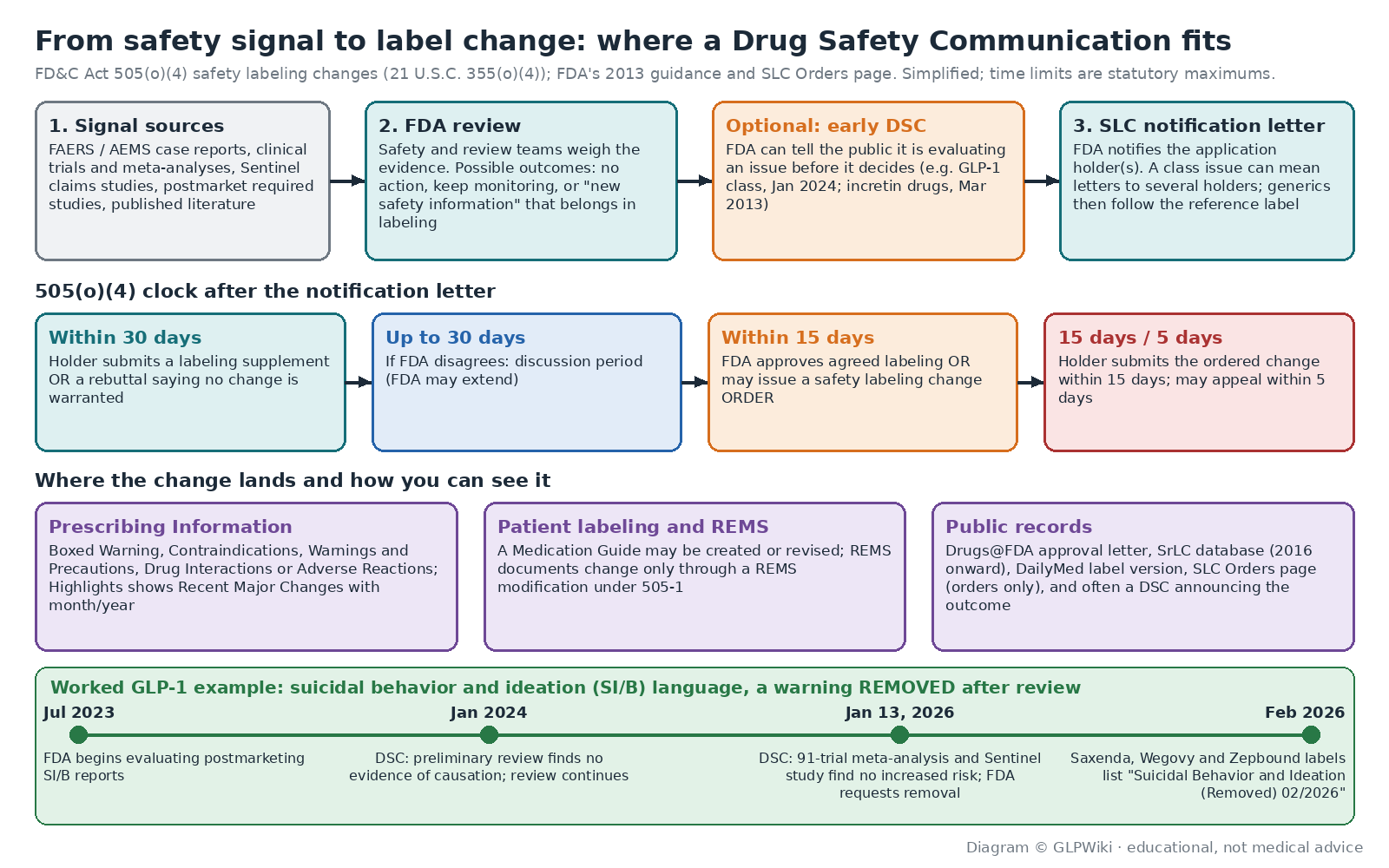
The 505(o)(4) clock
- FDA sends a safety labeling change notification letter to the application holder (or to generic holders if the reference product is no longer marketed).
- Within 30 days the holder must either submit a labeling supplement or a rebuttal statement explaining why no change is warranted.
- If FDA disagrees, it starts discussions lasting no more than 30 days unless FDA extends them.
- Within 15 days after discussions end, FDA may issue an order. The holder then has 15 days to submit the ordered change, and may appeal within 5 days of the order.
- Changes that touch a REMS are submitted as REMS modifications under section 505-1. A new or revised Medication Guide may be required so all labeling stays consistent.
Orders are rare
FDA's Safety Labeling Change Orders page lists about 70 entries going back to 2008, the most recent dated March 2, 2026. Most required changes are settled at the supplement stage, so the absence of an order says nothing about whether a label changed. Generic labels follow: the Injectafer DSC notes that generic application holders "are expected to update their labeling" after the brand change is approved.
Boxed Warnings: the most prominent warning
Under 21 CFR 201.57(c)(1), FDA may require that certain contraindications or serious warnings, "particularly those that may lead to death or serious injury," appear in a box with an uppercase heading containing the word WARNING. The box must refer to the detailed text in Contraindications or Warnings and Precautions. Highlights must carry a summary of up to 20 lines, followed by the statement "See full prescribing information for complete boxed warning."
The rule also says a boxed warning "ordinarily must be based on clinical data, but serious animal toxicity may also be the basis." Labels for long-acting GLP-1 receptor agonists such as Ozempic, Wegovy, Mounjaro and Zepbound show this: their box about the risk of thyroid C-cell tumors rests on rodent findings and has been there since approval, not added by a DSC. Boxed Warnings added after approval are common: a study of 2008-2015 found 111 postmarket Boxed Warnings: 32 new, 35 major updates and 44 minor updates (Solotke et al., 2018).
MedWatch alerts and other notices that are not DSCs
MedWatch, FDA's Safety Information and Adverse Event Reporting Program, does two jobs. It takes voluntary reports from health professionals and consumers (online, or Forms 3500 and 3500B), and it publishes safety alerts for human medical products that you can get by email or RSS. DSCs are commonly also distributed as MedWatch alerts, but many MedWatch alerts are not DSCs.
A GLP-1 example: on July 26, 2024 FDA alerted health care providers, compounders and patients to dosing errors with compounded injectable semaglutide. FDA described reports, some requiring hospitalization, in which patients drew up far more than intended from multiple-dose vials, often because of confusion between milligrams, milliliters and "units" and oversized syringes, and cases where providers miscalculated. That notice sits on FDA's human drug compounding pages and was sent as a MedWatch bulletin. It is not on the DSC index; compounded drugs are not FDA-approved and have no FDA-approved labeling for FDA to change.
FAERS quarterly potential signals are another channel. Section 505(k)(5) requires FDA to post a quarterly report of potential signals of serious risk found in its adverse event database. FDA notes that a listing does not mean it has concluded that the drug causes the risk. Our FAERS guide explains how those lists and the 2023 GLP-1 entries work.
DSCs and REMS actions
When FDA adds, modifies or removes a Risk Evaluation and Mitigation Strategy (REMS) under section 505-1, a DSC may explain why. The clozapine DSC of August 27, 2025 is a clear case: after re-evaluating the program and holding a November 2024 advisory committee meeting, FDA decided the REMS was no longer needed, while the risk stays in labeling with a new Medication Guide.
GLP-1 medicines currently have no REMS, so GLP-1 DSCs have been about labeling and evaluations rather than REMS programs. Our REMS guide covers the history and how to read REMS@FDA.
The GLP-1 record: what FDA actually communicated
Three FDA communications on the DSC pages concern GLP-1 medicines directly. Each shows a different stage of the process.
March 14, 2013: an early communication on incretin drugs and the pancreas
FDA said it was evaluating unpublished academic findings, based on a small number of pancreatic tissue samples taken after death, that suggested more pancreatitis and pre-cancerous cell changes with incretin mimetics, including exenatide and liraglutide as well as DPP-4 inhibitors. FDA said it had not reached new conclusions and that pancreatitis warnings were already in labeling. A 2014 New England Journal of Medicine report by FDA and EMA staff later said both agencies found claims of a causal link to pancreatitis or pancreatic cancer inconsistent with the current data, while pancreatitis would continue to be treated as a risk.
January 2024: a preliminary DSC on suicidal thoughts or actions
After reviewing FAERS reports, clinical trials and observational studies, FDA said its preliminary evaluation "has not found evidence that use of these medicines causes suicidal thoughts or actions," but that it could not rule out a small risk because events were few. It listed 13 approved GLP-1 receptor agonist products and announced a meta-analysis and a Sentinel analysis. Weight-management labels already carried a suicidal behavior and ideation warning, a carry-over from older weight-loss medicines. Independent observational work around that time, such as a 2024 Nature Medicine cohort study, also did not support a higher risk with semaglutide.
January 13, 2026: FDA requests removal of the warning
FDA reported a meta-analysis of 91 placebo-controlled trials with 107,910 patients that showed no increased risk of suicidal behavior and ideation or of other psychiatric events, and a Sentinel cohort study of 2,243,138 new users with type 2 diabetes that found no increased risk of intentional self-harm compared with SGLT2 inhibitors. FDA asked the holders of Saxenda, Wegovy and Zepbound to remove the warning so that all GLP-1 labels say the same thing. The current DailyMed labels for all three list "Suicidal Behavior and Ideation (Removed) 02/2026" under Recent Major Changes. The DSC still tells people to report new or worsening depression or mood changes to a health care professional, and lists the 988 crisis line.
Where to find DSCs and check what changed
- FDA Drug Safety Communications index: dated list from 2020, with an archive link for earlier DSCs and an email sign-up.
- Postmarket Drug Safety Information for Patients and Providers: the site required by FD&C Act 505(r), linking DSCs, MedWatch alerts, potential signals, SLC orders, REMS@FDA and labeling databases in one place.
- MedWatch Medical Product Safety Information: all safety alerts, plus reporting forms and RSS.
- Drug Safety-related Labeling Changes (SrLC) database: safety-related label changes from January 2016 onward, searchable by product and section.
- Drugs@FDA: supplement approval letters and labeling history by application number.
- DailyMed: the current label, its version history and the Recent Major Changes list in Highlights.
A seven-point checklist for reading any DSC
These checks help you read a DSC, or a news story about one, accurately:
- Check the date and whether a newer DSC updates it. Follow the banner links in both directions.
- Read the verb: evaluating, adding, boxing, restricting, removing or withdrawing.
- Confirm scope: one product, several named products, or a whole class. Check whether your product is named.
- Separate evidence types: case reports show that something was reported, not how often it happens. Trials, meta-analyses and Sentinel studies say more about rates.
- Look for the labeling outcome on DailyMed (Recent Major Changes), Drugs@FDA or SrLC. The label is the controlling text.
- Keep compounded and unapproved products separate: FDA notices about them are usually compounding or drug alerts, not label changes.
- Do not stop or change a medicine because of a DSC without talking to a health care professional; DSCs themselves say this. Report side effects to MedWatch.
What research says about DSCs
Studies suggest DSCs matter but do not always change behavior. A 2012 systematic review of 49 studies found that some FDA risk communications had immediate and strong effects, but many had delayed effects or none on health care use (Dusetzina et al.). In a 2019 national survey of zolpidem and eszopiclone users, about two-thirds of zolpidem users said they had heard the DSC messages, but the median respondent correctly identified only 2 of 5 key facts (Kesselheim et al.). A 2019 research letter described the sources of the initial safety signals behind DSCs and their links to later label changes (Tau et al.). The lesson for readers: go to the primary DSC and the label, not a summary of a summary.
Scope, disclaimer and review date
This page explains how FDA Drug Safety Communications, safety labeling changes, Boxed Warnings, MedWatch alerts and related FDA records work, and how to read them. It does not provide doses, strengths, schedules, injection or device instructions, product, pharmacy or switching recommendations, or individual medical advice, and nothing here suggests starting, stopping or changing any medicine. Questions about a specific medicine or symptom belong with a licensed clinician or pharmacist. If you are in crisis, call or text 988 in the U.S. Side effects can be reported to FDA MedWatch.
Last reviewed: November 4, 2026. FDA pages, labels and databases change; check the linked primary sources for the current version.
Frequently asked questions
- Is a Drug Safety Communication the same as a label change?
- No. A DSC is FDA's public explanation. The legal change is made in the product's labeling through a supplement that FDA approves, sometimes required under FD&C Act 505(o)(4). Check DailyMed, Drugs@FDA or the SrLC database to see the actual change.
- Does a DSC mean a medicine is unsafe or should be stopped?
- Not by itself. Many DSCs report an evaluation in progress or a new warning for a specific situation, and some remove warnings. FDA's DSCs usually tell patients not to stop a medicine without talking to a health care professional. This page gives no treatment advice.
- Has FDA issued Drug Safety Communications about GLP-1 medicines?
- Yes. FDA's pages show a March 14, 2013 early communication on incretin drugs and the pancreas, a January 2024 preliminary DSC on suicidal thoughts or actions, and a January 13, 2026 DSC requesting removal of suicidal behavior and ideation warnings from Saxenda, Wegovy and Zepbound labeling.
- Was FDA's 2024 warning about compounded semaglutide dosing errors a DSC?
- No. The July 26, 2024 notice is on FDA's human drug compounding pages and was sent as a MedWatch alert. It is not on the DSC index. Compounded products are not FDA-approved and have no FDA-approved labeling to change.
- What is a safety labeling change order?
- Under 505(o)(4)(E), if FDA and the application holder cannot agree on required safety labeling after discussions, FDA may order the change. The holder must submit it within 15 days and may appeal within 5 days. FDA posts its order letters online; they are rare.
- Why do many GLP-1 labels have a Boxed Warning if no DSC added it?
- 21 CFR 201.57(c)(1) allows a boxed warning based on serious animal toxicity. Long-acting GLP-1 receptor agonist labels such as Ozempic, Wegovy, Mounjaro and Zepbound have carried a box about thyroid C-cell tumors, based on rodent findings, since approval.
- How can I get new DSCs when they come out?
- Sign up for FDA's Drug Safety Communications email alerts from the DSC index, or subscribe to MedWatch safety alerts by email or RSS. FDA also publishes Drug Safety Podcasts.
- Are FAERS quarterly potential signals the same as DSCs?
- No. The quarterly lists, required by section 505(k)(5), name possible issues FDA is evaluating, and FDA states that a listing does not mean the drug causes the risk. A DSC is a fuller public communication, often after or alongside a decision.
SOURCES
- 01Drug Safety Communications (index)— FDA
- 02FDA Requests Removal of Suicidal Behavior and Ideation Warning from GLP-1 RA Medications (Drug Safety Communication, January 13, 2026)— FDA
- 03Update on FDA's ongoing evaluation of reports of suicidal thoughts or actions in patients taking a certain type of medicines approved for type 2 diabetes and obesity (Drug Safety Communication, January 2024)— FDA
- 04FDA Drug Safety Communication: FDA investigating reports of possible increased risk of pancreatitis and pre-cancerous findings of the pancreas from incretin mimetic drugs for type 2 diabetes (March 14, 2013; archived copy)— FDA (Internet Archive)
- 05FDA Adds Boxed Warning to Labeling for Ferric Carboxymaltose Injection (Injectafer) to Describe Risk of Low Phosphate Levels (September 1, 2026)— FDA
- 06FDA Approves Labeling Changes for OTC Weight Loss Drug alli (Orlistat) to Warn of Risk of Kidney Stones and Kidney Injury (June 10, 2026)— FDA
- 07FDA Approves Additional Information in Labeling for Kybella (Deoxycholic Acid) Injection Warning of Adverse Reactions Associated with Unapproved Use (September 15, 2026)— FDA
- 08FDA removes risk evaluation and mitigation strategy (REMS) program for the antipsychotic drug Clozapine (August 27, 2025)— FDA
- 09FDA requests the withdrawal of the weight-loss drug Belviq, Belviq XR (lorcaserin) from the market (February 13, 2020)— FDA
- 1021 U.S.C. 355 — New drugs (FD&C Act 505, including 505(k)(5), 505(o)(4) and 505(r))— U.S. Code (Cornell LII)
- 1121 U.S.C. 355-1 — Risk evaluation and mitigation strategies (FD&C Act 505-1)— U.S. Code (Cornell LII)
- 12Safety Labeling Changes — Implementation of Section 505(o)(4) of the FD&C Act (guidance for industry, July 2013)— FDA
- 13Safety Labeling Change Orders— FDA
- 1421 CFR 201.57 — Specific requirements on content and format of labeling (Boxed Warning, Highlights, Recent Major Changes)— eCFR
- 15Drug Safety-related Labeling Changes— FDA
- 16Drug Safety-related Labeling Changes (SrLC) database— FDA
- 17Medical Product Safety Information (MedWatch safety alerts)— FDA
- 18Subscribe to MedWatch Safety Alerts— FDA
- 19MedWatch Forms for FDA Safety Reporting— FDA
- 20Postmarket Drug Safety Information for Patients and Providers— FDA
- 21Potential Signals of Serious Risks/New Safety Information Identified from the FDA Adverse Event Reporting System (FAERS)— FDA
- 22Postmarketing Surveillance Programs— FDA
- 23FDA's Sentinel Initiative— FDA
- 24FDA Drug Safety Podcasts— FDA
- 25FDA alerts health care providers, compounders and patients of dosing errors associated with compounded injectable semaglutide products (July 26, 2024)— FDA
- 26FDA MedWatch bulletin: FDA Alerts Health Care Providers, Compounders and Patients of Dosing Errors Associated with Compounded Injectable Semaglutide Products (July 2024)— FDA (GovDelivery)
- 27Withdrawn and Expired Guidances (Drugs): Drug Safety Information — FDA's Communication to the Public (2007 final and 2012 draft, withdrawn December 4, 2017)— FDA
- 28Drugs@FDA: FDA-Approved Drugs— FDA
- 29DailyMed: Wegovy (semaglutide) label, Novo Nordisk— National Library of Medicine
- 30DailyMed: Saxenda (liraglutide) label, Novo Nordisk— National Library of Medicine
- 31DailyMed: Zepbound (tirzepatide) label, Eli Lilly— National Library of Medicine
- 32Egan AG, Blind E, Dunder K, et al. Pancreatic safety of incretin-based drugs — FDA and EMA assessment. N Engl J Med. 2014;370(9):794-797— PubMed
- 33Wang W, Volkow ND, Berger NA, Davis PB, Kaelber DC, Xu R. Association of semaglutide with risk of suicidal ideation in a real-world cohort. Nat Med. 2024;30(1):168-176— PubMed
- 34Solotke MT, Dhruva SS, Downing NS, Shah ND, Ross JS. New and incremental FDA black box warnings from 2008 to 2015. Expert Opin Drug Saf. 2018;17(2):117-123— PubMed
- 35Dusetzina SB, Higashi AS, Dorsey ER, et al. Impact of FDA drug risk communications on health care utilization and health behaviors: a systematic review. Med Care. 2012;50(6):466-478— PubMed
- 36Kesselheim AS, Sinha MS, Rausch P, et al. Patients' knowledge of key messaging in Drug Safety Communications for zolpidem and eszopiclone: a national survey. J Law Med Ethics. 2019;47(3):430-441— PubMed
- 37Tau N, Shochat T, Gafter-Gvili A, et al. Association between data sources and US Food and Drug Administration Drug Safety Communications. JAMA Intern Med. 2019;179(11):1590-1592— PubMed
EDUCATIONAL REFERENCE ONLY · Not medical advice. Nothing here diagnoses, treats, cures or prevents any disease, and nothing here is a dosing recommendation. Consult a licensed clinician before any treatment decision.