REMS and Medication Guide distribution literacy: what a REMS is, how REMS@FDA works, and why GLP-1 medicines have none

A few prescription medicines come with more than a label. FDA can require a Risk Evaluation and Mitigation Strategy, or REMS: a safety program that can add patient handouts, letters to clinicians, certified prescribers and pharmacies, lab checks or registries on top of the Prescribing Information. Separately, many more medicines carry a Medication Guide that the pharmacy must hand out. This guide explains what a REMS legally is, the building blocks FDA can choose from, how to read an entry on REMS@FDA, who in the supply chain is responsible for getting a Medication Guide to you and in which settings, and why today's GLP-1 medicines have a Medication Guide but no REMS. It is about reading regulatory records. It gives no doses or treatment advice and is not medical advice.
UPDATED 02 NOV 2026 · 18 MIN READ
KEY TAKEAWAYS
- A REMS is a drug safety program FDA can require when it decides one is necessary to ensure a drug's benefits outweigh its risks. The authority is section 505-1 of the FD&C Act (21 U.S.C. 355-1), created by the Food and Drug Administration Amendments Act of 2007. FDA notes that only a few medications require one.
- FDA weighs six statutory factors before requiring a REMS: the size of the likely patient population, the seriousness of the disease, the expected benefit, the duration of treatment, the seriousness and background rate of the adverse events, and whether the drug is a new molecular entity.
- Every REMS has a timetable for assessments (by 18 months, by 3 years and in year 7). FDA can add a Medication Guide or patient package insert, a communication plan, packaging or disposal requirements, and elements to assure safe use (ETASU) such as certified prescribers and pharmacies, safe-use documentation, monitoring or a registry.
- A Medication Guide is not the same as a REMS. Since FDA's 2011 guidance, most Medication Guides are required as labeling under 21 CFR Part 208 only, and FDA generally makes a Medication Guide a REMS element only when the REMS also has ETASU.
- Under 21 CFR 208.24 the manufacturer supplies Medication Guides, distributors pass them on, and the authorized dispenser hands one to each patient or the patient's agent when the drug is dispensed. A patient who asks must get one, even if the prescriber directed otherwise (208.26(b)).
- FDA's 2011 guidance expects a Medication Guide every time a drug is dispensed directly to a patient in an outpatient setting, the first time (and after a material change) when a clinic administers it, and not routinely for admitted inpatients, unless the patient asks or a REMS says otherwise.
- Several older GLP-1 receptor agonists launched with communication-plan REMS about thyroid C-cell tumor and pancreatitis risks; FDA released them between 2011 and 2018 once the goals were met. FDA's risk reviews for semaglutide (2017), tirzepatide (2022) and orforglipron (2026) concluded labeling with a Medication Guide was enough, and REMS@FDA listed no GLP-1 product on November 2, 2026.
- REMS and FDA-approved Medication Guides attach to approved applications. Compounded GLP-1 preparations and research-use products are not FDA-approved, so they have neither, which is a gap in information, not a sign of lower risk.
What a REMS is, and what it is not
FDA describes a Risk Evaluation and Mitigation Strategy as "a drug safety program that the U.S. Food and Drug Administration (FDA) can require for certain medications with serious safety concerns to help ensure the benefits of the medication outweigh its risks." It adds, plainly: "While all medications have labeling that informs health care stakeholders about medication risks, only a few medications require a REMS."
The legal basis is section 505-1 of the Federal Food, Drug, and Cosmetic Act (21 U.S.C. 355-1), added by the Food and Drug Administration Amendments Act of 2007 (FDAAA). FDA's 2011 Medication Guide guidance notes that the REMS provisions took effect on March 25, 2008.
A REMS is narrow by design. FDA says REMS "are not designed to mitigate all the adverse events of a medication"; those are communicated in the Prescribing Information. Instead, a REMS focuses on "preventing, monitoring and/or managing a specific serious risk." FDA's REMS FAQ adds that a REMS supports a drug's safe use as described in its approved labeling, and that some drugs with serious risks could not otherwise be approved or kept on the market.
FDA decides whether a REMS is needed, specifies the requirements and approves the program, but the manufacturer develops, runs and assesses it, often through a vendor. A REMS can apply to brand drugs, biologics and generics. It does not apply to over-the-counter medicines.
Words you will see
- REMS: the whole strategy, with one or more goals plus the elements FDA requires.
- REMS document: the FDA-approved description of what each participant must do. It is posted on REMS@FDA along with REMS materials.
- ETASU (elements to assure safe use): the strongest tools, such as certification, safe-use documentation, monitoring or a registry.
- Shared system REMS: a single program that a brand manufacturer and generic manufacturers run together.
- Released REMS: a REMS FDA has determined is no longer necessary. Labeling, including any Medication Guide, stays in place.
When FDA requires one: the six statutory factors
Section 505-1(a)(1) says FDA may require a proposed REMS with an application if FDA, consulting the office that reviews the drug and the office responsible for postapproval safety, "determines that a risk evaluation and mitigation strategy is necessary to ensure that the benefits of the drug outweigh the risks of the drug." In making that call, FDA "shall consider" six factors:
- (A) the estimated size of the population likely to use the drug;
- (B) the seriousness of the disease or condition being treated;
- (C) the expected benefit of the drug for that disease or condition;
- (D) the expected or actual duration of treatment;
- (E) the seriousness of known or potential adverse events and their background incidence in the population likely to use the drug;
- (F) whether the drug is a new molecular entity.
After approval, too
A REMS is not only an approval-time decision. Under 505-1(a)(2), FDA may require a REMS for an already-approved drug if it becomes aware of new safety information and determines a REMS is necessary. The statute defines new safety information broadly, including clinical trial results, adverse event reports, postapproval studies and peer-reviewed literature.
FDA's REMS FAQ describes the practical test the same way: whether a particular risk, on balance, outweighs the drug's benefits, and whether interventions beyond FDA-approved labeling are necessary. FDA says it also considers the burden a REMS would impose, and may seek advice from advisory committees and from patients and caregivers.
Generics follow the brand
FDA's FAQ answers a common worry directly: a REMS does not mean there will be no generic. The law requires generics of a REMS drug to have a REMS too. Under 505-1(i), a generic shares the brand's Medication Guide or patient package insert and any ETASU, either through a single shared system or a different, comparable program, and 505-1(f)(8) bars a brand holder from using ETASU to block or delay a generic approval.
The building blocks: from assessment timetable to ETASU
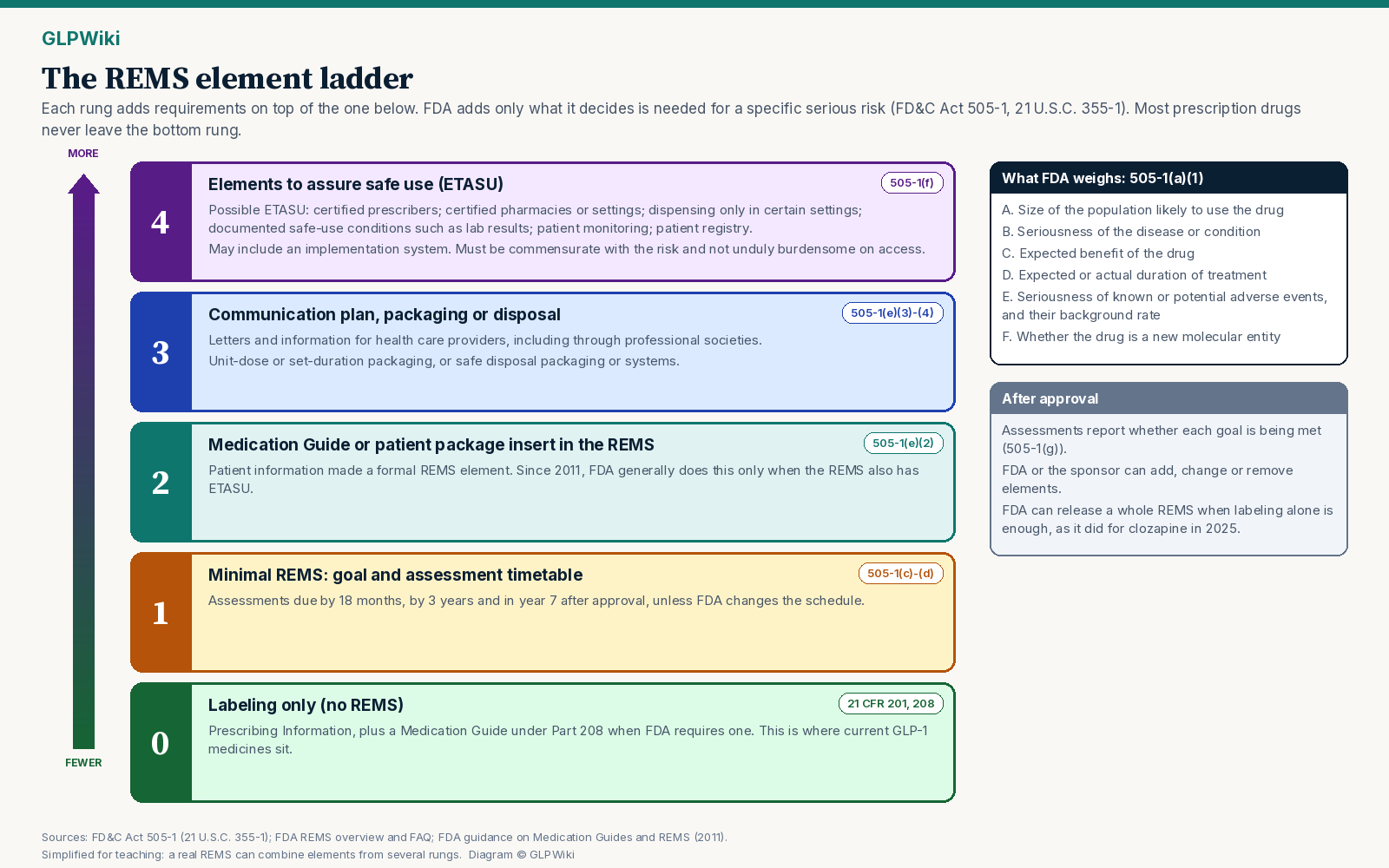
Section 505-1 is built like a menu. Every REMS must include a timetable for submitting assessments. Everything else is optional and added only when FDA makes the required determination for that element. The ladder below orders the elements from fewest to most requirements.
Timetable for assessments (every REMS)
Under 505-1(d), a REMS must schedule assessments by 18 months after initial approval, by 3 years, and in the seventh year, with other frequencies as the strategy specifies. FDA may eliminate the assessment requirement after the 3-year point if it determines the drug's serious risks have been adequately identified, assessed and managed.
Medication Guide or patient package insert (505-1(e)(2))
A REMS may require the sponsor to develop, for distribution to each patient when the drug is dispensed, a Medication Guide under 21 CFR Part 208 and, if FDA decides it may help mitigate a serious risk, a patient package insert. As the next section explains, this is now uncommon on its own.
Communication plan (505-1(e)(3))
A communication plan targets health care providers: letters, information about the REMS elements or safety protocols such as periodic lab monitoring, and messages delivered through professional societies. FDA's REMS overview notes these communications can also reach state licensing boards.
Packaging and disposal (505-1(e)(4))
For certain risks, FDA may require unit-dose or set-duration packaging, or that the drug be dispensed with safe disposal packaging or a safe disposal system.
Elements to assure safe use (505-1(f))
ETASU are reserved for a drug that "has been shown to be effective, but is associated with a serious adverse drug experience" and could be approved only if, or would be withdrawn unless, such elements are required. Each ETASU must address a specific serious risk listed in the labeling. The statute lists six options, which FDA's REMS overview explains with examples:
- (A) prescribers have particular training or experience, or are specially certified;
- (B) pharmacies, practitioners or health care settings that dispense the drug are specially certified;
- (C) the drug is dispensed only in certain health care settings, such as hospitals;
- (D) the drug is dispensed with evidence or other documentation of safe-use conditions, such as laboratory test results;
- (E) each patient using the drug is subject to certain monitoring;
- (F) each patient using the drug is enrolled in a registry.
Guardrails on ETASU
Section 505-1(f)(2) requires ETASU to be commensurate with the risk, posted publicly with an explanation within 30 days, and not unduly burdensome on patient access, with particular attention to patients with serious or life-threatening conditions, patients who have difficulty accessing care, including in rural or medically underserved areas, and patients with functional limitations. They should also minimize burden on the health care delivery system. ETASU in categories B, C and D may include an implementation system the sponsor uses to monitor and improve how pharmacies and providers carry them out.
FDA's own example is the long-acting injectable olanzapine product Zyprexa Relprevv: because of a risk of post-injection delirium sedation syndrome, its REMS requires that it be given only in certified health care facilities that can observe patients for at least three hours after each injection.
A Medication Guide is not automatically a REMS
Medication Guides are older than REMS. FDA created them by regulation in 1998 (21 CFR Part 208) for drugs it determines pose "a serious and significant public health concern requiring distribution of FDA-approved patient information." Under 208.1(c), FDA requires one when patient labeling could help prevent serious adverse effects, when patients should know about serious risks that could affect their decision to use or continue a product, or when adherence to directions is crucial to effectiveness. What a Medication Guide must contain, and how to read one, is covered in our Section 17 guide; this page is about the program it sits in and how it is delivered.
For a few years after FDAAA, FDA treated every new Medication Guide, and every safety-related change to one, as part of a REMS. Its November 2011 guidance reports that between March 25, 2008 and January 1, 2011, FDA approved over 150 Medication Guides as part of a REMS, and 108 of those REMS included only a Medication Guide and an assessment timetable.
The 2011 guidance changed course. "Not every newly required Medication Guide will be an element of a REMS," FDA wrote. FDA may approve a Medication Guide under Part 208 alone when that is adequate, and "in most cases, FDA expects to include a Medication Guide as part of a REMS only when the REMS includes elements to assure safe use." FDA's Q&A on the guidance adds that sponsors with a Medication Guide-only REMS could ask to remove the REMS, and that the drug would still have a Medication Guide distributed under the regulations.
Two consequences matter for readers. First, a Medication Guide in your bag says FDA determined patient information is necessary for that product; it does not by itself mean the drug has a REMS. Second, FDA can still require a new or changed Medication Guide quickly without a REMS, through the safety labeling change authority in section 505(o)(4), as the 2011 guidance points out.
Medication Guide distribution: who hands what to whom
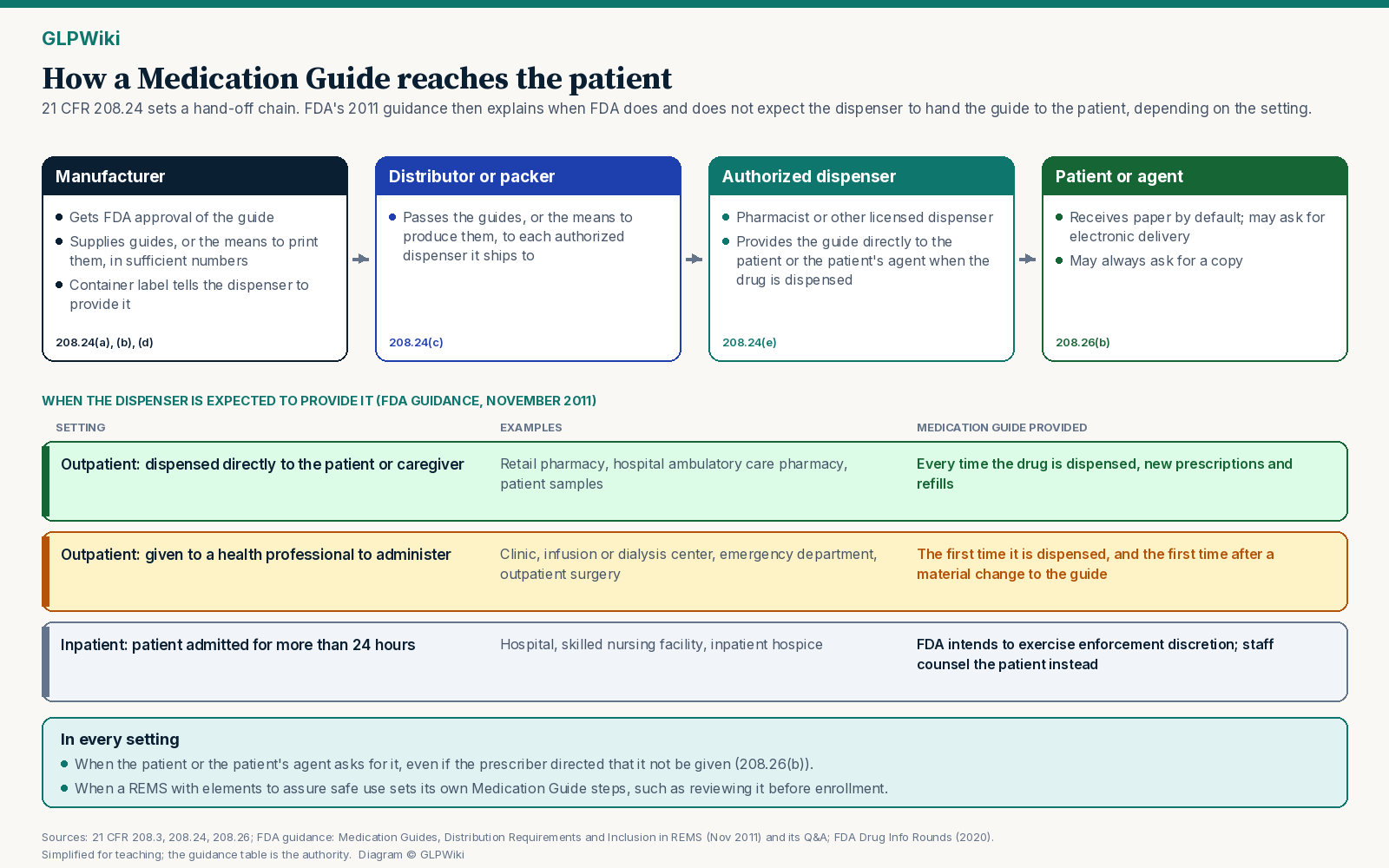
Part 208 sets a chain of responsibility. Under 21 CFR 208.24, the manufacturer must get FDA approval of the Medication Guide before distributing it and must supply guides, or the means to produce them, in sufficient numbers so that the authorized dispenser can give one to each patient. Distributors and packers pass them along. The container label, or the package label if the container is too small, must tell the dispenser to provide a Medication Guide and say how it is provided.
Then comes the step patients see: "Each authorized dispenser of a prescription drug product for which a Medication Guide is required under this part shall, when the product is dispensed to a patient (or to a patient's agent), provide a Medication Guide directly to each patient (or to the patient's agent) unless an exemption applies" (208.24(e)). Section 208.3 defines an authorized dispenser as an individual licensed, registered or otherwise permitted by the jurisdiction to provide prescription drugs in professional practice, and Part 208 applies to refills as well as new prescriptions (208.1(a)).
Section 208.26(b) adds the patient's override. A prescriber may direct that a Medication Guide not be given to a particular patient because of significant concerns about its effect, but the dispenser "shall provide a Medication Guide to any patient who requests information when the drug product is dispensed regardless of any such direction." FDA's patient labeling resources page notes the guide is provided in paper form unless the patient asks for electronic delivery.
What the 2011 guidance changed about settings
Part 208 was written mainly for outpatient medicines a patient takes without direct supervision. Hospitals, dialysis units and infusion centers asked whether they had to hand out a guide every time a nurse gave a dose. FDA's guidance answered with an enforcement discretion policy, summarized in its Table 1:
- Outpatient, dispensed directly to the patient or caregiver (for example a retail pharmacy, a hospital ambulatory care pharmacy, or patient samples): a Medication Guide each time the drug is dispensed.
- Outpatient, dispensed to a health professional who administers the drug (for example a clinic, dialysis or infusion center, emergency department or outpatient surgery): a Medication Guide the first time, and the first time after the guide is materially changed, such as a new indication or new safety information.
- Inpatient (FDA's Q&A defines this as a facility where the patient is admitted and receives care, room and board for longer than 24 hours): FDA intends to exercise enforcement discretion, and staff should counsel the patient instead.
- Every setting: a Medication Guide must be provided whenever the patient or agent requests one, and as specified by any REMS with ETASU that sets Medication Guide steps, such as reviewing the guide with a patient before enrollment.
Edge cases FDA addressed
FDA's Q&A classifies by what happens next. If a drug is started in an emergency department or day-surgery unit and the patient continues it at home, that is outpatient; if the patient is admitted and staff keep administering it, that is inpatient. Assisted living facilities, urgent care, home hospice and home health where the patient self-administers are listed as outpatient settings where the drug goes directly to the patient. FDA's 2020 Drug Info Rounds video for health care professionals restates the same rules.
How to read REMS@FDA
REMS@FDA is FDA's public database of approved REMS that are currently active, with their REMS documents and materials. It is searchable by drug name, active ingredient or REMS name. When you open an entry, the useful parts are:
- The products covered: brand and generic products under the same REMS, which tells you whether it is a shared system REMS.
- The goal or goals: one or two sentences naming the specific serious risk the REMS addresses.
- The REMS elements: which of the building blocks apply, for example a Medication Guide, a communication plan or particular ETASU.
- The REMS document and materials: enrollment forms, prescriber and pharmacy guides, patient materials and fact sheets. FDA notes that manufacturers often host the same materials on a program website.
- Dates: the initial approval and the most recent modification, which help you tell whether materials you were given are current.
- Contacts: the program's phone line or website. FDA also lists its Division of Drug Information (855-543-3784 or druginfo@fda.hhs.gov) for questions about a particular REMS.
Matching the database to the label
Drugs with ETASU usually name the program in their Prescribing Information, commonly in Warnings and Precautions and in the Highlights, and the label's Section 17 points to the Medication Guide. If a drug is absent from REMS@FDA, that normally means it has no active REMS; released REMS are not listed as current programs, although FDA approval letters on Drugs@FDA record their history.
For a live example, search REMS@FDA for isotretinoin. Its iPLEDGE program is a shared system REMS whose ETASU are built around preventing fetal exposure, which researchers have compared with other teratogen REMS. Its entry shows how the goal, the participants and the materials fit together.
Assessments, modifications and releases
A REMS is meant to be measured. Under 505-1(g), each assessment must evaluate, for every goal, whether the strategy and each element are meeting it or should be modified. FDA's FAQ explains that sponsors submit assessment reports at set intervals and FDA decides whether the REMS is working and whether goals, elements, tools or the assessment plan should change. FDA's draft guidance on REMS assessment planning and reporting describes how sponsors are expected to design those measurements.
Either side can propose changes. A sponsor may propose adding, modifying or removing any goal or element at any time with a rationale, and FDA may require a modification within 120 days or another reasonable time to ensure benefits outweigh risks, to reduce burden on the health care system, or to accommodate a comparable generic program (505-1(g)(4)).
FDA can also release a REMS. Its FAQ says FDA may release a REMS or remove components when the extra measures are no longer necessary. The most prominent recent example is clozapine: FDA stopped expecting participation in the clozapine REMS in February 2025 and removed it effective June 13, 2025, after a November 2024 advisory committee meeting. FDA's August 27, 2025 Drug Safety Communication says the risk of severe neutropenia remains, but labeling, including a Boxed Warning and a new Medication Guide, is sufficient, and that prescribers should continue monitoring as described in the Prescribing Information.
The lesson for reading records: a released REMS does not mean a risk disappeared. It means FDA decided labeling could carry the message without the extra program.
Why GLP-1 medicines have a Medication Guide but no REMS
GLP-1 receptor agonists have a REMS history, and it ends in release. FDA risk management reviews and approval letters describe the sequence:
- Byetta (exenatide) was approved in 2009 with a communication plan REMS addressing pancreatitis and renal failure; it was eliminated in 2011 after the communication activities were completed.
- Victoza (liraglutide) was approved on January 25, 2010 with a REMS consisting of a Medication Guide, a communication plan and an assessment timetable. In 2011 FDA removed the Medication Guide from the REMS, noting it would stay part of the approved labeling under Part 208. In 2017 FDA eliminated the communication plan and stated that "a REMS is no longer required" for Victoza.
- Bydureon (exenatide extended-release), Trulicity (dulaglutide), Tanzeum (albiglutide) and Xultophy (insulin degludec and liraglutide) carried communication plan REMS about medullary thyroid carcinoma and acute pancreatitis. FDA released Bydureon's in 2015 and the others in 2017, citing completed communication activities, assessments showing prescribers' acceptable knowledge of the risks, and no new safety information requiring continuation.
- Saxenda (liraglutide for weight management) was approved in December 2014 with a communication plan REMS, released in December 2018 on the same reasoning.
Newer approvals: labeling was judged enough
For Ozempic (semaglutide), FDA's risk management review dated November 6, 2017 concluded that "a REMS is not necessary" and that additional measures beyond labeling were not needed.
For Mounjaro (tirzepatide), FDA's Division of Risk Management review dated May 13, 2022 concluded that, given the similarity of tirzepatide's risks to those of other GLP-1 receptor agonists and assessment data showing acceptable prescriber knowledge, "additional risk mitigation measures beyond labeling are not necessary."
For Foundayo (orforglipron), the first small-molecule GLP-1 receptor agonist for weight reduction, the division's review dated March 27, 2026 walked through the statutory factors and concluded that "a REMS is not necessary," noting that "labeling which includes a Medication Guide is sufficient" and that none of the serious risks identified was new or unusual for the expected prescribers. The review also says the recommendation can be re-evaluated if new safety information changes the benefit-risk profile.
When we searched REMS@FDA on November 2, 2026, no semaglutide, tirzepatide, liraglutide, dulaglutide or exenatide product appeared among active REMS.
What "no REMS" does and does not mean
It does not mean no serious risks. The labels of long-acting GLP-1 medicines such as semaglutide, tirzepatide, liraglutide and dulaglutide still carry a Boxed Warning about thyroid C-cell tumors and Warnings and Precautions such as pancreatitis, and their Medication Guides must be dispensed under Part 208. It means FDA decided the label and Medication Guide, together with routine safety surveillance, are adequate, without certification, enrollment or mandatory lab documentation. FDA can revisit that decision if new safety information emerges; the FAERS and recall guides explain how such signals are tracked.
Compounded and research products sit outside this system
REMS attach to approved applications: section 505-1 applies to holders of covered new drug and biologics applications and, through 505-1(i), to generic applications. FDA-approved Medication Guides are likewise part of an approved product's labeling. Compounded drugs made under section 503A or 503B are not FDA-approved, so they have no REMS and no FDA-approved Medication Guide, even when the active ingredient matches an approved product. "Research use only" products have no labeling for human use at all.
That absence is easy to misread. It does not mean a compounded or research product has fewer risks; it means none of the FDA-approved risk communication described here applies to it. Ask the dispensing pharmacy what written information comes with any compounded product, and see our compounding guides for how 503A and 503B differ.
What research says about REMS in practice
Independent and FDA-collaborative studies give a mixed picture, and they are useful mainly as context for why FDA keeps adjusting REMS:
- Guadamuz and colleagues used public FDA data to describe how FDA used REMS from 2008 to 2019, including the number and classes of drugs, the strategies deployed and the risks targeted (JAMA, 2020).
- In a national survey of 1,295 physicians who prescribed one of eight REMS drugs, conducted with FDA staff, 68% said certification provided useful drug information and 63% said safe-use requirements helped discussions with patients, but 57% said those requirements delayed access; many wanted benefit information and non-REMS risks included (Sarpatwari et al., Clinical Pharmacology & Therapeutics, 2024).
- A scoping review found only seven studies measuring REMS workflow changes such as order sets, alerts or enrollment portals, and concluded that evidence on REMS automation and electronic data exchange is limited (Tajchman et al., Applied Clinical Informatics, 2022).
- Among novel small-molecule drugs approved from 2000 to 2013, having a REMS was associated with a 25% delay in generic approvals after adjustment for other factors (Kao et al., Health Affairs, 2025).
- An analysis of REMS for teratogenic drugs found wide variation in primary and secondary prevention measures across programs (Brown, Kesselheim and Sarpatwari, PLOS Medicine, 2023).
A five-point reading checklist
When a medicine, article or online seller mentions a REMS or a Medication Guide, these checks keep the records straight:
- Search REMS@FDA by name. Present means an active REMS; read its goal to learn which specific risk it targets.
- Check the label's Highlights and Section 17 for "Medication Guide." If one is required and you did not get it, ask the pharmacist; you are entitled to it on request.
- Do not equate a Medication Guide with a REMS, or "no REMS" with "no serious risk." Read the Boxed Warning and Warnings and Precautions either way.
- Compare dates. The REMS modification date, the Medication Guide revision date and the label revision date can all differ.
- Remember the scope. Compounded and research products are outside both systems, so their paperwork is not FDA-approved risk communication.
Scope, disclaimer and review date
This page explains how FDA Risk Evaluation and Mitigation Strategies and Medication Guide distribution rules work and how to read the public records. It does not provide doses, schedules, injection or device instructions, product or pharmacy recommendations, or individual medical advice, and nothing here suggests starting, stopping or changing any medicine. Questions about a specific medicine belong with your pharmacist or prescriber; for a medical emergency, call 911 or your local emergency number.
Last reviewed: November 2, 2026. REMS are approved, modified and released over time; verify any statement here against REMS@FDA, Drugs@FDA and the current FDA-approved labeling.
Frequently asked questions
- What is a REMS in plain terms?
- A Risk Evaluation and Mitigation Strategy is a drug safety program FDA can require, under section 505-1 of the FD&C Act, when it decides one is needed to ensure a medicine's benefits outweigh a specific serious risk. It adds requirements beyond the label, such as patient materials, provider communications, certification or monitoring. FDA says only a few medicines require one.
- What are elements to assure safe use (ETASU)?
- They are the strongest REMS tools: certified prescribers, certified pharmacies or settings, dispensing only in certain settings, documented safe-use conditions such as lab results, patient monitoring, and patient registries (505-1(f)(3)). FDA may require them only when a drug could not otherwise be approved or would be withdrawn.
- Does every Medication Guide mean the drug has a REMS?
- No. Since FDA's 2011 guidance, most Medication Guides are required as labeling under 21 CFR Part 208 alone. FDA generally includes a Medication Guide in a REMS only when the REMS also has elements to assure safe use.
- Is my pharmacy required to give me a Medication Guide?
- For a drug that requires one, 21 CFR 208.24(e) says the authorized dispenser must provide it to each patient or the patient's agent when the drug is dispensed, including refills. FDA's 2011 guidance expects this every time in outpatient pharmacies, and any patient who asks must receive one (208.26(b)).
- Why didn't I get a Medication Guide in the hospital?
- FDA's 2011 guidance says FDA intends to exercise enforcement discretion for admitted inpatients, where staff administer the drug and counsel the patient. A guide must still be provided if you ask, or if a REMS with elements to assure safe use requires it.
- Do semaglutide or tirzepatide have a REMS?
- No. On November 2, 2026, REMS@FDA listed no GLP-1 product. FDA's 2022 tirzepatide risk review concluded measures beyond labeling were not necessary, and earlier GLP-1 communication-plan REMS were released between 2011 and 2018. These medicines still have Boxed Warnings and Medication Guides.
- Can FDA end a REMS?
- Yes. FDA may release a REMS or remove elements when they are no longer necessary. FDA removed the clozapine REMS effective June 13, 2025, while keeping a Boxed Warning, a new Medication Guide and monitoring recommendations in the labeling.
- Do compounded GLP-1 products come with a REMS or Medication Guide?
- No. REMS and FDA-approved Medication Guides belong to FDA-approved products. Compounded preparations under 503A or 503B are not FDA-approved, so neither applies. That is a gap in information, not evidence of lower risk.
SOURCES
- 0121 U.S.C. 355-1 — Risk evaluation and mitigation strategies (FD&C Act 505-1)— U.S. Code (GovInfo)
- 02Risk Evaluation and Mitigation Strategies (REMS)— FDA
- 03What's in a REMS?— FDA
- 04Frequently Asked Questions (FAQs) about REMS— FDA
- 05REMS@FDA: Approved Risk Evaluation and Mitigation Strategies— FDA
- 06REMS Assessment: Planning and Reporting (draft guidance)— FDA
- 07Format and Content of a REMS Document (guidance)— FDA
- 0821 CFR 208.1 — Scope and purpose (Medication Guides)— eCFR
- 0921 CFR 208.3 — Definitions— eCFR
- 1021 CFR 208.20 — Content and format of a Medication Guide— eCFR
- 1121 CFR 208.24 — Distributing and dispensing a Medication Guide— eCFR
- 1221 CFR 208.26 — Exemptions and deferrals— eCFR
- 13Medication Guides — Distribution Requirements and Inclusion in Risk Evaluation and Mitigation Strategies (REMS) (guidance, November 2011)— FDA
- 14Medication Guides — Distribution Requirements and Inclusion in REMS (guidance page)— FDA
- 15Questions and Answers on Guidance for Industry: Medication Guides — Distribution Requirements and Inclusion in REMS— FDA
- 16Medication Guides: Distribution Requirements for Health Care Professionals (Drug Info Rounds, March 2020)— FDA
- 17Guidance for Industry on Medication Guide Distribution Requirements and Inclusion of Medication Guides in REMS; Availability (76 FR, Nov 18, 2011)— Federal Register
- 18Patient Labeling Resources— FDA
- 19Medication Guides— FDA
- 20FDA removes risk evaluation and mitigation strategy (REMS) program for the antipsychotic drug clozapine (Drug Safety Communication, Aug 27, 2025)— FDA
- 21Information on Clozapine— FDA
- 22Victoza (liraglutide) supplement approval letter, REMS modification, 2011 (NDA 022341/S-004)— FDA (Drugs@FDA)
- 23Victoza (liraglutide) supplement approval letter, REMS release, 2017 (NDA 022341/S-029)— FDA (Drugs@FDA)
- 24Saxenda (liraglutide) supplement approval letter, REMS release, December 2018 (NDA 206321/S-009)— FDA (Drugs@FDA)
- 25Risk Assessment and Risk Mitigation Review: Ozempic (semaglutide) NDA 209637, November 6, 2017— FDA (Drugs@FDA)
- 26Risk Assessment and Risk Mitigation Review: Mounjaro (tirzepatide) NDA 215866, May 13, 2022— FDA (Drugs@FDA)
- 27Risk Assessment and Risk Mitigation Review: Foundayo (orforglipron) NDA 220934, March 27, 2026— FDA (Drugs@FDA)
- 28Drugs@FDA: FDA-Approved Drugs— FDA
- 29Guadamuz JS, Qato DM, Alexander GC. Use of Risk Evaluation and Mitigation Strategies by the US Food and Drug Administration, 2008-2019. JAMA. 2020;324(3):299-301— PubMed
- 30Sarpatwari A, et al. How Do Risk Evaluation and Mitigation Strategies Impact Clinical Practice? A National Survey of Physicians. Clin Pharmacol Ther. 2024;115(6):1293-1303— PubMed
- 31Tajchman S, et al. Implementation and Use of Risk Evaluation and Mitigation Strategies Programs in Practice: A Scoping Review of the Literature. Appl Clin Inform. 2022;13(5):1151-1160— PubMed
- 32Kao J, et al. Impact of Risk Evaluation and Mitigation Strategies on Generic Approvals of US Pharmaceutical Products. Health Aff (Millwood). 2025;44(10):1285-1290— PubMed
- 33Brown BL, Kesselheim AS, Sarpatwari A. Analysis of risk evaluation and mitigation strategies for teratogenic drugs: Variation in primary and secondary prevention measures. PLoS Med. 2023;20(3):e1004190— PubMed
EDUCATIONAL REFERENCE ONLY · Not medical advice. Nothing here diagnoses, treats, cures or prevents any disease, and nothing here is a dosing recommendation. Consult a licensed clinician before any treatment decision.