Drug recall and shortage literacy: recall classes, Enforcement Reports, checking a lot, and what shortage status means
FDA keeps two public lists that people often mix up. One tracks recalls: specific lots of a product that a firm is removing or correcting because something is wrong with them. The other tracks shortages: periods when national supply of a drug does not meet demand. This guide explains recall classes I, II and III, how recalls differ from market withdrawals, how to read an FDA Enforcement Report entry and check a product by its lot number, what the Drug Shortages Database does and does not say, and why shortage status mattered so much for GLP-1 compounding. It is about reading public records. It gives no doses or treatment advice and is not medical advice.
UPDATED 01 NOV 2026 · 19 MIN READ
KEY TAKEAWAYS
- A recall is a firm's removal or correction of a marketed product that FDA considers violative and would take legal action against (21 CFR 7.3(g)). A drug shortage is a period when U.S. demand or projected demand exceeds supply. They are different lists answering different questions.
- FDA assigns recall classes by relative health hazard: Class I is a reasonable probability of serious adverse health consequences or death, Class II is temporary or medically reversible consequences or a remote probability of serious ones, and Class III is not likely to cause adverse health consequences (21 CFR 7.3(m)).
- Market withdrawals (a minor or no violation) and stock recoveries (product that never left the firm's control) are not recalls, and FDA's weekly Enforcement Report does not list them (21 CFR 7.50).
- Recalls are listed in the Enforcement Report by product, with a "Code Information" field listing lot numbers and expiration or beyond-use dates. Matching the exact lot on your carton or container is the core check; a brand or ingredient name alone is not enough.
- FDA's drug recall page says that for Class II and III recalls consumers can generally continue taking the medicine unless the recalling company gives other instructions, and that stopping can sometimes be more harmful than continuing. Questions belong with a pharmacist or prescriber.
- On November 1, 2026, openFDA held 57 drug enforcement records mentioning semaglutide (all Class II) and 28 mentioning tirzepatide (27 Class II, 1 Class I). The most common stated reason was lack of assurance of sterility, and most records came from compounders rather than from the approved-product manufacturers.
- Semaglutide and tirzepatide injections were in shortage from 2022 because of increased demand. FDA declared the tirzepatide shortage resolved on October 2, 2024 (reaffirmed December 19, 2024) and the semaglutide shortage resolved on February 21, 2025; the enforcement-discretion windows for compounders ended in 2025.
- Shortage status matters for compounding because a drug on FDA's shortage list is not treated as "commercially available" under 503A, and 503B's limits on copies and on bulk drug substances relax for drugs on the list. Every other compounding condition still applies, and compounded drugs are still not FDA-approved.
Two FDA lists that answer different questions
When a medicine is in the news, two words tend to appear together: recall and shortage. They come from different parts of FDA, are defined by different rules, and live in different databases.
A recall is about specific product that has a problem. FDA's regulations define a recall as "a firm's removal or correction of a marketed product that the Food and Drug Administration considers to be in violation of the laws it administers and against which the agency would initiate legal action, e.g., seizure" (21 CFR 7.3(g)). Recalls are tracked by lot in the weekly FDA Enforcement Report.
A shortage is about supply. FDA's drug shortage FAQ explains that the FD&C Act defines a drug shortage as "a period of time when the demand or projected demand for the drug within the United States exceeds the supply of the drug," and that FDA tracks shortages at the national level. Shortages are tracked in the FDA Drug Shortages Database.
The two can be connected. A large recall can remove enough product to cause a shortage, and FDA's FAQ says manufacturing and quality problems are the most common reason for shortages. But a shortage listing is not a finding that anything is wrong with the product in your hand, and a recall of one firm's lots says nothing about whether the medicine is in short supply.
GLPWiki's 503A versus 503B guide covers the full GLP-1 compounding and shortage history. This page focuses on how to read the two lists themselves and keeps the shortage timeline brief.
Recall, market withdrawal, stock recovery and correction
Part 7, subpart C of FDA's regulations sets out recall policy for all FDA-regulated products. Its definitions in 21 CFR 7.3 decide what counts as a recall at all.
- Recall (7.3(g)): removal or correction of a marketed product that FDA considers violative and would take legal action against. "Recall does not include a market withdrawal or a stock recovery."
- Correction (7.3(h)): "repair, modification, adjustment, relabeling, destruction, or inspection (including patient monitoring) of a product without its physical removal to some other location." A relabeling can be a recall even if no product moves.
- Market withdrawal (7.3(j)): removal or correction of a distributed product involving "a minor violation that would not be subject to legal action" by FDA, or no violation at all, such as normal stock rotation. FDA's definitions page gives the example of a product removed because of tampering "without evidence of manufacturing or distribution problems."
- Stock recovery (7.3(k)): removal or correction of product that "has not been marketed or that has not left the direct control of the firm," with no portion of the lot released for sale or use.
- Recalling firm (7.3(i)): the firm that starts the recall or, for an FDA-requested recall, the firm primarily responsible for making and marketing the product. For a compounded product this is the pharmacy or outsourcing facility, not the maker of an approved brand.
- Consignee (7.3(n)): "anyone who received, purchased, or used the product being recalled" — wholesalers, pharmacies, clinics and, at consumer level, patients.
Who starts a recall
Under 21 CFR 7.40, recall is described as "a voluntary action" that manufacturers and distributors take to carry out their responsibility to protect the public. A firm may recall on its own (7.46), or FDA may request a recall when a distributed product presents a risk of illness, injury or gross consumer deception, the firm has not recalled it, and agency action is needed (7.45). FDA's recall definitions page adds that recalls may also be conducted "by FDA order under statutory authority" for products where the law gives FDA that power.
If a firm will not recall, or a recall would not be effective, FDA can go to court: 7.40(c) names seizure, multiple seizure or other court action. Recall is generally preferred when many lots are widely distributed because it reaches more product faster.
Class I, II and III: what the numbers mean
Every recall gets a numerical class after an FDA health hazard evaluation. Under 21 CFR 7.41, an ad hoc committee of FDA scientists considers whether any disease or injury has already occurred, which populations are exposed and which are most at risk, how serious the hazard is, how likely it is to occur, and its immediate or long-range consequences.
The resulting class, defined in 7.3(m), indicates "the relative degree of health hazard presented by the product being recalled."
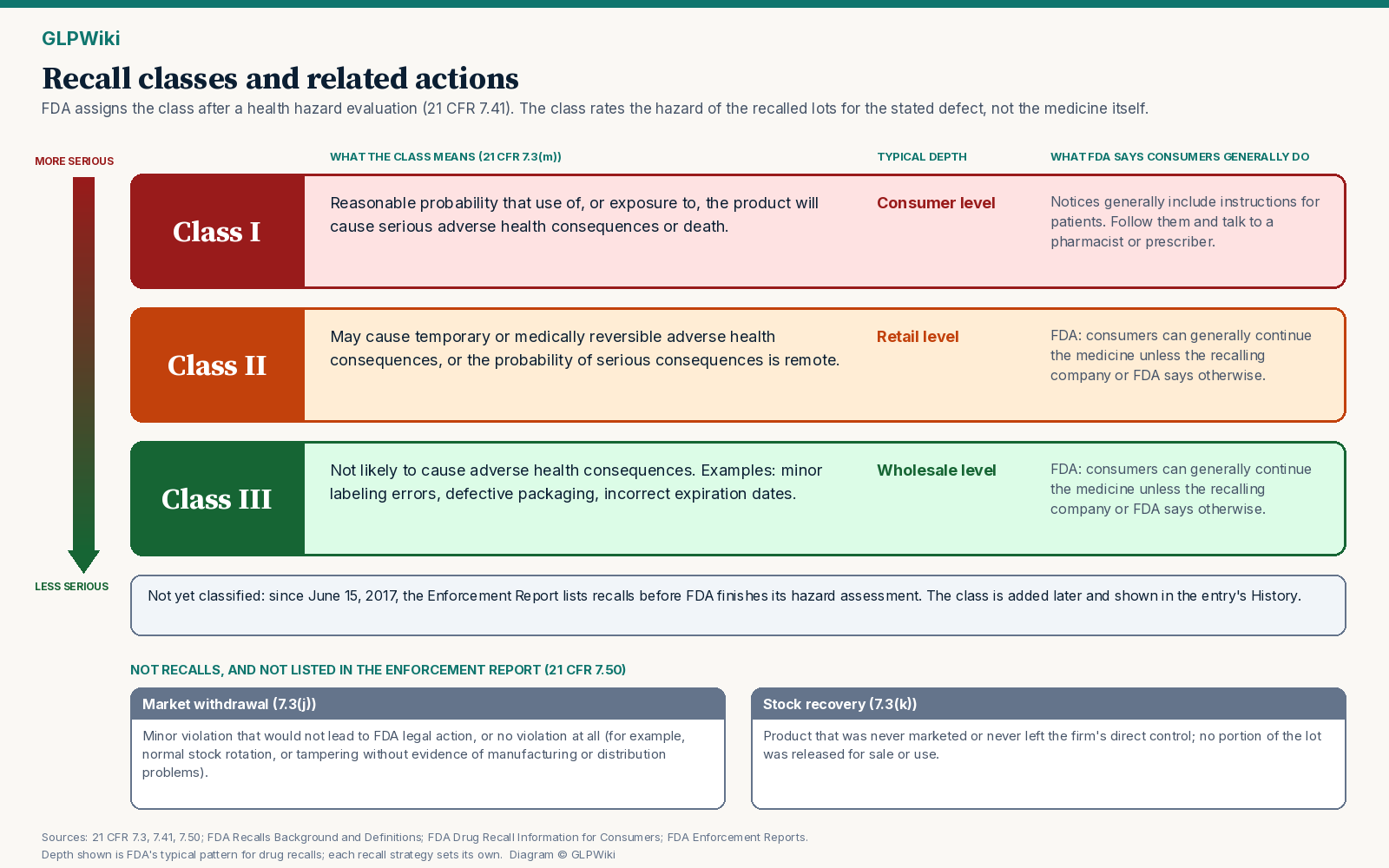
- Class I: "a reasonable probability that the use of, or exposure to, a violative product will cause serious adverse health consequences or death." FDA's drug recall page says these recalls are "generally conducted at the consumer level" and that Class I notifications generally include instructions for patients.
- Class II: use or exposure "may cause temporary or medically reversible adverse health consequences or where the probability of serious adverse health consequences is remote." FDA says these are generally conducted at the retail level.
- Class III: use or exposure "is not likely to cause adverse health consequences." FDA's examples include minor labeling errors, defective packaging or incorrect expiration dates; these are generally conducted at the wholesale level.
- Not yet classified: since June 15, 2017, the Enforcement Report has listed recalls before FDA finishes its hazard assessment, so the public hears sooner. The entry is updated with a class later.
What the class does and does not tell you
The class describes the hazard of the specific recalled lots for the stated reason. It is not a grade for the medicine, the molecule or the company. A Class II recall of one compounder's vials says nothing about an approved pen from another firm, and a Class III recall for a carton misprint is not a safety alarm about the drug inside.
FDA's drug recall page is explicit about what consumers generally do: for Class II and III recalls, "consumers can generally continue taking the medicine unless the recalling company provides other instructions," and "in some instances, stopping your medicine may be more harmful to your health than continuing to take the recalled medicine." The practical reading is to follow the recall notice and ask a pharmacist or prescriber; this guide does not tell anyone to stop or continue a medicine.
How a recall runs: depth, public warnings, effectiveness checks and status
Each recall follows a recall strategy (21 CFR 7.42), written by FDA for an FDA-requested recall or by the firm for a firm-initiated one. The strategy weighs the hazard evaluation, how easy the product is to identify, how obvious the defect is to users, how much product remains unused, and "continued availability of essential products" — a reminder that recalls and supply are linked from the start.
- Depth: how far down the distribution chain the recall reaches — wholesale level, retail level, or consumer or user level (7.42(b)(1)).
- Public warning: reserved "for urgent situations where other means for preventing use of the recalled product appear inadequate" (7.42(b)(2)). That is why many recalls never get a press release.
- Effectiveness checks: verifying that consignees got the notice and acted. Levels run from A (100% of consignees contacted) through B (more than 10% and less than 100%), C (10%), D (2%) to E (no effectiveness checks) (7.42(b)(3)).
- Recall communications (7.49): should identify "the product, size, lot number(s), code(s) or serial number(s)," explain the reason and hazard, and say what to do. Envelopes and letters are marked "urgent" for Class I and II recalls.
- Status reports (7.53): firms generally report progress to FDA every 2 to 4 weeks — how many consignees were notified, responded, and returned product.
- Status in the Enforcement Report: Ongoing (in progress), Completed (the firm has retrieved all product that could reasonably be recovered or finished corrections), or Terminated (FDA has determined all reasonable efforts were made and proper disposition occurred, 7.55).
Reading an FDA Enforcement Report entry
Under 21 CFR 7.50, FDA publishes "a descriptive listing of each new recall according to its classification" in the weekly Enforcement Report. FDA's Enforcement Report page says it "includes all recalls monitored by FDA," classified or not yet classified. Market withdrawals and stock recoveries are excluded, and 7.50 allows FDA to delay public notice for certain drugs and devices when notice could cause "unnecessary and harmful anxiety" and patients should first consult their physicians.
The report can be browsed by week, searched by product description, code information, class, firm, status, recall number, reason and date, exported to CSV, or queried through an API (also mirrored by openFDA's drug enforcement endpoint). Since July 24, 2018, a History feature shows later changes to an entry's classification, reason, code information or product description. You can subscribe to e-mail alerts by product type or keyword.
FDA's Enforcement Report definitions describe each field. The ones that matter most for reading an entry:
- Recall Number and Event ID: tracking numbers. One event (one firm's recall action) can include many products, each with its own recall number.
- Classification: Class I, II, III or Not Yet Classified, plus Center Classification Date.
- Product Description: the product as labeled, often including the NDC. For compounded products this may show an internal number rather than a listed NDC.
- Code Information: "a list of all lot and/or serial numbers, product numbers, expiration dates, sell or use by dates, etc., which appear on the product or its labeling." This is the field to match against your package.
- Reason for Recall: how the product is defective, in FDA's wording (for example, "Lack of Assurance of Sterility" or a labeling mix-up).
- Product Quantity and Distribution Pattern: how much product and where it was initially shipped. FDA notes that later distribution by consignees "may not be included."
- Voluntary/Mandated: "Voluntary: Firm initiated" covers most drug recalls; "Mandated" means a statutory recall authority, court order or FDA order.
- Recall Initiation Date and Status: when the firm began notifying consignees, and where the recall stands now.
Press releases are a subset
FDA's Recalls, Market Withdrawals and Safety Alerts page collects company press releases and public notices, but says "not all recalls have press releases or are posted on this page," and items there are archived after three years. FDA's drug recall page adds that public notification is generally issued when a product has been widely distributed or poses a serious hazard. For a complete record, use the Enforcement Report.
FDA also notes that a firm's own public warning may come well before FDA finishes classification, so a press release can appear weeks before the class shows up in the report.
Checking a product by lot: a literacy walkthrough
FDA's consumer advice is simple: if your medicine may have been recalled, "check the lot number on the label of your medicine to see if it matches the lot number of the recalled medicine in the notification." Recalls are lot-specific because 21 CFR 7.59 asks firms to code products for "positive lot identification" and keep distribution records.
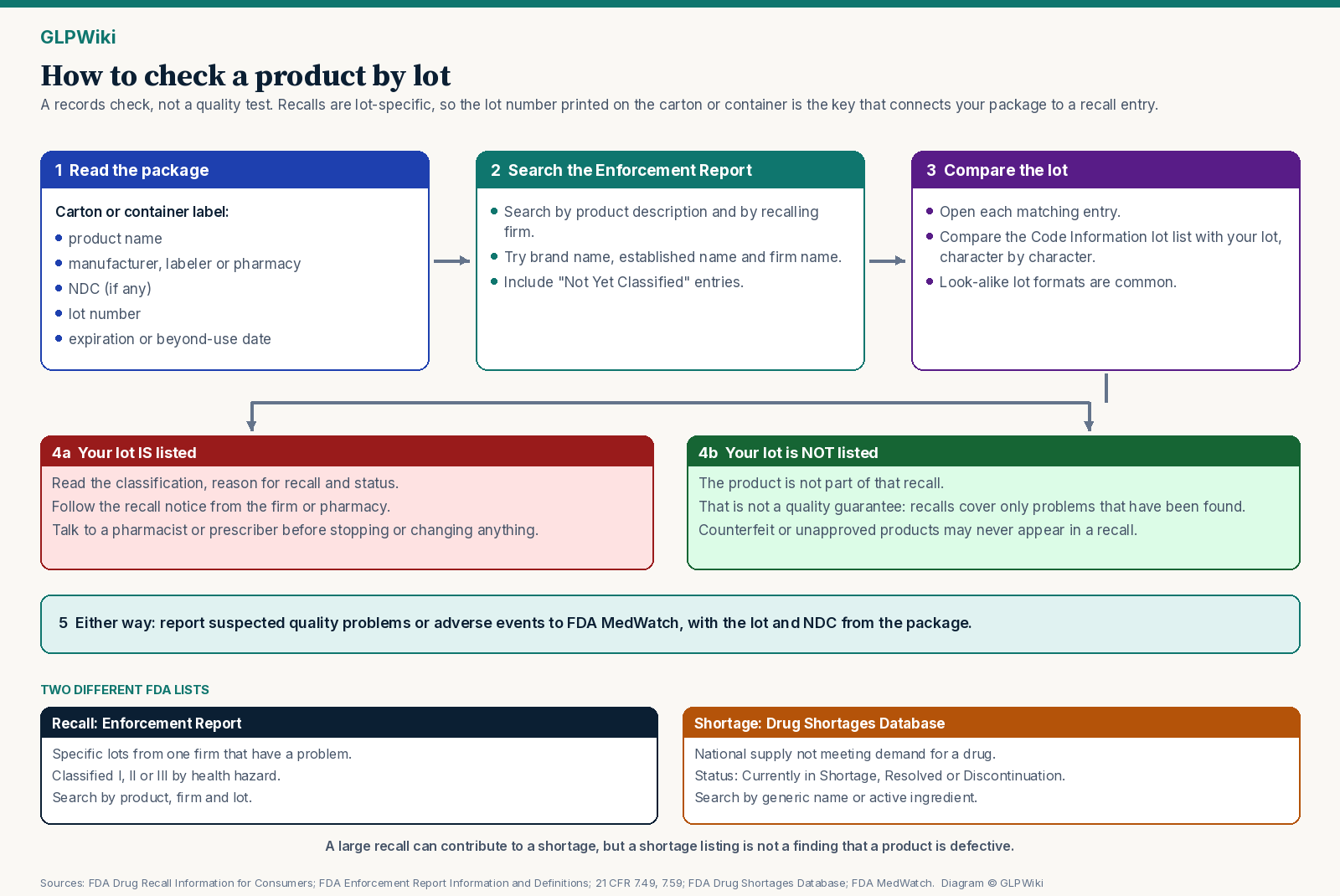
- Step 1 — Read the package. From the carton or container label, note the product name, the manufacturer, labeler or compounding pharmacy, the NDC (if any), the lot number and the expiration or beyond-use date. GLPWiki's carton and container label guide shows where each one is printed.
- Step 2 — Search the Enforcement Report by product description and by recalling firm. Search more than one spelling: brand name, established name, and the firm's name.
- Step 3 — Open each matching entry and compare the Code Information lot list with your lot, character by character. Partial matches and look-alike lot formats are common.
- Step 4a — If your lot is listed, read the classification, reason and status, follow the recall notice from the firm or pharmacy, and talk to a pharmacist or prescriber before stopping or changing anything.
- Step 4b — If your lot is not listed, the product is not part of that recall. That is a narrower statement than "this product is fine": recalls only cover problems that have been found, and unapproved or counterfeit products may never appear in a recall at all.
- Step 5 — Report suspected problems. Product quality problems and adverse events go to MedWatch, with the lot and NDC from the package; GLPWiki's MedWatch and FAERS guide explains what a report asks for.
Common snags
- Pharmacy labels: the pharmacy sticker on a bag often shows a prescription number, not the manufacturer's lot. The lot is on the carton or container.
- Compounded products: entries often list a beyond-use date (BUD) rather than an expiration date, and the recalling firm is the pharmacy or outsourcing facility.
- Counterfeits are not recalls: FDA's GLP-1 page says it is "aware of counterfeit Ozempic marketed in the U.S." and that counterfeit drugs "could contain the wrong ingredients" or none at all. Counterfeit alerts are separate safety communications, and the legitimate manufacturer's lots are not the ones being recalled.
- Not yet classified: an entry can appear before it has a class; check back for the History update.
What GLP-1 entries in the Enforcement Report look like
GLPWiki queried openFDA's drug enforcement endpoint on November 1, 2026, searching product descriptions for the ingredient names. These are record counts, not a complete audit: one recall event can produce many product records, and descriptions that misspell or omit the ingredient will be missed.
- Semaglutide: 57 records, all Class II, all "Voluntary: Firm initiated," from 15 recalling firms. Stated reasons: lack of assurance of sterility (30), particulate matter (13), lack of processing controls (6), potency problems (4), and a few cGMP or temperature issues. Most records came from compounding pharmacies or outsourcing facilities. Five involved approved brand products: three from the approved-product manufacturer (a 2021 entry for temperature-abused product samples and two January 2026 entries for particulate matter found in pens) and two from a distributor for temperature exposure in storage or shipping. Two more covered semaglutide bulk ingredient labeled for compounding use, recalled by an overseas supplier for cGMP deviations.
- Tirzepatide: 28 records (27 Class II, 1 Class I), all firm-initiated, from 9 recalling firms, all compounders. Stated reasons: lack of assurance of sterility (19), lack of processing controls (7), one potency issue, and one labeling mix-up.
- The one Class I tirzepatide record (2024) was a labeling mix-up: a compounded product labeled as tirzepatide that actually contained testosterone cypionate. It shows why FDA treats a wrong-product label as a serious hazard.
- Status: most of these records were listed as Ongoing on the query date. Ongoing does not mean the product is still being sold; it means FDA has not recorded completion or termination.
How this fits the published research
The pattern matches broader studies of FDA drug recalls. An analysis of recalls from June 2012 to January 2021 found 12,343 recalled drug products, 5,572 from compounders, with "sterility assurance" the predominant reason among compounders and product quality the most frequent among manufacturers (Mattingly 2022). An earlier 30-month analysis found compounding firms were more often associated with contamination than other firms (Hall 2016). A ten-year analysis of FDA data (2012–2023) found about 330 drug recalls initiated per year on average, Class I in 14% of recall events, and an average of 1.3 years from initiation to termination (Ghijs 2024).
Record counts are not risk rates. They reflect how many firms made a product, how often inspections or complaints found a problem, and how recalls were split into product records. They cannot tell you how likely any one vial or pen is to be defective.
What the FDA Drug Shortages Database says
FDA's Drug Shortages Database lists current and resolved shortages and discontinuations reported to FDA, searchable by generic name or active ingredient. The FD&C Act section 506E (21 U.S.C. 356e) requires FDA to keep an up-to-date shortage list that includes the drug name and NDC, each manufacturer, the reason for the shortage chosen from set categories, and the estimated duration.
- Currently in Shortage: FDA has determined national supply is not meeting current or projected demand and is working with manufacturers to mitigate it.
- Resolved: FDA's database says a drug receives Resolved status when the Drug Shortages Staff "determines that the market is covered" — supply is available from at least one manufacturer to cover total market demand, though "some manufacturers may not have all presentations available."
- Discontinuation: a manufacturer has notified FDA that it is permanently stopping a product. Section 506C requires notice at least six months in advance for certain drugs, or as soon as practicable, and FDA's FAQ says notice of a discontinuance or interruption must come no later than five business days after it occurs.
- Manufacturer "available" notes: FDA's GLP-1 page warns that when a presentation is noted as available, that "is not an FDA determination that the shortage has been resolved."
- Reason categories in 506E: good manufacturing practice compliance, regulatory delay, active or inactive ingredient shortage, discontinuance, shipping delay, and demand increase.
Local outage versus national shortage
FDA's FAQ says reports of a medicine being hard to find are "usually temporary and often involve distribution issues" that resolve when a pharmacy reorders. A pharmacy being out of stock is not the same as an FDA-listed shortage. Patients and health professionals can report a possible new shortage through FDA's public portal, and FDA checks with manufacturers whether national supply is adequate.
FDA can respond to shortages by working with firms on quality problems, expediting review of new production lines or sources, reviewing data to support extended use dates for existing inventory, and in some cases allowing temporary importation of foreign-approved product. FDA says it cannot require a firm to keep making or increase production of a drug. Shortages of older sterile injectables have been a recurring problem, largely because of manufacturing quality issues (Gupta 2013; FDA's 2019 root-causes report).
The GLP-1 shortage timeline, briefly
FDA's page on compounding policy as GLP-1 supply stabilized is the primary chronology. In short:
- 2022: semaglutide and tirzepatide injection products entered FDA's shortage list "due to increased demand."
- October 2, 2024: FDA determined the tirzepatide injection shortage was resolved. After litigation the decision was remanded for reevaluation, and on December 19, 2024 FDA issued a new decision that the shortage was resolved.
- February 21, 2025: FDA determined the semaglutide injection shortage was resolved, after confirming the manufacturer's supply and capacity could meet present and projected national demand.
- 2025: FDA's time-limited enforcement-discretion windows for compounders ended — for tirzepatide, February–March 2025 (503A after a March 5 court decision; 503B on March 19), and for semaglutide, after an April 24 court decision for 503A and on May 22 for 503B.
- April 1, 2026: FDA stated that tirzepatide and semaglutide "do not currently appear on the 503B bulks list or on FDA's drug shortage list."
- November 1, 2026 (GLPWiki check): the Drug Shortages Database listed liraglutide injection as Currently in Shortage, with a separate liraglutide discontinuation entry; semaglutide injection and tirzepatide injection did not appear as current shortages. Check the live database before relying on any date-stamped statement, including this one.
Where to read the full history
Litigation details, the 503B bulks-list proposal and the essentially-a-copy rules are covered in GLPWiki's 503A versus 503B guide and the compounded versus FDA-approved GLP-1 guide. They are not repeated here.
Why shortage status matters for compounding
Shortage status is not just a supply statistic for GLP-1 medicines; it changes which compounding conditions apply. FDA's page on compounding when drugs are on the shortage list says that when an approved drug is on the list, "some federal law restrictions may not apply, such as restrictions on compounding drugs that are essentially copies of approved drugs. However, other conditions and requirements remain."
- 503A (state-licensed pharmacies and physicians): section 503A restricts compounding, regularly or in inordinate amounts, of drugs that are essentially copies of commercially available drugs. FDA says a drug "is not considered to be commercially available if it is on FDA's drug shortages list," and that when a shortage is resolved, FDA "generally considers the drug to be commercially available." All other 503A conditions, including a valid prescription for an individual patient, still apply.
- 503B (outsourcing facilities): section 503B restricts making essentially a copy of an approved drug, but that limit does not apply to identical or nearly identical copies of a drug on the shortage list. Separately, outsourcing facilities may compound from bulk drug substances only if the substance is on the 503B bulks list or the drug is on the shortage list "at the time of compounding, distribution and dispensing."
- What does not change: compounded drugs are not FDA-approved and are not reviewed for safety, effectiveness or quality before marketing. FDA recommends that patients be prescribed an FDA-approved drug when available and appropriate.
- Professional guidance: the American Diabetes Association's 2025 statement notes that GLP-1 and GIP/GLP-1 shortages led in part to compounded products that bypass regulatory measures, and that these products continued to be heavily marketed even as shortages resolved.
Common misreadings
These are the mistakes that show up most often when recall and shortage records are quoted online.
- "Drug X was recalled" — usually means specific lots from one firm were recalled for a stated reason. Check which firm, which lots and which class.
- "Class I means the drug is dangerous" — Class I describes the hazard of the recalled product for the stated defect, such as a wrong-product label, not the safety profile of the medicine as approved.
- "No press release, so no recall" — most recalls appear only in the Enforcement Report.
- "The shortage is over, so compounded versions are banned" or "it's on the shortage list, so anything goes" — neither slogan is accurate. Shortage status changes some conditions; the rest still apply, and FDA's own statements are dated.
- "My pharmacy is out, so it's a shortage" — local outages are often distribution issues. Check the database.
- "Not on the recall list, so it's safe" — a lot check only shows that a product is not part of a known recall.
Scope, disclaimer and review date
This page explains how FDA recall and drug shortage records work and how to read them. It does not provide doses, schedules, injection or device instructions, product or pharmacy recommendations, or individual medical advice, and nothing here suggests starting, stopping or changing any medicine. If you think a medicine you have is recalled, follow the recall notice and talk with a pharmacist or prescriber; for a medical emergency, call 911 or your local emergency number.
Last reviewed: November 1, 2026. Recall and shortage records change weekly; verify with FDA's Enforcement Report, the Drug Shortages Database and FDA's compounding pages before relying on any statement here.
Frequently asked questions
- What is the difference between a recall and a drug shortage?
- A recall is a firm's removal or correction of specific product that FDA considers violative (21 CFR 7.3(g)); it is tracked by lot in the Enforcement Report. A shortage is a period when national demand or projected demand exceeds supply; it is tracked in the Drug Shortages Database. A recall can contribute to a shortage, but the lists answer different questions.
- What do Class I, II and III mean?
- They are FDA's ratings of the relative health hazard of the recalled product. Class I is a reasonable probability of serious adverse health consequences or death; Class II is temporary or medically reversible consequences, or a remote probability of serious ones; Class III is not likely to cause adverse health consequences.
- Is a market withdrawal the same as a recall?
- No. A market withdrawal involves a minor violation that would not lead to FDA legal action, or no violation at all. Market withdrawals and stock recoveries are not listed in the Enforcement Report.
- How do I check whether my medicine is part of a recall?
- Find the lot number on the carton or container label, search the FDA Enforcement Report by product and firm, and compare your lot with the Code Information list in each matching entry. If it matches, follow the recall notice and ask a pharmacist or prescriber before changing anything.
- Should I stop a medicine if its lot is recalled?
- This page cannot answer that for you. FDA says Class I notices generally include instructions for patients, and that for Class II and III recalls consumers can generally continue unless told otherwise, because stopping can sometimes be more harmful. Ask your pharmacist or prescriber.
- Are semaglutide and tirzepatide still in shortage?
- FDA declared the tirzepatide injection shortage resolved in 2024 and the semaglutide injection shortage resolved on February 21, 2025. On November 1, 2026, neither appeared as a current shortage in FDA's database, while liraglutide injection did. Check the live database for current status.
- Why did shortage status matter for compounded GLP-1 products?
- A drug on FDA's shortage list is not considered commercially available under 503A, and 503B's limits on copies and on bulk drug substances relax for listed drugs. When the shortages were resolved, those allowances ended after FDA's transition periods. Compounded drugs are still not FDA-approved either way.
- Why are most GLP-1 recall records from compounders?
- In openFDA's records, most semaglutide and tirzepatide recalls were firm-initiated Class II recalls by compounding pharmacies or outsourcing facilities, most often for lack of assurance of sterility. That matches published research on compounder recalls, but record counts are not risk rates.
SOURCES
- 0121 CFR 7.3 — Definitions (recall, correction, market withdrawal, stock recovery, recall classification)— eCFR
- 0221 CFR 7.40 — Recall policy— eCFR
- 0321 CFR 7.41 — Health hazard evaluation and recall classification— eCFR
- 0421 CFR 7.42 — Recall strategy— eCFR
- 0521 CFR 7.45 — FDA-requested recall— eCFR
- 0621 CFR 7.46 — Firm-initiated recall— eCFR
- 0721 CFR 7.49 — Recall communications— eCFR
- 0821 CFR 7.50 — Public notification of recall— eCFR
- 0921 CFR 7.53 — Recall status reports— eCFR
- 1021 CFR 7.55 — Termination of a recall— eCFR
- 1121 CFR 7.59 — General industry guidance— eCFR
- 12Recalls Background and Definitions— FDA
- 13Drug Recalls— FDA
- 14Drug Recall Information for Consumers, Health Care Professionals and Industry— FDA
- 15Enforcement Reports— FDA
- 16Enforcement Report Information and Definitions— FDA
- 17FDA Enforcement Report (search)— FDA
- 18Recalls, Market Withdrawals, & Safety Alerts— FDA
- 19Drug Recall Enforcement Reports API— openFDA
- 20Initiation of Voluntary Recalls Under 21 CFR Part 7, Subpart C (guidance)— FDA
- 21Drug Shortages— FDA
- 22FDA Drug Shortages Database— FDA
- 23Frequently Asked Questions About Drug Shortages— FDA
- 24Report: Drug Shortages: Root Causes and Potential Solutions— FDA
- 25Guidance: Notifying FDA of a Permanent Discontinuance or Interruption in Manufacturing Under Section 506C— FDA
- 2621 U.S.C. 356c — Discontinuance or interruption in the production of life-saving drugs (FD&C Act 506C)— U.S. Code (GovInfo)
- 2721 U.S.C. 356e — Drug shortage list (FD&C Act 506E)— U.S. Code (GovInfo)
- 28FDA clarifies policies for compounders as national GLP-1 supply begins to stabilize— FDA
- 29Compounding when Drugs are on FDA's Drug Shortages List— FDA
- 3021 U.S.C. 353a — Pharmacy compounding (FD&C Act 503A)— U.S. Code (GovInfo)
- 3121 U.S.C. 353b — Outsourcing facilities (FD&C Act 503B)— U.S. Code (GovInfo)
- 32FDA's Concerns with Unapproved GLP-1 Drugs Used for Weight Loss— FDA
- 33Hall K, et al. Characteristics of FDA drug recalls: a 30-month analysis. Am J Health Syst Pharm. 2016;73(4):235-240— PubMed
- 34Mattingly AN, et al. Categorization and comparisons of drug recalls for manufacturers and compounders. J Am Pharm Assoc. 2022;62(4):1344-1350— PubMed
- 35Ghijs S, et al. The continuing challenge of drug recalls: insights from a ten-year FDA data analysis. J Pharm Biomed Anal. 2024;249:116349— PubMed
- 36Gupta DK, Huang SM. Drug shortages in the United States: a critical evaluation of root causes and the need for action. Clin Pharmacol Ther. 2013;93(2):133-135— PubMed
- 37Neumiller JJ, et al. Compounded GLP-1 and dual GIP/GLP-1 receptor agonists: a statement from the American Diabetes Association. Diabetes Care. 2025;48(2):177-181— PubMed
EDUCATIONAL REFERENCE ONLY · Not medical advice. Nothing here diagnoses, treats, cures or prevents any disease, and nothing here is a dosing recommendation. Consult a licensed clinician before any treatment decision.