How to read an FDA carton and container label: principal display panel, Rx only, lot, expiry and barcodes
The Prescribing Information is the long document. The carton and the pen, vial or syringe label are what people actually hold. Those small panels are also FDA-regulated labeling, with their own rules about what must appear, where, and how prominently. This guide explains how to read them: the principal display panel, the proprietary and established names, how strength and package type are expressed, "Rx only," the Medication Guide statement, the lot number, the expiration date, the barcodes, and the DSCSA product identifier. It also explains how to match a carton to DailyMed and why compounded and "research" vials follow different rules. The examples come from current GLP-1 cartons. This page explains how labels are organized. It does not give doses or instructions, and it is not medical advice.
UPDATED 30 OCT 2026 · 13 MIN READ
KEY TAKEAWAYS
- "Label" and "labeling" are different legal terms. Under FD&C Act section 201(k), the label is the written, printed or graphic matter on the immediate container. Labeling, under section 201(m), is broader: all labels plus anything on or accompanying the product, including the carton, the Prescribing Information (PI), the Medication Guide and the Instructions for Use.
- The principal display panel (PDP) is the panel most likely to be seen. FDA's 2022 guidance on container label and carton labeling design recommends that the PDP prominently show the proprietary name, the established or proper name, the dosage form, the strength, the route, and any key warning or cautionary statements.
- For prescription drugs, 21 CFR 201.100(b) requires the label to carry "Rx only," a dosage statement (21 CFR 201.55 allows "See package insert for dosage information"), the route if not oral, the quantity of each active ingredient, inactive ingredients for non-oral products, and a lot or control number. Biologics follow parallel container and package label rules in 21 CFR 610.60 and 610.61.
- The established name must accompany the brand name and be printed at least half as large, with commensurate prominence (21 CFR 201.10(g)).
- Lot and expiry are traceability and quality fields. Under 21 CFR 201.18 the lot number "should be capable of yielding the complete manufacturing history of the package." Under 201.17 and 211.137 the expiration date comes from stability testing and must appear on the container and the outer package. FDA recommends a YYYY-MM-DD style, and a year-and-month date means the last day of that month.
- There are usually two kinds of barcode. A linear barcode with the NDC (21 CFR 201.25) supports bedside scanning. A 2D data matrix carries the DSCSA product identifier: NDC, serial number, lot and expiry. A QR code is optional and is neither of these.
- DailyMed shows each carton and container as a "Package Label / Principal Display Panel" image. Lot, expiry and serial number are printed per package, so your carton will differ from that image in those fields only.
- Compounded drugs from outsourcing facilities have their own statutory label list under FD&C Act 503B(a)(10), starting with "This is a compounded drug." Products sold "for research use only" are not labeled medicines at all.
Why the carton matters
GLPWiki's label-literacy series has worked through the Prescribing Information section by section, from Highlights to Section 17, plus the Medication Guide and Instructions for Use. The Section 16 guide explains How Supplied, storage and the NDC. This guide covers the last piece: the printed panels on the carton and on the pen, vial or syringe.
These panels are small, but they carry the information most often used at the moment of dispensing and use: which product, which strength, which package type, which lot, and until when. FDA's 2022 guidance Safety Considerations for Container Labels and Carton Labeling Design to Minimize Medication Errors lists design problems found in medication error reports. They include key information that is missing or not prominent, information that cannot be read without rotating the container, look-alike labels across strengths or products, visual clutter, error-prone abbreviations, and poor contrast. Independent human-factors research points the same way. In a randomized simulation with 30 critical care nurses, tall man lettering on syringe labels lowered selection errors from 5.3% to 0.7% (Lohmeyer et al., BMJ Qual Saf 2023). A simulated neonatal ICU study estimated more than 40% lower human error probability with a human-centred label design than with a look-alike label (Aceves-Gonzalez et al., Eur J Clin Pharmacol 2024). These are design studies, not product comparisons, but they show why the carton has rules at all.
Label, labeling, container, carton: the vocabulary
Five terms recur throughout this guide. The legal definitions come from the FD&C Act; the last term comes from FDA guidance.
- Label (FD&C Act 201(k)): "a display of written, printed, or graphic matter upon the immediate container of any article." If something must appear on the label, it must also appear on the outside container or wrapper, or be easily legible through it.
- Labeling (201(m)): "all labels and other written, printed, or graphic matter (1) upon any article or any of its containers or wrappers, or (2) accompanying such article." The carton, the PI, the Medication Guide and the Instructions for Use are all labeling.
- Container label: the label on the immediate container, such as the pen body, vial or prefilled syringe.
- Carton labeling: the printed outer package.
- Principal display panel (PDP): in FDA's guidance, the part of a label or labeling "most likely to be displayed, presented, shown, or examined under customary conditions of display."
Small containers
Small containers get some flexibility. If an immediate container is too small for every required item, 21 CFR 201.10(i) allows a reduced label, provided the full information appears on the carton or in the PI. FDA's guidance says that, at minimum, such a drug container label must still show the proprietary name (if any) and established name, the lot or control number, and the name of the manufacturer, packer or distributor. The biologic rule, 610.60(c), sets a similar minimum and adds the recommended individual dose for multiple-dose containers. FDA "strongly recommend[s]" adding the strength and expiration date even when they are not strictly required. Under 201.15, the exemption is not available when the space shortage is caused by non-required text or design elements.
Anatomy of a principal display panel
FDA's guidance recommends that the items listed below be the most prominent information on the PDP. For injectables, it adds the package type term, such as single-dose, multiple-dose or single-patient-use, if space permits. Less critical items, such as the lot, expiry and full ingredient lists, can go on side or back panels so they do not crowd the PDP. The figure shows where each item typically sits on a generic carton.
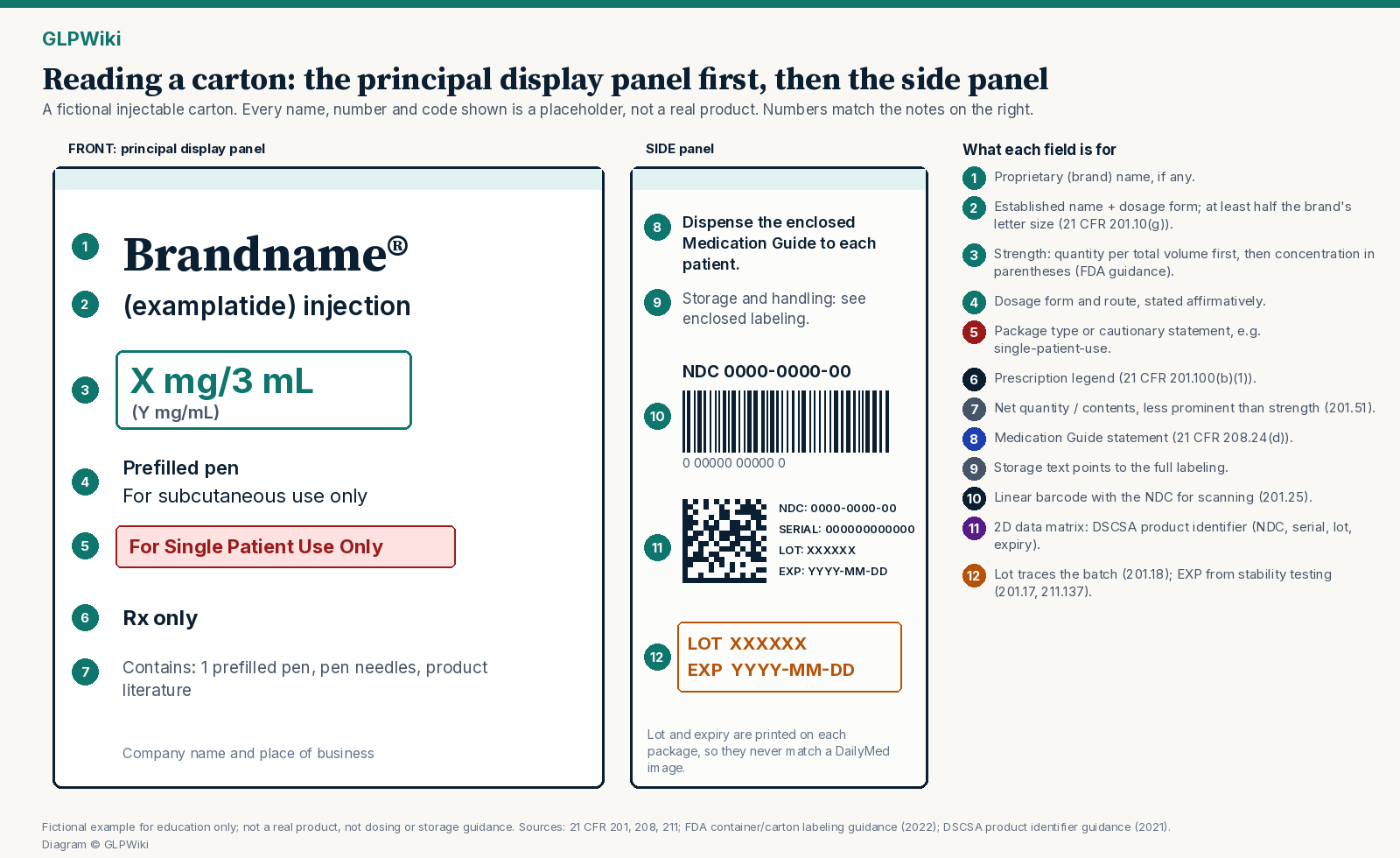
- proprietary name, if there is one
- established name (drugs) or proper name (biologics)
- dosage form
- product strength
- route(s) of administration
- warnings or cautionary statements, if any
- controlled substance schedule, if applicable
Names
21 CFR 201.10(g) requires the established name to accompany the proprietary name each time the brand is featured. It must be printed "in letters that are at least half as large as the letters comprising the proprietary name" and with "a prominence commensurate" with the brand, "taking into account all pertinent factors, including typography, layout, contrast, and other printing features." FDA's guidance, citing 201.10(a), adds that there must be no intervening written, printed or graphic matter between the proprietary name and the established name, and notes that ® and ™ symbols are not treated as intervening matter. On current GLP-1 cartons on DailyMed, the established name sits right beside the brand in parentheses, followed by "injection": for example, "OZEMPIC® (semaglutide) injection" and "Zepbound® (tirzepatide) injection." For licensed biologics, the proper name plays the same role (21 CFR 610.60–610.62).
Strength
The guidance treats strength as the single most error-prone field and gives specific formats for small-volume injections (100 mL or less). The main formats are listed below.
- Quantity per total volume should be the primary expression, followed by the concentration in parentheses. The guidance's own placeholder example is "500 mg/10 mL (50 mg/mL)." This prevents the common error of reading the concentration and missing the total volume.
- Containers holding less than 1 mL should show only the quantity per that fraction of a milliliter, not a per-mL concentration.
- A single-dose autoinjector that delivers its entire contents should show only quantity per total volume.
- Insulin is the exception: "100 units/mL (U-100)."
- Strengths should not use trailing zeros (4 mg, not 4.0 mg), values below 1 should have a leading zero (0.4 mg, not .4 mg), and labels should avoid error-prone abbreviations such as "µg" and "IU."
Strength on GLP-1 cartons and net quantity
Current GLP-1 cartons follow these patterns. Ozempic's multi-dose pen cartons show total quantity per total volume with the concentration in parentheses. Single-dose pen cartons for Wegovy, Mounjaro and Zepbound show quantity per total volume only. We describe the format, not the numbers. The strength on a carton is not a dosing instruction, and nothing here suggests what anyone should use.
The net quantity (21 CFR 201.51), such as the number of pens in the carton, should be separate from the strength and less prominent, so that "4 pens" is never mistaken for a strength. GLP-1 cartons pair a count with a "Contains:" statement listing what is in the box, such as pens, pen needles and product literature, or noting "Needles and Syringes are not included" for vials.
Package type terms
FDA's 2018 package-type guidance defines three injectable package types, listed below.
- Single-dose: one patient, one injection. Labeled with a discard statement when space permits.
- Multiple-dose: more than one dose. It must meet antimicrobial effectiveness testing or be exempt. Once entered, it generally has a 28-day beyond-use date unless the label says otherwise.
- Single-patient-use: multiple doses for one patient only. This replaced the older term "single-use."
Package type and cautionary statements on real cartons
You will see these terms on real cartons. Mounjaro's single-dose vial carton reads "Single-dose Vial - discard unused portion." Ozempic's multi-dose pen carton carries "For Single Patient Use Only" prominently on the PDP. FDA's guidance recommends that pens show that safety warning prominently because sharing a pen between people can transmit bloodborne pathogens. The guidance also prefers affirmative wording, such as "For subcutaneous use only," over negative wording, because the word "not" is easy to miss.
The required prescription-label items
For a prescription drug to be exempt from the general "adequate directions for use" requirement, 21 CFR 201.100(b) requires its label to bear the seven items listed below.
- the statement "Rx only"
- the recommended or usual dosage. 21 CFR 201.55 says a statement such as "See package insert for dosage information" meets this when a useful dosage statement will not fit.
- the route, if not oral
- the quantity or proportion of each active ingredient, plus the established-name information required by section 502(e)
- for non-oral products, the names of inactive ingredients. For injectables, it also requires their quantity or proportion, with some exceptions.
- an identifying lot or control number "from which it is possible to determine the complete manufacturing history of the package"
- a statement for the pharmacist about the dispensing container. This is not required for unit-of-use packages designed to be dispensed as-is.
Small containers
Small containers inside an outer carton may move several of these items to the carton or package insert. "Rx only" may appear on the outer container only.
The Medication Guide statement
When a Medication Guide is required, 21 CFR 208.24(d) requires the container or package label to tell the dispenser to give one to each patient and how it is provided. That is why GLP-1 cartons say "Dispense the enclosed Medication Guide to each patient." Our patient-labeling guide covers the Medication Guide itself.
Biologics
For biologics (BLA products such as dulaglutide and the insulins), 21 CFR 610.60 lists container-label items and 610.61 lists package-label items. They include the proper name, the manufacturer's name, address and license number, the lot, the expiration date, the recommended storage temperature, statements such as "Do not Freeze" when indicated, the preservative or "no preservative" when that is a safety factor, and "Rx only." Section 610.60(e) also requires enough of the container to stay uncovered to allow visual inspection of the contents.
Lot numbers and expiration dates
Two fields on every carton and container tie a package to its manufacturing history and its shelf life: the lot number and the expiration date.
Lot number
21 CFR 201.18 says the lot number "should be capable of yielding the complete manufacturing history of the package," and "an incorrect lot number may be regarded as causing the article to be misbranded." The lot is how recalls, complaints and adverse event reports are tied to a specific batch. If you report a problem to the manufacturer or to FDA MedWatch, the lot from the carton or container is one of the most useful details to include.
Expiration date
Under 21 CFR 211.137, the expiration date is set by stability testing and "shall be related to any storage conditions stated on the labeling." If a product is reconstituted at dispensing, the labeling must give expiry information for both forms. Under 201.17, the date appears on the immediate container and on the outer package, unless it is legible through it. For single-dose containers packed in individual cartons, it may appear on the carton instead.
FDA's guidance recommends unambiguous formats: "EXP" or a similar clear abbreviation, then YYYY-MM-DD (for example 2021-01-01) or YYYY-MMM-DD (2021-JAN-01). It warns that codes such as "MA12" have caused confusion, because MA could mean March or May. If only a year and month are printed, "FDA considers the drug product's actual expiration date to be the last calendar day of the month." The guidance's example is that 2021-07 means July 31, 2021.
Expiration date vs beyond-use date (BUD)
The expiration date applies to the unopened product stored as labeled. A BUD is the date or time after which a product that has been manipulated must be discarded. Examples include reconstitution, first entry of a multiple-dose vial, or a move from refrigerated to room-temperature storage. The guidance says a BUD "should not be later than the manufacturer expiration date." For in-use periods, the labeling (PI, Medication Guide, Instructions for Use) is the authority for your specific product. Our Section 16 guide shows where storage wording lives.
Barcodes: three different codes
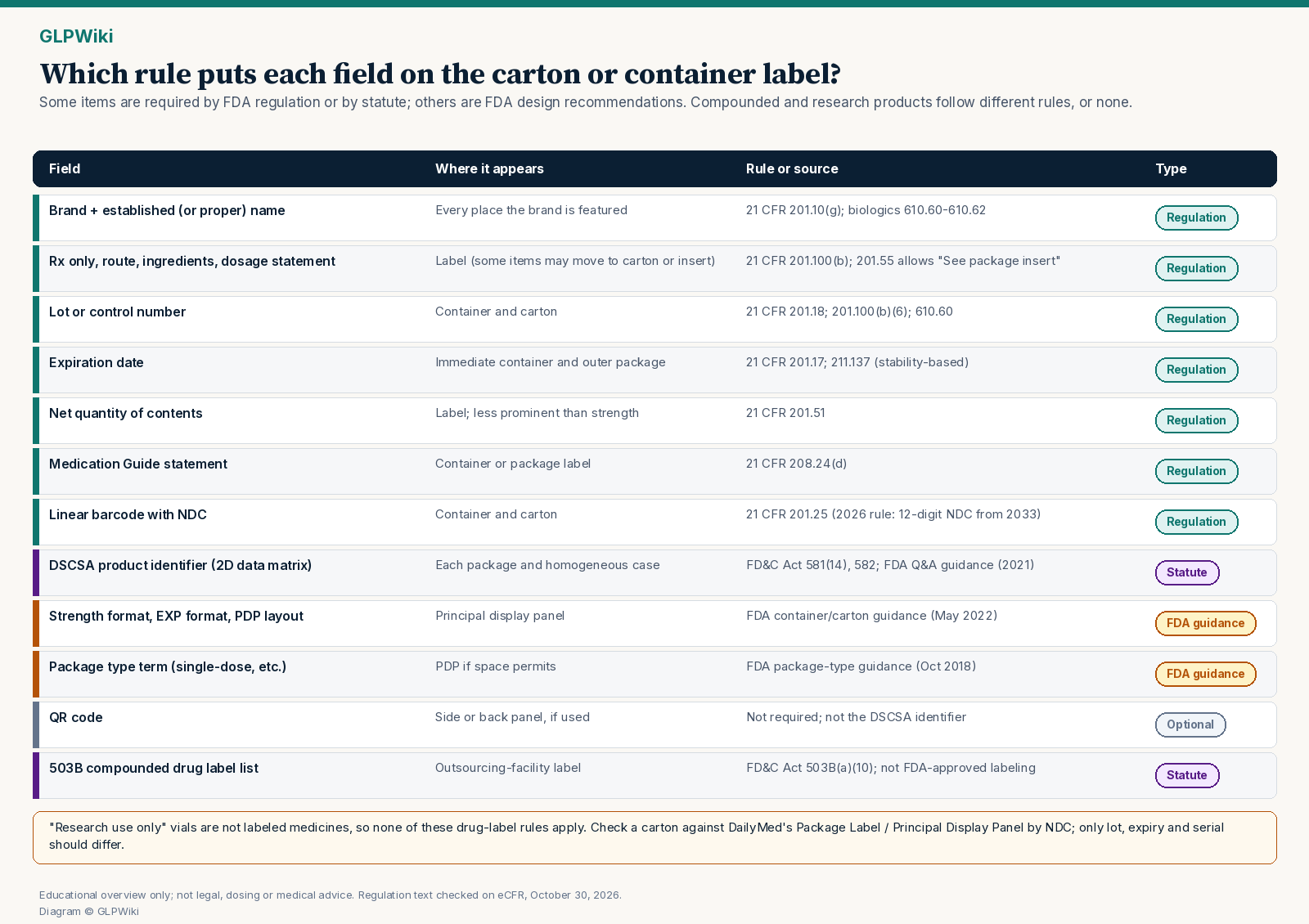
Most prescription cartons carry up to three different codes, and they do different jobs. The figure maps every carton field, including these codes, to the rule or guidance behind it.
Linear NDC barcode (21 CFR 201.25)
Most prescription drugs and biologics must carry a linear barcode containing at least the NDC, with sufficient blank space around it. It must appear on the drug's label as defined in section 201(k), which in practice means the immediate container and the outer carton. It exists so that hospital scanners can check right drug, right dose and right route at the bedside. FDA's March 5, 2026 final rule, Revising the National Drug Code Format and Drug Label Barcode Requirements, adopts a uniform 12-digit NDC and permits other data carriers that meet the rule's standards. It takes effect March 7, 2033. FDA says that from then a single 2D data matrix may satisfy both the NDC barcode and DSCSA requirements.
DSCSA product identifier (2D data matrix)
Under FD&C Act sections 581 and 582, part of the Drug Supply Chain Security Act, manufacturers have had to put a product identifier on each package and homogeneous case since November 27, 2017. It contains the NDC, a unique serial number, the lot and the expiration date, in both human-readable and machine-readable form. Packages must use a 2D data matrix barcode. FDA's 2021 Q&A guidance recommends the human-readable lines "NDC:", "SERIAL:", "LOT:" and "EXP:". This identifier supports tracing through the supply chain. It is not a consumer authenticity app.
QR codes
These are optional. FDA's guidance notes that a QR code does not contain the DSCSA product identifier and recommends that, if used, it sit away from the barcode on a side or back panel. A QR code can link anywhere. Treat its destination as you would any web link, and confirm product information against DailyMed or Drugs@FDA.
Matching a carton to DailyMed and the approved labeling
FDA reviews carton and container labeling as part of an application. Changes go through supplements like any other labeling change. A recent example is Ozempic supplement S-044, approved in August 2026, a prior approval supplement to "remove the Quick Guide from the product carton." In the approval letter, FDA acknowledges the company's "final printed carton and container labeling." Our version-tracking guide explains supplements and letters.
On DailyMed, each SPL ends with sections titled "Package Label / Principal Display Panel," with an image and transcribed text for every presentation. To check a carton in hand, follow the steps below.
FDA's guidance also recommends consistency between the carton, the container, the PI and patient labeling. A mismatch in units or terms is itself a known error trap.
- Step 1: Search DailyMed by the NDC printed on the carton, keeping the hyphens.
- Step 2: Open the SPL and scroll to the Package Label / Principal Display Panel image for your presentation.
- Step 3: Compare the brand and established name, strength expression, package type, route and "Contains:" statement.
- Step 4: Expect lot, expiry and serial number to differ. They are printed on each package and are not part of the SPL image. Images can even carry placeholders. One current Ozempic panel for a prefilled-syringe presentation shows "NDC XXXX-XXXX-XX."
- Step 5: If something on the carton does not match DailyMed, such as a different name, strength format or package type, ask the dispensing pharmacist before relying on it. The carton may be an older approved version, a different presentation, or not the product you think it is.
Compounded and "research" products
503B outsourcing facilities. FD&C Act section 503B(a)(10) sets a specific label list for compounded drugs from outsourcing facilities: the statement "This is a compounded drug." (or a comparable alternative specified by FDA), the facility's name, address and phone number, the lot or batch number, the established name, the dosage form and strength, the quantity or volume, the date compounded, the expiration date, storage and handling instructions, the NDC if available, "Not for resale" (and "Office Use Only" when not dispensed for an identified patient), and an ingredient list. The container from which units are dispensed must add MedWatch contact information and directions for use. None of this makes the product FDA-approved. It has no approved PI behind the carton.
503A pharmacy compounding for an individual patient is labeled mainly under state pharmacy rules, so it will look like a pharmacy dispensing label rather than a manufacturer carton.
"Research use only" vials are not labeled drugs at all, so none of the rules above apply. Our vial-label guide explains how to read those stickers against a COA, and it is a different exercise.
FDA has warned about dosing errors with compounded semaglutide, including confusion between milligrams, milliliters and "units." A poison-center case series described patients who received vials and syringes without counseling, including 10-fold errors (Lambson et al., J Am Pharm Assoc 2023). The approved-product carton conventions above, such as total quantity per total volume, package type and units consistent with the PI, exist precisely to prevent that kind of confusion.
Common misreadings
Seven misreadings come up again and again when people read cartons.
- "The big number on the front is my dose." The strength describes what is in the container. Dosing comes from the prescriber and the PI. Never infer a dose from a carton.
- "The concentration is the total amount." For multi-dose presentations, the concentration in parentheses (per mL) differs from the total quantity per total volume.
- "No expiry day printed means it expires on the 1st." FDA reads a year-and-month date as the last day of that month. In-use limits in the labeling can be much shorter.
- "The QR code proves it's genuine." A QR code is optional marketing or information space. It is not the DSCSA identifier.
- "An NDC on the box means FDA approved it." FDA says assigning an NDC does not denote approval. Check Drugs@FDA. (See our Section 16 guide.)
- "If it looks like the DailyMed image, every field should match." Lot, expiry and serial are package-specific. Everything else should match.
- "Compounded labels follow the same format." 503B labels follow their own statutory list, and research vials follow none.
A six-step carton check
Work through these six steps in order whenever you pick up a new carton or refill.
- Step 1: Read the PDP first: brand and established name, dosage form, strength (quantity per total volume, then concentration), route and package type.
- Step 2: Find "Rx only" and the Medication Guide statement. Confirm the Medication Guide is in the box or was provided.
- Step 3: Find the lot and EXP on both the carton and the container. Read the date as written. A year and month means the end of that month.
- Step 4: Find the NDC and barcodes. The linear NDC barcode and the 2D data matrix with NDC, SERIAL, LOT and EXP should both be present on most prescription packages.
- Step 5: Match DailyMed by NDC: Package Label / Principal Display Panel, then Section 16, the Medication Guide and the Instructions for Use for that presentation.
- Step 6: Ask the pharmacist about anything that does not match, and keep the lot number if you ever need to report a problem.
Scope, disclaimer and review date
GLPWiki is an educational resource. This guide explains how FDA-regulated carton and container labels are organized and which rules govern them. It is not medical advice. It does not give doses, dosing schedules, administration or storage instructions, or product recommendations, and nothing here recommends starting, stopping or switching any medicine or research chemical. Strength formats are described as label conventions only. Follow the current FDA-approved labeling for your exact product and ask your pharmacist or clinician. Label examples were checked on DailyMed on October 30, 2026 and may change. To report a suspected adverse reaction or product problem, contact the manufacturer or FDA MedWatch at 1-800-FDA-1088 or www.fda.gov/medwatch.
Last reviewed: October 30, 2026. Labels, cartons and the rules behind them change; verify with DailyMed, Drugs@FDA, eCFR and your pharmacist or clinician.
Frequently asked questions
- What is the principal display panel on a drug carton?
- It is the panel most likely to be seen under customary display conditions. FDA recommends it prominently show the brand and established or proper name, dosage form, strength, route, and any important warnings. For injectables, it should also show the package type when space permits.
- What does "Rx only" on a carton mean?
- It is the prescription legend required by 21 CFR 201.100(b)(1) (and 610.60/610.61 for biologics). It signals the product may be dispensed only on a prescription.
- How do I read an expiration date that shows only a month and year?
- FDA's guidance says that when only a year and month are printed, FDA considers the product to expire on the last calendar day of that month. In-use or beyond-use limits in the labeling can be shorter.
- What is the difference between the lot number and the serial number?
- The lot number identifies a manufacturing batch and must allow its full manufacturing history to be traced (21 CFR 201.18). The serial number, part of the DSCSA product identifier, is unique to each individual package.
- What are the two barcodes on a prescription drug carton?
- Usually a linear barcode containing the NDC (21 CFR 201.25), used for bedside scanning, and a 2D data matrix containing the DSCSA product identifier: NDC, serial number, lot and expiry.
- Why does my carton not match the DailyMed picture exactly?
- DailyMed's Package Label / Principal Display Panel images are representative. Lot, expiration date and serial number are printed on each package, and images may use placeholders. Names, strength, package type and route should match. If they don't, ask your pharmacist.
- What does "single-patient-use" mean on a pen?
- It is an FDA package type term for a container holding multiple doses intended for one patient only. FDA recommends that pens prominently carry the single-patient-use warning because sharing pens can transmit bloodborne pathogens.
- What must a 503B compounded drug label say?
- Under FD&C Act 503B(a)(10), it must include "This is a compounded drug." (or an FDA-specified alternative), the outsourcing facility's contact details, lot, established name, dosage form and strength, quantity, compounding date, expiration date, storage and handling, the NDC if available, "Not for resale," and an ingredient list. It is not FDA-approved labeling.
SOURCES
- 0121 U.S.C. 321 (FD&C Act section 201), definitions (k) "label" and (m) "labeling"— GovInfo, U.S. Code
- 0221 CFR 201.1 — Name and place of business of manufacturer, packer, or distributor— eCFR
- 0321 CFR 201.2 — National Drug Code numbers on labels (requested, not required)— eCFR
- 0421 CFR 201.10 — Statement of ingredients; (a) intervening matter, (g) established name size and prominence, (i) small-container exemptions— eCFR
- 0521 CFR 201.15 — Prominence of required label statements— eCFR
- 0621 CFR 201.17 — Location of expiration date— eCFR
- 0721 CFR 201.18 — Significance of control numbers— eCFR
- 0821 CFR 201.25 — Bar code label requirements— eCFR
- 0921 CFR 201.51 — Declaration of net quantity of contents— eCFR
- 1021 CFR 201.55 — Statement of dosage ("See package insert for dosage information")— eCFR
- 1121 CFR 201.100 — Prescription drugs for human use; (b) required label items including "Rx only" and lot number— eCFR
- 1221 CFR 208.24 — Distributing and dispensing a Medication Guide; (d) label statement— eCFR
- 1321 CFR 211.137 — Expiration dating— eCFR
- 1421 CFR 610.60 — Container label (biological products)— eCFR
- 1521 CFR 610.61 — Package label (biological products)— eCFR
- 1621 CFR 610.62 — Proper name; package label; legible type (biological products)— eCFR
- 17Safety Considerations for Container Labels and Carton Labeling Design to Minimize Medication Errors (final guidance, May 2022)— FDA
- 18Safety Considerations for Container Labels and Carton Labeling Design to Minimize Medication Errors (guidance full text PDF)— FDA
- 19Notice of availability of the final container/carton labeling guidance, 87 FR 30227, May 18, 2022— Federal Register (GovInfo)
- 20Selection of the Appropriate Package Type Terms and Recommendations for Labeling Injectable Medical Products Packaged in Multiple-Dose, Single-Dose, and Single-Patient-Use Containers for Human Use (guidance, Oct 2018)— FDA
- 21Product Identifiers Under the Drug Supply Chain Security Act — Questions and Answers (guidance, June 2021)— FDA
- 22Carton and Container Labeling Resources— FDA
- 23Bar Code Label Requirements (questions and answers page)— FDA
- 24Revising the National Drug Code Format and Drug Label Barcode Requirements (final rule), 91 FR 10749, Mar 5, 2026— Federal Register
- 25National Drug Code Format (12-digit NDC; single 2D data matrix from March 7, 2033)— FDA
- 26FDA Name Differentiation Project (tall man lettering)— FDA
- 2721 U.S.C. 353b (FD&C Act section 503B), (a)(10) labeling of outsourcing-facility compounded drugs— GovInfo, U.S. Code
- 28NDA 209637/S-044 supplement approval letter (Ozempic; carton Quick Guide removal; final printed carton and container labeling), Aug 2026— FDA
- 29OZEMPIC (semaglutide) injection — Package Label / Principal Display Panel sections— DailyMed
- 30WEGOVY (semaglutide) injection — Package Label / Principal Display Panel sections— DailyMed
- 31MOUNJARO (tirzepatide) injection — Package Label sections (pens, single-dose vials)— DailyMed
- 32ZEPBOUND (tirzepatide) injection — Package Label sections (pens, vials)— DailyMed
- 33FDA alerts health care providers, compounders and patients of dosing errors associated with compounded injectable semaglutide products— FDA
- 34Lambson JE, Flegal SC, Johnson AR. Administration errors of compounded semaglutide reported to a poison control center — Case series. J Am Pharm Assoc. 2023;63(5):1643-1645— PubMed
- 35Lohmeyer Q, et al. Effects of tall man lettering on the visual behaviour of critical care nurses while identifying syringe drug labels: a randomised in situ simulation. BMJ Qual Saf. 2023;32(1):26-33— PubMed
- 36Aceves-Gonzalez C, et al. Estimating the impact of label design on reducing the risk of medication errors by applying HEART in drug administration. Eur J Clin Pharmacol. 2024;80(4):575-588— PubMed
- 37MedWatch: The FDA Safety Information and Adverse Event Reporting Program— FDA
EDUCATIONAL REFERENCE ONLY · Not medical advice. Nothing here diagnoses, treats, cures or prevents any disease, and nothing here is a dosing recommendation. Consult a licensed clinician before any treatment decision.