MedWatch and FAERS (now AEMS) literacy: how adverse event reports work and what the numbers can and cannot tell you

When a medicine is on the market, most of what FDA learns about rare or unexpected problems starts as a report: a patient, a pharmacist or a manufacturer describing something that happened. Those reports flow through MedWatch into FDA's adverse event database, long known as FAERS and, since March 11, 2026, part of the Adverse Event Monitoring System (AEMS). This guide explains who reports and what the rules require, what a MedWatch form asks for (including the lot and NDC from the carton), how the public dashboard and data files work, why a count of reports is not a rate, and how a signal travels from a quarterly posting to a label change, using the 2023 GLP-1 class signals as the worked example. It is about reading and reporting systems. It gives no doses or treatment advice and is not medical advice.
UPDATED 31 OCT 2026 · 15 MIN READ
KEY TAKEAWAYS
- MedWatch is FDA's safety reporting program; FAERS was the database behind it for human drugs and therapeutic biologics. FDA moved FAERS data into the new Adverse Event Monitoring System (AEMS) on March 11, 2026, so current FDA pages say "AEMS (formerly FAERS)."
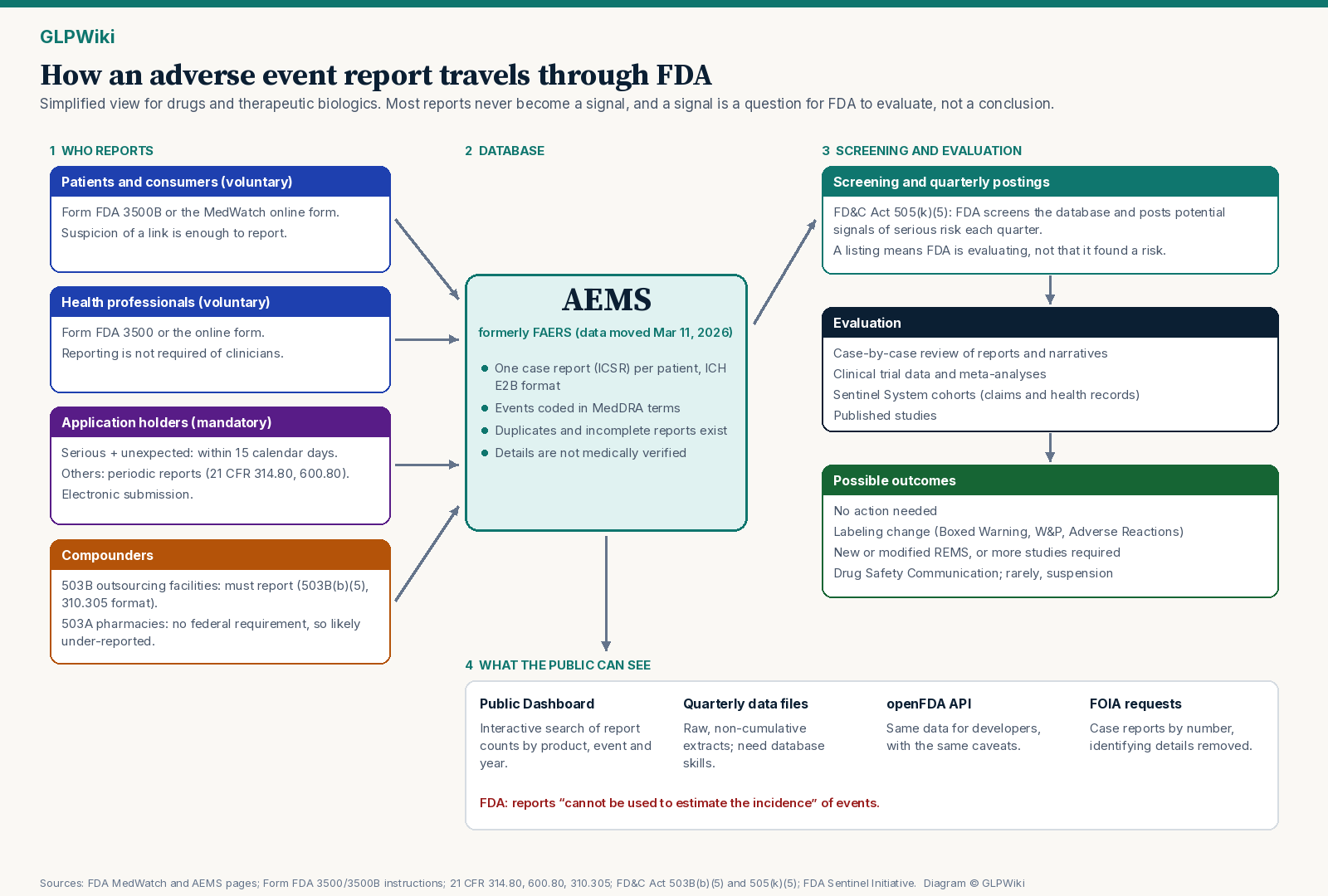
- Reporting is voluntary for patients, consumers and health professionals (Forms 3500B and 3500, or the online form). It is mandatory for application holders: serious and unexpected events go to FDA within 15 calendar days, and other events in periodic reports (21 CFR 314.80 for drugs, 600.80 for biologics).
- You do not need to be sure a product caused a problem to report it. FDA's Form 3500 instructions say suspicion of an association is enough, and that a report is not an admission that anyone or any product caused the event.
- For quality problems, FDA calls the labeler, strength, NDC and lot number "critical." Those come from the carton or container label, not usually from the pharmacy sticker.
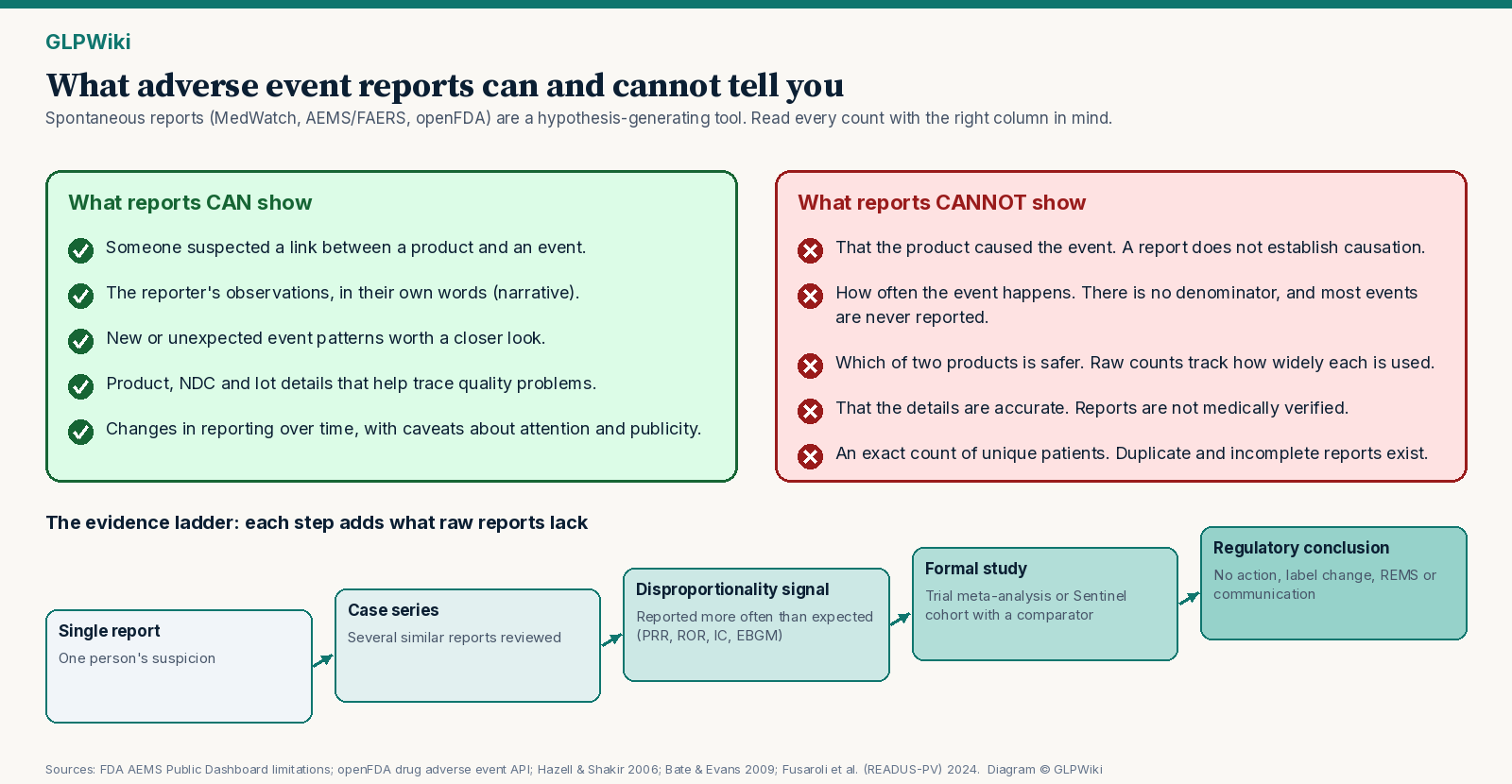
- FDA's own dashboard page lists the limits: duplicate and incomplete reports exist, a report does not establish causation, the information is not verified, and the reports "cannot be used to estimate the incidence" of events.
- Under-reporting is large and uneven. A systematic review of 37 studies found a median under-reporting rate of 94%, and a FAERS study found reporting varied widely by drug type and event. Counts therefore reflect reporting behaviour as well as biology.
- A potential signal on FDA's quarterly list means FDA is evaluating a question, not that it has found a risk. For the GLP-1 class, the July–September 2023 list ended in three different outcomes: label updates for aspiration, Adverse Reactions updates for alopecia on some products, and, for suicidal ideation, a 2026 request to remove the existing warning after FDA's review found no increased risk.
- State-licensed 503A pharmacies are not federally required to submit adverse event reports, so FDA says compounded GLP-1 events are likely under-reported. Outsourcing facilities (503B) must report.
Why post-marketing reports exist
Clinical trials are large, but they are not large enough or long enough to show every rare problem, and they enrol selected patients. FDA's consumer explainer puts it plainly: some risks "come to light only after a medical product gets on the market and is used in a larger number of patients, for a longer period of time, and in patients whose health characteristics are different from those of the patients studied before approval."
Spontaneous reports are the oldest and simplest way to catch those problems. Someone notices something, writes it down, and sends it in. FDA says every MedWatch report "is recorded in an FDA database for review and comparison to similar previous reports," and that, added together, reports "can signal a safety problem." The same page notes that for consumer complaints "as few as one or two complaints can make a difference."
GLPWiki's Warnings, Precautions and Adverse Reactions guide explains how Section 6 of a label is built from controlled trial data and a separate Postmarketing Experience list. This guide covers the other side: the reporting system that feeds that postmarketing list, and how to read its numbers without over-reading them.
The vocabulary: MedWatch, FAERS, AEMS and the forms
Several names get used interchangeably online. They refer to different things.
Programs and databases
- MedWatch: FDA's medical product safety reporting program for health professionals, patients and consumers. It covers drugs, biologics, medical devices, combination products such as prefilled syringes and auto-injectors, cosmetics and some other products. It also publishes MedWatch safety alerts.
- FAERS (FDA Adverse Event Reporting System): the database of adverse event reports, medication error reports and product quality complaints that resulted in adverse events, for drugs and therapeutic biologics. FAERS launched on September 10, 2012, replacing the older AERS.
- AEMS (Adverse Event Monitoring System): FDA's new consolidated system. FDA states that data from FAERS "was moved to AEMS for the launch of AEMS on March 11, 2026." AEMS is designed to bring reporting for many FDA-regulated product types into one platform. Current FDA pages are titled "AEMS [Formerly FAERS]," and older research papers and dashboards still say FAERS.
- VAERS: vaccines use a separate system, the Vaccine Adverse Event Reporting System. Tobacco and dietary supplement problems go through the Safety Reporting Portal.
- Sentinel: FDA's active surveillance system, launched as an initiative in May 2008 and as a full system in February 2016. It analyses health insurance claims and electronic health records. Unlike spontaneous reports, it can compare groups of patients.
Forms and coding
- Form FDA 3500: voluntary reporting, designed for health professionals but usable by anyone.
- Form FDA 3500B: the consumer and patient version, in plainer language (also in Spanish).
- Form FDA 3500A: mandatory reporting by manufacturers, distributors, importers, user facilities and IND researchers, used only when electronic submission is not required.
- ICSR (individual case safety report): one report about one patient. FAERS follows the ICH E2B international format for these reports.
- MedDRA: the Medical Dictionary for Regulatory Activities. Reporters' words are coded into MedDRA terms, which is why dashboards show standardised event names rather than the reporter's own phrasing.
Who reports, and what the rules require
Reports reach FDA through two very different routes, and the difference matters when you read the data.
Voluntary reports: patients, consumers and health professionals
Anyone can report. FDA encourages patients to take the form to their doctor, because the health care provider can add clinical details from the medical record. But FDA also says "your health care provider is NOT required to report to the FDA," and that patients may complete the online form themselves.
Form 3500 instructions state: "To report, it is not necessary to be certain of a cause/effect relationship between the adverse event and the use of the medical product(s) in question. Suspicion of an association is sufficient reason to report." They add that a submission "does not constitute an admission that medical personnel or the product caused or contributed to the event."
Voluntary reports can cover four kinds of problem: adverse events (side effects), product use or medication errors, product quality problems, and therapeutic failure, including problems after switching from one manufacturer of the same medicine to another.
Mandatory reports: application holders
Companies that hold an approved application must review adverse drug experience information "from any source, foreign or domestic" (21 CFR 314.80(b)). Under 314.80(c), each event that is both serious and unexpected must be reported "as soon as possible but no later than 15 calendar days" after the company receives it. These are "15-day Alert reports." Other events go into periodic reports, quarterly for the first 3 years after approval and annually after that. Biologics follow parallel rules in 21 CFR 600.80. These reports must be electronic.
Two definitions in 314.80(a) are worth knowing. Serious means an outcome of death, a life-threatening experience, inpatient hospitalisation or prolonged hospitalisation, persistent or significant disability, or a congenital anomaly, plus important medical events judged to jeopardise the patient. Unexpected means "not listed in the current labeling," including events that are more severe or more specific than what the label describes.
Because companies must forward what they receive, a problem first described to a manufacturer's phone line can reach FDA as a manufacturer-submitted report. That is one reason the same event can appear more than once, once from the company and once from a patient or clinician who also reported it directly.
Other reporters and quality reports
- Unapproved marketed prescription drugs: manufacturers, packers and distributors must report serious, unexpected events under 21 CFR 310.305.
- Outsourcing facilities (503B): FD&C Act 503B(b)(5) requires them to submit adverse event reports in line with 310.305. Their container labels must also carry the MedWatch web address and 1-800-FDA-1088 "to facilitate adverse event reporting" (503B(a)(10)(B)).
- State-licensed 503A pharmacies: FDA states that federal law does not require pharmacies that are not outsourcing facilities to submit adverse events to FDA.
- Quality defects: separately from adverse events, application holders must send an NDA Field Alert Report within 3 working days about distributed products that may be mistaken for another article, are contaminated, have deteriorated, or fail specifications (21 CFR 314.81(b)(1)).
What a MedWatch report asks for
Knowing the form explains what the database can and cannot contain. The consumer Form 3500B (09/2025 version) has six parts.
- Section A, About the Problem: what kind of problem it was (hurt or had a bad side effect; used a product incorrectly; noticed a quality problem; had problems after switching makers), whether a serious outcome occurred, the date, and a free-text description of up to 4,000 characters, plus relevant test results.
- Section B, Product Availability: whether you still have the product (FDA says not to send it) and whether you have pictures. FDA notes that pictures "of all sides of the product" help.
- Section C, About the Products: the name "as it appears on the box, bottle, or package," the place and date of purchase (including a website if bought online), the maker or compounder, the product type (brand, generic or biosimilar, OTC, or compounded by a pharmacy or outsourcing facility), the expiration date, the lot number, the NDC number and the labeled strength.
- Section D, About the Medical Device: model, catalog, lot and serial numbers for device problems.
- Section E, About the Person Who Had the Problem: initials, sex, age, date of birth, weight and race or ethnicity, but not the person's name.
- Section F, About the Person Filling Out This Form: contact details, so FDA can follow up if needed.
Why the carton matters for a report
Form 3500 instructions say that, for quality problems, identifying "the labeler/distributor and pharmaceutical manufacturer, the labeled strength, the NDC number and when appropriate, the lot number of the product is critical." They ask reporters to copy the NDC "with any zeros and dashes" exactly as printed, and note that the NDC "is usually not found on dispensed pharmacy prescriptions." If the packaging is gone, FDA suggests asking the dispensing pharmacy.
This is where label literacy and safety reporting meet. GLPWiki's carton and container label guide explains where the lot number, expiration date and NDC appear on a carton and why a lot number "should be capable of yielding the complete manufacturing history of the package" (21 CFR 201.18). A report without a lot number can still be useful, but a quality investigation usually starts from the lot.
Privacy: what happens to names
FDA asks reporters not to use a patient's name or Social Security number. On Form 3500 the patient identifier should be initials or another code that lets the reporter find the case again. FDA says the patient's identity "is held in strict confidence by FDA and protected to the fullest extent of the law."
FDA's public-information rules add a specific protection for voluntary reporters. Under 21 CFR 20.63(f), names and other information that would identify a voluntary reporter or any person in an adverse event report "shall not be disclosed" by FDA, or by a manufacturer holding the report, in response to a request, demand or order.
There is one sharing step to understand. For serious events, FDA may give the reporter's name and contact details to the product's manufacturer so it can follow up. Both forms include a box to opt out (Form 3500 block G5; Form 3500B Section F). For health professionals, FDA states that the HIPAA Privacy Rule permits covered entities to report adverse events to FDA and to manufacturers, while sending the minimum necessary protected health information.
Reading the public data: dashboard, data files and openFDA
There are three public ways to look at FDA adverse event data, and each comes with the same warnings.
AEMS (formerly FAERS) Public Dashboard
FDA describes the dashboard as a "highly interactive web-based tool" for searching reports from industry, health care providers and consumers. Its own page lists the limitations, and they are worth reading word for word:
- "Duplicate and incomplete reports are in the system."
- "Existence of a report does not establish causation." The event may have been caused by the underlying disease, another drug, or something else, and the report "reflect[s] only the reporter's observations and opinions."
- "Information in reports has not been verified."
- "Rates of occurrence cannot be established with reports." The reports "cannot be used to estimate the incidence (occurrence rates) of the events reported."
- FDA adds: "Patients should talk to their doctor before stopping or changing how they take their medications."
Quarterly data files and FOIA
FDA publishes raw quarterly extracts, in ASCII or SGML, covering demographics, drugs, reactions, outcomes and report sources. FDA notes the files "are not cumulative" and that using them requires building a relational database. A summary report for a product, or individual case reports by number, can be requested through the Freedom of Information Act, with identifying information removed.
openFDA
openFDA offers the same report data through a public API. Its documentation adds two practical warnings. First, "many drug products appear frequently in adverse event reports simply because they are commonly taken by many people in the population." Second, rises in the total number of reports are "likely caused by improved reporting." The page also notes that a drug marked "suspect" in a report is the reporter's judgement and "is not validated."
Why a count of reports is not a rate
A rate needs a numerator (how many people had the event) and a denominator (how many people used the product). Spontaneous reports provide only a partial numerator and no denominator. That is the single most important point in this guide.
The numerator is incomplete, and unevenly so
Most adverse reactions are never reported. A systematic review of 37 studies from 12 countries found a median under-reporting rate of 94% (interquartile range 82–98%), and still 85% for specific serious reaction–drug pairs (Hazell and Shakir, Drug Saf 2006). A FAERS study comparing reports with expected event numbers found significant under-reporting for most drug–event pairs, and that it "varies considerably by the type of drug and the type of ADEs" (Alatawi and Hansen, Expert Opin Drug Saf 2017).
Reporting also responds to attention. News coverage, lawsuits, new warnings and social media can all raise reporting for one product or event without any change in the underlying risk. The classic "Weber effect" claimed that reports peak about two years after approval. An analysis of 62 drugs in FAERS found most did not follow that curve; reporting rose over the first three quarters and then stayed fairly flat (Hoffman et al., Drug Saf 2014). The lesson is not that timing never matters, but that patterns in report counts need a reason before they are read as risk.
The denominator is missing
A widely used product will collect more reports than a rarely used one even if both are equally safe, as openFDA's documentation says. Comparing raw counts between two GLP-1 medicines, between a brand and a compounded version, or between this year and last year, says as much about how many people used them and how often people reported as it does about safety.
What disproportionality analysis does and does not do
Researchers often use disproportionality measures, such as the proportional reporting ratio (PRR), reporting odds ratio (ROR), information component (IC) and empirical Bayes geometric mean (EBGM), to see whether an event is reported more often with one drug than with all others in the database (Bate and Evans, Pharmacoepidemiol Drug Saf 2009). These measure reporting imbalance, not risk. A high ROR is a reason to look closer. It is not an estimate of how likely the event is.
Because many published disproportionality studies are over-interpreted, an international group published the READUS-PV reporting guideline in 2024, with 14 items to help authors, reviewers and readers place results "in the correct context" (Fusaroli et al., Drug Saf 2024). When you read a headline built on FAERS data, check whether the study says it is hypothesis-generating and whether it reports duplicates handling, the comparator and the limits.
From signal to label: the GLP-1 case study
Section 505(k)(5) of the FD&C Act, added in 2007 and amended by the 21st Century Cures Act in 2016, requires FDA to screen its adverse event database and post a quarterly report of "any new safety information or potential signal of a serious risk." FDA is explicit about what a listing means: it "does not mean that FDA has concluded that the drug or biological product has the listed risk." It means FDA "has identified a potential safety signal and is evaluating the signal." Possible outcomes include no action, a labeling change, a new or modified REMS, more studies, or, rarely, marketing suspension.
The July–September 2023 quarterly report listed the whole GLP-1 receptor agonist class, from exenatide to semaglutide and tirzepatide, for three potential signals. They ended in three different places.
- Aspiration: the Warnings and Precautions, Adverse Reactions and Patient Counseling sections were updated between October and November 2024 to describe pulmonary aspiration during general anesthesia or deep sedation. In November 2024 FDA also required a postmarketing trial on withholding GLP-1 RAs and fasting duration before procedures.
- Alopecia: the Adverse Reactions section of several products (including Ozempic, Rybelsus, Mounjaro, Trulicity, Victoza and Saxenda) was updated between December 2024 and May 2025 to include alopecia. For Byetta, Bydureon, Bydureon BCise, Wegovy and Zepbound, FDA determined the existing labeling was adequate.
- Suicidal ideation: FDA's January 2024 Drug Safety Communication said reviews of FAERS reports did not show a clear relationship, because the information "was often limited" and the events "can be influenced by other potential factors," and that it could not rule out a small risk. On January 13, 2026, FDA reported a meta-analysis of 91 placebo-controlled trials with 107,910 patients and a Sentinel cohort of more than 2.2 million new users of GLP-1 RAs or SGLT2 inhibitors, found no increased risk, and requested removal of the suicidal ideation and behavior warning from Saxenda, Wegovy and Zepbound labeling.
What the example teaches
The same kind of report-based signal led to a new warning in one case, a line in Adverse Reactions in another, and the removal of an existing warning in the third. Reports raised the questions. Trial data, a large comparative cohort and case review answered them. When a label changes after a signal, GLPWiki's label version tracking guide explains how to see exactly what changed and when.
Compounded and "research" products
Reporting gaps are largest where reporting is not required. FDA's page on unapproved GLP-1 drugs states that federal law does not require state-licensed pharmacies that are not outsourcing facilities to report adverse events, so "it is likely that adverse events from compounded versions of these drugs are underreported." As of May 31, 2026, FDA said it had received 990 reports associated with compounded semaglutide and more than 730 associated with compounded tirzepatide, and that many "appear to be consistent with adverse events related to the FDA-approved versions." FDA also describes reports linked to dosing errors with compounded products, some requiring hospitalisation.
Those numbers are a good test of everything above. They are counts, not rates. There is no reliable denominator for compounded use. Reporting is not required for most compounders. And FDA itself notes "it is not always possible to determine if the adverse event directly resulted from use of the drug." The counts show that problems are being reported. They cannot show whether compounded products are more or less risky than approved ones.
Form 3500B lets reporters mark a product as "Compounded product (By a Pharmacy or an Outsourcing Facility)" and record where and from what website it was bought. Products sold as "for research use only" or "not for human consumption" are not approved or labeled medicines. FDA has warned companies selling such semaglutide, tirzepatide and retatrutide products and says they are "of unknown quality." MedWatch covers prescription drugs, biologics and combination products such as prefilled pens, and Form 3500 lists "suspected counterfeit product" as a product problem category.
Common misreadings
These come up again and again in posts, videos and even some news stories.
- "There are thousands of FAERS reports, so it must be dangerous." Report totals mostly track how many people use a product and how much attention it gets. They are not incidence.
- "It's in FAERS, so the drug caused it." FDA says the existence of a report "does not establish causation."
- "Drug A has more reports than drug B, so B is safer." Without denominators and comparable reporting, raw counts cannot rank products.
- "FDA listed it as a potential signal, so FDA confirmed a risk." A listing means FDA is evaluating. Outcomes range from no action to a label change or warning removal.
- "No reports means no problem." Under-reporting is the norm, and for 503A compounded and research products reporting is often not required at all.
- "A high reporting odds ratio is the risk." Disproportionality measures reporting imbalance and needs formal study to confirm.
- "FAERS and AEMS are different data." FAERS data were moved into AEMS in March 2026; older papers and tools simply use the older name.
A six-question checklist for any adverse event number
Use these questions whenever a FAERS or AEMS figure appears in an article, a forum post or a sales pitch.
- Step 1: What exactly was counted: reports, cases or patients, and were duplicates removed?
- Step 2: Which product: a specific approved brand, a generic, a compounded product, or an ingredient name that mixes them?
- Step 3: What time window, and did anything (a warning, a lawsuit, news coverage) change reporting during it?
- Step 4: Is there a denominator? If not, the number cannot be a rate or a risk.
- Step 5: Is it a disproportionality result? If so, is it presented as a hypothesis, and does it follow READUS-PV-style reporting?
- Step 6: What did FDA conclude? Check the quarterly signal page, Drug Safety Communications and the current label on DailyMed or Drugs@FDA.
Scope, disclaimer and review date
This page explains how FDA adverse event reporting systems work and how to interpret their public data. It does not provide doses, schedules, injection or device instructions, product recommendations, symptom triage or individual medical advice, and nothing here suggests starting, stopping or changing any medicine. MedWatch is not an emergency service: for a medical emergency, call 911 or your local emergency number, and talk with a licensed clinician or pharmacist about any symptom or medication question.
Last reviewed: October 31, 2026. FDA systems, forms and labels change; verify with FDA's MedWatch and AEMS pages, the current labeling on DailyMed or Drugs@FDA, and your pharmacist or clinician.
Frequently asked questions
- Is FAERS gone?
- The data are not gone. FDA moved FAERS data into the Adverse Event Monitoring System (AEMS) when AEMS launched on March 11, 2026. Current FDA pages are titled "AEMS (formerly FAERS)," and the public dashboard, quarterly data files and quarterly signal postings continue under the AEMS name.
- Do I need to be sure a medicine caused a problem before reporting it?
- No. FDA's Form 3500 instructions say suspicion of an association is enough, and that a report does not mean anyone or any product caused the event.
- Who is required to report adverse events to FDA?
- Application holders (manufacturers with approved applications) under 21 CFR 314.80 and 600.80, manufacturers of unapproved marketed prescription drugs under 310.305, and 503B outsourcing facilities. Patients, consumers and health professionals report voluntarily. FDA says state-licensed 503A pharmacies are not federally required to report.
- What details from the package help a report?
- For quality problems FDA calls the manufacturer or labeler, labeled strength, NDC and lot number critical. These are printed on the carton or container label; FDA asks for the NDC exactly as printed and suggests asking the dispensing pharmacy if the packaging is gone.
- Will my name be made public?
- No. Under 21 CFR 20.63(f), FDA does not disclose information identifying a voluntary reporter or a patient in response to public requests. For serious events FDA may share the reporter's contact details with the manufacturer for follow-up unless the reporter opts out on the form.
- Can I use the dashboard to see how common a side effect is?
- No. FDA states that the reports cannot be used to estimate incidence. Rates come from controlled trials (Section 6 of the label) or well-designed observational studies with denominators.
- What does it mean when a GLP-1 medicine appears on FDA's quarterly signal list?
- That FDA identified a potential signal and is evaluating it, not that it has found a risk. The 2023 GLP-1 class listings ended in label updates for aspiration, Adverse Reactions updates for alopecia on some products, and removal of an existing suicidal ideation warning after FDA's review.
- Does this page tell me what to do about a side effect?
- No. It explains reporting systems only. Questions about symptoms or medicines belong with a licensed clinician or pharmacist, and emergencies should go to 911 or local emergency services.
SOURCES
- 01MedWatch: The FDA Safety Information and Adverse Event Reporting Program— FDA
- 02Reporting Serious Problems to FDA— FDA
- 03MedWatch Forms for FDA Safety Reporting— FDA
- 04Instructions for Completing Form FDA 3500— FDA
- 05Form FDA 3500B — MedWatch Consumer Voluntary Reporting (PDF)— FDA
- 06Form FDA 3500 — MedWatch Voluntary Reporting (PDF)— FDA
- 07MedWatch Online Voluntary Reporting Form— FDA
- 08FDA 101: How to Use the Consumer Complaint System and MedWatch— FDA
- 09FDA Adverse Event Monitoring System (AEMS) [formerly FAERS]— FDA
- 10FDA Adverse Event Monitoring System (AEMS) Public Dashboard— FDA
- 11FDA Adverse Event Monitoring System (AEMS) Latest Quarterly Data Files— FDA
- 12New Safety Information or Potential Signals of Serious Risks Identified from AEMS— FDA
- 13July – September 2023 Potential Signals of Serious Risks/New Safety Information Identified by FAERS— FDA
- 14FDA Adverse Event Monitoring System (AEMS) Electronic Submissions— FDA
- 15Drug/Biologic/HCT/P Manufacturers, Distributors, and Packers — mandatory reporting— FDA
- 16HIPAA Compliance for Reporters to FDA MedWatch— FDA
- 17openFDA: Drug adverse event API overview— FDA / openFDA
- 18FDA's Sentinel Initiative— FDA
- 19Drug Safety Communication (01-11-2024): Update on FDA's ongoing evaluation of reports of suicidal thoughts or actions with GLP-1 RAs— FDA
- 20Drug Safety Communication (01-13-2026): FDA requests removal of suicidal behavior and ideation warning from GLP-1 RA medications— FDA
- 21FDA's Concerns with Unapproved GLP-1 Drugs Used for Weight Loss— FDA
- 2221 CFR 314.80 — Postmarketing reporting of adverse drug experiences— eCFR
- 2321 CFR 600.80 — Postmarketing reporting of adverse experiences (biologics)— eCFR
- 2421 CFR 310.305 — Adverse drug experience reports for marketed prescription drugs without approved applications— eCFR
- 2521 CFR 314.81 — Other postmarketing reports (NDA Field Alert Reports)— eCFR
- 2621 CFR 20.63 — Personnel, medical, and similar files (reporter identity protection)— eCFR
- 2721 U.S.C. 353b — Outsourcing facilities (FD&C Act 503B)— U.S. Code (GovInfo)
- 2821 U.S.C. 355 — New drugs (FD&C Act 505(k)(5) quarterly signal postings)— U.S. Code (GovInfo)
- 29Hazell L, Shakir SA. Under-reporting of adverse drug reactions: a systematic review. Drug Saf. 2006;29(5):385-396— PubMed
- 30Alatawi YM, Hansen RA. Empirical estimation of under-reporting in the U.S. FDA Adverse Event Reporting System (FAERS). Expert Opin Drug Saf. 2017;16(7):761-767— PubMed
- 31Hoffman KB, et al. The Weber effect and the United States FDA's Adverse Event Reporting System (FAERS): analysis of sixty-two drugs approved from 2006 to 2010. Drug Saf. 2014;37(4):283-294— PubMed
- 32Bate A, Evans SJ. Quantitative signal detection using spontaneous ADR reporting. Pharmacoepidemiol Drug Saf. 2009;18(6):427-436— PubMed
- 33Fusaroli M, et al. The REporting of A Disproportionality Analysis for DrUg Safety Signal Detection Using Individual Case Safety Reports in PharmacoVigilance (READUS-PV): Explanation and Elaboration. Drug Saf. 2024;47(6):585-599— PubMed
EDUCATIONAL REFERENCE ONLY · Not medical advice. Nothing here diagnoses, treats, cures or prevents any disease, and nothing here is a dosing recommendation. Consult a licensed clinician before any treatment decision.