Patient-reported outcomes and quality-of-life literacy: how questionnaires like IWQOL-Lite-CT, SF-36, KCCQ and PROMIS measure how people feel and function in GLP-1 trials and labels

Weight, HbA1c and blood pressure are measured with scales, lab tests and cuffs. How a person feels and functions has to be measured by asking them. Patient-reported outcomes (PROs) are the questionnaires trials use to do that, and they now sit at the center of several GLP-1 trials: the KCCQ in heart failure, WOMAC pain in knee osteoarthritis, PROMIS sleep scales in sleep apnea, and IWQOL-Lite-CT and SF-36 physical functioning in the STEP and SURMOUNT obesity programs. This guide explains the clinical outcome assessment (COA) vocabulary; FDA's 2009 PRO guidance and its four-part patient-focused drug development series; what makes an instrument fit for purpose; the main instruments used in obesity trials; minimal clinically important difference and meaningful within-patient change, anchor-based versus distribution-based methods, and how to read cumulative distribution plots; what FDA reviewers actually concluded about the PRO data for Wegovy and Zepbound; missing data, unblinding and response shift; reporting standards; and how PRO results do or do not reach a label. Educational only: no doses, no treatment advice and no product rankings.
UPDATED 28 NOV 2026 · 36 MIN READ
KEY TAKEAWAYS
- A patient-reported outcome is, in FDA's words, a measurement based on a report that comes directly from the patient about their health condition, without amendment or interpretation by a clinician or anyone else. It is one of four types of clinical outcome assessment, alongside clinician-reported, observer-reported and performance outcomes.
- FDA's December 2009 PRO guidance set out how the agency evaluates questionnaires used to support labeling claims. Its patient-focused drug development series extends that work: Guidances 1 to 3 are final (Guidance 3 in October 2025), and Guidance 4, on turning COAs into endpoints and interpreting meaningful change, was issued in draft in April 2023.
- A statistically significant difference on a questionnaire is not the same as a difference patients would notice. FDA prefers anchor-based methods, which tie score changes to patients' own global ratings, and says distribution-based rules such as half a standard deviation should not be the sole basis for a meaningful-change threshold.
- In STEP 1, semaglutide beat placebo on SF-36 physical functioning by 1.80 points and on IWQOL-Lite-CT physical function by 9.44 points, both in the testing hierarchy. FDA's clinical outcome assessment reviewers nonetheless found minimal change at the item level, floor effects and uncertain clinical meaning, and the Wegovy label carries no PRO claim.
- For Zepbound, FDA reviewers judged the SURMOUNT physical-function differences of about 2 to 3 points small and of uncertain clinical meaning, partly because participants' baseline scores were close to the general-population average. FDA's January 2025 draft obesity guidance now asks sponsors to plan for enough baseline impairment to show meaningful change.
- PROs can be primary endpoints. STEP-HFpEF and SUMMIT used the KCCQ Clinical Summary Score, STEP 9 used WOMAC pain, and the Zepbound label describes improvement on a PROMIS sleep-related impairment short form and uses the Epworth Sleepiness Scale in its definition of remission or mild non-symptomatic sleep apnea.
- Cumulative distribution (eCDF) plots and responder percentages show how individual changes spread out, but responder results depend heavily on the chosen threshold. FDA's draft Guidance 4 asks sponsors to annotate eCDF plots with a range of meaningful-change values rather than one cutoff.
- PRO data are vulnerable to missing questionnaires, unblinding (for example, through gastrointestinal side effects), expectation effects and response shift. CONSORT-PRO, SPIRIT-PRO and SISAQOL set reporting and analysis standards that help readers judge how much weight a PRO result can bear.
Why trials ask patients directly
GLP-1 trials measure a lot of things with instruments: scales for weight, lab assays for HbA1c, cuffs for blood pressure, sleep studies for apnea events, adjudication committees for heart attacks and strokes. None of those tells you whether a person can climb stairs more easily, sleeps better, has less knee pain, worries less about their weight in public or feels their heart-failure symptoms have eased. For those questions the most direct source is the person living with the condition.
A patient-reported outcome (PRO) measure is a structured way of asking. It is usually a questionnaire with fixed wording, fixed response options, a defined recall period (for example, 'in the past 7 days') and a scoring rule that turns answers into a number. Done well, it captures aspects of health that matter to patients and that no lab test can see. Done poorly, it produces numbers that are hard to interpret, easy to over-sell and vulnerable to bias.
PROs matter for readers of GLP-1 news for two reasons. First, headlines increasingly mention them: 'improved quality of life,' 'better physical function,' 'less knee pain,' 'fewer heart-failure symptoms.' Second, regulators treat them carefully. A PRO result only becomes a labeling claim when FDA concludes that the instrument measures the right concept in the right population and that the observed change is meaningful to patients. That is a higher bar than statistical significance.
This guide continues GLPWiki's trial-literacy series. The surrogate endpoints guide explains markers that stand in for outcomes; the estimands guide explains how intercurrent events and missing data shape trial estimates; this guide covers the outcome class defined by how patients feel and function.
The vocabulary: COA, PRO, ClinRO, ObsRO and PerfO
FDA and the FDA-NIH BEST glossary group these measures under the umbrella term clinical outcome assessment (COA): an assessment of a clinical outcome made through report by a clinician, a patient, a non-clinician observer or through a performance-based assessment. FDA's COA frequently asked questions page describes a COA as a measure that describes or reflects how a patient feels, functions or survives.
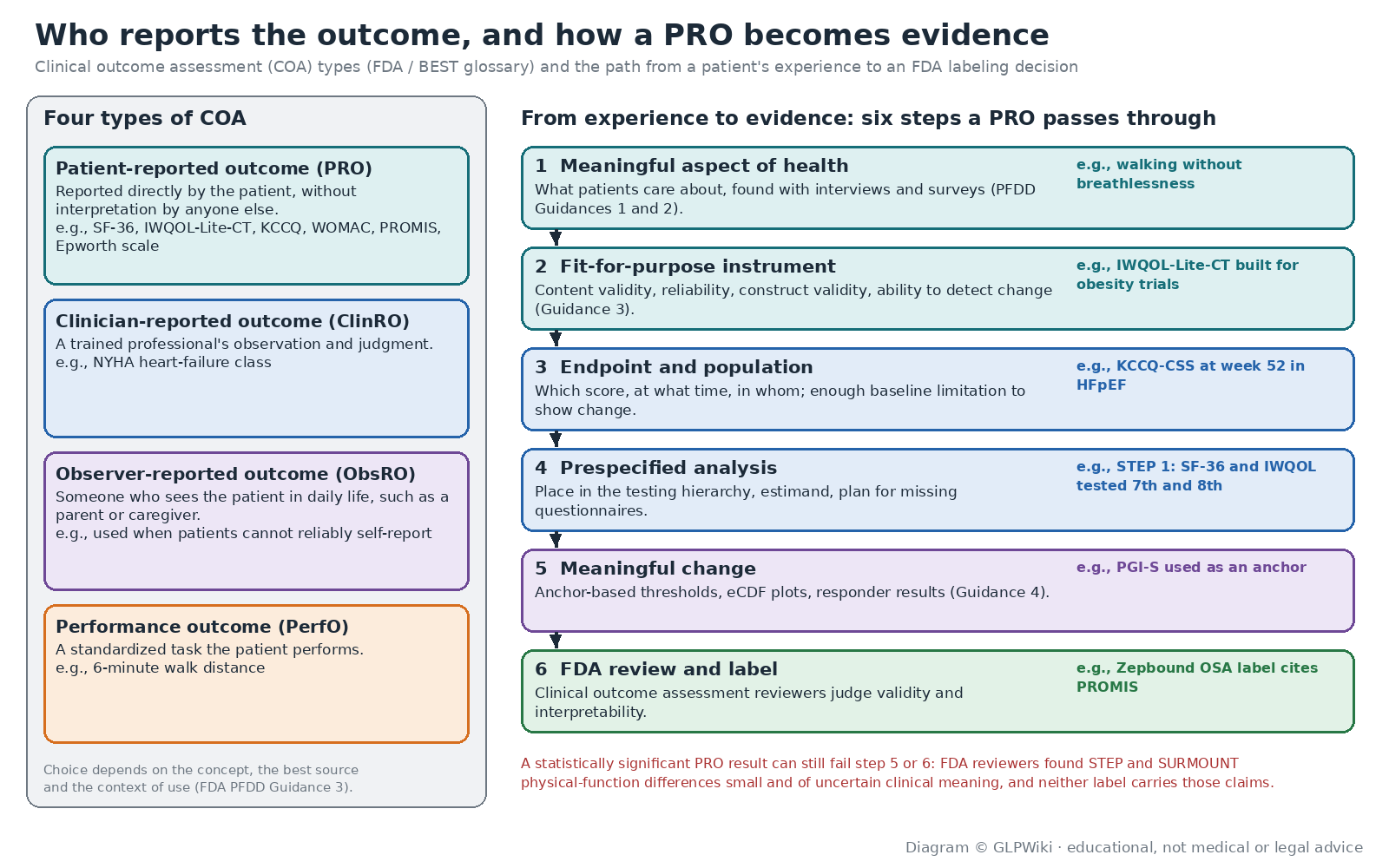
There are four types. A patient-reported outcome comes directly from the patient. FDA's 2009 guidance defines it as 'a measurement based on a report that comes directly from the patient (i.e., study subject) about the status of a patient's health condition without amendment or interpretation of the patient's response by a clinician or anyone else.' A clinician-reported outcome (ClinRO) is based on a trained health professional's observation and judgment. An observer-reported outcome (ObsRO) comes from someone such as a parent or caregiver who sees the patient in daily life, and is used when patients cannot reliably report for themselves. A performance outcome (PerfO) is a standardized task the patient performs, such as a 6-minute walk test.
FDA's final Guidance 3 (October 2025) explains that choosing among these types depends on the concept to be measured, the best source of that information and the context in which it will be used. Several other terms recur in FDA documents and trial papers:
- Meaningful aspect of health: an aspect of a disease or its treatment that patients care about and want to avoid or improve, such as being able to walk without breathlessness.
- Concept of interest: what the instrument actually measures, for example physical functioning limitations attributed to weight. It may reflect the meaningful aspect directly or less directly.
- Context of use: how COA scores will be used as the basis for an endpoint, including the population, trial design and the role of the endpoint (primary, key secondary, exploratory).
- Fit for purpose: BEST's term for a conclusion that the level of validation is sufficient to support the context of use.
- Recall period: the time window a question asks about. Shorter recall periods reduce memory errors; longer ones capture fluctuating symptoms.
- Health-related quality of life (HRQoL): a broad, multi-domain concept covering physical, emotional and social functioning. Guyatt and colleagues' 1993 overview distinguished generic instruments, which work across conditions, from disease-specific ones, which are more sensitive to change in a particular condition.
FDA's framework: the 2009 PRO guidance and the PFDD series
FDA's guidance 'Patient-Reported Outcome Measures: Use in Medical Product Development to Support Labeling Claims,' issued in December 2009 by CDER, CBER and CDRH, describes how the agency reviews existing, modified or new PRO instruments when they are used to support claims in approved labeling. It introduced a structured vocabulary that still shapes trial design: a conceptual framework linking items to domains and concepts; content validity, meaning evidence that the instrument measures the concept of interest in the target population; other measurement properties such as reliability, construct validity and ability to detect change; an endpoint model; and planning for interpretation with a responder definition.
On responder definitions the 2009 guidance says the empirical evidence 'is derived using anchor-based methods,' that distribution-based methods 'should be considered as supportive and are not appropriate as the sole basis,' and that sponsors can alternatively present the entire distribution of responses in each group. It also warns that patient ratings of change are less useful as anchors when patients are not blinded. All three ideas reappear in the GLP-1 reviews discussed below.
The 21st Century Cures Act and the FDA Reauthorization Act of 2017 directed FDA to issue guidance on collecting and using patient experience data. FDA responded with a four-part methodological patient-focused drug development (PFDD) series:
- Guidance 1, Collecting Comprehensive and Representative Input (final, posted June 16, 2020): sampling methods and how to decide from whom to get patient input.
- Guidance 2, Methods to Identify What Is Important to Patients (final): interviews, focus groups and surveys for learning which symptoms and impacts matter, including how to avoid priming participants.
- Guidance 3, Selecting, Developing, or Modifying Fit-for-Purpose Clinical Outcome Assessments (final, October 2025, finalizing the June 30, 2022 draft): how to choose, adapt or build a COA and evaluate it, including content validity and other measurement properties.
- Guidance 4, Incorporating Clinical Outcome Assessments Into Endpoints for Regulatory Decision-Making (draft, April 2023): turning COA scores into endpoints, handling missing data, and defining and interpreting meaningful change.
Qualification, the COA Compendium and review divisions
A COA does not have to be formally qualified to support a labeling claim. FDA's COA Qualification Program describes qualification as a regulatory conclusion that a COA is a well-defined and reliable assessment of a specified concept of interest in a specified context of use, and notes that formal qualification 'is a multi-year process' that is 'not required' for successful use in drug development. Most instruments in GLP-1 programs were instead reviewed within individual applications, where CDER's Division of Clinical Outcome Assessment (DCOA) is consulted by the review team.
FDA's COA Compendium collates how COAs have been used in trials and labeling across many diseases. FDA describes it as a starting point, not an endorsement. FDA has also issued technical specifications for submitting COA data analyzed with item response theory and, in oncology, a guidance on core patient-reported outcomes for cancer trials, which shows how the agency increasingly expects specific PRO concepts to be measured in particular settings.
What makes a questionnaire fit for purpose
Validation is not a property an instrument has once and for all. The 2009 guidance stresses that measurement properties 'are specific to the measurement application and cannot be assumed to be relevant to all measurement situations, purposes, populations, or settings.' A questionnaire developed for people in intensive residential weight-loss treatment, for example, may not capture what matters to the broader population enrolled in a drug trial.
The core evidence falls into a few families. The ISPOR good research practices reports by Patrick and colleagues (2011) and the COSMIN consensus on terminology (Mokkink and colleagues, 2010) are standard references; Terwee and colleagues (2007) proposed widely used quality criteria.
- Content validity: qualitative evidence, usually concept-elicitation and cognitive interviews with patients, that the items cover what matters and are understood as intended. FDA treats this as foundational.
- Reliability: internal consistency (often summarized by Cronbach's alpha) and test-retest reliability (often intraclass correlation coefficients) showing scores are stable when health has not changed.
- Construct validity: scores correlate as expected with related measures and differ between groups known to differ, such as people with higher versus lower BMI.
- Ability to detect change (responsiveness): scores move when health genuinely changes. Floor and ceiling effects, where many people already score at the best or worst end, limit this.
- Interpretability: evidence about what a given score or score change means to patients, which leads to the meaningful-change questions below.
From IWQOL-Lite to IWQOL-Lite-CT: a worked example
The Impact of Weight on Quality of Life-Lite (IWQOL-Lite), described by Kolotkin and colleagues in 2001, is a 31-item short form with five scales: physical function, self-esteem, sexual life, public distress and work. It was derived from a longer questionnaire developed with people in intensive treatment. A 2019 validation paper noted that it 'may include concepts not relevant to clinical trial populations and may be missing concepts that are relevant to these populations,' so a clinical-trials version, IWQOL-Lite-CT, was developed and validated following FDA's PRO guidance.
IWQOL-Lite-CT has 20 items in two primary domains, Physical (7 items) and Psychosocial (13 items), plus a five-item Physical Function composite and a total score. Its psychometric evaluations used data from a semaglutide phase 2 obesity trial and the PIONEER 1 diabetes trial, then STEP 1 and STEP 2, where internal consistency and test-retest reliability were high and anchor-based analyses supported responder thresholds ranging from 13.5 to 16.6 points across composite scores. The development and validation work was funded by Novo Nordisk, which the papers disclose; that is common for instruments built for a specific program and is one reason FDA reviews COAs independently.
The instruments you will meet in GLP-1 and obesity trials
Generic instruments allow comparison across diseases and with population norms; disease-specific ones are closer to what a particular group of patients experiences. Many trials use one of each. The list below describes what each instrument measures, not what any product achieved.
- SF-36 version 2 (Short Form-36): a generic 36-item health survey from the Medical Outcomes Study (Ware and Sherbourne, 1992) with eight domains, including physical functioning, role-physical, bodily pain, general health, vitality, social functioning, role-emotional and mental health, plus physical and mental component summary scores. Norm-based scoring sets the general-population mean at 50; the 'acute' form uses a one-week recall period. SF-36 physical functioning was a key secondary endpoint in STEP and SURMOUNT.
- IWQOL-Lite-CT: a weight-specific measure of physical and psychosocial functioning (described above), scored 0 to 100 with higher scores meaning better functioning.
- EQ-5D: a generic instrument from the EuroQol Group, which introduced its approach in 1990. EQ-5D describes health on five dimensions (mobility, self-care, usual activities, pain or discomfort, anxiety or depression) and a visual analogue scale. The five-level EQ-5D-5L was described by Herdman and colleagues in 2011. Its index values are often used to calculate quality-adjusted life years in cost-effectiveness analyses.
- PROMIS: the NIH-supported Patient-Reported Outcomes Measurement Information System, which built calibrated item banks and short forms scored on a T-score metric (Cella and colleagues, 2010). PROMIS sleep disturbance and sleep-related impairment measures were described by Buysse and colleagues in 2010.
- KCCQ: the Kansas City Cardiomyopathy Questionnaire (Green and colleagues, 2000), a heart-failure-specific measure of symptoms, physical limitations, social limitations and quality of life. Its Clinical Summary Score (KCCQ-CSS) combines symptoms and physical limitations. A 2020 review notes that FDA has qualified it as a clinical outcome assessment.
- WOMAC: the Western Ontario and McMaster Universities Osteoarthritis Index (Bellamy and colleagues, 1988), measuring pain, stiffness and physical function in hip and knee osteoarthritis.
- Epworth Sleepiness Scale (ESS): an eight-situation rating of how likely a person is to doze (Johns, 1991). Functional Outcomes of Sleep Questionnaire (FOSQ): impact of sleepiness on daily activities (Weaver and colleagues, 1997).
- Patient Global Impression of Severity (PGI-S) and of Change (PGI-C): single questions asking patients to rate their overall severity or change. They are rarely endpoints themselves but are common anchors for interpreting other scores.
Statistically significant versus meaningful: MCID, MID and meaningful within-patient change
With thousands of participants, very small average differences on a questionnaire become statistically significant. The question readers should ask is whether the difference is large enough for patients to notice and value. In 1989 Jaeschke, Singer and Guyatt proposed the minimal clinically important difference (MCID), 'the smallest difference in score in the domain of interest which patients perceive as beneficial,' and estimated it by comparing questionnaire changes with patients' global ratings of change. In chronic heart and lung disease they found it was roughly 0.5 points per item on a seven-point scale.
The terminology has since multiplied: minimal important difference (MID), minimal important change, meaningful within-patient change (MWPC) and, in FDA's draft Guidance 4, meaningful score difference (MSD). Schünemann and Guyatt argued in 2005 for dropping 'clinically' because the patient's perspective is what matters. The distinction that matters most for readers is between within-patient change, meaning how much one person's score must move to be meaningful to that person, and between-group difference, meaning the difference in average change between treatment and placebo. A between-group difference smaller than a within-patient threshold does not prove no one benefited, and a large one does not prove everyone did.
Anchor-based and distribution-based methods
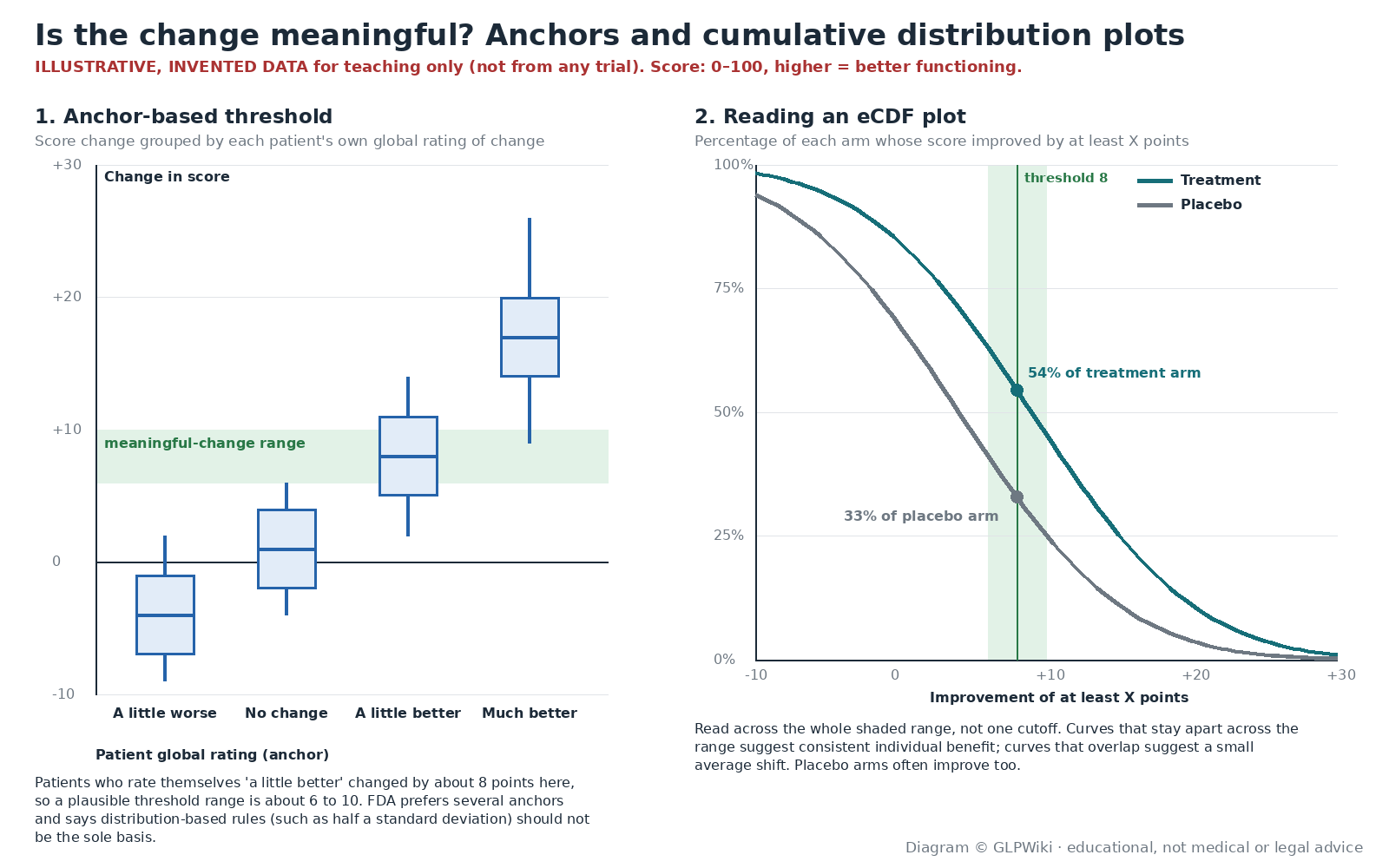
Anchor-based methods relate score changes to an external variable whose meaning is already clear, such as a patient's PGI-S or PGI-C rating. If people who say they are 'a little better' improved by a median of 8 points, that suggests a threshold near 8. FDA's draft Guidance 4 describes an anchor as 'some external variable, not derived from the COA whose scores require interpretation, for which meaningful differences are directly interpretable or already known,' and recommends multiple anchors, assessed at comparable time points and well correlated with the target score.
Distribution-based methods use statistical properties of the scores, such as half a standard deviation, an effect size or the standard error of measurement. Norman and colleagues (2003) found that many published MID estimates clustered near half a standard deviation. Draft Guidance 4 states that distribution-based methods 'do not directly consider the patient voice, and as such, are insufficient to serve as the sole basis for identifying an MSD,' while noting they describe measurement variability. Revicki and colleagues (2008), Crosby and colleagues (2003) and Trigg and Griffiths (2021) recommend triangulating several anchor-based estimates, with distribution-based figures as support. Reviews by Guyatt and colleagues (2002), Wyrwich and colleagues (2005), Cappelleri and colleagues (2014) and Coon and colleagues (2018) survey the full toolkit, from anchor-based thresholds to cumulative distribution displays.
Two assumptions deserve scrutiny. Guidance 4 lists them explicitly: that the meaningful difference is the same regardless of baseline score, and the same for improvement and deterioration. Neither is guaranteed. Revicki's group also stressed that an MID 'may vary by population and context, and no one MID may be valid for all study applications.'
Reading cumulative distribution plots and responder analyses
Average differences hide how individual changes are spread. An empirical cumulative distribution function (eCDF) plot shows, for every possible amount of change on the horizontal axis, the percentage of participants in each arm who changed by at least that much. When the treatment curve sits consistently above the placebo curve across the meaningful range, more treated participants reached every threshold. When the curves overlap, or separate only in a narrow band, the average difference is not translating into consistent individual change.
FDA's draft Guidance 4 recommends exactly this display: plot the eCDF or probability density function of changes for each arm, annotate it 'with a range of MSD values and the proportion of patients in each trial arm whose change-from-baseline exceeds one or more values of MSD,' and interpret it alongside the main treatment-effect estimate. The 2009 guidance similarly noted that presenting the entire distribution avoids picking one responder criterion.
Responder analyses convert continuous scores into yes or no at a threshold. They are intuitive, but the result depends heavily on where the line is drawn, and dichotomizing discards information. A threshold near the middle of the distribution can make a modest average shift look like a large difference in 'responders.' The absolute versus relative risk guide explains how to translate responder percentages, and the estimands guide covers why responder endpoints need careful handling of missing data.
Before STEP: weight loss and quality of life in earlier research
The idea that weight loss improves quality of life is intuitive, but the evidence is less uniform than headlines suggest. A 2017 systematic review of reviews by Kolotkin and Andersen found that obesity was consistently associated with lower generic and obesity-specific health-related quality of life. Improvement after bariatric surgery was consistently shown, but improvement after non-surgical weight loss 'was not consistently demonstrated, even in randomized controlled trials,' which the authors attributed partly to variation in measures, populations, interventions and reporting quality. They recommended using both generic and obesity-specific instruments.
The SCALE Obesity and Prediabetes trial of liraglutide, published in 2015, is a useful reference point. Its quality-of-life analysis used the original IWQOL-Lite and the SF-36. After one year the estimated treatment differences were 3.1 points on the IWQOL-Lite total score, 1.7 points on the SF-36 physical component summary and 0.9 points on the mental component summary. At three years the IWQOL-Lite total difference was 3.4 points, the SF-36 physical component difference 0.87 points and the mental component summary no longer differed significantly; greater weight loss was associated with greater improvement. These are statistically significant but modest between-group differences in a population that, on average, did not start with severe limitations.
That history shaped the next generation of trials. Sponsors developed IWQOL-Lite-CT to fit clinical-trial populations better, moved physical functioning into confirmatory testing hierarchies, and began collecting global impression items to serve as anchors. FDA, for its part, increasingly asked whether the populations enrolled were limited enough for change to be interpretable.
PROs in the STEP program, and what FDA's reviewers said
In the STEP obesity trials of semaglutide, the PROs were confirmatory secondary endpoints placed at the end of a fixed-sequence testing hierarchy. FDA's statistical review lists change in SF-36 physical functioning score and change in the five-item IWQOL-Lite-CT physical function score as the seventh and eighth endpoints in STEP 1's fixed testing sequence, after the weight endpoints, waist circumference and systolic blood pressure. The STEP 1 statistical analysis plan lists the other SF-36 and IWQOL-Lite-CT scores, and responder definitions for both measures, as supportive endpoints.
FDA's statistical review reports that in STEP 1 the estimated treatment difference was 1.80 points (95% CI 1.16 to 2.45) for SF-36 physical functioning and 9.44 points (7.46 to 11.42) for IWQOL-Lite-CT physical function, both statistically significant under the treatment-policy estimand with retrieved-dropout multiple imputation. In STEP 2, in people with type 2 diabetes, the differences were 1.52 and 4.83 points. In STEP 3, where all participants received intensive behavioral therapy, the SF-36 difference of 0.84 points (−0.28 to 1.95; p = 0.14) was not statistically significant.
A 2024 pooled analysis by Rubino and colleagues reported that more semaglutide than placebo participants reached meaningful within-person change thresholds, for example 51.8% versus 28.3% for IWQOL-Lite-CT physical function and 39.8% versus 24.1% for SF-36 physical functioning in STEP 1, and 18.0% versus 6.6% for SF-36 physical functioning in STEP 4, the withdrawal trial. A 2026 meta-analysis by Eisa and colleagues estimated a pooled SF-36 physical functioning difference of 1.71 points and noted that it fell below a 3.7-point meaningful within-patient change threshold.
Inside the Wegovy COA consult review
The Wegovy approval package includes a clinical outcome assessment consult review by DCOA, signed in June 2021. Much of it is redacted, but the public text is instructive. The reviewers evaluated the two PRO instruments for content validity and other measurement properties, wrote that 'the relevancy of some of the items is questionable,' and concluded that responsiveness 'may need to be further explored.' Despite statistical significance, they found 'minimal observed score changes, if any, when looking at the item- and domain-level data at the raw score scale,' with similarly small changes on transformed scores, and raised 'concern that the data would not provide results with clear clinical meaning.'
The applicant attributed the small changes to floor effects, meaning many participants reported little limitation at baseline. The reviewer agreed the findings were consistent with that explanation and stated: 'This reviewer is not questioning the validity of the instruments. The concern is with regard to the interpretability of the observed data.' Earlier FDA advice, quoted in the review, had asked for anchor-based analyses using the PGI-S in each of the four trials, supplemented with eCDF and probability density curves, and said responder thresholds on transformed scores should exceed at least a one-unit change on the original response scale.
The review's recommendation for future obesity trials is the clearest statement of the lesson: sponsors should 'specify and define functional impacts that are relevant and important to patients with obesity or excess weight and that are likely to demonstrate meaningful and interpretable changes,' and should 'select a sufficiently impaired population' or plan stratification. The current Wegovy prescribing information on DailyMed contains no SF-36 or IWQOL-Lite-CT results.
PROs in SURMOUNT and the Zepbound review
In SURMOUNT-1, tirzepatide's statistical analysis plan placed change in SF-36 physical functioning among the key secondary endpoints controlled for type I error, while change in the IWQOL-Lite-CT physical function composite was a secondary endpoint outside that control. An exploratory analysis in participants with impaired physical function at baseline was prespecified after earlier FDA comments. SURMOUNT-2, SURMOUNT-3 and SURMOUNT-4 also registered IWQOL-Lite-CT outcomes on ClinicalTrials.gov.
FDA's clinical review of Zepbound, summarizing a joint review by DCOA and FDA's Patient-Focused Statistical Scientists dated October 18, 2023, found a statistically significant improvement in SF-36 physical functioning in SURMOUNT-1, with similar but not multiplicity-controlled improvements in SURMOUNT-2. The reviewers listed several problems:
- The differences between treatment and placebo were 'small and of uncertain clinical meaningfulness.'
- Measurement at only two time points (baseline and week 72 or early discontinuation) could have missed information.
- Baseline scores of 47.9 to 49.6 were close to the general-population mean of 50, so participants 'were not sufficiently limited in physical functioning at baseline for an adequate assessment of improvement.'
- Median raw scores at item and domain level showed minimal to no change, and eCDF curves did not clearly separate.
- In the 20.7% (SURMOUNT-1) and 23.0% (SURMOUNT-2) of participants rating themselves 'moderately limited' or worse on a PGI-S item, eCDF curves did separate and mean improvements were roughly 3 points rather than 2, but this subgroup analysis was exploratory.
- The anchor-based threshold work had limits: the PGI-S was also used to define the impaired subgroup, and cognitive interviews asked about the smallest meaningful improvement on one item hypothetically. The review concluded it was 'uncertain whether the observed changes in physical functioning scores, ranging from 2-3, were clinically meaningful.'
How FDA's obesity guidance absorbed the lesson
FDA's January 2025 draft guidance 'Obesity and Overweight: Developing Drugs and Biological Products for Weight Reduction' reads like a summary of these reviews. It says fit-for-purpose COAs could be appropriate secondary endpoints to support a labeling claim and recommends that sponsors seeking a claim on functional impacts such as physical functioning specify impacts that are relevant and likely to show meaningful change, 'consider whether the target population will have sufficient limitation in their physical functioning,' and, if not, prespecify an impaired subgroup and agree the analysis plan with FDA before the trial. It also asks sponsors to discuss endpoints, analyses and anchors early.
Meta-analyses show the same pattern across trials. Schmidt and colleagues (2026) pooled six tirzepatide trials and estimated differences of 2.26 points on SF-36 physical functioning and 10.10 points on IWQOL-Lite-CT physical function, with very high heterogeneity. The larger number on the weight-specific instrument reflects a different scale and different item content, not necessarily a larger benefit; differences on different instruments cannot be compared directly.
When a PRO is the primary endpoint: heart failure, knee osteoarthritis and sleep apnea
In some GLP-1 trials the PRO was not a supporting secondary measure but the main question, usually because the population was chosen for having the symptoms the instrument measures. That design addresses the floor-effect problem seen in general obesity trials.
Heart failure with preserved ejection fraction: the KCCQ
STEP-HFpEF enrolled people with obesity and heart failure with preserved ejection fraction, with dual primary endpoints of change in KCCQ-CSS and change in body weight. The mean KCCQ-CSS change was 16.6 points with semaglutide and 8.7 with placebo, an estimated difference of 7.8 points (95% CI 4.8 to 10.9). In STEP-HFpEF DM, in people who also had type 2 diabetes, the difference was 7.3 points, and a pooled analysis of the two trials was published by Butler and colleagues in 2024. The ClinicalTrials.gov record lists, among secondary outcomes, the share of participants improving by 5 and 10 points and the share achieving a clinically meaningful within-participant change threshold derived from the PGI-S.
Note the large placebo improvement. A KCCQ improvement in the placebo arm can reflect regression to the mean, closer attention in a trial and expectations. That is why the between-group difference, not the within-arm change, is the effect estimate. A secondary analysis in Circulation found larger treatment differences in participants with lower baseline KCCQ-CSS (10.7, 8.1 and 4.6 points across tertiles), consistent with more room to improve.
SUMMIT tested tirzepatide in a similar population with two primary endpoints: a composite of cardiovascular death or worsening heart-failure events and change in KCCQ-CSS at 52 weeks. The KCCQ-CSS difference was 6.9 points (95% CI 3.3 to 10.6). A companion analysis reported improvements in EQ-5D-5L (0.06) and a more favorable PGI-S distribution. For context, Spertus and colleagues reported in 2005 that small, moderate and large clinical improvements corresponded to KCCQ increases of about 5.7, 10.5 and 22.3 points, which is the source of the commonly used 5-point threshold. As of this review date, the current Wegovy and Zepbound labels on DailyMed do not include KCCQ results.
Knee osteoarthritis: WOMAC pain
STEP 9 enrolled people with obesity and knee osteoarthritis with dual primary endpoints of body-weight change and WOMAC pain score. At week 68 the mean WOMAC pain change was −41.7 points with semaglutide and −27.5 with placebo on a scale where the baseline mean was 70.9, and SF-36 physical function improved by 12.0 versus 6.5 points. The much larger SF-36 changes than in STEP 1 illustrate the baseline-impairment point: people with painful knees had more limitation to recover.
Obstructive sleep apnea: PROMIS and the Epworth scale
SURMOUNT-OSA's primary endpoint was the apnea-hypopnea index, a physiologic measure from sleep studies. PROs entered in two ways. The ClinicalTrials.gov record lists change in PROMIS Sleep-Related Impairment and Sleep Disturbance short forms as secondary outcomes, and a 2025 analysis reported improvements in those scales, the FOSQ, EQ-5D-5L and most SF-36 domains. And the outcome 'AHI below 5, or AHI 5 to 14 with an Epworth Sleepiness Scale score of 10 or less' combines a physiologic measure with a PRO.
The current Zepbound prescribing information describes improvement in sleep-related impairment measured with the PROMIS Short Form Sleep-Related Impairment 8a in the OSA studies, and reports the share of patients achieving remission or mild non-symptomatic OSA using the ESS-based definition. FDA's December 2024 announcement described 'remission or mild OSA with resolution of symptoms.' This is one of the clearest current examples of PRO language in a GLP-1-class label. A 2026 post hoc analysis found larger PRO improvements in participants who were sleepier or more fatigued at baseline, while improvements in objective measures such as the AHI were similar across symptom subgroups, another illustration of the baseline-impairment principle.
How PRO results reach, or do not reach, a label
A trial can collect a dozen questionnaires without any of them appearing in the prescribing information. In U.S. labeling, efficacy results appear mainly in Section 14 (Clinical Studies), and FDA allows PRO results there when the instrument is fit for purpose, the endpoint was prespecified and controlled for multiplicity, and the result is interpretable as a meaningful benefit. The clinical studies label guide explains how to read Section 14 tables.
Reviews of FDA approvals show how selective this is. Gnanasakthy and colleagues found that 28 of 116 new products approved from 2006 to 2010 (24%) received PRO claims, mostly for symptoms, and that 20 of those 28 were based on a PRO primary endpoint. For 2011 to 2015, 16.5% of 182 new drug applications had PRO labeling, and 76.7% of that labeling was based on primary endpoints. DeMuro and colleagues compiled reasons for denial, including fitness for purpose, study design, data quality or interpretation, statistical issues and lack of demonstrated treatment benefit.
The GLP-1 record fits that pattern. PRO secondary endpoints in large obesity trials did not translate into label claims, while the clearest label language came where the PRO measured the indication's core symptom in a population that had it. Even SELECT, a cardiovascular outcomes trial, registered PRO outcomes such as the EQ-5D visual analogue scale on ClinicalTrials.gov; collecting a PRO is common, but turning it into a claim is not. Readers should treat 'improved quality of life' in a press release as a trial finding to check, not as an approved claim.
Building a PRO into a trial: schedules, modes and translations
Much of what makes a PRO result trustworthy is decided before the first participant enrolls. FDA's 2009 guidance and draft Guidance 4 ask sponsors to specify, in the protocol and statistical analysis plan, the instrument version, recall period, assessment schedule, mode of administration, scoring rules, handling of missing items, the endpoint definition and how meaningful change will be interpreted.
Timing matters. A questionnaire given only at baseline and at the end of treatment cannot show the trajectory of change, and it is more vulnerable to missing data at the single follow-up visit; the Zepbound review explicitly flagged measurement at only two time points. Recall periods should match how the concept behaves: daily diaries for fluctuating symptoms, one-week or four-week recall for functioning.
Mode matters too. The 2009 guidance lists changing an instrument from paper to electronic format among modifications that may need additional evidence, and it says electronic PRO systems must meet the same source-data and inspection requirements as other trial records. Multinational trials also need translated and culturally adapted versions; the guidance asks sponsors to document translation and cultural adaptation, because a phrase about climbing stairs or bending over may not carry the same meaning in every language and setting.
Finally, the PRO must have a defined place in the testing strategy. FDA's multiple endpoints guidance explains why secondary endpoints can support claims only when type I error is controlled across the family of tests. A PRO tested after the hierarchy has already stopped, or analyzed outside it, is descriptive however small its p-value.
Missing questionnaires, unblinding and response shift
PRO data are missing more often than lab values, and the reasons are rarely random. People who feel worse or stop treatment because of side effects are less likely to complete questionnaires. FDA's draft Guidance 4 distinguishes missing items within a questionnaire from missing whole assessments, says 'every effort should be made to avoid missing COA data,' asks sites to record reasons, and says methods for missing data should align with the estimand. It also notes that missing data differ from intercurrent events such as treatment discontinuation, which ICH E9(R1) handles through estimand strategies. Bell and Fairclough (2014) and Fielding and colleagues (2012) show how analysis choices can change conclusions.
The Zepbound review shows the practical issue: applicant summary figures reproduced in the review carried forward the last on-treatment observation for SF-36 and IWQOL-Lite-CT scores, and the FDA reviewers flagged the limitation of measuring physical functioning at only two time points. Sparse PRO schedules make imputation assumptions more influential.
Blinding matters more for subjective outcomes. Schulz and Grimes (2002) explained how knowledge of assignment can bias assessments, and a large meta-epidemiological study (Moustgaard and colleagues, 2020) examined how blinding affects estimated effects across many trials, with less consistent results than earlier work suggested. GLP-1 medicines cause noticeable gastrointestinal effects and weight change, which can let participants guess their assignment. That does not invalidate PRO results, but it is one reason FDA looks for consistency with objective measures and is cautious about patient ratings of change as anchors when patients may not be effectively blinded.
Response shift, described by Sprangers and Schwartz (1999), is a change in how people judge their own health: their internal standards, values or definition of quality of life shift over time. Someone who loses substantial weight may recalibrate what 'a little limited' means. Response shift can make PRO changes look smaller or larger than the underlying change.
Reporting standards: CONSORT-PRO, SPIRIT-PRO and SISAQOL
Several international standards help readers judge PRO evidence. The CONSORT-PRO extension (Calvert and colleagues, JAMA 2013) asks trial reports to identify PROs as primary or secondary outcomes, describe the instrument's validity and reliability, state the statistical approach to missing data, and discuss PRO-specific limitations. SPIRIT-PRO (JAMA 2018) asks protocols to specify the PRO rationale, hypotheses, time points, administration mode and plans to minimize missing data. The SISAQOL consortium published recommendations for analyzing PRO endpoints in cancer trials in 2020, and SISAQOL-IMI extended them in 2025 to design, analysis, interpretation and presentation; their principles apply beyond oncology.
Mercieca-Bebber and colleagues (2018) summarized recurring weaknesses in PRO trials, including missing data, poor reporting and outcomes that are collected but never published. Basch (2017) described the broader push to use PROs in clinical care. When a PRO is listed on ClinicalTrials.gov but never reported in the publication, the clinical trial registration guide explains how to look for the posted results.
A reader's checklist for any quality-of-life or PRO claim
Use these questions on a press release, a journal abstract or a label.
- Which instrument, which score, which time point? 'Quality of life' could mean an SF-36 domain, an IWQOL-Lite-CT composite, the KCCQ-CSS or a single global question.
- Was it primary, key secondary inside the testing hierarchy, or exploratory? Only controlled endpoints support confirmatory claims; the estimands guide explains testing hierarchies.
- Is the instrument fit for purpose in this population? Look for content validity evidence and whether FDA reviewers raised concerns.
- How impaired were participants at baseline? Scores near population norms leave little room to improve.
- What is the between-group difference, and how does it compare with an anchor-based meaningful-change range? Ignore within-arm changes on their own.
- Is there an eCDF plot or responder analysis, and was the threshold prespecified and justified with anchors?
- How much PRO data were missing, and how were missing questionnaires handled?
- Could unblinding or expectations have influenced answers? Are results consistent with objective measures such as walk distance or sleep-study findings?
- Who developed and funded the instrument and analysis, and are the authors' disclosures stated?
- Is the claim in the label? Check Section 14 of the current prescribing information on DailyMed. Personal decisions belong with a licensed clinician.
Common misreadings of patient-reported outcomes
A few patterns account for most misunderstandings.
- 'Statistically significant, so patients felt better.' A significant average difference can be smaller than the change individual patients would notice.
- 'Treated patients improved by 16 points.' Within-arm change includes placebo response and regression to the mean. The treatment effect is the between-group difference.
- 'A 10-point difference on one questionnaire beats a 2-point difference on another.' Scales differ in range, items and spread; numbers on different instruments are not comparable.
- 'Half a standard deviation is the MCID.' It is a rough distribution-based benchmark, not a patient-anchored threshold, and FDA does not accept it as the sole basis.
- 'One MCID applies everywhere.' Meaningful-change thresholds vary by population, baseline severity and direction of change.
- 'More responders means a bigger effect.' Responder percentages depend on the chosen threshold and can exaggerate modest shifts.
- 'Quality-of-life improvement is approved.' Unless it appears in the label, it is a trial finding that FDA has not accepted as a claim.
- 'PROs are soft data.' Well-designed PROs in the right population are rigorous and are sometimes primary endpoints; the issue is design and interpretation, not the source.
Scope, disclaimer and review date
This guide explains how patient-reported outcomes and other clinical outcome assessments are defined, validated, analyzed, interpreted and used in GLP-1 and related obesity trials, FDA reviews and FDA labeling. It is educational only. It does not provide doses, schedules, titration, injection or device instructions, treatment recommendations, or product comparisons or rankings for any individual. Trial results describe groups of enrolled participants over defined periods, not any particular person's experience. Decisions about any medicine should be made with a licensed clinician using the current FDA-approved labeling.
Guidance status and labels change: draft guidances are revised or finalized, and prescribing information is updated. Facts here reflect the cited FDA guidance documents and pages, FDA review documents, DailyMed labeling, ClinicalTrials.gov records, statistical analysis plans and peer-reviewed publications indexed in PubMed as of the review date, all listed below.
Last reviewed: November 28, 2026.
Frequently asked questions
- What is a patient-reported outcome?
- A patient-reported outcome (PRO) is a measurement based on a report that comes directly from the patient about their health, without interpretation by a clinician or anyone else. In trials it is usually a validated questionnaire with fixed questions, response options, a recall period and a scoring rule, such as SF-36, IWQOL-Lite-CT, KCCQ or a PROMIS short form.
- How is a PRO different from other clinical outcome assessments?
- Clinical outcome assessments come in four types. PROs come from the patient; clinician-reported outcomes from a trained professional's judgment; observer-reported outcomes from someone like a caregiver who sees the patient in daily life; and performance outcomes from a standardized task such as a 6-minute walk test. The right type depends on what is being measured and who can report it best.
- What is a minimal clinically important difference?
- It is the smallest change in a score that patients perceive as beneficial, first proposed by Jaeschke, Singer and Guyatt in 1989. Related terms include minimal important difference, meaningful within-patient change and FDA's meaningful score difference. Thresholds should be estimated mainly with anchor-based methods tied to patients' own ratings, and they can vary by population and baseline severity.
- Why didn't the Wegovy label include the STEP quality-of-life results?
- The SF-36 and IWQOL-Lite-CT physical function differences in STEP 1 were statistically significant, but FDA's clinical outcome assessment reviewers found minimal item-level change, floor effects and some items of questionable relevance, and said the data might not provide results with clear clinical meaning. They did not question the instruments' validity; their concern was interpretability. The current Wegovy label contains no SF-36 or IWQOL-Lite-CT results.
- Do any GLP-1-class labels describe PRO results?
- Yes. The current Zepbound prescribing information describes improvement in sleep-related impairment in its obstructive sleep apnea studies using the PROMIS Short Form Sleep-Related Impairment 8a, and it reports remission or mild non-symptomatic sleep apnea using a definition that includes the Epworth Sleepiness Scale. Heart-failure and knee-osteoarthritis trials used PROs as primary endpoints, but as of the review date those results are not in the Wegovy or Zepbound labels.
- What does an eCDF plot show?
- An empirical cumulative distribution function plot shows, for each possible amount of change, the percentage of participants in each arm who changed by at least that much. If the treatment curve stays above the placebo curve across the meaningful-change range, more treated participants improved meaningfully. FDA's draft Guidance 4 recommends annotating these plots with a range of meaningful-change values.
- Why do placebo groups improve on quality-of-life questionnaires?
- Placebo arms often improve because of regression to the mean, the support and attention of trial participation, lifestyle advice given to everyone, and expectations. That is why the treatment effect is the difference between groups, not the improvement within the treated group alone. In STEP-HFpEF, for example, the placebo group's KCCQ score rose by 8.7 points.
- How should I read a headline saying a GLP-1 medicine improves quality of life?
- Find which instrument and score were used, whether the endpoint was primary or secondary and controlled for multiplicity, how impaired participants were at baseline, how large the between-group difference was compared with a meaningful-change threshold, and how missing questionnaires were handled. Then check whether the claim appears in Section 14 of the current label. Personal decisions belong with a licensed clinician.
SOURCES
- 01Patient-Reported Outcome Measures: Use in Medical Product Development to Support Labeling Claims (guidance for industry, December 2009)— U.S. Food and Drug Administration
- 02Patient-Reported Outcome Measures guidance, December 2009 (PDF)— U.S. Food and Drug Administration
- 03FDA Patient-Focused Drug Development Guidance Series for Enhancing the Incorporation of the Patient's Voice in Medical Product Development and Regulatory Decision Making— U.S. Food and Drug Administration
- 04Patient-Focused Drug Development: Collecting Comprehensive and Representative Input (Guidance 1, final, June 2020)— U.S. Food and Drug Administration
- 05Patient-Focused Drug Development: Methods to Identify What Is Important to Patients (Guidance 2, final)— U.S. Food and Drug Administration
- 06Patient-Focused Drug Development: Selecting, Developing, or Modifying Fit-for-Purpose Clinical Outcome Assessments (Guidance 3, final, October 2025)— U.S. Food and Drug Administration
- 07PFDD Guidance 3, final, October 2025 (PDF)— U.S. Food and Drug Administration
- 08Patient-Focused Drug Development: Incorporating Clinical Outcome Assessments Into Endpoints for Regulatory Decision-Making (Guidance 4, draft, April 2023)— U.S. Food and Drug Administration
- 09PFDD Guidance 4, draft, April 2023 (PDF)— U.S. Food and Drug Administration
- 10Patient-Focused Drug Development Glossary— U.S. Food and Drug Administration
- 11CDER Patient-Focused Drug Development— U.S. Food and Drug Administration
- 12Clinical Outcome Assessment (COA) Qualification Program— U.S. Food and Drug Administration
- 13Clinical Outcome Assessment (COA): Frequently Asked Questions— U.S. Food and Drug Administration
- 14Clinical Outcome Assessment Compendium— U.S. Food and Drug Administration
- 15Drug Development Tool (DDT) Qualification Programs— U.S. Food and Drug Administration
- 16Submitting Clinical Trial Datasets and Documentation for Clinical Outcome Assessments Using Item Response Theory (technical specifications guidance)— U.S. Food and Drug Administration
- 17Core Patient-Reported Outcomes in Cancer Clinical Trials (guidance)— U.S. Food and Drug Administration
- 18Obesity and Overweight: Developing Drugs and Biological Products for Weight Reduction (draft guidance, January 2025)— U.S. Food and Drug Administration
- 19Multiple Endpoints in Clinical Trials (final guidance, October 2022)— U.S. Food and Drug Administration
- 20E9(R1) Statistical Principles for Clinical Trials: Addendum: Estimands and Sensitivity Analysis in Clinical Trials (final guidance, May 2021)— U.S. Food and Drug Administration
- 21ICH E9(R1) Addendum on Estimands and Sensitivity Analysis in Clinical Trials (Step 4, adopted November 20, 2019)— International Council for Harmonisation (ICH)
- 22FDA Approves First Medication for Obstructive Sleep Apnea (Zepbound, December 20, 2024)— U.S. Food and Drug Administration
- 23Drug Approval Package: Wegovy (semaglutide), NDA 215256 (approved June 4, 2021)— Drugs@FDA
- 24Wegovy NDA 215256 Clinical Review, including the Clinical Outcome Assessment (COA) consult review— Drugs@FDA
- 25Wegovy NDA 215256 Statistical Review (STEP 1–4 key secondary endpoints)— Drugs@FDA
- 26Drug Approval Package: Zepbound (tirzepatide), NDA 217806— Drugs@FDA
- 27Zepbound NDA 217806 Clinical Review (physical functioning PROs, DCOA/PFSS findings)— Drugs@FDA
- 28WEGOVY (semaglutide) – current prescribing information— DailyMed (NLM)
- 29ZEPBOUND (tirzepatide) – current prescribing information (Section 14, OSA studies)— DailyMed (NLM)
- 30STEP 1 Statistical Analysis Plan (NN9536-4373, version 2.0), posted on ClinicalTrials.gov— ClinicalTrials.gov / Novo Nordisk
- 31SURMOUNT-1 Statistical Analysis Plan (I8F-MC-GPHK, version 2), posted on ClinicalTrials.gov— ClinicalTrials.gov / Eli Lilly and Company
- 32ClinicalTrials.gov NCT03548935: STEP 1 — STEP 1: Research Study Investigating How Well Semaglutide Works in People Suffering From Overweight or Obesity— ClinicalTrials.gov
- 33ClinicalTrials.gov NCT03552757: STEP 2 — Research Study Investigating How Well Semaglutide Works in People With Type 2 Diabetes Suffering From Overweight or Obesity— ClinicalTrials.gov
- 34ClinicalTrials.gov NCT03611582: STEP 3 — Research Study to Look at How Well Semaglutide is at Lowering Weight When Taken Together With an Intensive Lifestyle Program— ClinicalTrials.gov
- 35ClinicalTrials.gov NCT03548987: STEP 4 — Research Study Investigating How Well Semaglutide Works in People Suffering From Overweight or Obesity— ClinicalTrials.gov
- 36ClinicalTrials.gov NCT04788511: STEP-HFpEF — Research Study to Investigate How Well Semaglutide Works in People Living With Heart Failure and Obesity— ClinicalTrials.gov
- 37ClinicalTrials.gov NCT04916470: STEP-HFpEF DM — Research Study to Look at How Well Semaglutide Works in People Living With Heart Failure, Obesity and Type 2 Diabetes— ClinicalTrials.gov
- 38ClinicalTrials.gov NCT05064735: STEP 9 — Research Study Looking at How Well Semaglutide Works in People Suffering From Obesity and Knee Osteoarthritis— ClinicalTrials.gov
- 39ClinicalTrials.gov NCT03574597: SELECT — Semaglutide Effects on Heart Disease and Stroke in Patients With Overweight or Obesity— ClinicalTrials.gov
- 40ClinicalTrials.gov NCT04184622: SURMOUNT-1 — A Study of Tirzepatide (LY3298176) in Participants With Obesity or Overweight— ClinicalTrials.gov
- 41ClinicalTrials.gov NCT04657003: SURMOUNT-2 — A Study of Tirzepatide (LY3298176) in Participants With Type 2 Diabetes Who Have Obesity or Are Overweight— ClinicalTrials.gov
- 42ClinicalTrials.gov NCT04657016: SURMOUNT-3 — A Study of Tirzepatide (LY3298176) In Participants After A Lifestyle Weight Loss Program— ClinicalTrials.gov
- 43ClinicalTrials.gov NCT04660643: SURMOUNT-4 — A Study of Tirzepatide (LY3298176) in Participants With Obesity or Overweight for the Maintenance of Weight Loss— ClinicalTrials.gov
- 44ClinicalTrials.gov NCT05412004: SURMOUNT-OSA — Obstructive Sleep Apnea Master Protocol GPIF: A Study of Tirzepatide (LY3298176) in Participants With Obstructive Sleep Apnea— ClinicalTrials.gov
- 45ClinicalTrials.gov NCT04847557: SUMMIT — A Study of Tirzepatide (LY3298176) in Participants With Heart Failure With Preserved Ejection Fraction (HFpEF) and Obesity: The SUMMIT Trial— ClinicalTrials.gov
- 46ClinicalTrials.gov NCT01272219: SCALE Obesity and Prediabetes — Effect of Liraglutide on Body Weight in Non-diabetic Obese Subjects or Overweight Subjects With Co-morbidities: SCALE™ - Obesity and Pre-diabetes— ClinicalTrials.gov
- 47ClinicalTrials.gov NCT02453711: Semaglutide phase 2 dose-finding obesity trial — Investigation of Safety and Efficacy of Once-daily Semaglutide in Obese Subjects Without Diabetes Mellitus— ClinicalTrials.gov
- 48ClinicalTrials.gov NCT02906930: PIONEER 1 — Efficacy and Safety of Oral Semaglutide Versus Placebo in Subjects With Type 2 Diabetes Mellitus Treated With Diet and Exercise Only— ClinicalTrials.gov
- 49Jaeschke R et al. Measurement of health status. Ascertaining the minimal clinically important difference. Control Clin Trials. 1989 (PMID 2691207)— PubMed
- 50Schünemann HJ et al. Commentary--goodbye M(C)ID! Hello MID, where do you come from?. Health Serv Res. 2005 (PMID 15762909)— PubMed
- 51Revicki D et al. Recommended methods for determining responsiveness and minimally important differences for patient-reported outcomes. J Clin Epidemiol. 2008 (PMID 18177782)— PubMed
- 52Crosby RD et al. Defining clinically meaningful change in health-related quality of life. J Clin Epidemiol. 2003 (PMID 12812812)— PubMed
- 53Norman GR et al. Interpretation of changes in health-related quality of life: the remarkable universality of half a standard deviation. Med Care. 2003 (PMID 12719681)— PubMed
- 54Wyrwich KW et al. Estimating clinically significant differences in quality of life outcomes. Qual Life Res. 2005 (PMID 15892420)— PubMed
- 55Guyatt GH et al. Methods to explain the clinical significance of health status measures. Mayo Clin Proc. 2002 (PMID 11936935)— PubMed
- 56Cappelleri JC et al. Interpretation of patient-reported outcomes. Stat Methods Med Res. 2014 (PMID 23427226)— PubMed
- 57Coon CD et al. Moving from significance to real-world meaning: methods for interpreting change in clinical outcome assessment scores. Qual Life Res. 2018 (PMID 28620874)— PubMed
- 58Trigg A et al. Triangulation of multiple meaningful change thresholds for patient-reported outcome scores. Qual Life Res. 2021 (PMID 34319532)— PubMed
- 59Guyatt GH et al. Measuring health-related quality of life. Ann Intern Med. 1993 (PMID 8452328)— PubMed
- 60Patrick DL et al. Content validity--establishing and reporting the evidence in newly developed patient-reported outcomes (PRO) instruments for medical product evaluation: ISPOR PRO good research practices task force report: part 1--eliciting concepts for a new PRO instrument. Value Health. 2011 (PMID 22152165)— PubMed
- 61Patrick DL et al. Content validity--establishing and reporting the evidence in newly developed patient-reported outcomes (PRO) instruments for medical product evaluation: ISPOR PRO Good Research Practices Task Force report: part 2--assessing respondent understanding. Value Health. 2011 (PMID 22152166)— PubMed
- 62Mokkink LB et al. The COSMIN study reached international consensus on taxonomy, terminology, and definitions of measurement properties for health-related patient-reported outcomes. J Clin Epidemiol. 2010 (PMID 20494804)— PubMed
- 63Terwee CB et al. Quality criteria were proposed for measurement properties of health status questionnaires. J Clin Epidemiol. 2007 (PMID 17161752)— PubMed
- 64Sprangers MA et al. Integrating response shift into health-related quality of life research: a theoretical model. Soc Sci Med. 1999 (PMID 10400253)— PubMed
- 65Gnanasakthy A et al. A review of patient-reported outcome labels in the United States: 2006 to 2010. Value Health. 2012 (PMID 22583453)— PubMed
- 66DeMuro C et al. Reasons for rejection of patient-reported outcome label claims: a compilation based on a review of patient-reported outcome use among new molecular entities and biologic license applications, 2006-2010. Value Health. 2012 (PMID 22583454)— PubMed
- 67Gnanasakthy A et al. A Review of Patient-Reported Outcome Labeling in the United States (2011-2015). Value Health. 2017 (PMID 28292487)— PubMed
- 68Calvert M et al. Reporting of patient-reported outcomes in randomized trials: the CONSORT PRO extension. JAMA. 2013 (PMID 23443445)— PubMed
- 69Calvert M et al. Guidelines for Inclusion of Patient-Reported Outcomes in Clinical Trial Protocols: The SPIRIT-PRO Extension. JAMA. 2018 (PMID 29411037)— PubMed
- 70Coens C et al. International standards for the analysis of quality-of-life and patient-reported outcome endpoints in cancer randomised controlled trials: recommendations of the SISAQOL Consortium. Lancet Oncol. 2020 (PMID 32007209)— PubMed
- 71Amdal CD et al. SISAQOL-IMI consensus-based guidelines to design, analyse, interpret, and present patient-reported outcomes in cancer clinical trials. Lancet Oncol. 2025 (PMID 41308689)— PubMed
- 72Mercieca-Bebber R et al. The importance of patient-reported outcomes in clinical trials and strategies for future optimization. Patient Relat Outcome Meas. 2018 (PMID 30464666)— PubMed
- 73Basch E. Patient-Reported Outcomes - Harnessing Patients' Voices to Improve Clinical Care. N Engl J Med. 2017 (PMID 28076708)— PubMed
- 74Bell ML et al. Practical and statistical issues in missing data for longitudinal patient-reported outcomes. Stat Methods Med Res. 2014 (PMID 23427225)— PubMed
- 75Fielding S et al. Analysing randomised controlled trials with missing data: choice of approach affects conclusions. Contemp Clin Trials. 2012 (PMID 22265924)— PubMed
- 76Schulz KF et al. Blinding in randomised trials: hiding who got what. Lancet. 2002 (PMID 11879884)— PubMed
- 77Moustgaard H et al. Impact of blinding on estimated treatment effects in randomised clinical trials: meta-epidemiological study. BMJ. 2020 (PMID 31964641)— PubMed
- 78EuroQol Group. EuroQol--a new facility for the measurement of health-related quality of life. Health Policy. 1990 (PMID 10109801)— PubMed
- 79Herdman M et al. Development and preliminary testing of the new five-level version of EQ-5D (EQ-5D-5L). Qual Life Res. 2011 (PMID 21479777)— PubMed
- 80Ware JE Jr et al. The MOS 36-item short-form health survey (SF-36). I. Conceptual framework and item selection. Med Care. 1992 (PMID 1593914)— PubMed
- 81Kolotkin RL et al. Development of a brief measure to assess quality of life in obesity. Obes Res. 2001 (PMID 11316344)— PubMed
- 82Kolotkin RL et al. Validation of a new measure of quality of life in obesity trials: Impact of Weight on Quality of Life-Lite Clinical Trials Version. Clin Obes. 2019 (PMID 30993900)— PubMed
- 83Kolotkin RL et al. Confirmatory psychometric evaluations of the Impact of Weight on Quality of Life-Lite Clinical Trials Version (IWQOL-Lite-CT). Clin Obes. 2021 (PMID 34296522)— PubMed
- 84Kolotkin RL et al. A systematic review of reviews: exploring the relationship between obesity, weight loss and health-related quality of life. Clin Obes. 2017 (PMID 28695722)— PubMed
- 85Cella D et al. The Patient-Reported Outcomes Measurement Information System (PROMIS) developed and tested its first wave of adult self-reported health outcome item banks: 2005-2008. J Clin Epidemiol. 2010 (PMID 20685078)— PubMed
- 86Buysse DJ et al. Development and validation of patient-reported outcome measures for sleep disturbance and sleep-related impairments. Sleep. 2010 (PMID 20550019)— PubMed
- 87Green CP et al. Development and evaluation of the Kansas City Cardiomyopathy Questionnaire: a new health status measure for heart failure. J Am Coll Cardiol. 2000 (PMID 10758967)— PubMed
- 88Spertus J et al. Monitoring clinical changes in patients with heart failure: a comparison of methods. Am Heart J. 2005 (PMID 16209970)— PubMed
- 89Spertus JA et al. Interpreting the Kansas City Cardiomyopathy Questionnaire in Clinical Trials and Clinical Care: JACC State-of-the-Art Review. J Am Coll Cardiol. 2020 (PMID 33183512)— PubMed
- 90Bellamy N et al. Validation study of WOMAC: a health status instrument for measuring clinically important patient relevant outcomes to antirheumatic drug therapy in patients with osteoarthritis of the hip or knee. J Rheumatol. 1988 (PMID 3068365)— PubMed
- 91Johns MW. A new method for measuring daytime sleepiness: the Epworth sleepiness scale. Sleep. 1991 (PMID 1798888)— PubMed
- 92Weaver TE et al. An instrument to measure functional status outcomes for disorders of excessive sleepiness. Sleep. 1997 (PMID 9415942)— PubMed
- 93Wilding JPH et al. Once-Weekly Semaglutide in Adults with Overweight or Obesity. N Engl J Med. 2021 (PMID 33567185)— PubMed
- 94Davies M et al. Semaglutide 2·4 mg once a week in adults with overweight or obesity, and type 2 diabetes (STEP 2): a randomised, double-blind, double-dummy, placebo-controlled, phase 3 trial. Lancet. 2021 (PMID 33667417)— PubMed
- 95Wadden TA et al. Effect of Subcutaneous Semaglutide vs Placebo as an Adjunct to Intensive Behavioral Therapy on Body Weight in Adults With Overweight or Obesity: The STEP 3 Randomized Clinical Trial. JAMA. 2021 (PMID 33625476)— PubMed
- 96Rubino D et al. Effect of Continued Weekly Subcutaneous Semaglutide vs Placebo on Weight Loss Maintenance in Adults With Overweight or Obesity: The STEP 4 Randomized Clinical Trial. JAMA. 2021 (PMID 33755728)— PubMed
- 97Rubino D et al. Effect of semaglutide 2.4 mg on physical functioning and weight- and health-related quality of life in adults with overweight or obesity: Patient-reported outcomes from the STEP 1-4 trials. Diabetes Obes Metab. 2024 (PMID 38698650)— PubMed
- 98Eisa N et al. The Effect of Semaglutide on Quality of Life in Adults With Overweight or Obesity: A Brief Systematic Review and Meta-Analysis. Diabetes Obes Metab. 2026 (PMID 42297754)— PubMed
- 99Jastreboff AM et al. Tirzepatide Once Weekly for the Treatment of Obesity. N Engl J Med. 2022 (PMID 35658024)— PubMed
- 100Garvey WT et al. Tirzepatide once weekly for the treatment of obesity in people with type 2 diabetes (SURMOUNT-2): a double-blind, randomised, multicentre, placebo-controlled, phase 3 trial. Lancet. 2023 (PMID 37385275)— PubMed
- 101Wadden TA et al. Tirzepatide after intensive lifestyle intervention in adults with overweight or obesity: the SURMOUNT-3 phase 3 trial. Nat Med. 2023 (PMID 37840095)— PubMed
- 102Aronne LJ et al. Continued Treatment With Tirzepatide for Maintenance of Weight Reduction in Adults With Obesity: The SURMOUNT-4 Randomized Clinical Trial. JAMA. 2024 (PMID 38078870)— PubMed
- 103Schmidt PHS et al. Tirzepatide on physical function in adults with overweight or obesity: A systematic review and meta-analysis. Diabetes Obes Metab. 2026 (PMID 41705736)— PubMed
- 104Kosiborod MN et al. Semaglutide in Patients with Heart Failure with Preserved Ejection Fraction and Obesity. N Engl J Med. 2023 (PMID 37622681)— PubMed
- 105Kosiborod MN et al. Semaglutide in Patients with Obesity-Related Heart Failure and Type 2 Diabetes. N Engl J Med. 2024 (PMID 38587233)— PubMed
- 106Butler J et al. Semaglutide versus placebo in people with obesity-related heart failure with preserved ejection fraction: a pooled analysis of the STEP-HFpEF and STEP-HFpEF DM randomised trials. Lancet. 2024 (PMID 38599221)— PubMed
- 107Kosiborod MN et al. Effects of Semaglutide on Symptoms, Function, and Quality of Life in Patients With Heart Failure With Preserved Ejection Fraction and Obesity: A Prespecified Analysis of the STEP-HFpEF Trial. Circulation. 2024 (PMID 37952180)— PubMed
- 108Packer M et al. Tirzepatide for Heart Failure with Preserved Ejection Fraction and Obesity. N Engl J Med. 2025 (PMID 39555826)— PubMed
- 109Zile MR et al. Effects of Tirzepatide on the Clinical Trajectory of Patients With Heart Failure, Preserved Ejection Fraction, and Obesity. Circulation. 2025 (PMID 39556714)— PubMed
- 110Bliddal H et al. Once-Weekly Semaglutide in Persons with Obesity and Knee Osteoarthritis. N Engl J Med. 2024 (PMID 39476339)— PubMed
- 111Malhotra A et al. Tirzepatide for the Treatment of Obstructive Sleep Apnea and Obesity. N Engl J Med. 2024 (PMID 38912654)— PubMed
- 112Kanu C et al. Effect of tirzepatide treatment on patient-reported outcomes among SURMOUNT-OSA participants with obstructive sleep apnea and obesity. Sleep Med. 2025 (PMID 40774158)— PubMed
- 113Kanu C et al. Changes in patient-reported outcomes and objective assessments based on baseline symptom severity in SURMOUNT-OSA: post-hoc analyses. Sleep. 2026 (PMID 42412744)— PubMed
- 114Pi-Sunyer X et al. A Randomized, Controlled Trial of 3.0 mg of Liraglutide in Weight Management. N Engl J Med. 2015 (PMID 26132939)— PubMed
- 115Kolotkin RL et al. Improvements in health-related quality of life with liraglutide 3.0 mg compared with placebo in weight management. Clin Obes. 2016 (PMID 27198973)— PubMed
- 116Kolotkin RL et al. Improvements in health-related quality of life over 3 years with liraglutide 3.0 mg compared with placebo in participants with overweight or obesity. Clin Obes. 2018 (PMID 29045079)— PubMed
- 117Lincoff AM et al. Semaglutide and Cardiovascular Outcomes in Obesity without Diabetes. N Engl J Med. 2023 (PMID 37952131)— PubMed
- 118Aroda VR et al. PIONEER 1: Randomized Clinical Trial of the Efficacy and Safety of Oral Semaglutide Monotherapy in Comparison With Placebo in Patients With Type 2 Diabetes. Diabetes Care. 2019 (PMID 31186300)— PubMed
EDUCATIONAL REFERENCE ONLY · Not medical advice. Nothing here diagnoses, treats, cures or prevents any disease, and nothing here is a dosing recommendation. Consult a licensed clinician before any treatment decision.