How to read a peptide study without fooling yourself
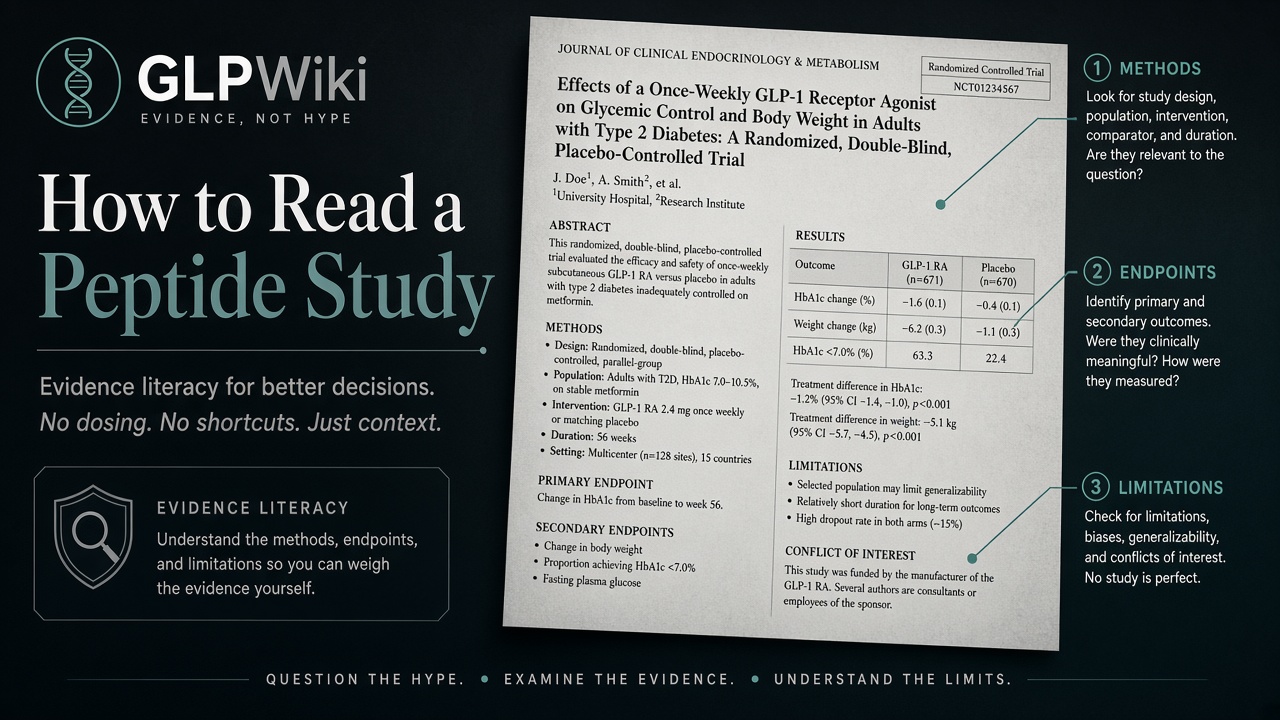
Five questions that separate a meaningful result from an impressive-sounding one.
25 June 2026 · 7 MIN READ
1. Species
Most peptide claims circulating online trace back to rodent work. Rodent healing, metabolism and lifespan respond to interventions that do nothing in humans. Always find the species before the effect size.
2. Control and randomisation
Open-label single-group studies cannot separate a drug from expectation, regression to the mean and natural recovery — which is exactly what most tissue-repair claims involve.
3. Independence and replication
A literature dominated by one laboratory is a flag, not a disqualification. Look for a second group reproducing the core finding.
4. Endpoint honesty
Surrogate markers — IGF-1, liver fat fraction, a cytokine panel — are useful but are not outcomes. Ask whether anyone measured what the reader actually cares about.
5. What is being sold
Research-chemical vendors are not regulated, and independent testing has repeatedly found mislabelled or underdosed vials. Study quality and product quality are two different problems.
Educational reference only. Nothing here is medical advice, a dosing protocol or an endorsement of any product. Investigational and research peptides are not approved medicines.