FDA warning letters and import alerts literacy: how to read Form 483s, warning letters and the GLP-1 green list

Headlines about GLP-1 medicines increasingly cite FDA paperwork: a telehealth company "received a warning letter," a compounder "got a 483," an ingredient supplier "is not on the green list." Those records are public, but each one means something narrower than the headline suggests. This guide explains the enforcement ladder from inspection observations to warning letters and court actions, how to read the parts of a warning letter, what FDA's GLP-1 telehealth, online-seller and compounding letters have actually said, how import alerts and the GLP-1 API green list (Import Alert 66-80) work, where to find these records, and what they cannot tell you. It is educational only: no doses, no product or pharmacy picks, no sourcing tips, and no legal advice.
UPDATED 10 NOV 2026 · 18 MIN READ
KEY TAKEAWAYS
- An FDA Form 483 lists inspection observations that, in the investigator's judgment, may be violations. FDA says it is not an all-inclusive list and not a final agency determination; FDA weighs it with the Establishment Inspection Report, collected evidence and the firm's response.
- After an inspection FDA assigns a final classification: No Action Indicated (NAI), Voluntary Action Indicated (VAI) or Official Action Indicated (OAI). OAI means FDA considers the facility to be in an unacceptable state of compliance.
- FDA's Regulatory Procedures Manual describes a warning letter as informal and advisory, issued for violations of regulatory significance to achieve voluntary compliance and establish prior notice. It is not final agency action, and FDA is not required to send one before taking enforcement action.
- An untitled letter cites violations that do not meet the threshold for a warning letter. A close-out letter may issue only after FDA verifies — usually by follow-up inspection — that corrections were actually made.
- For GLP-1s, FDA warning letters have targeted telehealth companies for implying compounded semaglutide or tirzepatide is the same as, generic to, or as clinically proven as FDA-approved products, or that a pharmacy is "FDA-approved"; FDA says it does not approve or license pharmacies or outsourcing facilities.
- Import alerts let FDA detain shipments without physical examination (DWPE) based on the appearance of a violation. Firms on a red or yellow list are subject to DWPE; for a green-list alert, only listed firms and products are exempt.
- Import Alert 66-80 is a green-list alert for GLP-1 active pharmaceutical ingredients. FDA said it evaluated 48 GLP-1 API sites and found 21% noncompliant, and that GLP-1 APIs from manufacturers not on the green list may be detained.
- These records are snapshots. FDA notes that later interactions may change the regulatory status of a letter, that its inspection database is not comprehensive, and that the absence of a letter is not a clean bill of health. This page does not rate any company or recommend any product.
Why FDA enforcement records keep coming up with GLP-1s
Few medicines have generated as much regulatory paperwork in so short a time as the GLP-1 receptor agonists. Shortages of semaglutide and tirzepatide drove a surge in compounding, compounding drove demand for imported active ingredients, and a large online market grew up around telehealth platforms, "research use only" sellers and websites offering medicines without a prescription. FDA has responded with inspections, warning letters to telehealth firms and online sellers, and a dedicated import alert for GLP-1 active pharmaceutical ingredients (APIs).
Each of those actions leaves a public record — and each record is easy to misread. A Form 483 is sometimes reported as if FDA had found a company guilty of something; a warning letter is sometimes treated as a ban; a green list is sometimes described as a list of approved pharmacies. None of those readings is accurate.
This guide is literacy about the documents themselves: what each one is, who issues it, what legal language it uses, and what it can and cannot tell a reader. It complements GLPWiki's guides on compounded versus FDA-approved GLP-1s, 503A versus 503B compounding, recalls and shortages, personal importation and DSCSA product verification. It does not evaluate or rank any company, and nothing here is a recommendation about where to obtain a medicine.
The enforcement ladder: from inspection to court
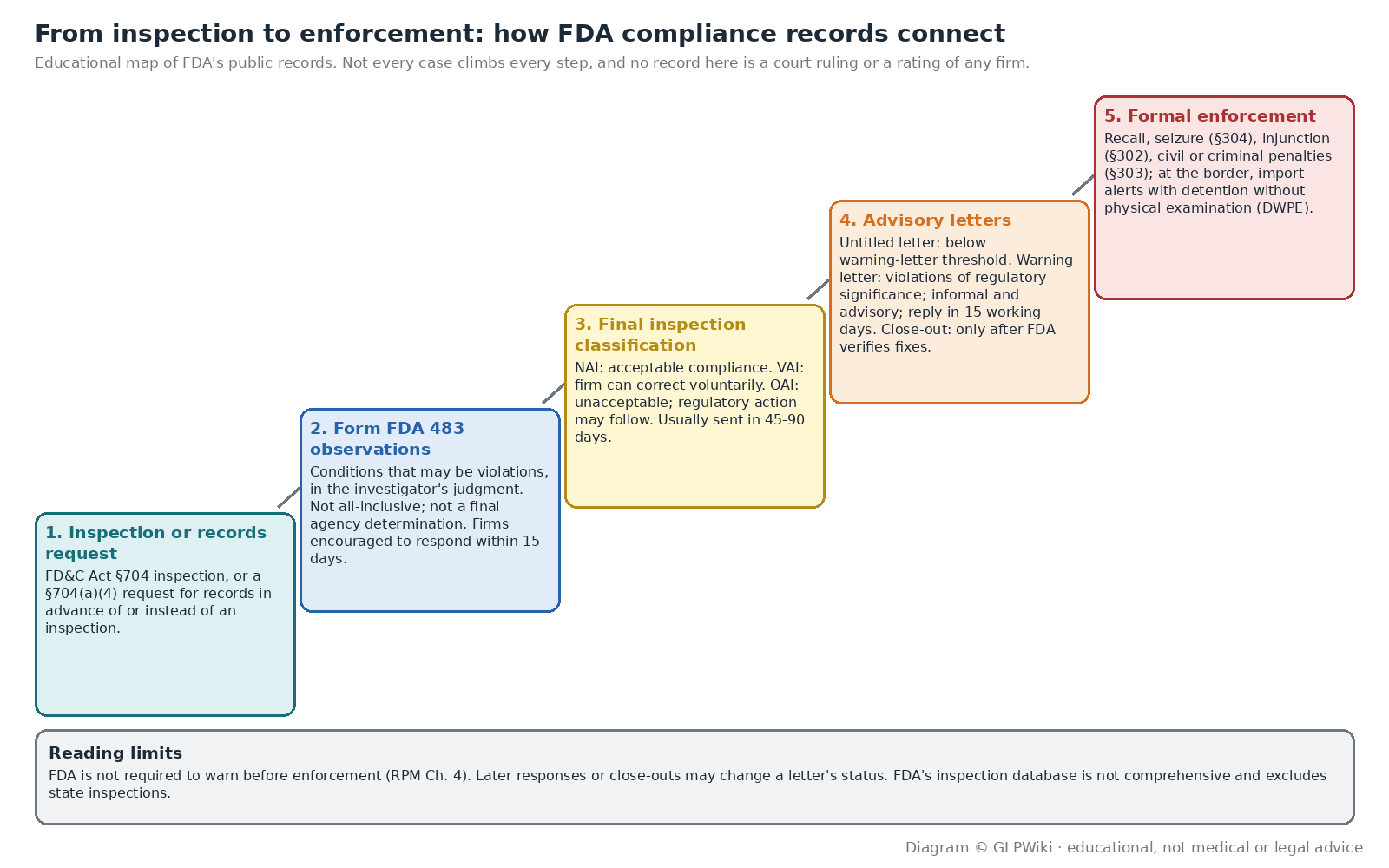
FDA's compliance tools are easier to read as a ladder. At the bottom are observations made during an inspection or a remote review; in the middle are advisory letters that ask a firm to fix problems voluntarily; at the top are formal enforcement actions such as seizure, injunction, civil money penalties or criminal prosecution, which generally run through the courts. Import alerts sit alongside the ladder at the border, letting FDA detain products from firms with a history of apparent violations.
Not every case climbs every rung. FDA's Regulatory Procedures Manual (RPM) Chapter 4 says warning letters are not a prerequisite to enforcement action, and that responsible officials "should not assume that they would receive a Warning Letter, or other prior notice, before FDA initiates enforcement action." Equally, many observations end at the first rung because a firm corrects them.
Rung 1: inspections and Form 483 observations
Section 704 of the Federal Food, Drug, and Cosmetic Act (FD&C Act) authorizes FDA inspections of establishments where drugs are made, processed, packed or held, and section 704(a)(4) lets FDA request records in advance of or instead of an inspection. At the end of an on-site inspection, if an investigator has observed conditions that in their judgment may constitute violations, FDA issues a Form FDA 483 to firm management and discusses each observation.
FDA's own FAQ is careful about what a 483 is not. It is "not an all-inclusive list of every possible deviation," and it "does not constitute a final Agency determination of whether any condition is in violation." FDA considers the 483 together with the Establishment Inspection Report (EIR), evidence collected on site and the firm's response. FDA encourages firms to respond in writing, generally within 15 days, with a corrective action plan.
Rung 2: the final inspection classification
FDA then assigns a final classification to each project area of the inspection, usually communicated to the firm within 45 to 90 days:
- No Action Indicated (NAI): the facility is in an acceptable state of compliance; usually no 483 was issued.
- Voluntary Action Indicated (VAI): objectionable conditions were found, but FDA will not recommend action because the firm can correct them voluntarily; usually a 483 was issued.
- Official Action Indicated (OAI): the facility is in an unacceptable state of compliance; FDA may pursue regulatory action such as a warning letter.
Rung 3: untitled letters, warning letters and close-outs
RPM Chapter 4 defines a warning letter as the agency's principal means of achieving prompt voluntary compliance, issued "only for violations of regulatory significance" — violations that may lead to enforcement action if not promptly and adequately corrected. It also says a warning letter "is informal and advisory" and that FDA does not consider it final agency action. An untitled letter cites violations that do not meet that threshold; it is not titled and does not carry the warning that failure to correct may lead to enforcement without further notice.
A close-out letter may follow once FDA has evaluated a firm's corrective actions. FDA says a close-out will not issue based on promises: the corrections must actually be made and verified, usually by a follow-up inspection, and violations that by their nature cannot be corrected never receive a close-out.
Rung 4: formal enforcement
If voluntary correction fails, FDA can pursue actions defined in the FD&C Act: seizure of violative products (section 304), injunctions (section 302), and civil or criminal penalties (section 303), alongside recalls and administrative detention. These generally involve the Department of Justice and the courts, which is why a warning letter, on its own, is not a court finding.
How to read a warning letter, part by part
Warning letters follow a fairly standard structure. Reading one becomes much easier once you know which parts are facts about what FDA observed, which are FDA's legal characterization, and which are procedural boilerplate.
- Header: recipient, date, a MARCS-CMS reference number and the issuing office (for example a CDER office for drugs). The posted date can be weeks after the issue date.
- How FDA found it: an inspection, a 704(a)(4) records request, a sample analysis, or a review of a website or social media content on a specific date.
- The cited provisions: common drug charges are adulteration under FD&C Act section 501 (for example, CGMP failures under 501(a)(2)(B)), misbranding under section 502 (false or misleading labeling under 502(a); false or misleading advertising of compounded drugs under 502(bb)), and unapproved new drugs under section 505(a), tied to prohibited acts in section 301.
- Quoted evidence: verbatim claims, observations or test results FDA relies on. These are the most informative lines for a reader.
- "Not an exhaustive list": letters typically say the violations cited may not be all of them.
- The response request: commonly a written response within 15 working days describing specific corrective steps, or the firm's reasoning if it disagrees.
- Consequences language: a statement that failure to correct may result in legal action without further notice, such as seizure or injunction.
What GLP-1 warning letters have actually said
Because the letters are public, readers can see exactly which claims and practices FDA objected to. Several distinct groups of GLP-1-related letters stand out.
Telehealth marketing of compounded GLP-1s
In September 2025, alongside a broad crackdown on misleading direct-to-consumer drug advertising, FDA sent a warning letter to Hims & Hers Health citing website claims such as "same active ingredient as Ozempic and Wegovy" and "clinically proven ingredients" for compounded semaglutide. FDA said compounded drugs are not FDA-approved, that the claims implied sameness with an approved product, and that the products were therefore misbranded under sections 502(a) and 502(bb).
On March 3, 2026 FDA announced 30 more warning letters to telehealth companies over compounded GLP-1 claims, describing the primary violations as claims implying sameness with FDA-approved products and branding that obscured who actually compounded the drug. A June 8, 2026 letter to Altru Telehealth cited claims that compounded semaglutide and tirzepatide offer "the same results" as brand products and that its compounding pharmacies were "FDA approved." FDA's letter states that the FD&C Act does not establish an "FDA-approved" or "FDA-licensed" designation for pharmacies or outsourcing facilities.
FDA's guidance page for telehealth companies summarizes the pattern: do not imply the telehealth company is the compounder, do not call a compounded drug generic or the same as an approved drug, do not claim it is FDA-approved or clinically proven to produce the same result, and do not claim it comes from an FDA-approved or FDA-licensed pharmacy.
Online sellers and "research use only" products
FDA's page on unapproved GLP-1 drugs says the agency monitors the internet and has issued warning letters to stop distribution of illegally marketed semaglutide and tirzepatide, and has warned companies selling semaglutide, tirzepatide, retatrutide, survodutide or mazdutide falsely labeled "for research purposes" or "not for human consumption" directly to consumers with dosing instructions. FDA's Internet Pharmacy Warning Letters page lists websites that received letters for offering unapproved prescription drugs, offering prescription drugs without a prescription, or lacking adequate directions and required warnings.
Independent test buys help explain FDA's concern. A 2024 study purchasing semaglutide from illegal online pharmacies received no prefilled pens (nondelivery scams), and the vials that did arrive had measured purity of roughly 8% to 14% against a labeled 99%, with endotoxin detected in all samples.
Compounders and manufacturers
Inspection-based letters to compounders and API makers usually cite CGMP or sterility problems rather than marketing. FDA's Compounding: Inspections, Recalls, and other Actions page posts, facility by facility, Form 483s, untitled letters, warning letters, close-outs, state referral letters and FMD-145 letters (FDA's post-inspection correspondence with compounders). A content analysis of 141 warning letters to compounding pharmacies from 2017 to 2022 found adulteration cited in 130 letters and misbranding in 103. An analysis of 2010–2020 CDER letters found CGMP and misbranding most common, with process validation, documentation or data integrity, and quality control the leading CGMP themes.
Context: a shift in promotion enforcement
FDA's September 9, 2025 announcement said it was sending thousands of letters about misleading drug ads and about 100 cease-and-desist letters, and noted that warning letters to pharmaceutical companies about promotion had fallen to one in 2023 and zero in 2024. That context matters when comparing counts across years: a jump in letters can reflect a policy change in enforcement, not only a change in industry behavior.
Import alerts, DWPE and the GLP-1 green list
Import alerts are FDA's border tool. Section 801(a) of the FD&C Act lets FDA refuse admission to products that appear to violate the law — the "appearance standard." An import alert tells FDA staff and importers that products from certain firms, or certain products generally, may be detained without physical examination (DWPE): instead of sampling each shipment, FDA can detain it, and it will be refused unless the importer overcomes the appearance of the violation.
Import alerts come in two list logics, and confusing them leads to opposite conclusions:
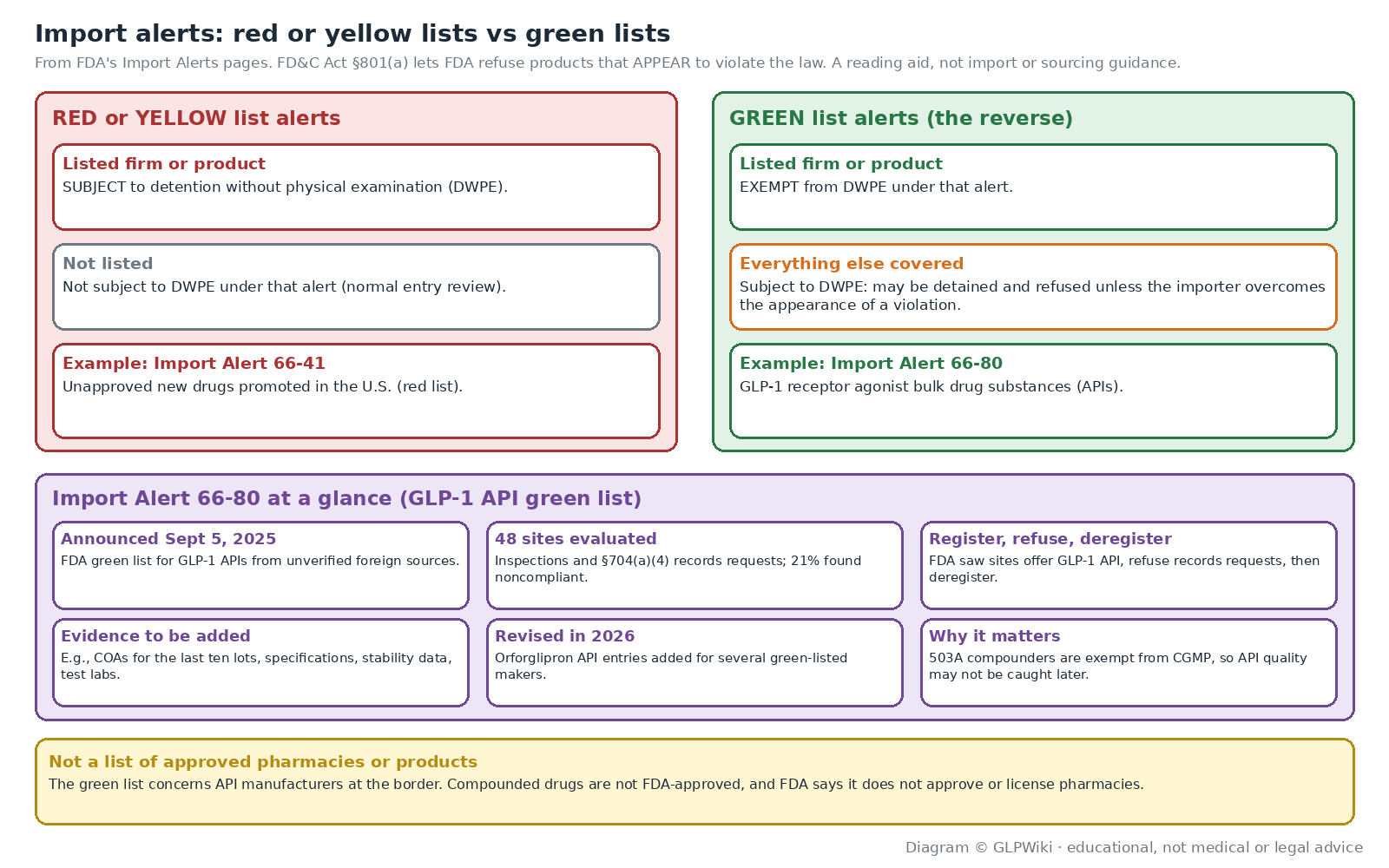
- Red list or yellow list: firms and products on the list ARE subject to DWPE. Example: Import Alert 66-41, "Unapproved New Drugs Promoted in the U.S.," uses a red list.
- Green list: firms and products on the list are EXEMPT from DWPE; everything else covered by the alert is subject to it. Example: Import Alert 66-80 for GLP-1 APIs.
What Import Alert 66-80 says
FDA announced the GLP-1 green list on September 5, 2025. The alert explains that shortages of approved GLP-1 products led to increased compounding using APIs from foreign sources, and that 503A compounders are exempt from CGMP requirements such as ensuring an API meets impurity and potency specifications — so quality problems in the bulk substance may not be caught downstream. FDA reports that it evaluated 48 GLP-1 API sites through inspections and 704(a)(4) records requests and found 21% noncompliant, and that it saw a pattern of sites that registered, offered GLP-1 APIs for import, refused records requests and then deregistered.
Under the alert, FDA divisions may detain GLP-1 API shipments except those from firms and products on the green list. The guidance section lists the kinds of evidence a manufacturer might submit to be added — for example, certificates of analysis for recent lots, release specifications and test methods, stability protocols and contract-laboratory details. The alert has been revised since issuance; a 2026 revision added orforglipron API entries for several green-listed manufacturers.
What the green list does not mean
The green list is about bulk drug substance manufacturers and border detention. It is not a list of FDA-approved drugs, approved pharmacies, or safe compounded products, and inclusion of a manufacturer says nothing about any particular finished product, pharmacy or website. FDA's telehealth letters specifically object to marketing that implies FDA approval of compounded products or pharmacies.
Where the public records live
All of the documents in this guide are published by FDA. The main entry points are:
- Warning Letters database: searchable by company, subject and issuing office, with filters for letters that have a posted response or close-out. FDA's page for telehealth firms suggests searching the term "telehealth."
- Compounding: Inspections, Recalls, and other Actions: per-facility lists of 483s, untitled letters, warning letters, close-outs and state referrals for 503A and 503B compounders.
- FDA Data Dashboard: inspection classifications (NAI/VAI/OAI), compliance actions, recalls and import refusals by fiscal year and firm.
- Import Alerts search: by number, country, industry or firm, with each alert's reason, guidance and red, yellow or green list.
- Internet Pharmacy Warning Letters: websites that received letters for illegal online drug sales.
- CDER promotion letters: warning letters and Office of Prescription Drug Promotion untitled letters about drug advertising.
- FOIA: records not posted online, such as many 483s and EIRs, can be requested through FDA's Freedom of Information process.
What these records can and cannot tell you
Enforcement records are valuable precisely because they are primary documents. But they are snapshots written for a regulatory purpose, and several limits apply.
- They can go stale. FDA's warning letter page notes that later interactions with the recipient "may have changed the regulatory status of issues discussed in the letter." Check for a posted response or close-out letter and the date.
- A 483 is not a verdict. FDA calls it observations, not a final determination; the classification and any letter that follows are more informative.
- No letter is not a clean bill of health. FDA says its inspection database is not comprehensive and excludes state inspections, and FDA is not required to warn before acting. A 2026 study of 48 newly registered 503B outsourcing facilities found only 11 had been inspected, after an average 2.2-year delay.
- A letter is FDA's position, not a court ruling. Warning letters are advisory; courts decide seizures, injunctions and penalties.
- Counts reflect policy. Letter volumes rise and fall with enforcement priorities; trend studies such as the analysis of 1,766 warning letters from 2016 to 2023 describe patterns but cannot show cause.
- Scope matters. An import alert entry or green-list listing applies to specific firms and products; it does not rate a pharmacy, a website or a finished medicine.
A reader checklist for enforcement headlines
When a news story, ad or social post cites an FDA action, these questions help put it in context:
- Which document is it — a 483, a classification, an untitled letter, a warning letter, a close-out, an import alert, or a court action?
- Who issued it and when, and is there a later response or close-out letter?
- Which FD&C Act provisions are cited — adulteration (501), misbranding (502), unapproved new drug (505)?
- Is the issue manufacturing quality, marketing claims, or selling without a prescription?
- For import alerts, is it a red/yellow list (listed firms are detained) or a green list (listed firms are exempt)?
- Does any claim say a pharmacy or compounded product is "FDA-approved"? FDA says it does not approve pharmacies or compounded drugs.
- Is the source the FDA document itself, or someone's summary of it?
- For a medical question about your own treatment, the right next step is a licensed clinician or pharmacist; for a safety or quality problem, FDA MedWatch.
Scope, disclaimer and review date
This page explains FDA Form 483s, inspection classifications, untitled letters, warning letters, close-out letters, formal enforcement actions, import alerts and detention without physical examination, and how FDA has used these tools around GLP-1 telehealth marketing, online sales, compounding and imported APIs. It does not provide doses, strengths, schedules, injection or device instructions, product, pharmacy, telehealth or supplier recommendations, instructions for importing, treatment advice, or legal counsel, and it does not rate or accuse any company. Letters quoted here reflect FDA's position at the time of issue; recipients may have responded or corrected issues since. Nothing here says to start, stop or switch any medicine. FDA pages and import alerts change, so check the linked primary sources for the current version.
Last reviewed: November 10, 2026.
Frequently asked questions
- Is a Form 483 the same as a warning letter?
- No. A Form 483 lists an investigator's observations at the end of an inspection, and FDA says it is not a final agency determination. A warning letter comes later, if FDA decides the violations are of regulatory significance, and it states FDA's position and asks for correction.
- Does a warning letter mean a product is banned or recalled?
- Not by itself. FDA describes warning letters as informal and advisory; they request voluntary correction and establish prior notice. Recalls, seizures, injunctions and penalties are separate actions. A product named in a letter may or may not be the subject of any of them.
- What do NAI, VAI and OAI mean?
- They are FDA's final inspection classifications. NAI (No Action Indicated) means an acceptable state of compliance; VAI (Voluntary Action Indicated) means objectionable conditions FDA expects the firm to fix voluntarily; OAI (Official Action Indicated) means an unacceptable state of compliance where regulatory action may follow.
- What is a close-out letter?
- A letter FDA may issue after it has verified, usually through a follow-up inspection, that a firm actually corrected the violations in a warning letter. FDA says close-outs are not issued based on promises, and some violations cannot be closed out.
- What is the GLP-1 green list?
- It is the green list in Import Alert 66-80, which covers GLP-1 receptor agonist active pharmaceutical ingredients. Shipments from manufacturers and products on the list are exempt from detention without physical examination; GLP-1 APIs from others may be detained. It is not a list of approved pharmacies or products.
- If a compounded GLP-1 is made with a green-listed API, is it FDA-approved?
- No. Compounded drugs are not FDA-approved, and FDA has said it does not approve or license pharmacies or outsourcing facilities. The green list concerns API manufacturers at the border, not the finished compounded product.
- Why did FDA send warning letters to telehealth companies?
- FDA cited website claims about compounded semaglutide and tirzepatide that implied sameness with FDA-approved products, called them clinically proven or FDA-approved, described pharmacies as FDA-approved, or branded products so the telehealth firm appeared to be the compounder. FDA treated these as misbranding under FD&C Act sections 502(a) and 502(bb).
- Is this page telling me which companies or products to avoid or use?
- No. It explains how to read FDA's public records. It does not rate companies, recommend products, pharmacies or telehealth services, or give medical or legal advice. Questions about your own treatment belong with a licensed clinician and pharmacist.
SOURCES
- 01About Warning and Close-Out Letters— FDA
- 02Warning Letters (searchable database)— FDA
- 03Regulatory Procedures Manual, Chapter 4 — Advisory Actions (Warning Letters and Untitled Letters) (PDF)— FDA
- 04FDA Form 483 Frequently Asked Questions— FDA
- 05Inspection Classification Database (NAI, VAI, OAI)— FDA
- 06FDA Data Dashboard (inspections, compliance actions, import refusals)— FDA
- 07Investigations Operations Manual (IOM)— FDA
- 08Import Alerts— FDA
- 09Removal from Import Alert (DWPE petitions)— FDA
- 10Import Alert 66-80 — Detention Without Physical Examination of GLP-1 Receptor Agonist Bulk Drug Substances (Green List)— FDA
- 11Import Alert 66-41 — Detention Without Physical Examination of Unapproved New Drugs Promoted in the U.S.— FDA
- 12FDA Launches Green List to Protect Americans from Illegal Imported GLP-1 Drug Ingredients (September 5, 2025)— FDA
- 13FDA's Concerns with Unapproved GLP-1 Drugs Used for Weight Loss— FDA
- 14Internet Pharmacy Warning Letters— FDA
- 15FDA Warns 30 Telehealth Companies Against Illegal Marketing of Compounded GLP-1s (March 3, 2026)— FDA
- 16FDA to Telehealth Companies: What to Know When Promoting Compounded Drugs— FDA
- 17Warning Letter: Hims & Hers Health, Inc. dba Hers — MARCS-CMS 716825 (September 9, 2025)— FDA
- 18Warning Letter: Altru Telehealth, LLC — MARCS-CMS 728274 (June 8, 2026)— FDA
- 19Compounding: Inspections, Recalls, and other Actions— FDA
- 20FDA Launches Crackdown on Deceptive Drug Advertising (September 9, 2025)— FDA
- 21Warning Letters and Notice of Violation Letters to Pharmaceutical Companies (incl. OPDP untitled letters)— FDA
- 2221 U.S.C. 352 — Misbranded drugs and devices (FD&C Act §502, incl. §502(bb))— U.S. Code (Cornell LII)
- 2321 U.S.C. 374 — Inspection (FD&C Act §704, incl. §704(a)(4) records requests)— U.S. Code (Cornell LII)
- 2421 U.S.C. 381 — Imports and exports (FD&C Act §801)— U.S. Code (Cornell LII)
- 2521 U.S.C. 332 — Injunction proceedings (FD&C Act §302)— U.S. Code (Cornell LII)
- 2621 U.S.C. 333 — Penalties (FD&C Act §303)— U.S. Code (Cornell LII)
- 2721 U.S.C. 334 — Seizure (FD&C Act §304)— U.S. Code (Cornell LII)
- 2821 CFR Part 211 — Current Good Manufacturing Practice for Finished Pharmaceuticals— eCFR
- 29How to Make a FOIA Request— FDA
- 30MedWatch: The FDA Safety Information and Adverse Event Reporting Program— FDA
- 31Dmour I. Content Analysis of US FDA Warning Letters Issued to Compounding Pharmacies Regarding Violations of Current Good Manufacturing Practices Between 2017 and 2022. J Pharm Innov. 2022— PubMed
- 32Rathore AS, et al. FDA Warning Letters: A Retrospective Analysis of Letters Issued to Pharmaceutical Companies from 2010-2020. J Pharm Innov. 2022— PubMed
- 33Park Y, Kwon K. Trends in FDA Data Integrity Enforcement Before and After the COVID-19 Pandemic: An Analysis of 1766 Warning Letters (2016-2023). Ther Innov Regul Sci. 2026;60(1):190-198— PubMed
- 34McCall KL, et al. A quantitative and qualitative study of US FDA inspection reports of 503B outsourcing facilities. J Am Pharm Assoc (2003). 2026;66(5):103156— PubMed
- 35Ashraf AR, et al. Multifactor Quality and Safety Analysis of Semaglutide Products Sold by Online Sellers Without a Prescription. J Med Internet Res. 2024;26:e65440— PubMed
EDUCATIONAL REFERENCE ONLY · Not medical advice. Nothing here diagnoses, treats, cures or prevents any disease, and nothing here is a dosing recommendation. Consult a licensed clinician before any treatment decision.