Personal importation and foreign pharmacy literacy: what FDA policy does and does not cover for GLP-1 medicines
Ads for "Canadian," "European" or "no-prescription" GLP-1 medicines often imply that buying from abroad is a normal, legal shortcut. FDA's own wording is narrower: in most circumstances it is illegal for individuals to import drugs for personal use, and the personal importation policy is a description of enforcement discretion, not a license. This guide explains what the policy actually says, how refusals and administrative destruction work, why state Section 804 importation programs are a different thing, how FDA's BeSafeRx tools separate state-licensed online pharmacies from risky storefronts, and what FDA, WHO and published test-buy studies have documented about GLP-1 products sold outside the U.S. supply chain. It is educational only: no doses, no sourcing tips, no product picks, and no legal advice.
UPDATED 09 NOV 2026 · 20 MIN READ
KEY TAKEAWAYS
- FDA's Personal Importation page says that, in most circumstances, it is illegal for individuals to import drugs or devices into the U.S. for personal use, and that a drug approved in another country but unapproved in the U.S. is illegal to import. Foreign-made versions of U.S.-approved drugs are generally treated as unapproved.
- FDA's personal importation policy lives in Regulatory Procedures Manual (RPM) subchapter 9-2. It describes when FDA staff may use enforcement discretion for personal-use quantities, and it states plainly that this discretion "should not be interpreted as a license to individuals to bring in such shipments."
- The more permissive scenario for prescription drugs was written around serious conditions where effective treatment may not be available domestically, with no commercialization or promotion to U.S. residents, no unreasonable risk, a written personal-use affirmation, generally no more than a three-month supply, and a U.S. treating doctor or proof of continuing treatment begun abroad. Readers should not assume any particular GLP-1 purchase fits those factors.
- Under FD&C Act section 801(a), articles that appear adulterated, misbranded or unapproved can be refused admission, counterfeit drugs must be refused, and refused drugs valued at $2,500 or less can be destroyed without the opportunity to export.
- Section 804 importation programs (SIPs) are state- or tribe-sponsored commercial programs for certain drugs from Canada, run by licensed pharmacists or wholesalers with FDA pre-import review, testing and relabeling. They are not a pathway for individuals, and the final rule excludes biological products and several other categories.
- FDA's BeSafeRx campaign lists four signs of a safe online pharmacy: it requires a valid prescription, has a U.S. physical address and phone number, is licensed by a state board of pharmacy, and has a licensed pharmacist available. Sites that ship from abroad, skip prescriptions or advertise prices that seem too good to be true are red flags.
- For GLP-1s specifically, FDA has warned about illegal online sales, "research use only" products and counterfeit Ozempic; WHO issued a 2024 alert on falsified semaglutide; and published test buys of no-prescription semaglutide documented nondelivery scams, low purity and mislabeled content.
- This page does not tell anyone how to import, where to buy, or what to take. Questions about access, cost or a specific prescription belong with a licensed clinician and a state-licensed pharmacist.
Why importation and foreign pharmacies keep coming up with GLP-1s
Demand for GLP-1 receptor agonists has made them some of the most searched-for prescription medicines online. That demand has been matched by websites, social accounts and messaging-app sellers offering semaglutide or tirzepatide "from Canada," "from Europe," "without a prescription," or "for research use only." Many of these offers lean on the idea that buying from abroad is an ordinary, legal cost-saving move.
FDA's public materials describe a narrower reality. The U.S. relies on a closed drug distribution system built on FDA approval, state pharmacy licensure and supply-chain tracing under the Drug Supply Chain Security Act (DSCSA). Medicines that arrive from outside that system — whether ordered from a foreign website, bought during travel, or relayed by a storefront business — are outside FDA's oversight, and FDA says it cannot ensure their safety and effectiveness.
This guide is literacy about the rules and records, not a how-to. It explains the vocabulary (personal importation, enforcement discretion, refusal of admission, Section 804, BeSafeRx) so readers can recognize misleading claims. It complements GLPWiki's DSCSA product verification guide, the compounded-versus-FDA-approved GLP-1 guide, and the travel and cold-chain guide.
The legal baseline: "approved abroad" is not "approved here"
Section 505(a) of the Federal Food, Drug, and Cosmetic Act (FD&C Act) prohibits introducing a new drug into interstate commerce unless an FDA approval is in effect for that product. FDA approval attaches to a specific product made by specific manufacturers at specific facilities under specific labeling — not to the active ingredient in the abstract. That is why FDA and U.S. Customs and Border Protection (CBP) both explain that foreign-made versions of drugs approved in the U.S. generally have not been evaluated or approved by FDA for use or sale here, and FDA generally considers them unapproved.
Section 801(a) of the FD&C Act governs imports. If an imported drug appears to be adulterated, misbranded or an unapproved new drug, it is subject to refusal of admission; if it appears to be counterfeit, it shall be refused. Section 301 lists prohibited acts, including introducing adulterated, misbranded or unapproved drugs into commerce.
FDA's Personal Importation page puts it in plain language: in most circumstances, it is illegal for individuals to import drugs or devices into the U.S. for personal use, because products purchased from other countries often have not been approved by FDA. If a drug is approved in another country but is an unapproved new drug in the U.S., it is illegal to import. FDA adds that it cannot ensure the safety and effectiveness of medicine purchased over the internet from foreign sources, from storefront businesses that offer to buy foreign medicine for you, or during trips outside the U.S., and recommends obtaining medicines only from legal sources in the U.S.
Why the same brand name can still mean a different product
A carton bought abroad may share a brand name with the U.S. product, but it can differ in manufacturing site, formulation details, device, labeling language, storage instructions and lot-tracing data. It also has no U.S. DSCSA transaction history. FDA's counterfeit and BeSafeRx materials note that unsafe sellers often use storefronts designed to make buyers think a product comes from a country with high safety standards when it could have been made anywhere.
What FDA's personal importation policy actually says
FDA's operating instructions for personal shipments appear in Regulatory Procedures Manual (RPM) Chapter 9, subchapter 9-2, "Coverage of Personal Importations." The background explains that personal shipments are usually small, so comprehensive coverage is not normally justified, and that FDA focuses its enforcement resources more on commercial shipments — including small shipments solicited by mail-order promotions — than on products personally carried or shipped from a foreign medical facility where a person was treated.
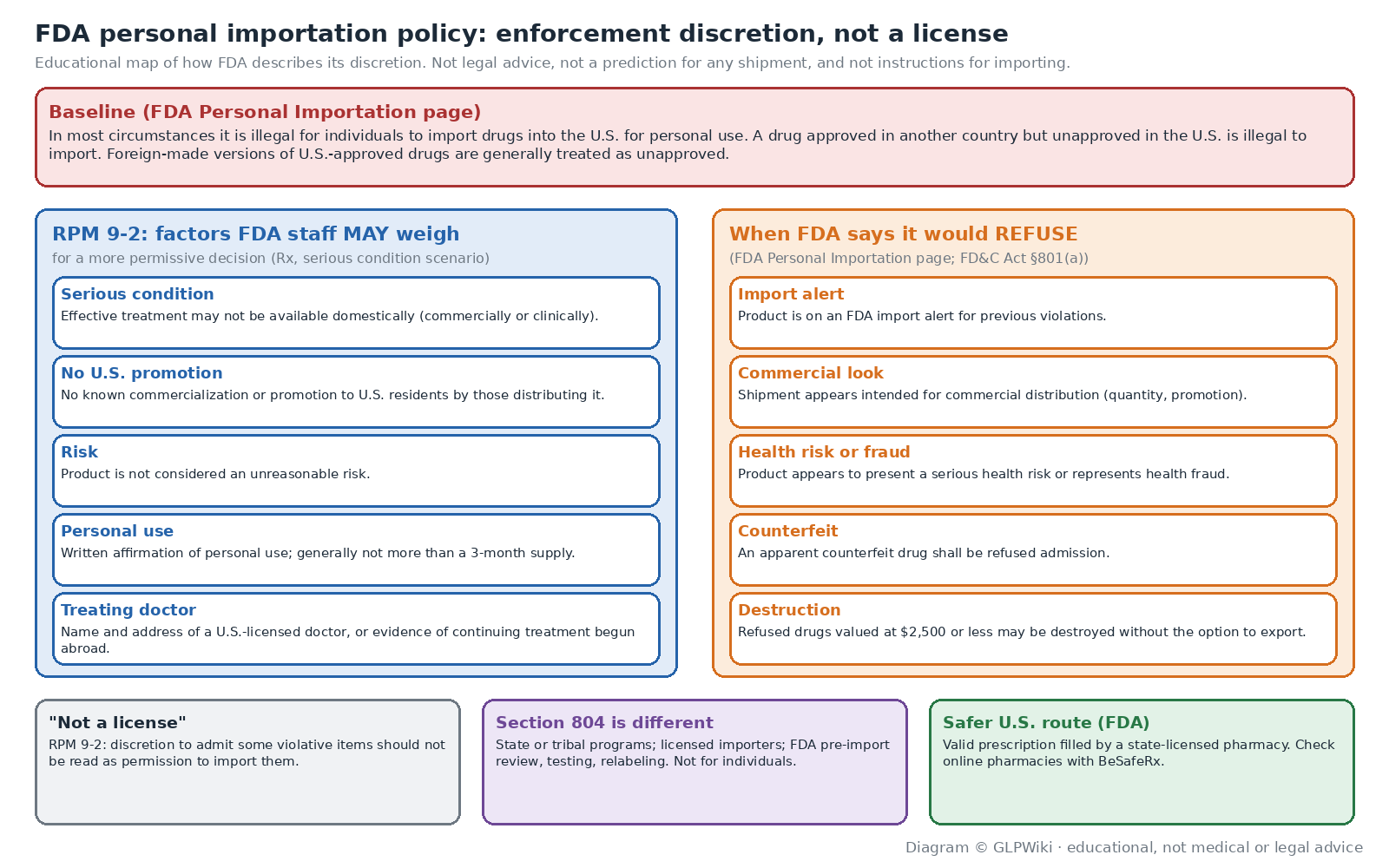
The general instructions say FDA personnel may allow entry when quantity and purpose are clearly for personal use and the product does not present an unreasonable risk, and they may examine background, risk and purpose before deciding. The same paragraph adds the line most marketing leaves out: although FDA may use discretion to allow admission of certain violative items, this "should not be interpreted as a license to individuals to bring in such shipments." Drugs subject to import alerts are generally not amenable to these procedures, and commercial or promotional shipments are excluded.
For drugs and devices, the RPM lists two situations in which staff may consider a more permissive decision: (1) the intended use is appropriately identified, is not for a serious condition, and the product is not known to present a significant health risk; or (2) the intended use is unapproved and for a serious condition for which effective treatment may not be available domestically, there is no known commercialization or promotion to U.S. residents by those distributing the product, the product is not considered an unreasonable risk, and the individual affirms in writing that it is for personal use (generally not more than a three-month supply) and provides the name and address of the U.S.-licensed doctor responsible for treatment, or evidence that it continues a treatment begun abroad.
Reading those factors against GLP-1 marketing
The more permissive scenario was written around people seeking treatments that are not available in the U.S. FDA-approved GLP-1 medicines are marketed in the U.S., and many online sellers actively promote to U.S. residents — which is the opposite of "no known commercialization or promotion." FDA has also placed GLP-1 active pharmaceutical ingredients on a green-list import alert (Import Alert 66-80) and has warned about illegal online GLP-1 sales. None of this is a legal ruling on any individual shipment; FDA decides case by case. The literacy point is simply that the policy does not say what many ads imply.
Release with comment, refusal and administrative destruction
When FDA allows a personal shipment it may issue a "Release with Comment" advising that the product appears unapproved in the U.S., should be used under medical supervision, and that future shipments may be detained. FDA's Personal Importation page lists situations in which it would refuse a personal importation: the product is on an import alert, the shipment appears intended for commercial distribution, the product appears to present a serious health risk, or it appears to represent health fraud.
Mail parcels arrive through International Mail Facilities, where CBP sets aside parcels that appear to contain drugs for FDA review. Detained parcels receive a Notice of FDA Action with an opportunity to respond. Under section 801(a), FDA may destroy a refused drug valued at $2,500 or less without the opportunity for export. In practice, a refused order can mean lost money as well as lost medicine.
Section 804(j): the statute behind the discretion
Section 804(j) of the FD&C Act states that, in enforcing the prohibition on importation by individuals, FDA should focus on cases that pose a significant threat to public health and exercise discretion when importation is clearly for personal use and does not appear to present an unreasonable risk. It also gives FDA authority to grant waivers by regulation or case by case. That language describes enforcement priorities; it does not create a general consumer right to import prescription drugs.
Visitors, travelers and controlled substances
FDA's page separately addresses foreign nationals visiting the U.S.: FDA will allow them to bring or ship a 90-day supply of their own medication, with documentation such as a copy of a visa or passport, a doctor's letter, or a prescription in English. CBP's Know Before You Go guidance tells U.S. citizens to travel only with their own medication prescribed by a licensed physician and legally obtained in the U.S. Controlled substances add Drug Enforcement Administration (DEA) requirements. GLPWiki's travel and cold-chain guide covers storage literacy for trips; this page does not provide packing or customs instructions.
Section 804 state importation programs are a different pathway
Headlines about states importing medicines from Canada refer to Section 804 Importation Programs (SIPs) under FD&C Act section 804 and FDA's 2020 final rule at 21 CFR part 251. These are commercial programs sponsored by states or Indian tribes. Under FDA's final rule Q&A, the importer must be a licensed pharmacist or wholesale distributor, eligible drugs must be Health Canada–approved versions that otherwise meet the conditions of an FDA-approved drug, and each drug requires an FDA-granted Pre-Import Request, authenticity and specification testing, and relabeling to FDA-approved labeling.
The final rule excludes several categories from eligibility, including controlled substances, biological products, infused drugs, intravenously, intrathecally or intraocularly injected drugs, drugs subject to a REMS, and drugs not subject to certain DSCSA provisions; FDA decides other products case by case. FDA authorized Florida's program in January 2024 (with later extension letters) and Colorado's in June 2026, according to FDA's Section 804 policies page. Individuals do not import under a SIP, and a SIP authorization is not evidence that any website's "Canadian" GLP-1 offer is legal or authentic. Check FDA's page for current status.
Online pharmacies: storefronts, "Canadian" claims and shipping from abroad
FDA's BeSafeRx campaign exists because legitimate and illegitimate online pharmacies can look alike. BeSafeRx's FAQ cites roughly 35,000 active online pharmacies at any given time and, citing the National Association of Boards of Pharmacy, says only about five percent comply with U.S. pharmacy laws and practice standards. FDA describes many unsafe sites as operated by criminal networks using fake storefronts to mimic licensed pharmacies.
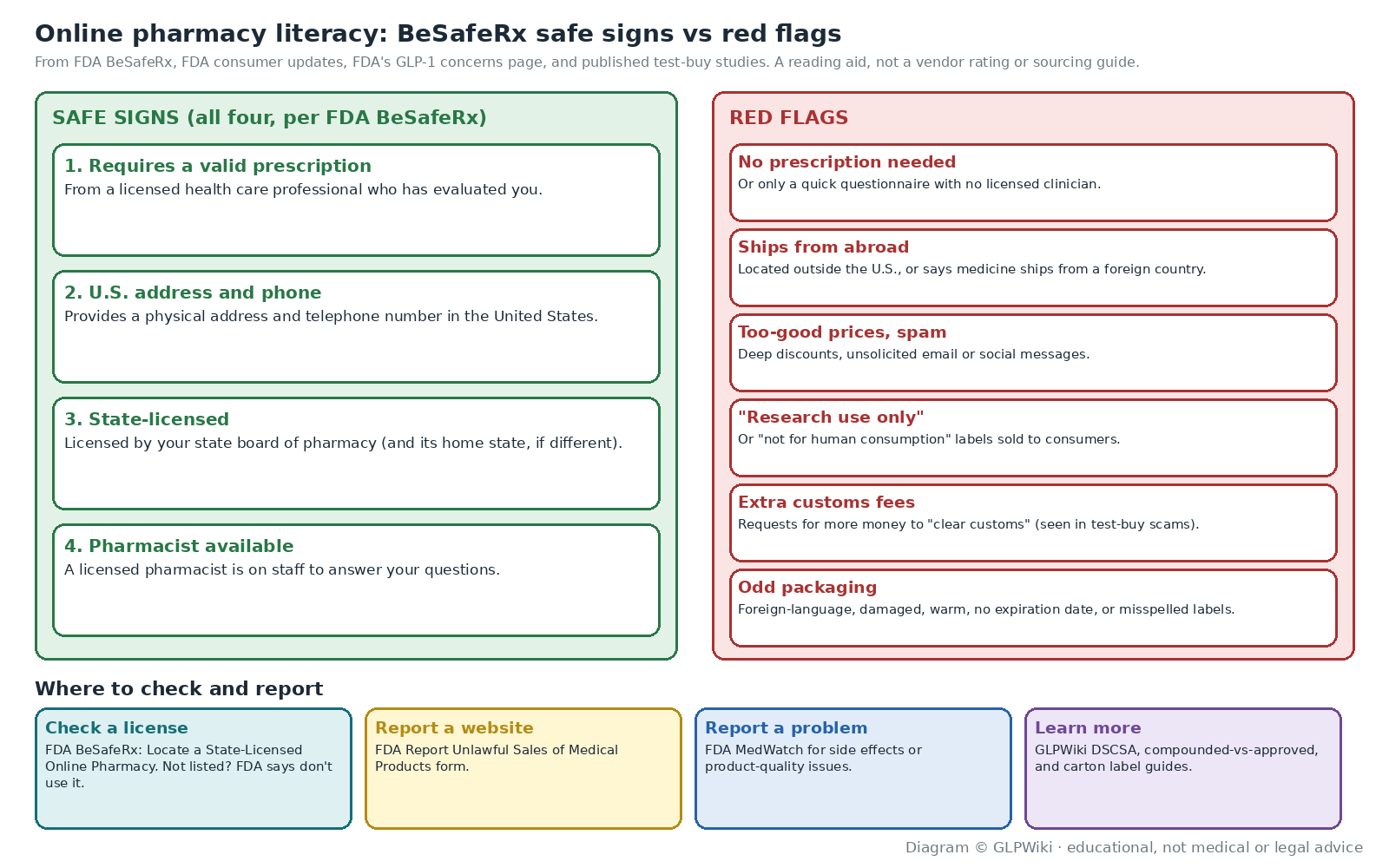
BeSafeRx lists warning signs: the site lets you buy prescription medicine without a prescription, offers prices that seem too good to be true, sends spam, states that medicine will ship from a foreign country, is located outside the U.S., or is not licensed by a U.S. state board of pharmacy. FDA's consumer update adds packaging that is broken, in a foreign language, missing an expiration date, or different from what your usual pharmacy dispenses, and sites that do not protect personal and financial information.
What a safe online pharmacy looks like in FDA's terms
- It always requires a valid prescription from a licensed health care professional.
- It provides a physical address and telephone number in the U.S.
- It is licensed by the board of pharmacy in your state and, if different, the state where it operates.
- It has a licensed pharmacist available to answer questions.
- You can confirm the license through FDA's Locate a State-Licensed Online Pharmacy tool, which links to each state's board-of-pharmacy database. FDA says that if the pharmacy is not listed, do not use it.
Telehealth-specific red flags FDA lists for GLP-1s
FDA's page on unapproved GLP-1 drugs adds red flags for telehealth sellers: claims that a compounded drug is the same as an FDA-approved drug, deep discounts, medicine that looks different from what was pictured or arrives damaged or without instructions, no screening or prescription by a licensed clinician, no clinician available afterward, spelling errors or incorrect pharmacy addresses on labels, and pharmacy names that may be fraudulent.
What FDA, WHO and researchers have documented for GLP-1s
FDA states that it monitors the internet for fraudulent or unapproved GLP-1 drugs and has issued warning letters to stop illegally marketed semaglutide and tirzepatide, which may be counterfeit, contain wrong or harmful ingredients, or contain too little, too much or no active ingredient. FDA has also warned companies selling semaglutide, tirzepatide, retatrutide, survodutide or mazdutide falsely labeled "for research purposes" or "not for human consumption" directly to consumers, and urges consumers not to buy them. A 2025 Annals of Pharmacotherapy commentary described how such "research" vials bypass prescribers and pharmacists entirely.
Counterfeits are not only an overseas problem. FDA's counterfeit Ozempic alert documents seizures of counterfeit units found in the legitimate U.S. supply chain in December 2023, April 2025 and December 2025, each tied to specific lot information, after distribution outside the manufacturer's authorized channels. In June 2024 the World Health Organization issued Medical Product Alert N°2/2024 on falsified Ozempic detected in Brazil, the United Kingdom and the United States, noting increased reports of falsified semaglutide in all regions since 2022 and advising people to buy with a prescription and avoid unverified sources, including online.
Published test buys and safety reports
Ashraf and colleagues (JAMA Network Open 2024; expanded in the Journal of Medical Internet Research 2024) searched Google and Bing results and found 317 online pharmacy links, of which about 42% led to illegal pharmacy operations. Of six test purchases from sites selling semaglutide without a prescription, three were never delivered — the sellers instead demanded extra payments to "clear customs," which customs agencies confirmed as fraudulent. The three delivered vials were judged probable substandard and falsified: measured purity was roughly 7–14% versus a claimed 99%, measured content exceeded the label by about 29–39%, and endotoxin was detected.
A 2026 EudraVigilance analysis by Zinzi and colleagues identified 234 individual case safety reports linked to potential counterfeit semaglutide, with 89.3% of suspected reactions classified as serious and hypoglycemia reported disproportionately often compared with non-counterfeit semaglutide. A 2026 case report described euglycemic ketoacidosis in a young adult who used semaglutide bought online without medical supervision. These are signals and case data, not population rates, but they illustrate why FDA and WHO emphasize licensed sources.
Broader research gives context. A 2022 systematic review of online pharmacies found that almost half were not properly regulated and that the share of ordered products actually received varied widely. An analysis of U.S. National Health Interview Survey data from 2011–2013 linked lack of health insurance with higher reported personal prescription-drug importation, which helps explain why cost pressure drives these searches — and why the safer answer is usually a conversation about access with a clinician or pharmacist.
Ingredient imports are a separate control point
FDA's Import Alert 66-80 allows detention without physical examination of GLP-1 active pharmaceutical ingredients unless the manufacturer and product are on the alert's green list, based on FDA's evaluation of manufacturing compliance. FDA says this targets potentially poor-quality foreign APIs used in compounding; it does not stop legal API imports from compliant manufacturers. It is a supply-side control, not a consumer import route.
How this connects to DSCSA, compounding and label literacy
- DSCSA: FDA-regulated prescription drugs move among authorized trading partners with tracing data. A parcel from a foreign website has no U.S. DSCSA transaction history. See GLPWiki's DSCSA product verification guide.
- Compounding: compounded GLP-1s are not FDA-approved, and foreign or "research" products are not U.S. compounded preparations either. See the compounded-versus-FDA-approved and 503A-versus-503B guides.
- Orange Book and Purple Book: those FDA records describe U.S.-approved and U.S.-licensed products. A foreign carton is not listed there just because its brand name matches.
- Carton and container labels: U.S. labeling carries specific required elements. Foreign-language packaging or missing expiration dates are FDA-listed warning signs, not proof of a better deal.
- Cold chain: injectable GLP-1s require refrigeration per their labeling, and FDA advises not using an injectable GLP-1 that arrives warm or with insufficient refrigeration. See the travel and cold-chain guide.
A reader's literacy checklist (not a buying guide)
Use these questions to evaluate claims you see online. They are not steps for importing or sourcing medicine.
- Does the offer require a valid prescription from a licensed clinician who evaluates you? If not, FDA treats that as a red flag.
- Is the pharmacy listed in your state board of pharmacy database via FDA's BeSafeRx locator, with a U.S. address and a pharmacist you can reach?
- Does the site say the medicine ships from abroad, or describe itself as Canadian or European while asking you to trust it rather than check a license?
- Is the product labeled "research use only" or "not for human consumption"? FDA has warned about exactly these GLP-1 listings.
- Are you being asked for an extra customs or clearance fee after paying? Published test buys found that pattern in nondelivery scams.
- Does a seller cite FDA's personal importation policy as if it were permission? RPM 9-2 says discretion is not a license.
- Does a seller cite a state Section 804 program? SIPs are run by state-sponsored licensed importers for specific approved drug lists; they are not consumer storefronts.
- Questions about cost, coverage or access to a GLP-1 belong with your prescriber and a state-licensed pharmacist.
Where to report suspicious sellers or problems
- Websites or social accounts that appear to sell medicine illegally: FDA's Report Unlawful Sales of Medical Products form (linked from FDA's Ways for Consumers to Contact FDA page and BeSafeRx).
- Side effects or product-quality problems: FDA MedWatch (see GLPWiki's FAERS and MedWatch reporting guide).
- Suspected counterfeit products or criminal activity: FDA's Office of Criminal Investigations reporting route or your FDA consumer complaint coordinator, as described in FDA's counterfeit Ozempic alert.
- Outside the U.S., WHO asks that falsified-product information be sent to national regulators and to WHO's rapid alert address listed in its alerts.
Scope, disclaimer and review date
This page explains how FDA describes personal importation of drugs, the RPM 9-2 enforcement-discretion factors, refusal of admission and administrative destruction under FD&C Act section 801(a), the difference between personal importation and Section 804 state importation programs, FDA's BeSafeRx online-pharmacy checks, and documented risks of GLP-1 products sold outside the U.S. supply chain. It does not provide doses, strengths, schedules, injection or device instructions, product, vendor or pharmacy recommendations, instructions for importing or clearing customs, treatment advice, or legal counsel. Nothing here says to start, stop or switch any medicine. Whether a particular shipment is admissible is decided by FDA and CBP case by case; questions about a specific situation belong with licensed clinicians, pharmacists, or qualified legal counsel. FDA, CBP and WHO pages change, so check the linked primary sources for the current version.
Last reviewed: November 9, 2026.
Frequently asked questions
- Is it legal to order a GLP-1 medicine from a foreign online pharmacy for my own use?
- FDA's Personal Importation page says that in most circumstances it is illegal for individuals to import drugs into the U.S. for personal use, and that a drug approved abroad but unapproved in the U.S. is illegal to import. FDA's personal importation policy describes limited enforcement discretion and states it is not a license. This page cannot evaluate any specific situation and is not legal advice.
- Isn't a foreign version of Ozempic or Mounjaro the same drug?
- Not in FDA's terms. FDA approval applies to a specific product, manufacturer, facility and labeling. FDA and CBP explain that foreign-made versions of U.S.-approved drugs generally have not been evaluated or approved by FDA, so FDA generally considers them unapproved — and FDA cannot verify how they were made, stored or shipped.
- What is the "three-month supply" rule I see online?
- It comes from FDA's RPM subchapter 9-2, which lists factors FDA staff may weigh for a more permissive decision, including that the quantity is generally not more than a three-month supply. That figure is one factor among several — such as a serious condition without effective domestic treatment and no promotion to U.S. residents — and FDA says the discretion is not a license. It is not a quantity that makes an import legal.
- Do state programs that import drugs from Canada let me buy GLP-1s from Canada?
- No. Section 804 Importation Programs are sponsored by states or tribes, run through licensed pharmacists or wholesale distributors, and require FDA pre-import approval, testing and relabeling for listed drugs. Individuals do not import under them, and the final rule excludes biological products and several other categories.
- How can I tell if an online pharmacy is legitimate?
- FDA's BeSafeRx campaign lists four signs: it requires a valid prescription, has a U.S. physical address and phone number, is licensed by a state board of pharmacy, and has a licensed pharmacist available. FDA's Locate a State-Licensed Online Pharmacy tool links to state license databases; FDA says that if the pharmacy is not listed, do not use it.
- What happens to a parcel of medicine FDA refuses at the border?
- Under FD&C Act section 801(a), refused articles are generally exported or destroyed, and FDA may destroy a refused drug valued at $2,500 or less without the opportunity to export. FDA issues a Notice of FDA Action with an opportunity to respond. FDA may also release some personal shipments with a comment that future shipments may be detained.
- Are "research use only" semaglutide or tirzepatide vials an acceptable workaround?
- FDA has warned companies that sell unapproved GLP-1 drugs falsely labeled "for research purposes" or "not for human consumption" directly to consumers, and urges consumers not to purchase them because they are of unknown quality and may be harmful. They are neither FDA-approved products nor U.S. compounded preparations.
- Is this page recommending where to get a GLP-1 medicine?
- No. It is educational literacy about FDA policy and documented risks. It does not recommend products, pharmacies, doses or import strategies. Questions about access, cost or a specific prescription belong with a licensed clinician and a state-licensed pharmacist.
SOURCES
- 01Personal Importation (Import Basics)— FDA
- 02Regulatory Procedures Manual, Chapter 9 Import Operations and Actions — subchapter 9-2 Coverage of Personal Importations (PDF)— FDA
- 0321 U.S.C. 381 — Imports and exports (FD&C Act §801)— U.S. Code (Cornell LII)
- 0421 U.S.C. 384 — Importation of prescription drugs (FD&C Act §804)— U.S. Code (Cornell LII)
- 0521 U.S.C. 331 — Prohibited acts (FD&C Act §301)— U.S. Code (Cornell LII)
- 0621 U.S.C. 355 — New drugs (FD&C Act §505)— U.S. Code (Cornell LII)
- 0721 CFR Part 251 — Section 804 Importation Program— eCFR
- 08Section 804 Importation Program Policies and Authorizations— FDA
- 09FDA Authorizes Florida's Drug Importation Program (press announcement, January 2024)— FDA
- 10Importation of Prescription Drugs Final Rule: Questions and Answers (PDF)— FDA
- 11BeSafeRx: Your Source for Online Pharmacy Information— FDA
- 12About BeSafeRx— FDA
- 13BeSafeRx: Frequently Asked Questions (FAQs)— FDA
- 14Locate a State-Licensed Online Pharmacy— FDA
- 15How to Buy Medicines Safely From an Online Pharmacy (Consumer Update)— FDA
- 16Navigating the World of Online Pharmacies with CDR Lysette Deshields— FDA
- 17Counterfeit Medicine— FDA
- 18FDA's Concerns with Unapproved GLP-1 Drugs Used for Weight Loss— FDA
- 19FDA warns consumers not to use counterfeit Ozempic (semaglutide) found in U.S. drug supply chain— FDA
- 20Import Alert 66-80 — GLP-1 active pharmaceutical ingredients (Green List)— FDA
- 21FDA Launches Green List to Protect Americans from Illegal Imported GLP-1 Drug Ingredients— FDA
- 22Ways for Consumers to Contact FDA about Human Drugs (incl. report unlawful sales)— FDA
- 23MedWatch: The FDA Safety Information and Adverse Event Reporting Program— FDA
- 24Drug Supply Chain Security Act (DSCSA)— FDA
- 25Prohibited and Restricted Items — Traveling with Medication (Know Before You Go)— U.S. Customs and Border Protection
- 26Medical Product Alert N°2/2024: Falsified OZEMPIC (semaglutide)— World Health Organization
- 27WHO issues warning on falsified medicines used for diabetes treatment and weight loss— World Health Organization
- 28Ashraf AR, et al. Safety and Risk Assessment of No-Prescription Online Semaglutide Purchases. JAMA Netw Open. 2024;7(8):e2428280— PubMed
- 29Ashraf AR, et al. Multifactor Quality and Safety Analysis of Semaglutide Products Sold by Online Sellers Without a Prescription. J Med Internet Res. 2024;26:e65440— PubMed
- 30Belcourt J, Ly P, White CM. Bypassing Prescribers and Pharmacists: Online Purchasing of Semaglutide and Tirzepatide "For Research Purposes". Ann Pharmacother. 2025;59(5):485-490— PubMed
- 31Zinzi A, et al. Unmasking counterfeit semaglutide: analysis of real-world safety data from EudraVigilance. Front Pharmacol. 2026;17:1805842— PubMed
- 32Sterckx M, De Keyser L. Euglycemic Ketoacidosis Following the Use of Counterfeit Semaglutide for Weight Loss. Cureus. 2026;18(1):e102627— PubMed
- 33Long CS, et al. Online Pharmacies Selling Prescription Drugs: Systematic Review. Pharmacy (Basel). 2022;10(2):42— PubMed
- 34Zullo AR, Howe CJ, Galárraga O. Estimating the Effect of Health Insurance on Personal Prescription Drug Importation. Med Care Res Rev. 2017;74(2):178-207— PubMed
EDUCATIONAL REFERENCE ONLY · Not medical advice. Nothing here diagnoses, treats, cures or prevents any disease, and nothing here is a dosing recommendation. Consult a licensed clinician before any treatment decision.