DSCSA product verification literacy: how to read suspect vs illegitimate product language, and what a reader can check
The Drug Supply Chain Security Act (DSCSA) is the U.S. framework for tracing and verifying most finished human prescription drugs as they move through manufacturers, wholesalers and pharmacies. This guide explains what DSCSA covers at a high level, how FDA defines suspect versus illegitimate product, how trading-partner verification works in concept, how that relates to GLP-1 counterfeit alerts and carton identifiers (without repeating barcode anatomy), where FDA posts alerts, and what a reader can reasonably check. It is educational literacy about regulatory records and public safety notices. It is not legal advice, not a pharmacy SOP, and not dosing or treatment advice.
UPDATED 05 NOV 2026 · 16 MIN READ
KEY TAKEAWAYS
- The DSCSA (Title II of the 2013 Drug Quality and Security Act) amended the FD&C Act to add product tracing, product identifiers, authorized trading partner rules and verification obligations for most finished human prescription drugs.
- Trading partners under DSCSA are manufacturers, repackagers, wholesale distributors and dispensers (primarily pharmacies). They must have systems to identify and handle suspect and illegitimate product.
- Suspect product means there is reason to believe a product may be counterfeit, diverted, stolen, the subject of a fraudulent transaction, intentionally adulterated with serious harm risk, or otherwise unfit with similarly serious risk. Illegitimate product means credible evidence shows those conditions.
- When a product is determined illegitimate, trading partners must quarantine and disposition it and notify FDA and appropriate immediate trading partners within 24 hours (Form FDA 3911 or the 3911 platform in CDER NextGen).
- DSCSA product-tracing requirements generally do not apply to OTC drugs, animal drugs, blood for transfusion, certain IV products, medical gases, certain homeopathic drugs, or lawfully compounded drugs — a different risk channel than finished approved-product verification.
- FDA has repeatedly warned about counterfeit Ozempic (semaglutide) found in the U.S. drug supply chain and urges purchase only through authorized distributor channels and state-licensed pharmacies; alerts may name lots, serial ranges or visual cues.
- A reader's practical checks are literacy steps: match NDC/lot/expiry to what was dispensed, prefer authorized sources, compare packaging to what is usual, and search FDA Drug Alerts and Counterfeit Medicine pages — then ask a pharmacist or clinician if something does not match.
- This page does not give legal advice, authenticity lab tests, doses, injection steps, product picks or treatment recommendations. Follow the current FDA alert text and licensed clinicians for case-specific decisions.
What the DSCSA is (and why verification language matters)
Congress enacted the Drug Supply Chain Security Act in 2013 as Title II of the Drug Quality and Security Act. It amended the Federal Food, Drug, and Cosmetic Act (FD&C Act) to build an electronic, interoperable system for identifying and tracing certain prescription drugs as they are distributed in the United States. FDA's implementation pages describe four pillars that matter for literacy readers: product tracing information exchanged with each transaction, a product identifier on packages, rules about authorized trading partners, and verification systems for suspect and illegitimate product.
The statutory definitions live in FD&C Act section 581 (21 U.S.C. 360eee). The main operational requirements for trading partners live in section 582 (21 U.S.C. 360eee-1). FDA has issued a stack of guidances — including Definitions of Suspect Product and Illegitimate Product (final, March 2023), Verification Systems Under the DSCSA (final, December 2023), Product Identifiers Q&A, Enhanced Drug Distribution Security at the Package Level, and Identification of Suspect Product and Notification — that interpret how those duties work in practice.
For patients and caregivers, the practical point is not to become a wholesaler compliance officer. It is to recognize the vocabulary FDA and pharmacies use when something looks wrong, to know where counterfeit and fraud alerts are posted, and to know which checks are reasonable before using a dispensed medicine — then to ask a licensed pharmacist or clinician, not the internet, when something does not match.
Which products are in scope
FDA's product-tracing FAQ explains that section 582 defines a "product" as a prescription drug in finished dosage form for administration to a patient without substantial further manufacturing (for example capsules, tablets, and lyophilized products before reconstitution). DSCSA product-tracing, product-identifier, authorized-trading-partner and verification requirements apply to trading partners as defined in section 581(23)(A): manufacturers, repackagers, wholesale distributors and dispensers.
- Generally outside DSCSA product-tracing scope (FDA FAQ): over-the-counter drugs; animal drugs; blood or blood components intended for transfusion; radioactive drugs or radioactive biologic products; imaging drugs; certain intravenous products; medical gases; certain homeopathic drugs; lawfully compounded drugs.
- Transaction exclusions in section 581(24) also mean some transfers are not "transactions" for tracing purposes.
- Lawfully compounded products sit outside this tracing system. FDA still posts separate alerts about fraudulent or unapproved compounded GLP-1 products; that is a related literacy topic, not the same as verifying a finished, approved package under DSCSA.
Suspect vs illegitimate product: reading the statutory language
Two definitions do most of the work in DSCSA verification talk. FDA's Definitions of Suspect Product and Illegitimate Product guidance quotes them from section 581 and explains how trading partners should read the key verbs.
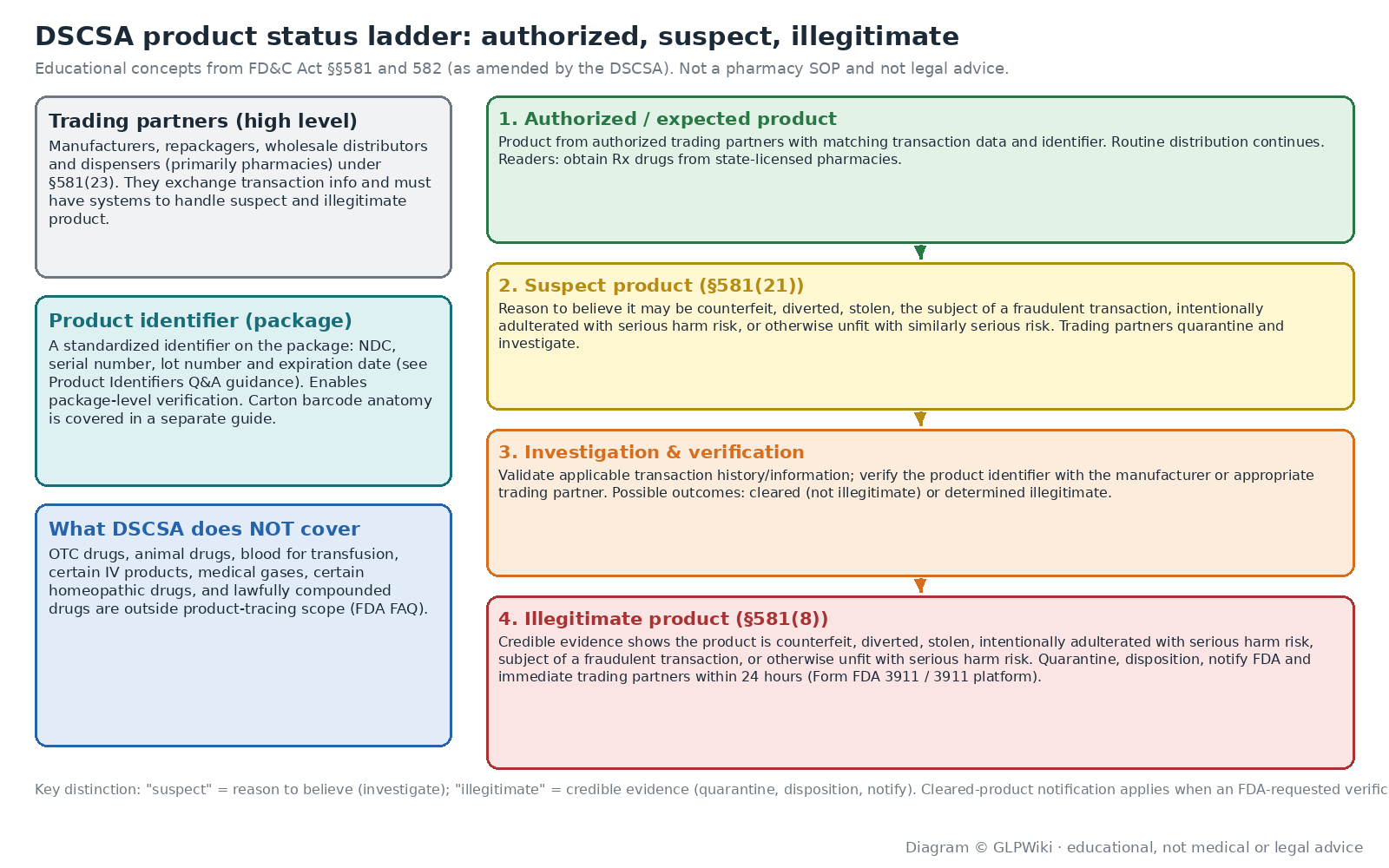
Suspect product (section 581(21))
A suspect product is one for which there is reason to believe that it: (A) is potentially counterfeit, diverted, or stolen; (B) is potentially intentionally adulterated such that the product would result in serious adverse health consequences or death to humans; (C) is potentially the subject of a fraudulent transaction; or (D) appears otherwise unfit for distribution such that the product would result in serious adverse health consequences or death to humans.
The literacy takeaway is the threshold: reason to believe / potentially. That is enough to trigger quarantine and investigation by trading partners. It is not yet a determination that the product is illegitimate.
Illegitimate product (section 581(8))
An illegitimate product is one for which credible evidence shows that the product: (A) is counterfeit, diverted, or stolen; (B) is intentionally adulterated such that the product would result in serious adverse health consequences or death to humans; (C) is the subject of a fraudulent transaction; or (D) appears otherwise unfit for distribution such that the product would be reasonably likely to result in serious adverse health consequences or death to humans.
Here the threshold is credible evidence / is (not merely potentially). That determination starts the 24-hour notification clock and the duty to quarantine and disposition the product so it does not re-enter distribution.
Why the distinction matters for readers
News stories and social posts often collapse "suspect," "counterfeit," "seized," and "recalled" into one word. DSCSA language is more precise. A pharmacy investigating a suspect package is not the same event as FDA announcing that counterfeit units of a named lot were found in the supply chain. When you read an FDA alert, look for whether FDA or the manufacturer is describing confirmed counterfeit product, specific lots or serial ranges, visual differences, and what patients and pharmacies should do next.
How trading-partner verification works at a high level
FDA's Verification Systems guidance describes the systems manufacturers, repackagers, wholesale distributors and dispensers must have for the quarantine and investigation of suspect product and the quarantine and disposition of illegitimate product. It also addresses cleared-product notifications after certain investigations and responding to verification requests, including for saleable returns.
At a conceptual level — not as an SOP — the pattern is:
- Identify: systems and processes to notice when a product may be suspect (mismatched identifier, broken seal, unexpected source, FDA or manufacturer alert, trading-partner notice).
- Quarantine: separate the product from distribution, physically and/or with effective electronic controls, while it is investigated.
- Investigate: coordinate with trading partners; validate applicable transaction history and transaction information; conduct required product-identifier verification.
- Decide: clear the product if it is not illegitimate, or determine it is illegitimate.
- If illegitimate: quarantine, disposition, and notify FDA and appropriate immediate trading partners within 24 hours.
- Manufacturers also notify FDA within 24 hours after determining a product is at high risk of illegitimacy, even before a final illegitimate determination, under the Identification of Suspect Product and Notification guidance.
Notification mechanics (Form FDA 3911)
FDA's Notify FDA of Illegitimate Products page says the preferred submission path is the 3911 platform in CDER NextGen; a completed Form FDA 3911 may also be emailed to drugnotifications@fda.hhs.gov with the subject line "Illegitimate Product Notification Submission." Notifications describe who is notifying, which product is involved, and the circumstances. FDA assigns an incident number used in later correspondence, including requests to terminate a notification after consultation with FDA.
Patients do not file Form FDA 3911. That form is a trading-partner tool. Patient and clinician reporting for adverse events and quality problems still goes through MedWatch; suspected criminal counterfeiting has separate FDA Office of Criminal Investigations and consumer-complaint channels.
Enhanced package-level security (context, not a how-to)
Section 582(g) enhanced drug distribution security requirements push the system toward interoperable, electronic, package-level tracing. FDA has published Enhanced Drug Distribution Security guidance and compliance policies, and has granted time-limited exemptions for some small dispensers while implementation continues. Those details matter for pharmacies and wholesalers. For readers, the literacy point is simpler: the package carries a product identifier so trading partners can verify what they are holding, and public alerts increasingly name package-level cues (lots, serial ranges, label layout differences).
Product identifiers, cartons, and what this guide does not repeat
Under the DSCSA, packages of covered product generally must bear a product identifier: the National Drug Code (NDC), a unique serial number, the lot number and the expiration date. FDA's Product Identifiers Under the DSCSA: Questions and Answers guidance explains how those elements are used for verification. On packaging, that identifier is commonly encoded in a 2D data matrix; a separate linear barcode may still support bedside scanning under 21 CFR 201.25.
GLPWiki's Carton and container label literacy guide already walks through carton versus container, principal display panel rules, lot and expiry conventions, and the difference between the linear NDC barcode and the DSCSA data matrix. This page does not repeat that barcode anatomy. It uses the identifier only as the hook for verification language: when FDA or a manufacturer says "check lot PAR…" or "serial numbers beginning with…," they are pointing at identifier elements that trading partners and, in alert-specific ways, patients are asked to compare.
- For label anatomy and barcode types, see /guides/carton-container-label-literacy.
- For lot-level quality problems framed as recalls or shortages, see /guides/drug-recall-and-shortage-literacy.
- For vial and carton wording on compounded or research-use products, see the peptide vial-label and COA literacy guides — those products are usually outside DSCSA tracing.
How this shows up in GLP-1 counterfeit and fraud alerts
DSCSA verification is the background system. Public FDA Drug Alerts and Statements are how most readers first meet the problem. FDA's Counterfeit Medicine page lists recent consumer-facing counterfeit notices, including repeated updates about counterfeit Ozempic (semaglutide) found in the U.S. drug supply chain.
Counterfeit Ozempic in the legitimate supply chain
FDA's alert page "FDA warns consumers not to use counterfeit Ozempic (semaglutide) found in U.S. drug supply chain" has been updated over time (including December 21, 2023; April 14, 2025; and December 5, 2025 entries on the same page). Across updates, FDA describes seizures of counterfeit units that had entered or been found in the U.S. drug supply chain, sometimes bearing lot numbers that also appear on authentic product, and sometimes distinguishable by label layout details (for example where EXP/LOT text sits relative to the date and lot).
FDA's recurring recommendations in those alerts include: patients should obtain product only with a valid prescription through state-licensed pharmacies; pharmacies should purchase through the manufacturer's authorized distributors; wholesalers, pharmacies and patients should check products against the alert's lot, serial or visual cues; and adverse events should be reported to MedWatch. FDA also notes when seized products are still being tested for composition and safety.
A December 2025 Department of Justice / FDA announcement described federal charges in an alleged transnational counterfeit Ozempic distribution scheme, illustrating that criminal enforcement runs alongside the DSCSA trading-partner system and public alerts.
Unapproved and fraudulent compounded GLP-1 products
FDA's page on concerns with unapproved GLP-1 drugs used for weight loss separately warns about fraudulent compounded semaglutide and tirzepatide marketed with false labeling — including pharmacy names that do not exist or licensed pharmacies that, based on FDA's information, did not compound the products. Because lawfully compounded drugs are generally outside DSCSA product-tracing requirements, these cases are not solved by scanning a DSCSA data matrix on an approved carton. They are a different literacy problem: source legitimacy and compounding oversight, covered in GLPWiki's compounded-versus-FDA-approved and 503A/503B guides.
What "authorized distributor" framing means for readers
When FDA urges pharmacies to buy only through a manufacturer's authorized distributors, it is pointing at the closed distribution idea behind DSCSA: finished prescription drugs are supposed to move among authorized trading partners with tracing data, not through informal gray-market sellers. Patients usually cannot audit a wholesaler's license file. What they can do is obtain medicines through state-licensed pharmacies (FDA's BeSafeRx campaign explains how to check online pharmacies), keep the dispensed carton and lot information, and treat deep-discount social-media sellers as a high-risk channel.
What a reader can check (without becoming a compliance department)
The checklist below is educational. It is not a guarantee of authenticity, not legal advice, and not a substitute for the dispensing pharmacist, the prescribing clinician, or the text of a current FDA alert.
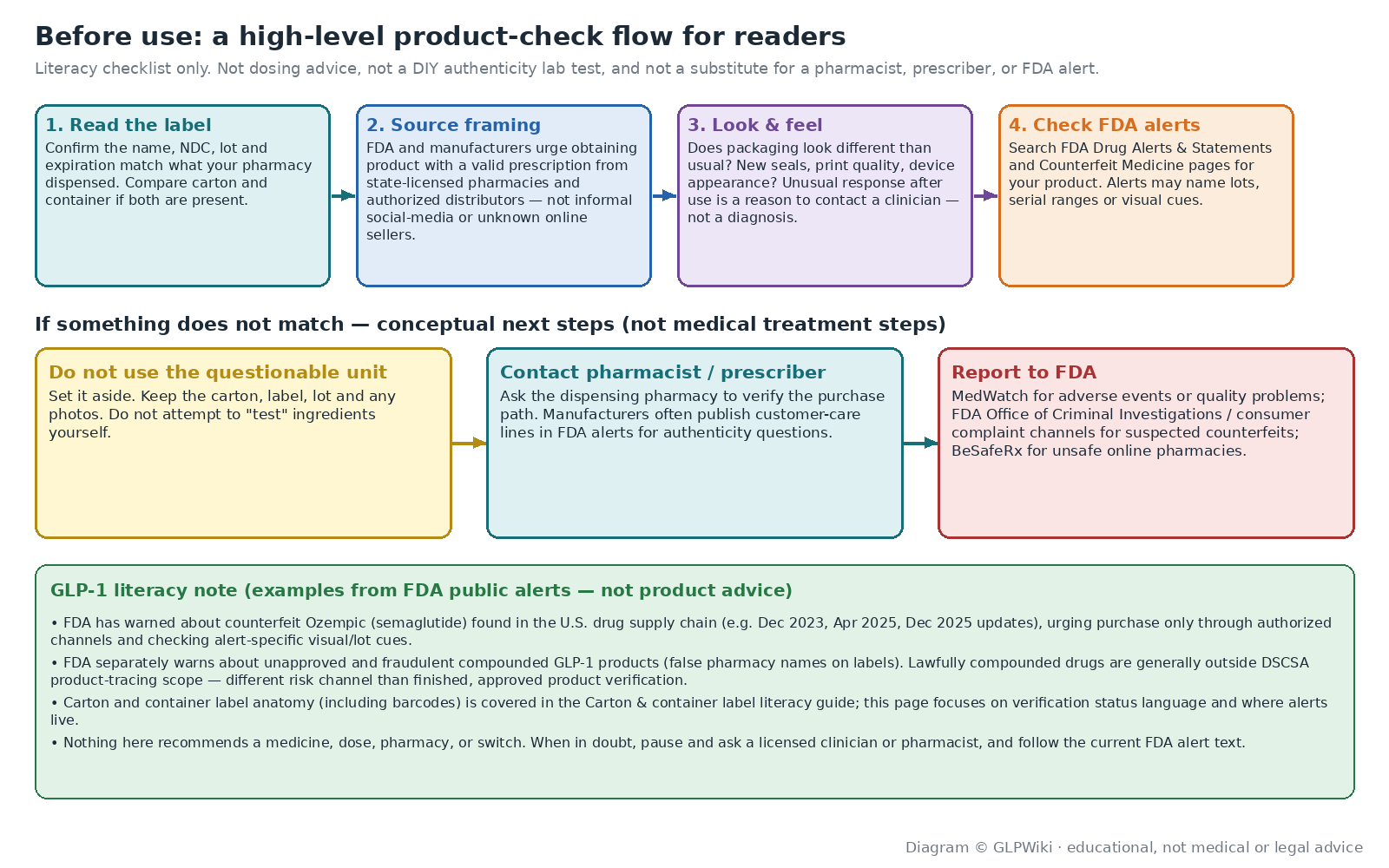
- Match identifiers: confirm the drug name, NDC, lot and expiration on the carton and container match what the pharmacy dispensed and any written pharmacy label.
- Source framing: prefer a valid prescription filled by a state-licensed pharmacy; use BeSafeRx tools before buying from an unfamiliar online pharmacy.
- Look and feel: note damaged seals, unexpected foreign-language-only labeling, missing expiry, or packaging that looks different from prior fills of the same product — then ask the pharmacy before using.
- Alert check: search FDA Drug Alerts and Statements and the Counterfeit Medicine page for your product name; read whether an alert names lots, serial ranges or visual cues.
- If something does not match: do not use the questionable unit; keep the packaging and lot information; contact the dispensing pharmacist and, as appropriate, the prescriber; report adverse events to MedWatch and suspected counterfeits through FDA's consumer complaint / criminal-activity reporting paths described on FDA.gov.
- Do not attempt DIY laboratory "authenticity tests," dosing changes, or product switches based on a blog post or social clip.
Where FDA posts counterfeit alerts and DSCSA materials
- Drug Alerts and Statements (FDA Drugs): consumer and professional alerts, including counterfeit Ozempic updates.
- Counterfeit Medicine page: overview of risks, possible signs, and a list of recent counterfeit reports.
- BeSafeRx: how to buy medicines safely online and locate state-licensed online pharmacies.
- Notify FDA of Illegitimate Products / Form FDA 3911: trading-partner illegitimate-product notifications (not a patient form).
- DSCSA Law and Policies and FDA's Implementation of DSCSA Requirements: indexes of guidances, compliance policies and statutory milestones.
- MedWatch: report serious problems with human medical products; subscribe to safety alerts.
- Office of Criminal Investigations contact / consumer complaint coordinators: paths FDA lists for suspected criminal activity and local complaints.
Scope, disclaimer and review date
This page explains DSCSA product-tracing and verification concepts, suspect versus illegitimate product language, high-level trading-partner duties, how public FDA counterfeit and fraud alerts relate to that system (including GLP-1 examples), and practical literacy checks a reader can make. It does not provide doses, strengths, schedules, injection or device instructions, product or pharmacy recommendations, treatment advice, or legal counsel. Nothing here says to start, stop or switch any medicine. Questions about a specific package, symptom or prescription belong with a licensed pharmacist or clinician. Side effects and quality problems can be reported to FDA MedWatch; suspected criminal counterfeiting should be reported through the channels FDA publishes for that purpose.
Last reviewed: November 5, 2026. FDA pages, guidances and alerts change; check the linked primary sources for the current version.
Frequently asked questions
- Is DSCSA the same thing as a drug recall?
- No. DSCSA is the ongoing tracing and verification framework for most finished human prescription drugs. A recall is a removal or correction of a marketed product that violates the law or presents a risk; FDA and firms publish recall information separately (see our drug-recall-and-shortage literacy guide). Counterfeit seizures and illegitimate-product notifications can overlap with recalls in news coverage, but the legal tools differ.
- What is the difference between a suspect product and an illegitimate product?
- Under FD&C Act section 581, suspect product means there is reason to believe the product may be counterfeit, diverted, stolen, fraudulently transacted, intentionally adulterated with serious harm risk, or otherwise unfit with similarly serious risk. Illegitimate product means credible evidence shows those conditions. Suspect status triggers quarantine and investigation; illegitimate status triggers quarantine, disposition and 24-hour notification to FDA and immediate trading partners.
- Do patients file Form FDA 3911?
- No. Form FDA 3911 (and the 3911 platform in CDER NextGen) is how manufacturers, repackagers, wholesale distributors and dispensers notify FDA of illegitimate product or, for manufacturers, certain high-risk situations. Patients and clinicians use MedWatch for adverse events and quality problems, and FDA's published criminal-activity / consumer-complaint channels for suspected counterfeits.
- Are compounded GLP-1 medicines covered by DSCSA tracing?
- FDA's product-tracing FAQ lists lawfully compounded drugs among the categories that DSCSA product-tracing requirements do not apply to. FDA still warns about fraudulent or unapproved compounded GLP-1 products through separate drug alerts. Those situations are about compounding oversight and labeling fraud, not scanning a DSCSA identifier on an approved finished carton.
- Where does FDA post counterfeit Ozempic alerts?
- On the Drug Alerts and Statements page titled "FDA warns consumers not to use counterfeit Ozempic (semaglutide) found in U.S. drug supply chain," which has been updated over time, and on FDA's Counterfeit Medicine overview page that links recent counterfeit reports. Always read the current alert text for lots, serial cues and recommendations.
- What can I personally check on a carton without special equipment?
- You can compare the drug name, NDC, lot and expiration to the pharmacy label and to any FDA alert that names those elements; look for damaged packaging or unexpected appearance; and confirm you obtained the product through a state-licensed pharmacy. Package-level electronic verification with trading partners is a pharmacy/wholesaler duty under DSCSA — not a consumer self-service portal.
- Does an authorized-distributor recommendation mean my neighborhood pharmacy is "unauthorized"?
- No. FDA's language in counterfeit alerts typically urges pharmacies to purchase from the manufacturer's authorized distributors, and patients to use state-licensed pharmacies with a valid prescription. Neighborhood and chain pharmacies that buy through those authorized channels are the intended path. The contrast is informal or gray-market sellers, not licensed retail pharmacy as a class.
- Is this page legal advice for pharmacies?
- No. It is educational literacy for general readers about public FDA materials and statutory definitions. Pharmacies and other trading partners must follow the FD&C Act, FDA guidances and their own compliance programs. Nothing here is a standard operating procedure or an attorney-client communication.
SOURCES
- 01FDA's Implementation of Drug Supply Chain Security Act (DSCSA) Requirements— FDA
- 02Drug Supply Chain Security Act Law and Policies— FDA
- 03Drug Supply Chain Security Act (DSCSA) hub (Drug Supply Chain Integrity)— FDA
- 04Title II of the Drug Quality and Security Act (DSCSA statutory text on FDA.gov)— FDA
- 0521 U.S.C. 360eee — Definitions (FD&C Act §581)— U.S. Code (Cornell LII)
- 0621 U.S.C. 360eee-1 — Requirements (FD&C Act §582)— U.S. Code (Cornell LII)
- 0721 U.S.C. 360eee-2 — Enhanced drug distribution security (related DSCSA provisions)— U.S. Code (Cornell LII)
- 08Definitions of Suspect Product and Illegitimate Product for Verification Obligations Under the DSCSA (guidance page)— FDA
- 09Definitions of Suspect Product and Illegitimate Product (PDF guidance)— FDA
- 10Verification Systems Under the Drug Supply Chain Security Act for Certain Prescription Drugs— FDA
- 11Drug Supply Chain Security Act Implementation: Identification of Suspect Product and Notification (guidance page)— FDA
- 12Identification of Suspect Product and Notification (PDF guidance)— FDA
- 13Notify FDA of Illegitimate Products— FDA
- 14Drug Supply Chain Security Act Product Tracing Requirements | Frequently Asked Questions— FDA
- 15Product Identifiers Under the Drug Supply Chain Security Act: Questions and Answers— FDA
- 16Enhanced Drug Distribution Security at the Package Level Under the DSCSA— FDA
- 17DSCSA Standards for the Interoperable Exchange of Information for Tracing of Certain Human, Finished, Prescription Drugs— FDA
- 18Exemptions under the Drug Supply Chain Security Act— FDA
- 19The Drug Supply Chain Security Act (DSCSA) Waivers, Exceptions, and Exemptions— FDA
- 20Engage with FDA (DSCSA meetings and webinars)— FDA
- 21Public Health Emergencies and DSCSA Requirements— FDA
- 22FDA warns consumers not to use counterfeit Ozempic (semaglutide) found in U.S. drug supply chain— FDA
- 23FDA's Concerns with Unapproved GLP-1 Drugs Used for Weight Loss— FDA
- 24Drug Alerts and Statements— FDA
- 25Counterfeit Medicine— FDA
- 26BeSafeRx: Your Source for Online Pharmacy Information— FDA
- 27How to Buy Medicines Safely From an Online Pharmacy— FDA
- 28MedWatch: The FDA Safety Information and Adverse Event Reporting Program— FDA
- 29Reporting Serious Problems to FDA (MedWatch)— FDA
- 30Consumer Complaint Coordinators— FDA
- 31Contact OCI (Office of Criminal Investigations)— FDA
- 32FDA Investigation Leads to Charges Against Two Indian Nationals Involved in Transnational Counterfeit Drug Distribution Scheme— FDA
- 3321 CFR 201.25 — Bar code label requirements— eCFR
- 3421 CFR 211.192 — Production record review (investigation of discrepancies)— eCFR
EDUCATIONAL REFERENCE ONLY · Not medical advice. Nothing here diagnoses, treats, cures or prevents any disease, and nothing here is a dosing recommendation. Consult a licensed clinician before any treatment decision.