Purple Book and biosimilar GLP-1 literacy: how biologics differ from Orange Book generics

FDA keeps two public "books" for approved medicines. The Orange Book lists drugs and their therapeutic-equivalence evaluations; the Purple Book lists licensed biologics and whether a follow-on product is biosimilar or interchangeable. This guide explains how those books differ for GLP-1-class products, why peptide GLP-1s usually sit in the Orange Book while dulaglutide-class Fc-fusion products are biologics in the Purple Book, what a 351(k) biosimilar pathway is versus an ANDA generic, and how interchangeable designation literacy works. It deep-links the Day 55 Orange Book guide and stays educational: no doses, no product picks, and no medical or legal advice.
UPDATED 07 NOV 2026 · 15 MIN READ
KEY TAKEAWAYS
- The Orange Book covers drugs approved under FD&C Act section 505 (NDAs and ANDAs) and publishes therapeutic equivalence (TE) codes. The Purple Book covers biological products licensed under PHS Act section 351 and publishes biosimilarity or interchangeability status — not TE codes.
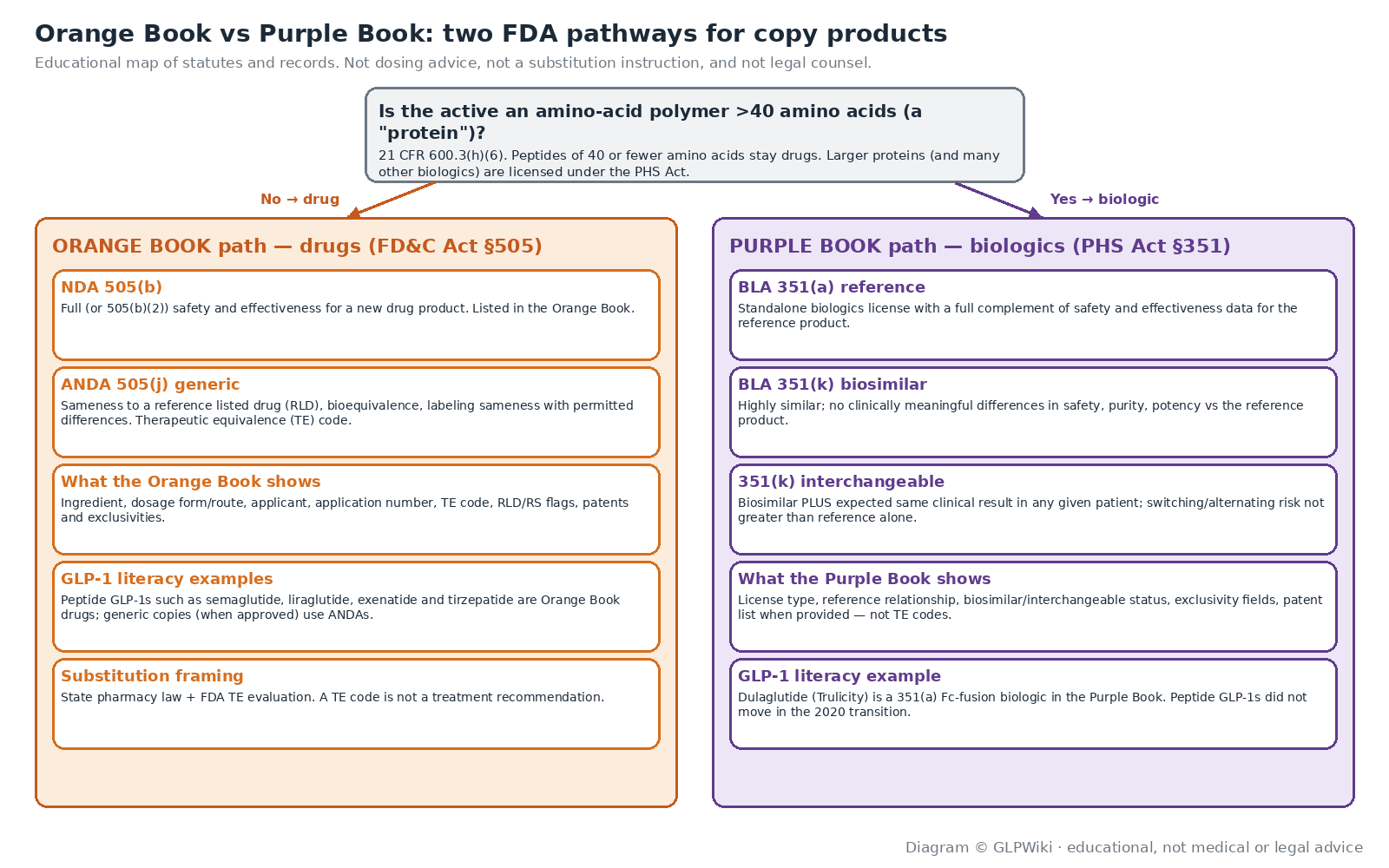
- Under 21 CFR 600.3(h)(6), an amino-acid polymer greater than 40 amino acids is a protein for biological-product classification. Peptide GLP-1s at or under that line (for example semaglutide, liraglutide, exenatide, tirzepatide) are regulated as drugs and listed in the Orange Book; dulaglutide, an Fc-fusion protein, is a 351(a) biologic listed in the Purple Book.
- A generic drug is approved through an ANDA under section 505(j) by showing sameness and bioequivalence to a reference listed drug. A biosimilar is licensed through a 351(k) BLA by showing it is highly similar to a reference biologic with no clinically meaningful differences in safety, purity, and potency.
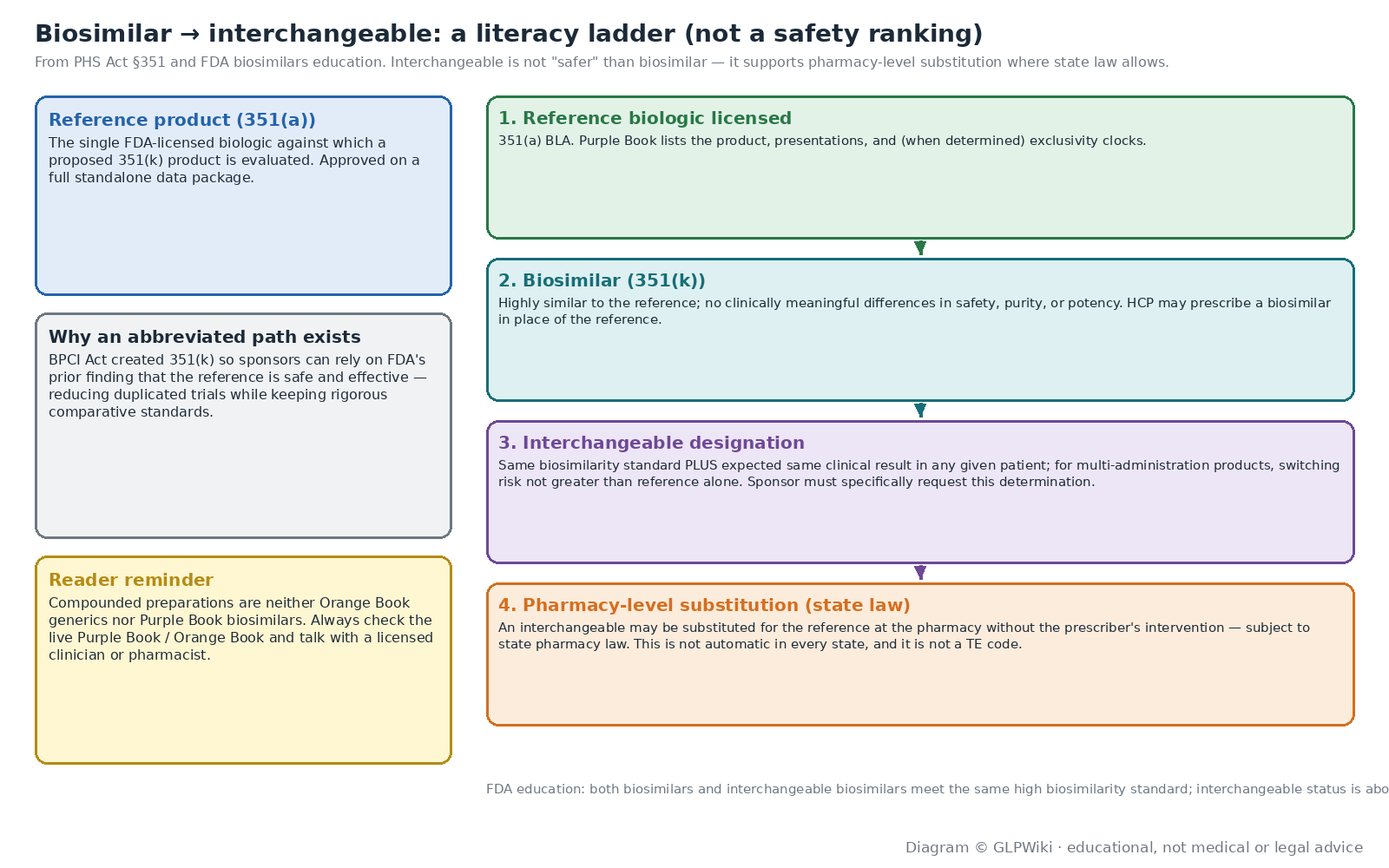
- An interchangeable biosimilar meets the biosimilarity standard plus additional statutory criteria (expected same clinical result in any given patient, and switching/alternating risk not greater than using the reference alone). A sponsor must specifically request interchangeability; not every biosimilar has that designation.
- FDA education emphasizes that interchangeable status supports pharmacy-level substitution where state law allows — it is not a claim that an interchangeable product is safer or more effective than a non-interchangeable biosimilar.
- Reference product exclusivity under section 351(k)(7) generally blocks 351(k) submission for 4 years and approval for 12 years after the reference product's first licensure. Those clocks are waiting periods, not approvals, and orphan or other exclusivities can also matter.
- As of a November 7, 2026 check of the Purple Book Product Details page for Trulicity (dulaglutide, BLA 125469), listed presentations were Lilly 351(a) products; the page did not show licensed 351(k) biosimilar or interchangeable rows under that core name. Always re-check the live Purple Book.
- Compounded preparations are neither Orange Book generics nor Purple Book biosimilars. This page does not recommend products, doses, switches, or pharmacy practices; follow licensed clinicians and the current FDA records.
Two FDA books, two statutes
When people talk about a "generic" of a brand-name medicine, they are usually thinking about the Orange Book world: small-molecule and peptide drugs approved under section 505 of the Federal Food, Drug, and Cosmetic Act (FD&C Act), with abbreviated new drug applications (ANDAs) under section 505(j). Biological products live under a different statute. They are licensed under section 351 of the Public Health Service Act (PHS Act), and FDA's public record for them is the Purple Book — formally the database of licensed biological products with reference-product exclusivity and biosimilarity or interchangeability evaluations.
FDA's Purple Book About page describes what the database holds: the date a biological product was licensed under section 351(a) or 351(k); whether a 351(k) product has been determined biosimilar to or interchangeable with a reference biological product; exclusivity expiration dates when FDA has determined eligibility; and, for certain products, patent information required by the Biological Product Patent Transparency provisions. The older separate CDER and CBER lists were replaced by the searchable online database released in February 2020.
GLPWiki's Generic GLP-1 Orange Book literacy guide (Day 55) already walks through ANDAs, TE codes, patents, and why compounded copies are not generics. This page is the Purple Book sibling: same literacy posture, different statute, different record, and a different meaning of "copy."
What each book is for
- Orange Book: Approved Drug Products with Therapeutic Equivalence Evaluations — NDAs and ANDAs; RLD/RS flags; TE codes; patents and exclusivities for drug products.
- Purple Book: licensed biologics (CDER and CBER), including 351(a) reference products and 351(k) biosimilar or interchangeable products; biosimilarity/interchangeability status; reference-product and first-interchangeable exclusivity fields; patent lists when provided.
- Neither book is a shopping list, a dosing table, or a state-law substitution manual. Both are FDA records that help readers understand what FDA has already decided.
Why some GLP-1 products are Orange Book drugs and others are Purple Book biologics
Classification is not a branding choice. FDA's regulation defines a "protein" as any alpha amino acid polymer with a specific, defined sequence that is greater than 40 amino acids in size (21 CFR 600.3(h)(6)). FDA's Q&A guidance on the BPCI Act transition explains that polymers of 40 or fewer amino acids are peptides, are not biological products on that basis, and continue to be regulated as drugs under the FD&C Act.
That line splits the GLP-1 field. Peptide backbone products at or under 40 amino acids — including widely discussed GLP-1 receptor agonists such as semaglutide, liraglutide, exenatide and tirzepatide — are NDAs listed in the Orange Book, so follow-on copies (when they exist) are ANDA generics. Dulaglutide is a GLP-1 analog covalently linked to an antibody Fc fragment; it is far larger than 40 amino acids and is licensed as a biologic. The Purple Book Product Details page for Trulicity lists proper name dulaglutide, BLA 125469, applicant Eli Lilly and Company, and original approval date September 18, 2014, with license type 351(a).
The 2020 "deemed to be a license" transition
The Biologics Price Competition and Innovation Act of 2009 (BPCI Act) required that, on March 23, 2020, approved NDAs for biological products be deemed to be biologics licenses. Insulins and several other protein products moved from the Orange Book into the Purple Book and became eligible for the 351(k) biosimilar pathway. FDA's transition Q&A guidance states that the Purple Book does not carry over Orange Book therapeutic-equivalence evaluations; instead it identifies whether a 351(k) product is biosimilar to or interchangeable with a reference product. Peptide GLP-1 drugs at or under the 40-amino-acid line did not become biologics under that transition.
What "copy" means in each world
In the Orange Book world, an ANDA generic must match its reference listed drug in active ingredient, dosage form, route, strength and labeled conditions of use (with permitted differences), and must show bioequivalence. In the Purple Book world, a biosimilar is not required to be identical; FDA and statute use "highly similar" with no clinically meaningful differences, because biologics made from living systems normally show minor batch-to-batch variation even for the same product. That is why FDA patient materials stress that biosimilars are not generics, even though both pathways are abbreviated and both can expand treatment options.
How to read a Purple Book entry (literacy, not a how-to for sponsors)
Purple Book Simple Search is designed around a product's proprietary (brand) name or nonproprietary (proper) name. Choosing a product opens results for biological products that share a core name — reference, related, biosimilar and interchangeable products in that family. FDA's user guide notes that matching product-card colors indicate biosimilar or interchangeable relationships to a reference product with the same color, and that Advanced Search exposes the fuller table of fields with download options.
- License type: 351(a) for the standalone reference (or other 351(a) products); 351(k) Biosimilar or 351(k) Interchangeable for abbreviated pathway products.
- Reference relationship: which 351(a) product a 351(k) application was evaluated against.
- Exclusivity fields: reference-product exclusivity expiration and first-interchangeable exclusivity expiration when FDA has made those determinations.
- Patent list provided: for certain products, a link to patent information the reference-product sponsor provided to FDA.
- Product label link: path to labeling (for example Drugs@FDA for many CDER products).
- Marketing status cues such as Rx or discontinued presentations — always confirm against the live record.
What you will not find
You will not find Orange Book-style TE codes (AP, AB, and so on) in the Purple Book. FDA's deemed-to-be-a-license Q&A states that TE evaluations from the Orange Book are not reflected there. Interchangeability is a different legal determination under section 351(k)(4), aimed at pharmacy-level substitution mechanics under state law — not a letter code that means "therapeutically equivalent" in the Orange Book sense.
351(k) biosimilar pathway literacy
The BPCI Act created an abbreviated licensure pathway for biological products shown to be biosimilar to, or interchangeable with, an FDA-licensed reference product. Under section 351(i)(4), the reference product is the single biological product licensed under section 351(a) against which a proposed 351(k) product is evaluated. Under section 351(i)(2), biosimilarity means the product is highly similar to the reference product notwithstanding minor differences in clinically inactive components, and there are no clinically meaningful differences between the products in terms of safety, purity and potency.
FDA's Review and Approval page explains that the goal of a biosimilar development program is to demonstrate biosimilarity to the reference product — not to independently re-prove the reference product's safety and effectiveness from scratch. Comparative analytical studies are foundational; animal studies and clinical pharmacology / immunogenicity / other clinical studies may be included unless FDA determines an element is unnecessary. FDA may approve a biosimilar for an indication approved for the reference product without a direct clinical study in every indication when the scientific justification is adequate.
Reference product exclusivity clocks
Section 351(k)(7) provides periods of reference product exclusivity beginning on the date the reference product is first licensed under section 351(a). If eligible, a 351(k) application generally may not be submitted until 4 years after first licensure, and approval of a 351(k) application generally may not be made effective until 12 years after first licensure. FDA's Purple Book background page notes that the published reference-product exclusivity expiration date reflects that 12-year date plus any applicable pediatric exclusivity, and that orphan exclusivity for particular indications can separately affect what may be licensed. A calendar reaching those dates is not the same thing as an approved biosimilar appearing in the Purple Book.
GLP-1 biologic example: dulaglutide
Trulicity (dulaglutide) is the clear GLP-1-class example of a Purple Book biologic rather than an Orange Book peptide drug. On a November 7, 2026 check of the Purple Book Product Details page for BLA 125469, the listed presentations were Eli Lilly 351(a) Trulicity rows (some marketed as Rx, some discontinued presentations). The page's glossary legends include 351(k) Biosimilar and 351(k) Interchangeable, but the product rows under that core name were 351(a). Literacy takeaway: do not assume a biosimilar exists because the reference product is older than 12 years — verify the live Purple Book before speaking as if a 351(k) product were licensed.
Interchangeable designation: a ladder, not a safety ranking
Under section 351(k)(4), an interchangeable biological product is biosimilar to the reference product and can be expected to produce the same clinical result as the reference product in any given patient. For a product administered more than once to an individual, the applicant must also show that the risk in terms of safety or diminished efficacy of alternating or switching between the product and the reference product is not greater than the risk of using the reference product without such alternation or switch.
FDA's Interchangeable Biological Products info sheet and "9 Things to Know" consumer/professional education repeat several points that media headlines often flatten. First, not all biosimilars are interchangeable; the manufacturer must specifically seek that determination. Second, health care professionals can prescribe both biosimilars and interchangeable biosimilars in place of the reference product — interchangeable status is not a higher safety tier. Third, pharmacy-level substitution of an interchangeable product for the reference product without the prescriber's intervention depends on state pharmacy law.
How this differs from Orange Book TE codes
Orange Book TE codes grew out of state generic-substitution frameworks for drug products. Purple Book interchangeability is a separate statutory designation for biologics. Collapsing both into the everyday word "generic" causes avoidable confusion: a peptide GLP-1 ANDA generic (when one exists) is not the same regulatory object as a 351(k) biosimilar to a biologic GLP-1, and an interchangeable biosimilar is not "the TE code for biologics."
Insulin as a worked non-GLP-1 example
FDA patient materials often use insulin to explain the 2020 transition: insulin products that meet the biologic criteria are now regulated as biologics, which allows biosimilar and interchangeable biosimilar insulin options under the Purple Book pathway. That example is useful literacy even though insulin is not a GLP-1: it shows how the same person can meet a familiar medicine in the Orange Book era and later need Purple Book vocabulary after the transition — while peptide GLP-1s stayed on the drug side of the line.
What a reader can check
The checklist below is educational record-reading. It is not authenticity testing, not legal advice for pharmacies, and not a recommendation to start, stop or switch any medicine.
- Identify the statute/book: is the product discussed as an NDA/ANDA Orange Book drug or a BLA Purple Book biologic?
- For peptide GLP-1 drugs, use the Orange Book / Drugs@FDA path and the Day 55 guide for TE codes, RLD flags and ANDA status.
- For biologic GLP-1-class products such as dulaglutide, open Purple Book Simple Search by brand or proper name and read license type (351(a) vs 351(k)).
- If a 351(k) product appears, note whether FDA lists it as biosimilar or interchangeable to which reference product.
- Do not equate marketing language ("generic Dulaglutide," "same as Trulicity," "biosimilar semaglutide") with an FDA listing — check the live book.
- Remember compounded preparations have no Orange Book TE code and no Purple Book biosimilarity listing; see the compounded-versus-FDA-approved GLP-1 guide.
- Questions about a specific prescription belong with the prescribing clinician and dispensing pharmacist.
Where FDA posts Purple Book and biosimilars materials
- Purple Book Search (purplebooksearch.fda.gov): About, FAQs, User Guide, Simple/Advanced Search, patent list and data download.
- Background Information: List of Licensed Biological Products… (Purple Book) on FDA.gov — definitions of reference, biosimilar, interchangeable, and exclusivity clocks.
- Biosimilars hub pages: Review and Approval; Biosimilars Basics for Patients; Overview for Health Care Professionals; Biosimilar Product Information; 9 Things to Know About Biosimilars and Interchangeable Biosimilars.
- Info sheets: Biosimilars Info Sheet Level 1 (foundational concepts); Interchangeable Biological Products; Biosimilars: What Patients Need to Know.
- Industry guidances index and the deemed-to-be-a-license Q&A guidance (March 2020) for the Orange Book → Purple Book transition.
- Orange Book hub and Generic Drug Facts for the drug-side companion vocabulary (deep-link Day 55).
Scope, disclaimer and review date
This page explains how FDA's Purple Book differs from the Orange Book for biologic versus drug GLP-1-class products, how the 351(k) biosimilar and interchangeable pathways differ from ANDA generics, how to read Purple Book status fields at a literacy level, and why many peptide GLP-1s remain Orange Book drugs while dulaglutide-class products are biologics. It does not provide doses, strengths, schedules, injection or device instructions, product or pharmacy recommendations, treatment advice, switching instructions, or legal counsel. Nothing here says to start, stop or switch any medicine. Case-specific questions belong with licensed clinicians and pharmacists; FDA records change, so check the linked primary sources for the current version.
Last reviewed: November 7, 2026.
Frequently asked questions
- Is a biosimilar the same thing as a generic?
- No. Generics are approved through ANDAs under FD&C Act section 505(j) for drug products and are listed in the Orange Book with therapeutic-equivalence evaluations. Biosimilars are licensed through section 351(k) of the PHS Act for biological products and are listed in the Purple Book with biosimilarity (and sometimes interchangeability) determinations. FDA patient materials explicitly contrast the two abbreviated pathways.
- Why is dulaglutide in the Purple Book while semaglutide is in the Orange Book?
- FDA classifies an amino-acid polymer greater than 40 amino acids as a protein (21 CFR 600.3(h)(6)). Dulaglutide is an Fc-fusion biologic licensed under section 351(a). Semaglutide and several other GLP-1 receptor agonists are peptides at or under that line and remain drugs under the FD&C Act, so they appear in the Orange Book rather than the Purple Book.
- What does "interchangeable" mean for a biosimilar?
- An interchangeable biosimilar has been shown to be biosimilar and to meet additional statutory criteria so that it can be expected to produce the same clinical result in any given patient; for products given more than once, switching or alternating must not increase safety or diminished-efficacy risk versus using the reference alone. Depending on state pharmacy law, an interchangeable product may be substituted at the pharmacy without the prescriber's intervention. FDA stresses this is not a higher safety tier than other biosimilars.
- Can my clinician prescribe a biosimilar that is not interchangeable?
- Yes. FDA education states that health care professionals can prescribe both biosimilars and interchangeable biosimilars in place of the reference product. Interchangeable designation mainly affects pharmacy-level substitution mechanics under state law, not whether a biosimilar may be prescribed by name.
- Do Purple Book entries use TE codes like AP or AB?
- No. Therapeutic equivalence codes are an Orange Book concept. The Purple Book identifies biosimilarity or interchangeability status for 351(k) products instead. FDA's deemed-to-be-a-license Q&A states that Orange Book TE evaluations are not carried into the Purple Book.
- If a biologic's 12-year exclusivity date has passed, does a biosimilar automatically exist?
- No. Section 351(k)(7) waiting periods affect when a 351(k) application may be submitted or made effective; they are not themselves an approval. A licensed biosimilar or interchangeable product appears in the Purple Book only after FDA licenses it. Always check the live Purple Book for the reference product's core name.
- Are compounded GLP-1 preparations biosimilars?
- No. Compounded preparations are not FDA-approved generics and are not FDA-licensed biosimilars. They have no Orange Book TE code and no Purple Book biosimilarity or interchangeability listing. See GLPWiki's compounded-versus-FDA-approved GLP-1 guide for that literacy topic.
- Is this page telling me to switch to a biosimilar?
- No. It is educational literacy about FDA records and statutory pathways. Treatment choices — including any switch between a reference biologic and a biosimilar — belong with a licensed clinician and pharmacist, informed by the product labeling and the patient's clinical context.
SOURCES
- 01Purple Book Search — About— FDA
- 02Purple Book Search — FAQs— FDA
- 03Purple Book Search — User Guide— FDA
- 04Purple Book Search — Home / Simple Search— FDA
- 05Background Information: List of Licensed Biological Products with Reference Product Exclusivity and Biosimilarity or Interchangeability Evaluations (Purple Book)— FDA
- 06Purple Book: Lists of Licensed Biological Products… (BLA section landing)— FDA
- 07Biosimilars (Therapeutic Biologics Applications)— FDA
- 08Biosimilar Product Information— FDA
- 09Review and Approval (Biosimilars)— FDA
- 10Biosimilars Basics for Patients— FDA
- 11Overview for Health Care Professionals (Biosimilars)— FDA
- 129 Things to Know About Biosimilars and Interchangeable Biosimilars— FDA
- 13Biosimilar and Interchangeable Biologics: More Treatment Choices (Consumer Update)— FDA
- 14Biosimilars Info Sheet Level 1: Foundational Concepts (PDF)— FDA
- 15Interchangeable Biological Products (PDF info sheet)— FDA
- 16Biosimilars: What Patients Need to Know (PDF)— FDA
- 17Biosimilar and Interchangeable Biological Products: From Basics to Bedside (overview slides PDF)— FDA
- 18Industry Information and Guidance (Biosimilars)— FDA
- 19Considerations in Demonstrating Interchangeability With a Reference Product (guidance page)— FDA
- 20Scientific Considerations in Demonstrating Biosimilarity to a Reference Product (PDF guidance)— FDA
- 21The "Deemed To Be a License" Provision of the BPCI Act: Questions and Answers (PDF guidance)— FDA
- 22Deemed to be a License Provision of the BPCI Act (FDA hub)— FDA
- 23Definition of the Term "Biological Product" Containing a Protein (PDF final rule preamble / related)— FDA
- 24Patient Materials (Biosimilars)— FDA
- 25Curriculum Materials for Health Care Degree Programs | Biosimilars— FDA
- 26Approved Drug Products with Therapeutic Equivalence Evaluations (Orange Book)— FDA
- 27Orange Book Search (FDA)— FDA
- 28Generic Drug Facts— FDA
- 2942 U.S.C. 262 — Regulation of biological products (PHS Act §351)— U.S. Code (Cornell LII)
- 3021 U.S.C. 355 — New drugs (FD&C Act §505)— U.S. Code (Cornell LII)
- 3121 CFR 600.3 — Definitions (biological products; protein)— eCFR
- 3221 CFR 314.3 — Definitions (ANDA / RLD / therapeutic equivalents)— eCFR
- 33Purple Book Product Details: Trulicity (dulaglutide, BLA 125469)— FDA
- 34Biosimilars Info Sheet Level 2 (PDF)— FDA
EDUCATIONAL REFERENCE ONLY · Not medical advice. Nothing here diagnoses, treats, cures or prevents any disease, and nothing here is a dosing recommendation. Consult a licensed clinician before any treatment decision.