Generic GLP-1 literacy: the Orange Book, TE codes, patents and why compounded copies are not generics

Generic liraglutide and exenatide are now FDA-approved, and online sellers use the word "generic" for many things that are not. This guide explains what an FDA generic legally is, why most GLP-1 medicines are regulated as drugs (Orange Book) while dulaglutide is a biologic (Purple Book), how to read an Orange Book entry and its therapeutic equivalence code, which GLP-1 generics FDA has approved so far, what FDA's July 2026 draft guidances ask of generic peptide makers, how patents and exclusivities shape timing, and why a compounded preparation is not a generic. It is about reading regulatory records. It gives no doses or treatment advice and is not medical advice.
UPDATED 03 NOV 2026 · 17 MIN READ
KEY TAKEAWAYS
- An FDA generic is approved through an abbreviated new drug application (ANDA) under section 505(j) of the FD&C Act. It must match its reference listed drug in active ingredient, dosage form, route, strength and conditions of use, show bioequivalence, and carry the same labeling apart from permitted differences.
- Whether a GLP-1 medicine is a drug or a biologic depends on size. FDA treats an amino-acid polymer of more than 40 amino acids as a protein (21 CFR 600.3(h)(6)). Semaglutide, liraglutide, exenatide and tirzepatide are peptides regulated as drugs and listed in the Orange Book; dulaglutide, an Fc-fusion protein, is a licensed biologic listed in the Purple Book.
- The Orange Book's therapeutic equivalence (TE) code is the key field. An A code means FDA considers a product therapeutically equivalent; AP covers injectable aqueous solutions. Generic liraglutide is coded AP1 when matched to Victoza and AP2 when matched to Saxenda, because the two brands share one heading.
- The GLP-1 generic era began in 2024: an authorized generic of Victoza launched in June, FDA approved the first ANDA generic in the class (exenatide, referencing Byetta) on November 19, and the first generic referencing Victoza on December 23. The first generic referencing Saxenda followed on August 27, 2025.
- In the October 2026 Orange Book data files, liraglutide had 11 ANDA listings from multiple applicants, while no ANDA was listed for semaglutide or tirzepatide.
- On July 28, 2026 FDA withdrew its 2021 synthetic peptide ANDA guidance and published 17 revised draft product-specific guidances, including semaglutide and tirzepatide, covering recombinant, synthetic or semi-synthetic sources, impurity thresholds, innate immune testing, higher order structure, biological activity and the pen's user interface.
- Listed patents and exclusivities are not launch dates. A generic applicant can challenge patents with a Paragraph IV certification; FDA's list shows such ANDAs submitted for semaglutide from December 6, 2021 and for tirzepatide from May 13, 2026, the first day allowed under the new chemical entity rules.
- Compounded GLP-1 preparations are not generics. FDA says they are not FDA-approved and are not reviewed for safety, effectiveness or quality; they have no reference listed drug, no TE code and no Orange Book entry.
What "generic" means in FDA law
FDA's Generic Drug Facts page describes a generic drug as a medication created to be the same as an already marketed brand-name drug in dosage form, safety, strength, route of administration, quality, performance characteristics and intended use. The legal route is the abbreviated new drug application (ANDA) under section 505(j) of the Federal Food, Drug, and Cosmetic Act (21 U.S.C. 355(j)), created by the Drug Price Competition and Patent Term Restoration Act of 1984, usually called Hatch-Waxman.
"Abbreviated" means the applicant does not repeat the brand's clinical trials. It relies on FDA's earlier finding that the brand, called the reference listed drug (RLD), is safe and effective, and instead shows sameness and bioequivalence. 21 CFR 314.3 defines the RLD as "the listed drug identified by FDA as the drug product upon which an applicant relies in seeking approval of its ANDA."
Labeling follows the brand. Under 21 CFR 314.94(a)(8), an ANDA must include the RLD's current labeling, including any Medication Guide, and a statement that the proposed labeling is the same "except for differences annotated and explained," such as a different manufacturer name or a carved-out use that is still under patent or exclusivity.
Words you will see
- Reference listed drug (RLD): the approved product a generic relies on. Flagged "RLD: Yes" in the Orange Book.
- Reference standard (RS): the product FDA selects for bioequivalence testing. Usually the same as the RLD.
- Pharmaceutical equivalents: same active ingredient (same salt or ester), same dosage form and route, identical amount, meeting the same compendial or other standards (21 CFR 314.3).
- Therapeutic equivalents: pharmaceutical equivalents for which bioequivalence has been demonstrated and that "can be expected to have the same clinical effect and safety profile" under the labeled conditions (21 CFR 314.3).
- Authorized generic: the brand's own approved product sold without the brand name, under the brand's application. The Orange Book preface treats it as therapeutically equivalent to the brand.
- 505(b)(2) application: an NDA that relies partly on data the applicant does not own. It is not a generic and generally has no TE code unless it is also a pharmaceutical equivalent.
Drug or biologic? The 40-amino-acid line
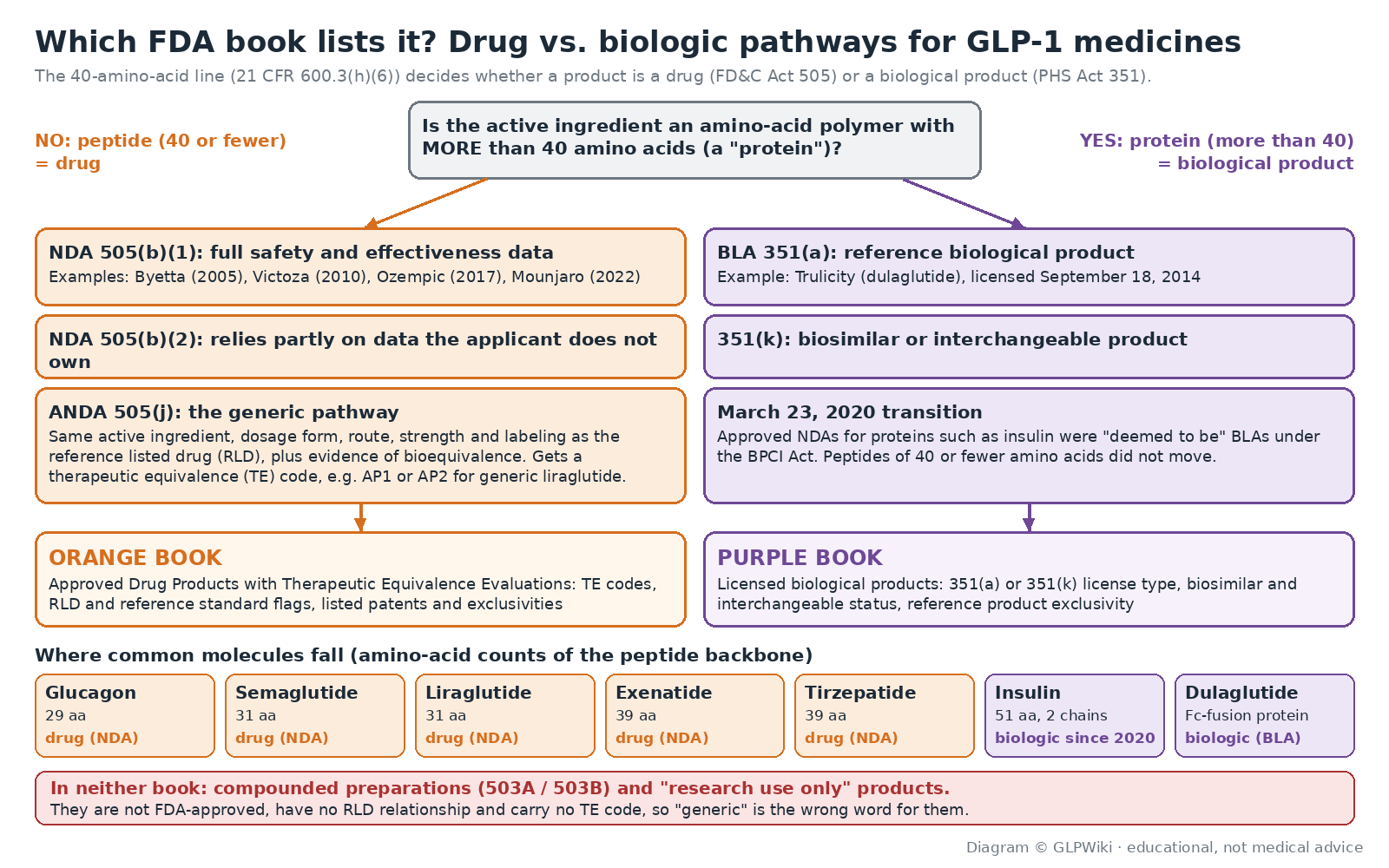
Two laws and two books govern copies of approved medicines. Drugs approved under section 505 of the FD&C Act are listed in the Orange Book, and their copies are generics approved by ANDA. Biological products licensed under section 351 of the Public Health Service Act (42 U.S.C. 262) are listed in the Purple Book, and their copies are biosimilar or interchangeable products licensed under 351(k).
Peptides sit right at the boundary. FDA's regulation defines a "protein" as "any alpha amino acid polymer with a specific, defined sequence that is greater than 40 amino acids in size" (21 CFR 600.3(h)(6)). FDA's Q&A guidance on the transition states that a polymer of 40 or fewer amino acids is a "peptide," is not a biological product on that basis, and "will continue to be regulated as a drug under the FD&C Act."
That is why the GLP-1 field is split. The peptide backbones of glucagon (29 amino acids), semaglutide and liraglutide (31 each), and exenatide and tirzepatide (39 each) fall under the line, so these products are NDAs in the Orange Book and generic copies go through ANDAs. Dulaglutide (Trulicity) is a GLP-1 analog fused to an antibody Fc fragment, far larger than 40 amino acids; its Purple Book record lists it as a 351(a) biologic (BLA 125469) first approved September 18, 2014.
The 2020 transition, and what did not move
The Biologics Price Competition and Innovation Act of 2009 required that, on March 23, 2020, approved NDAs for biological products be "deemed to be" biologics licenses. FDA's page on the provision explains that Congress later removed the exception for chemically synthesized polypeptides from the definition of protein, but that this change "does not affect 'peptides' (i.e., polymers composed of 40 or fewer amino acids)." Insulins, somatropin and several fertility hormones moved to the Purple Book; GLP-1 peptides stayed in the Orange Book.
For dulaglutide the copy pathway is therefore 351(k), not an ANDA. Under 42 U.S.C. 262(k)(7), a 351(k) application cannot be approved until 12 years after the reference product's first licensure. That clock is a waiting period, not an approval: when we checked on November 3, 2026, the Trulicity Purple Book record listed only Lilly's 351(a) presentations.
How to read an Orange Book entry
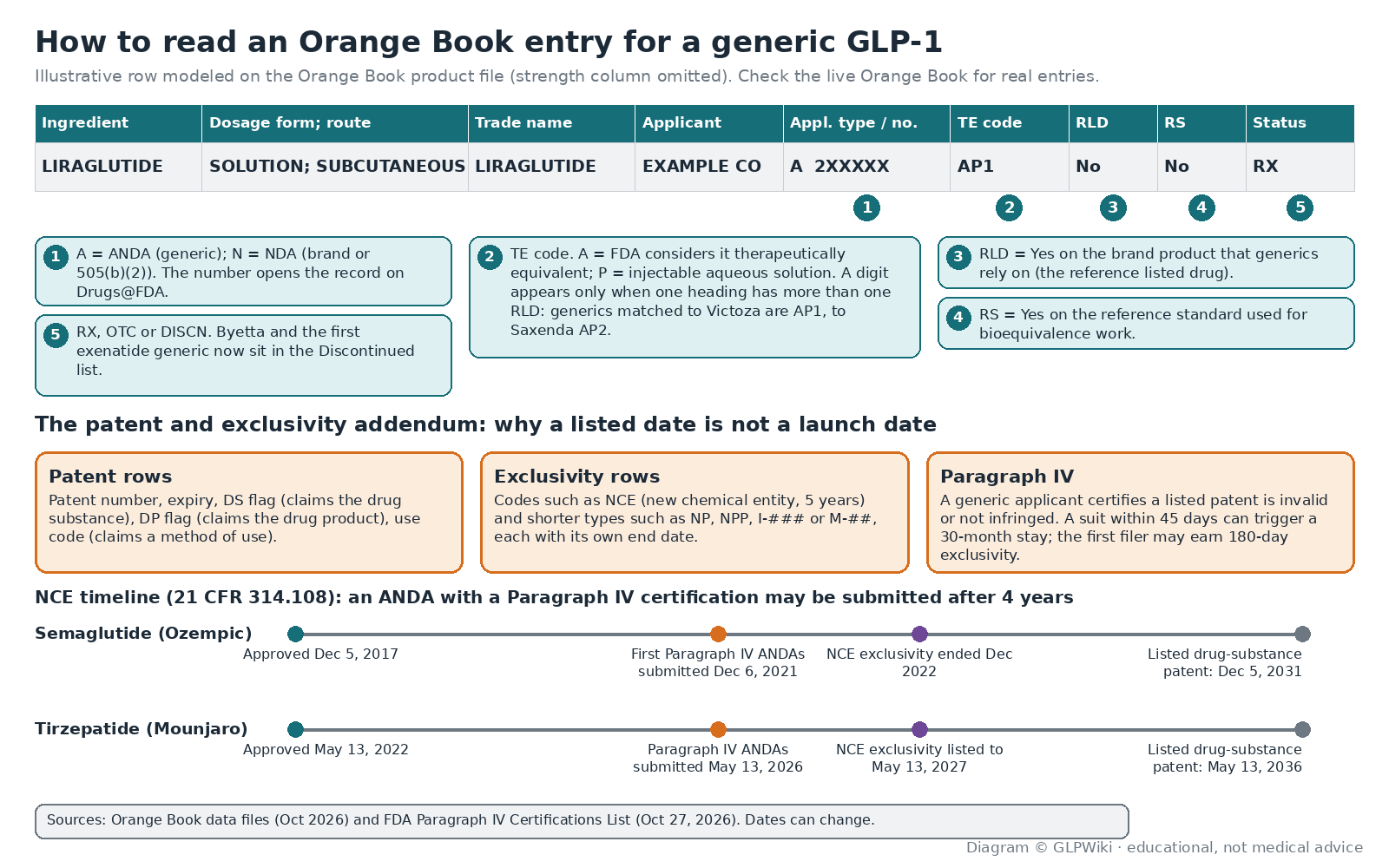
The Orange Book's formal title is Approved Drug Products with Therapeutic Equivalence Evaluations. FDA publishes it as a searchable website and as monthly data files. Each row is one approved product: ingredient, dosage form and route, trade name, applicant, strength, application type and number (N for NDA, A for ANDA), TE code, RLD and RS flags, approval date and marketing status (RX, OTC or DISCN for discontinued).
The TE code is the field most readers need. The preface explains that the first letter A marks products FDA considers therapeutically equivalent to other pharmaceutically equivalent products, while B marks products FDA "at this time, considers not to be therapeutically equivalent." The second letter tells you the dosage-form policy: AP is used for "injectable aqueous solutions." A digit is added only "when more than one RLD of the same strength has been designated under the same heading," and a generic receives the three-character code of the RLD it was compared against.
Why the liraglutide codes have digits
Victoza (diabetes) and Saxenda (chronic weight management) contain the same active ingredient in the same dosage form, route and listed strength, so they fall under one Orange Book heading even though their labeled uses differ. FDA gives Victoza AP1 and Saxenda AP2. In the October 2026 data files, eight liraglutide ANDAs carried AP1 and three carried AP2, which tells a reader which brand each generic was compared against and therefore which brand's labeling it follows.
What a TE code is, and is not
The preface explains that the Orange Book began because virtually every state has laws encouraging substitution of drug products, and states asked FDA for a common list. Whether a pharmacist may or must substitute is decided by state pharmacy law, not by the Orange Book. FDA also notes that TE evaluations "are not official FDA actions affecting the legal status of products," and that injectables rated equivalent can still differ, for example in preservatives. A code describes FDA's equivalence evaluation; it is not a treatment recommendation.
GLP-1 generics so far: a short record
The first GLP-1 receptor agonist, Byetta (exenatide), was approved in April 2005. For almost two decades no generic reached the U.S. market; a 2023 JAMA analysis found that no generic firm had yet successfully challenged GLP-1 patents to gain FDA approval. The record since then, from FDA and company announcements:
- June 24, 2024: Teva launched an authorized generic of Victoza, described by the company as the first generic GLP-1 in the U.S. An authorized generic is the brand's own product under the brand's NDA, not a new ANDA.
- November 19, 2024: FDA approved Amneal's exenatide injection (ANDA 206697), the first ANDA generic in the GLP-1 class, referencing Byetta. Drugs@FDA lists its TE code as AP. In the October 2026 data files both Byetta and this generic appear as discontinued.
- December 23, 2024: FDA approved Hikma's liraglutide injection, the first generic referencing Victoza. FDA's announcement noted that liraglutide was then in shortage and that FDA prioritizes generic applications for drugs in shortage.
- August 27, 2025: FDA approved Teva's liraglutide injection, the first generic referencing Saxenda, listed in FDA's 2025 first generic approvals.
- By the October 2026 Orange Book data files: 11 liraglutide ANDA listings from multiple applicants, and no ANDA listings for semaglutide or tirzepatide.
What these generics have in common
All are older, daily or twice-daily peptide products whose key patents and exclusivities had expired or been resolved. Liraglutide is also a case where the brand is made by recombinant DNA technology and the generics are made by chemical synthesis, which is why FDA built a specific scientific framework for peptide sameness, described next.
Proving a generic peptide is the same: FDA's 2026 draft guidances
For a small-molecule tablet, sameness is mostly chemistry plus a bioequivalence study. Peptides add questions about impurities, aggregation and immune responses. In May 2021 FDA finalized guidance on ANDAs for highly purified synthetic peptides referring to listed drugs of rDNA origin, covering glucagon, liraglutide, nesiritide, teriparatide and teduglutide. FDA presentations summarized its core test: shared impurities no higher than in the RLD, and any new peptide-related impurity above 0.5% not acceptable.
On July 28, 2026 FDA withdrew that guidance "as it no longer reflects FDA's current scientific thinking" and published 17 revised draft product-specific guidances (PSGs) for peptide products, including Victoza, Saxenda, Ozempic, Wegovy, Mounjaro and Zepbound. FDA said they update recommendations in five areas: submission of recombinantly, synthetically or semi-synthetically produced peptides as ANDAs, innate immune response testing, impurity thresholds, higher order structure assessment, and biological activity assessment. They are drafts, open for comment, and not binding.
What the semaglutide draft PSG asks for
The July 2026 draft PSG for semaglutide injection (RLD NDA 209637) recommends comparative characterization on at least three batches of the proposed product and three aged batches of the RLD. Its main elements:
- Active ingredient sameness: same primary sequence and physicochemical properties, with comparative higher order structure (including aggregates) and, where appropriate, biological activity.
- Impurities: report any active ingredient-related impurity above 0.1%, identify any above 0.5%, keep shared impurities no higher than the RLD level or 1.0% (whichever is greater), work to keep new impurities below 1.0%, and keep total impurities no higher than the RLD's.
- Innate immunity: comparable aggregation and compendial limits for particulates, microbial contaminants, solvents, elemental impurities and leachables; if met, in vitro innate immune testing may not be needed. Recombinant generics must also control host-cell impurities.
- Bioequivalence waiver: under 21 CFR 320.22(b)(1), a parenteral solution can be self-evidently bioequivalent if it is qualitatively (Q1) and quantitatively (Q2, within ±5%) the same in inactive ingredients as the RLD.
- Device: the pen and needles are device constituent parts, so applicants should match external critical design attributes and submit comparative user interface analyses under FDA's draft guidance on drug-device combination products in ANDAs.
What the research literature adds
Published work on generic peptide immunogenicity is still thin and often industry-authored. A 2025 perspective from an immunoinformatics company describes orthogonal in silico and cell-based methods for assessing impurity immunogenicity for ANDAs (De Groot et al., Pharmaceutical Research). A 2025 study by a peptide manufacturer reported no statistically significant difference in innate immune activation between synthetic and recombinant liraglutide in human blood-cell assays (Tang et al., Biochemical and Biophysical Research Communications). Both authors disclosed their affiliations; neither study is a clinical outcome trial.
Patents and exclusivities: why a listed date is not a launch date
An NDA holder must list patents that claim the drug substance, the drug product, or a method of use (21 CFR 314.53), and FDA publishes them in the Orange Book addendum with expiry dates, drug substance and drug product flags, and use codes. Separately, FDA grants statutory exclusivities with their own codes and end dates. Under 21 CFR 314.108, a new chemical entity (NCE) receives 5 years during which no ANDA may be submitted, "except that the 505(b)(2) application or ANDA may be submitted after 4 years if it contains a certification of patent invalidity or noninfringement." Other exclusivities, often 3 years, attach to new clinical investigations such as new indications.
That certification is the Paragraph IV certification described in 21 CFR 314.94. Under 21 U.S.C. 355(j)(5)(B), if the patent owner sues within 45 days of notice, FDA approval is generally stayed for 30 months unless the case resolves sooner, and the first applicant to file a substantially complete Paragraph IV ANDA may earn 180 days of generic exclusivity. FDA publishes a Paragraph IV Certifications List showing when such ANDAs were first submitted, but not who filed them.
Two GLP-1 examples from FDA's public records
- Semaglutide (Ozempic) was approved December 5, 2017. FDA's Paragraph IV list (October 27, 2026) shows the first Paragraph IV ANDAs for semaglutide injection submitted December 6, 2021, just after the 4-year mark. The October 2026 Orange Book data list a semaglutide drug-substance patent expiring December 5, 2031, plus later device and method patents.
- Tirzepatide (Mounjaro) was approved May 13, 2022. The Paragraph IV list shows ANDAs submitted May 13, 2026, the first day allowed, and the data files list NCE exclusivity to May 13, 2027 and a drug-substance patent to May 13, 2036, plus later patents.
Reading these dates carefully
A listed expiry is not a launch forecast. Litigation outcomes, settlements, pediatric exclusivity, patent delistings and later-listed patents can all move the real date, and a generic still needs FDA approval of its own ANDA. The 2023 JAMA analysis of 10 GLP-1 receptor agonists found a median of 19.5 listed patents per product, 54% of them on delivery devices rather than active ingredients, and a median of 18.3 years of expected protection after approval. GLPWiki does not predict generic launch dates.
Compounded GLP-1 preparations are not generics
FDA's page on unapproved GLP-1 drugs says compounded drugs "are not FDA-approved," that FDA "does not review compounded drugs for safety, effectiveness, or quality before they are marketed," and that compounded versions are not generic drugs. A compounded preparation has no reference listed drug, no bioequivalence or sameness review, no TE code and no Orange Book entry, and may use a different salt form than the approved product. FDA has also warned telehealth companies about claims that compounded products are the same as approved drugs.
So when an advertisement says "generic semaglutide," the Orange Book is the quickest check: in the October 2026 data files, no FDA-approved generic semaglutide or tirzepatide was listed. Products sold "for research use only" are further outside the system, with no FDA-approved labeling for human use. Our compounding guides explain 503A and 503B in detail.
A six-point reading checklist
When a product, pharmacy notice or article calls something a generic GLP-1, these checks keep the records straight:
- Search the Orange Book by active ingredient. A real generic appears with application type A and an approval date.
- Read the TE code. A codes mean FDA considers the product therapeutically equivalent; for liraglutide, note AP1 (Victoza) or AP2 (Saxenda).
- Check the marketing status. DISCN means discontinued, as with Byetta and the first exenatide generic.
- For dulaglutide or insulin products, use the Purple Book instead: copies are biosimilar or interchangeable products, not generics.
- Treat patent and exclusivity dates as context, not forecasts.
- If there is no ANDA listing, the product is not an FDA-approved generic, whatever the marketing says. Ask the pharmacist what the product is and how it was approved.
Scope, disclaimer and review date
This page explains how FDA generic drug approvals, the Orange Book and Purple Book, therapeutic equivalence codes, and patent and exclusivity listings work for GLP-1 medicines, and how to read the public records. It does not provide doses, strengths, schedules, injection or device instructions, product, pharmacy or switching recommendations, or individual medical advice, and nothing here suggests starting, stopping, substituting or changing any medicine. Questions about a specific medicine belong with your pharmacist or prescriber; for a medical emergency, call 911 or your local emergency number.
Last reviewed: November 3, 2026. Orange Book listings, Paragraph IV records and draft guidances change often; verify any statement here against the current Orange Book, Purple Book, Drugs@FDA and FDA guidance pages.
Frequently asked questions
- What makes a drug an FDA generic?
- It is approved through an abbreviated new drug application under section 505(j) of the FD&C Act. It must match a reference listed drug in active ingredient, dosage form, route, strength and conditions of use, show bioequivalence, and use the same labeling apart from permitted differences.
- Is there an FDA-approved generic semaglutide or tirzepatide?
- Not as of the October 2026 Orange Book data files, which listed no ANDA for either. FDA's Paragraph IV list shows generic applications have been submitted, and FDA issued revised draft guidances for both in July 2026, but submission is not approval.
- Which GLP-1 generics has FDA approved?
- Exenatide referencing Byetta (November 19, 2024, now listed as discontinued), liraglutide referencing Victoza (first on December 23, 2024) and liraglutide referencing Saxenda (first on August 27, 2025). An authorized generic of Victoza also launched in June 2024.
- What do AP1 and AP2 mean for liraglutide?
- A means FDA considers the product therapeutically equivalent and P means injectable aqueous solution. The digit shows which reference product a generic was compared against: AP1 for Victoza and AP2 for Saxenda, because both brands share one Orange Book heading.
- Why is dulaglutide in the Purple Book instead of the Orange Book?
- FDA treats amino-acid polymers larger than 40 amino acids as proteins, which are biological products. Dulaglutide is an Fc-fusion protein licensed under a BLA, so copies would be biosimilars under section 351(k), not ANDA generics.
- Is a compounded GLP-1 a generic?
- No. FDA says compounded drugs are not FDA-approved and are not reviewed for safety, effectiveness or quality before marketing. They have no reference listed drug, no TE code and no Orange Book listing.
- Does a patent expiry date in the Orange Book tell me when a generic will launch?
- No. Paragraph IV challenges, litigation, settlements, other exclusivities and FDA's own review of each ANDA all affect timing. The listed date is a record of what the brand holder submitted, not a forecast.
- Can a pharmacist swap a brand for a generic?
- Substitution is governed by state pharmacy law. Many states rely on the Orange Book's therapeutic equivalence codes, but the rules on when substitution is allowed or required, and on notice to patients, vary by state.
SOURCES
- 01Approved Drug Products with Therapeutic Equivalence Evaluations (Orange Book)— FDA
- 02Orange Book Preface (therapeutic equivalence codes, RLD and reference standard)— FDA
- 03Orange Book Data Files (products, patents, exclusivity; October 2026 files)— FDA
- 04Generic Drug Facts— FDA
- 0521 U.S.C. 355 — New drugs (FD&C Act 505, including 505(j))— U.S. Code (Cornell LII)
- 0621 CFR 314.3 — Definitions (RLD, reference standard, pharmaceutical and therapeutic equivalents)— eCFR
- 0721 CFR 314.94 — Content and format of an ANDA— eCFR
- 0821 CFR 314.53 — Submission of patent information— eCFR
- 0921 CFR 314.108 — New drug product exclusivity— eCFR
- 1021 CFR 320.22 — Criteria for waiver of evidence of in vivo bioavailability or bioequivalence— eCFR
- 1121 CFR 600.3 — Definitions (protein: more than 40 amino acids)— eCFR
- 1242 U.S.C. 262 — Regulation of biological products (PHS Act 351)— U.S. Code (Cornell LII)
- 13"Deemed to be a License" Provision of the BPCI Act— FDA
- 14The "Deemed to be a License" Provision of the BPCI Act: Questions and Answers (guidance)— FDA
- 15Purple Book: Database of Licensed Biological Products— FDA
- 16Purple Book product details: Trulicity (dulaglutide), BLA 125469— FDA
- 17FDA Publishes Revised Draft Product-Specific Guidances for Certain Generic Peptide Products (July 28, 2026)— FDA
- 18Draft Guidance on Semaglutide (subcutaneous solution; RLD NDA 209637), July 2026— FDA
- 19Draft Guidance on Liraglutide (subcutaneous solution; RLD NDA 022341), July 2026— FDA
- 20Draft Guidance on Tirzepatide (subcutaneous solution; RLD NDA 215866), July 2026— FDA
- 21Product-Specific Guidances for Generic Drug Development— FDA
- 22ANDAs for Certain Highly Purified Synthetic Peptide Drug Products That Refer to Listed Drugs of rDNA Origin; Guidance for Industry; Availability (86 FR, May 20, 2021; guidance withdrawn July 2026)— Federal Register
- 23Assessing Immunogenicity Risk of Peptides: the Synthetic Peptide Guidance and PSGs (FDA presentation)— FDA
- 24Comparative Analyses and Related Comparative Use Human Factors Studies for a Drug-Device Combination Product Submitted in an ANDA (draft guidance)— FDA
- 25FDA Approves First Generic of Once-Daily GLP-1 Injection to Lower Blood Sugar in Patients with Type 2 Diabetes (December 23, 2024)— FDA
- 262024 First Generic Drug Approvals— FDA
- 272025 First Generic Drug Approvals— FDA
- 28Drugs@FDA: ANDA 206697 (exenatide synthetic, Amneal)— FDA (Drugs@FDA)
- 29Patent Certifications and Suitability Petitions (Paragraph IV Certifications List)— FDA
- 30Frequently Asked Questions on Patents and Exclusivity— FDA
- 31FDA List of Authorized Generic Drugs— FDA
- 32Teva Announces Launch of Authorized Generic of Victoza (liraglutide injection) in the United States (June 24, 2024)— Teva Pharmaceuticals
- 33FDA's Concerns with Unapproved GLP-1 Drugs Used for Weight Loss— FDA
- 34Alhiary R, Kesselheim AS, Gabriele S, Beall RF, Tu SS, Feldman WB. Patents and Regulatory Exclusivities on GLP-1 Receptor Agonists. JAMA. 2023;330(7):650-657— PubMed
- 35De Groot AS, et al. Immunogenicity of Generic Peptide Impurities: Current Orthogonal Approaches. Pharm Res. 2025;42(5):805-818— PubMed
- 36Tang Y, Tang C, Lu X, Xing X. Assessment of innate immune response modulating impurities (IIRMI) in synthetic peptide drugs (liraglutide). Biochem Biophys Res Commun. 2025;771:151967— PubMed
EDUCATIONAL REFERENCE ONLY · Not medical advice. Nothing here diagnoses, treats, cures or prevents any disease, and nothing here is a dosing recommendation. Consult a licensed clinician before any treatment decision.