Amylin: the beta-cell partner hormone
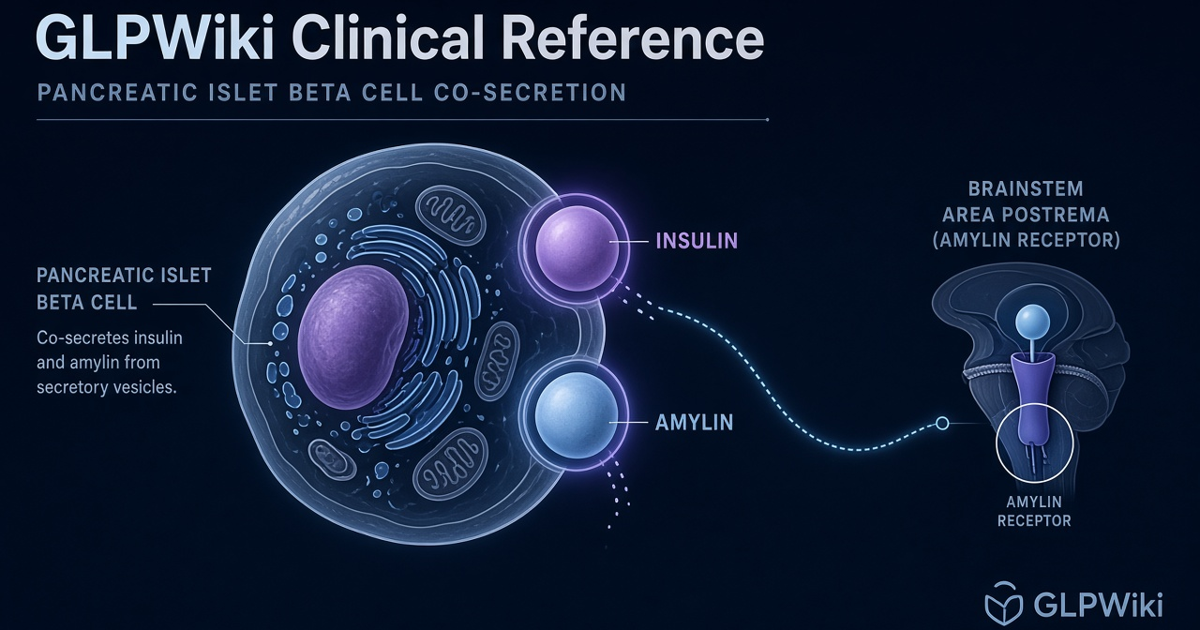
Amylin is a 37-amino-acid hormone packed with insulin in beta-cell secretory granules and released after meals. It slows gastric emptying, suppresses postprandial glucagon, and signals satiety through pathways that are distinct from the incretins. Here is the physiology, the approved analogue, and what investigational long-acting agonists are trying to do.
UPDATED 25 SEPT 2026 · 12 MIN READ
KEY TAKEAWAYS
- Amylin (islet amyloid polypeptide, IAPP) is a 37-amino-acid hormone co-located and co-secreted with insulin from pancreatic beta cells after nutrient intake.
- Its main postprandial actions: it slows gastric emptying without blocking nutrient absorption, suppresses an inappropriate postprandial glucagon rise, and promotes satiety via central pathways including the area postrema.
- Native amylin is short-lived and historically difficult to formulate; that is why medicines use engineered analogues rather than the unmodified hormone.
- Pramlintide (Symlin) is an FDA-approved synthetic amylin analogue used as an adjunct to mealtime insulin in adults with type 1 or type 2 diabetes under labeled conditions — verify current labeling on Drugs@FDA.
- Amylin signaling is not the same as GLP-1 or GIP incretin signaling; dual and triple incretin agonists and amylin agonists act on different receptor families.
- Long-acting investigational amylin agonists such as cagrilintide (alone or combined with semaglutide as CagriSema) remain investigational until a regulator approves a specific product — Phase 3 is not approval.
- This page is educational only: no doses, schedules, stacks, product picks, or DIY protocols.
What amylin is
Amylin, also called islet amyloid polypeptide (IAPP), is a 37-amino-acid peptide hormone made by the beta cells of the pancreatic islets — the same cells that make insulin. The two hormones are stored together in secretory granules and are released together when nutrients arrive, so circulating amylin rises and falls broadly in step with insulin around meals.
Because amylin is a beta-cell product, conditions that destroy or exhaust beta cells reduce it too. In type 1 diabetes amylin secretion is essentially absent, and in insulin-requiring type 2 diabetes it is often reduced. That observation — a missing partner hormone alongside missing insulin — is the historical reason an amylin analogue was developed as an add-on to mealtime insulin.
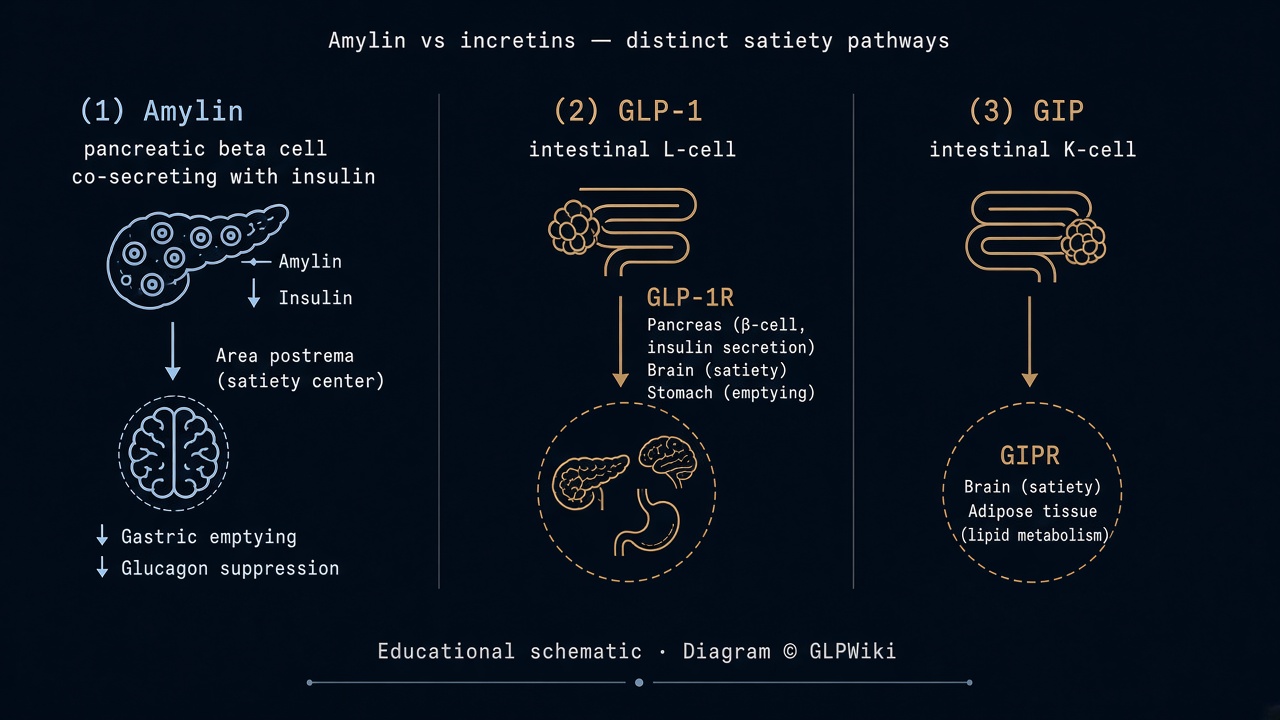
Amylin is not an incretin. Incretins such as GLP-1 and GIP come from intestinal endocrine cells and amplify insulin release in response to food in the gut. Amylin comes from the pancreas itself and works mainly on digestion timing, glucagon and appetite signaling rather than on insulin secretion.
The amylin receptor family
Amylin receptors are built from the calcitonin receptor combined with one of several receptor activity-modifying proteins (RAMPs). The pairing changes which peptide the complex responds to best, which is why amylin receptors are usually described as a family of complexes rather than one single receptor. The calcitonin receptor is a class B G-protein-coupled receptor, the same broad structural class as the GLP-1 and GIP receptors, but it is a different receptor with different ligands.
Amylin receptors are present in the brainstem, notably the area postrema, a region that sits outside the tight blood–brain barrier and can sense circulating hormones. Signaling there is linked to satiety and to gastric-emptying control. Some long-acting investigational analogues are described as acting on both amylin and calcitonin receptors; how that dual activity translates to clinical outcomes is a question for trial data, not receptor diagrams.
The practical point for readers: an amylin agonist does not activate GLP-1R or GIPR, and an incretin agonist does not activate amylin receptors. When the two are combined in a trial, they are two separate mechanisms rather than one stronger version of the same signal.
What native amylin does
Pramlintide labeling summarizes amylin's physiology in three postprandial actions. First, it slows gastric emptying — the rate food moves from the stomach into the small intestine — without changing the overall absorption of nutrients. Second, it suppresses the inappropriate rise in glucagon that can follow a meal in diabetes. Third, it contributes to satiety, reducing food intake through central signaling.
Together these actions moderate how quickly glucose appears in the bloodstream after eating. That is a different lever from insulin, which moves glucose out of the blood. Labeling language frames amylin replacement as helping match the rate of glucose appearance to insulin action, not as a substitute for insulin.
Slowed gastric emptying also explains why gastrointestinal effects such as nausea appear in labeling for amylin analogues, a feature they share with GLP-1 receptor agonists even though the receptors differ. For how GI effects arise with incretin medicines, see the GLP-1 GI-effects guide.
Why native amylin is not a practical medicine
Human amylin has a strong tendency to aggregate and form amyloid fibrils, which makes it physically unstable in solution and hard to formulate. It is also cleared quickly from the circulation, so any signal from the unmodified hormone is brief.
Analogues address those problems by changing the molecule. Pramlintide substitutes amino acids at several positions — modelled in part on the non-aggregating amylin found in some other species — to reduce aggregation while keeping receptor activity. Newer investigational analogues add structural changes such as lipidation intended to extend how long the molecule stays in circulation.
These are conceptual descriptions of drug design. They are not formulation instructions, and they do not mean that any material sold under an amylin-related name has the properties of a regulator-reviewed medicine.
Pramlintide (Symlin): the approved analogue
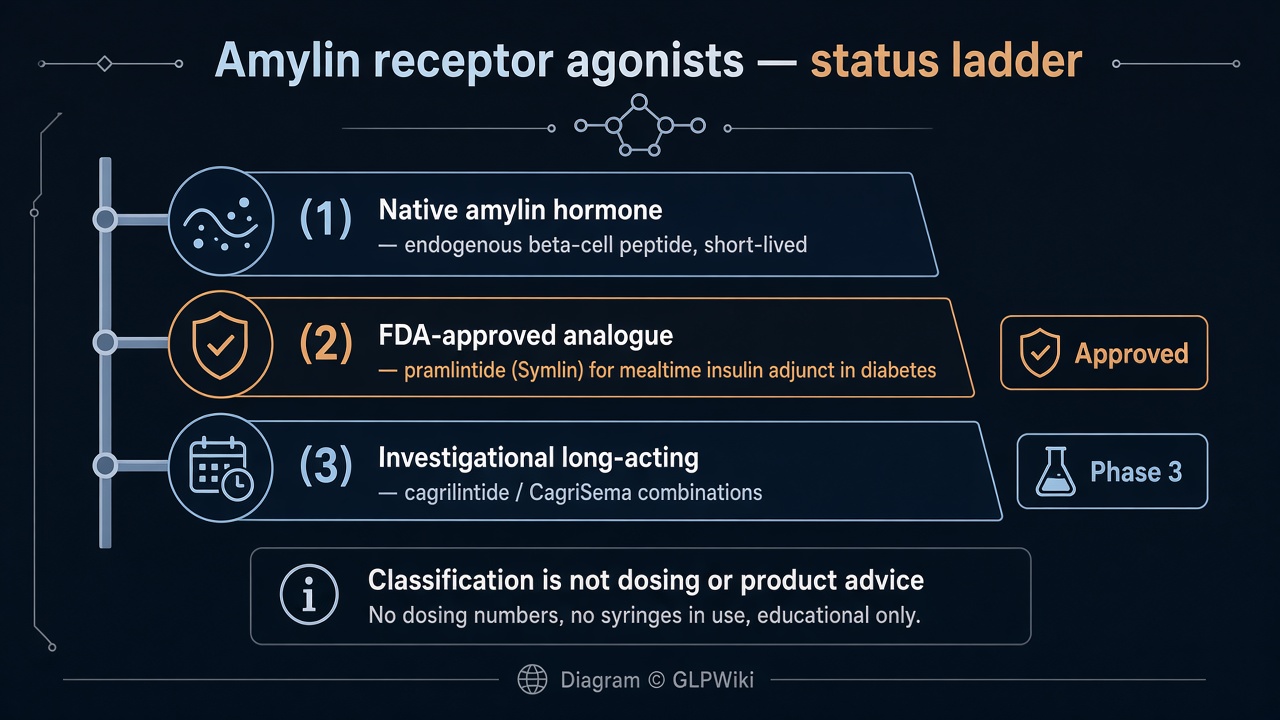
Pramlintide is a synthetic amylin analogue marketed as Symlin. FDA labeling describes it as an adjunct treatment for adults with type 1 or type 2 diabetes who use mealtime insulin and have not achieved desired glucose control despite optimal insulin therapy. It is used together with insulin, not in place of it.
Symlin is not labeled for obesity or chronic weight management. Its label carries a boxed warning about severe hypoglycemia risk when used with insulin, and the prescribing information lays out patient-selection criteria and monitoring that belong to the prescriber. GLPWiki does not restate any of those operational details; the current prescribing information on Drugs@FDA is the authoritative text.
Approval attaches to a specific finished product, manufacturer and indication. Symlin's approval does not extend to other amylin analogues, to compounded versions, or to research-labeled vials.
Long-acting amylin agonists: investigational status
Cagrilintide is a long-acting amylin analogue developed by Novo Nordisk, studied alone and in combination with semaglutide under the name CagriSema. Phase 3 obesity trials have been reported, including REDEFINE-1 in the New England Journal of Medicine. GLPWiki indexes cagrilintide as Phase 3 in the compound library.
Phase 3 results are evidence, not approval. A regulator reviews a complete application for a specific finished product and indication, and until that happens the product remains investigational. Trial outcomes describe what happened under protocol conditions with regulated study drug; they do not describe any retail or research product.
The status ladder below separates the native hormone, the approved analogue and investigational long-acting agonists so that the categories are not blurred together.
Amylin versus GLP-1 and GIP
Amylin — origin: pancreatic beta cells, co-secreted with insulin. Receptor: calcitonin receptor + RAMP complexes. Approved medicine example: pramlintide (Symlin), as an adjunct to mealtime insulin.
GLP-1 — origin: intestinal L-cells. Receptor: GLP-1R. Approved medicine examples: semaglutide, liraglutide and other GLP-1 receptor agonists for labeled indications.
GIP — origin: intestinal K-cells in the upper small intestine. Receptor: GIPR. Approved medicine example: tirzepatide, as a dual GIPR/GLP-1R agonist; there is no approved GIP-only medicine.
All three are meal-responsive peptides that influence post-meal glucose and appetite, which is why they are discussed together. Their receptors and cells of origin differ, so evidence for one does not transfer automatically to another.
Common misconceptions
“Amylin is basically GLP-1.” It is not. Amylin is a pancreatic hormone acting on calcitonin-family receptors; GLP-1 is an intestinal incretin acting on GLP-1R. Some effects overlap, such as slowed gastric emptying and satiety, but the mechanisms are separate.
“Symlin is approved, so amylin vials are approved.” Approval covers Symlin as a specific product for its labeled indication. It says nothing about research-labeled or compounded materials, whose identity, purity and sterility have not been reviewed the same way.
“CagriSema trial results mean it is available.” Trial results describe an investigational product under study conditions. They are not a retail product and not a basis for self-experimentation.
Scope and disclaimer
This page is educational. It explains physiology, receptor families, evidence and regulatory status, and it does not provide doses, schedules, combinations, product recommendations or individualized advice.
Any treatment decision belongs with a licensed clinician using the current official labeling. Regulatory status changes over time; confirm current approvals on Drugs@FDA and trial status on ClinicalTrials.gov.
Frequently asked questions
- What is amylin?
- Amylin (islet amyloid polypeptide) is a 37-amino-acid hormone made by pancreatic beta cells and released together with insulin after meals. It slows gastric emptying, suppresses postprandial glucagon and contributes to satiety.
- Is amylin the same as GLP-1?
- No. Amylin comes from pancreatic beta cells and acts on calcitonin-receptor/RAMP complexes. GLP-1 comes from intestinal L-cells and acts on the GLP-1 receptor. They share some effects but are separate pathways.
- What is pramlintide / Symlin approved for?
- FDA labeling describes Symlin as an adjunct to mealtime insulin in adults with type 1 or type 2 diabetes who have not achieved desired glucose control despite optimal insulin therapy. It is not labeled for weight management. Check the current prescribing information on Drugs@FDA.
- Is cagrilintide FDA-approved?
- Not as of this page's update. Cagrilintide, alone or as CagriSema with semaglutide, has been studied in Phase 3 trials and remains investigational until a regulator approves a specific product.
- Does this page recommend doses?
- No. GLPWiki never publishes doses, schedules, stacks or protocols. Treatment decisions belong with a clinician and the official label.
SOURCES
- 01SYMLIN (pramlintide) prescribing information— U.S. Food and Drug Administration
- 02Drugs@FDA— U.S. Food and Drug Administration
- 03Amylin physiology and islet biology (search)— PubMed
- 04Pramlintide, an amylin analogue (review)— Vascular Health and Risk Management
- 05CagriSema REDEFINE-1— New England Journal of Medicine
- 06ClinicalTrials.gov— U.S. National Library of Medicine
EDUCATIONAL REFERENCE ONLY · Not medical advice. Nothing here diagnoses, treats, cures or prevents any disease, and nothing here is a dosing recommendation. Consult a licensed clinician before any treatment decision.