How to read the Contraindications section (Section 4) of an FDA label: the label's shortest list, decoded

Section 4 of an FDA prescription label is usually the shortest numbered section, often just two bullets. It is also the section with the strictest legal standard: a situation belongs there only when the risk of use "clearly outweighs any possible therapeutic benefit." This guide explains where that standard comes from (21 CFR 201.57(c)(5) and FDA's 2011 guidance), the rule that the section must say "None" when nothing qualifies, the difference between a known hazard and a theoretical possibility, and how to tell "contraindicated" apart from "not recommended," a Warning, or a Limitation of Use. Our examples come from current GLP-1 and other weight-management labels on DailyMed. Label-reading literacy only: no doses, no treatment recommendations, no medical advice.
UPDATED 27 OCT 2026 · 12 MIN READ
KEY TAKEAWAYS
- Section 4 Contraindications lists situations in which a drug "should not be used because the risk of use … clearly outweighs any possible therapeutic benefit" (21 CFR 201.57(c)(5)). That is a higher bar than anything in Warnings and Precautions.
- The regulation says "Known hazards and not theoretical possibilities must be listed." If no contraindications are known, the section must say "None." Teduglutide (Gattex), a peptide, is a real example of a label whose Section 4 reads "None."
- FDA's 2011 guidance allows two evidence routes: an observed adverse reaction with a well-established causal link, or an anticipated reaction supported by data such as pharmacology, class effects or animal studies. A reaction based "wholly on theory" does not qualify.
- A hypersensitivity contraindication should appear only when serious hypersensitivity has actually been seen with the product, or can be expected from similar drugs. That is why GLP-1 labels say "serious hypersensitivity … including anaphylaxis and angioedema have been reported" rather than a generic allergy line.
- Every GLP-1 receptor agonist label we checked (Ozempic, Wegovy, Rybelsus, Victoza, Saxenda, Trulicity, Mounjaro, Zepbound) has the same two contraindications: personal or family history of medullary thyroid carcinoma (MTC) or Multiple Endocrine Neoplasia syndrome type 2 (MEN 2), and prior serious hypersensitivity. Exenatide (Byetta) differs: it lists drug-induced immune-mediated thrombocytopenia instead of the thyroid item.
- Contraindications change. Saxenda's label lists "Contraindications, Pregnancy (4) … (Removed) 05/2025" under Recent Major Changes. Pregnancy information now sits in Section 8.1 as risk language, not as a Section 4 contraindication.
- "Not recommended," "avoid," "use with caution," "has not been studied," and a Limitation of Use are not contraindications. FDA's guidance says contraindication-style wording ("Do not use") should not appear in Warnings and Precautions, so the words a label uses are themselves a signal.
- Section 4 lists contraindications that apply to an approved product. It does not list a trial's exclusion criteria, and it says nothing about compounded or "research" products, which have no FDA-approved label.
What this guide covers (and how it differs from sister pages)
Our Day 35 guide, Warnings, Precautions and Adverse Reactions literacy, explains how Contraindications (4), Warnings and Precautions (5), Adverse Reactions (6) and a Boxed Warning differ as safety categories, and it focuses on reading Section 6 incidence tables. The Indications and Usage guide (Day 45) contrasts a Limitation of Use with a contraindication, and the Highlights guide (Day 47) shows where Contraindications appears in the half-page summary.
This Day 48 guide is the deep dive on Section 4 itself. It covers the exact regulatory test, the evidence FDA's guidance asks for, how entries are worded and ordered, how one contraindication echoes across the Boxed Warning, Highlights and Sections 5, 13 and 17, how the section changes over time, and the most common ways readers misread it. We quote current labels from DailyMed only to show structure and wording. This page reproduces no doses, titration steps or strengths, and nothing here suggests who should or should not use any medicine.
The legal test: 21 CFR 201.57(c)(5)
In the Physician Labeling Rule (PLR) format, Contraindications is numbered Section 4 of the Full Prescribing Information. The regulation reads, in full:
"This section must describe any situations in which the drug should not be used because the risk of use (e.g., certain potentially fatal adverse reactions) clearly outweighs any possible therapeutic benefit. Those situations include use of the drug in patients who, because of their particular age, sex, concomitant therapy, disease state, or other condition, have a substantial risk of being harmed by the drug and for whom no potential benefit makes the risk acceptable. Known hazards and not theoretical possibilities must be listed (e.g., if severe hypersensitivity to the drug has not been demonstrated, it should not be listed as a contraindication). If no contraindications are known, this section must state 'None.'"
Four phrases in that paragraph do most of the work:
- "Clearly outweighs any possible therapeutic benefit." The weighing is lopsided by design. Section 4 is not for risks that need monitoring or a judgment call. Those go to Warnings and Precautions.
- "For whom no potential benefit makes the risk acceptable." The contraindication applies to a defined group of patients, described by age, sex, concomitant therapy, disease state or another condition.
- "Known hazards and not theoretical possibilities." Speculation does not belong here. The regulation's own example is hypersensitivity: if severe hypersensitivity has not been demonstrated, it should not be listed.
- "None." An empty Section 4 is not allowed. If nothing qualifies, the label must say so explicitly.
Where the same test shows up: Highlights and old-format labels
The Highlights rule, 21 CFR 201.57(a)(9), requires "a concise statement of each of the product's contraindications" in the front summary, so every Section 4 item reappears in Highlights with a "(4)" pointer. Under 201.57(a)(5), substantive changes to Contraindications from the past year also appear in Highlights under Recent Major Changes.
The older, non-PLR format in 21 CFR 201.80(d) uses nearly the same test ("the risk of use clearly outweighs any possible benefit … Known hazards and not theoretical possibilities shall be listed"), so the concept is the same on old-format labels even though the section is not numbered.
What counts as evidence: FDA's 2011 guidance
FDA's October 2011 guidance, Warnings and Precautions, Contraindications, and Boxed Warning Sections of Labeling for Human Prescription Drug and Biological Products — Content and Format, explains how applicants and reviewers should apply the regulation. Like all FDA guidance it is nonbinding, but it describes the agency's current thinking. Section III ("When to Contraindicate") describes two routes.
Observed adverse reactions. These are ordinarily a reason to contraindicate when two conditions are both met. First, the risk in that clinical situation, "based on both likelihood and severity," outweighs any potential benefit to any patient. Second, the causal link between the drug and the reaction "is well established."
Anticipated adverse reactions. A reaction that has not yet been seen can still support a contraindication if the risk outweighs any potential benefit and either (a) "based on what is known about the pharmacology, chemistry, or class of the drug, it appears highly likely that the adverse reaction is caused by the drug," or (b) "animal data raise substantial concern about the potential for occurrence of the adverse reaction in humans." The guidance draws a sharp line here. Anticipated reactions "are supported by data," while reactions "based wholly on theory (theoretical possibilities) are not supported by data and would not be appropriate" for Section 4. When a contraindication rests on an anticipated reaction, the labeling should acknowledge that the reaction has not yet been observed.
The guidance lists the kinds of situations where a contraindication might be appropriate:
- a comorbid condition or physiological state (its examples include hepatic or renal disease, congenital long QT syndrome, hypokalemia, and pregnancy or childbearing potential)
- a demographic factor such as age or sex
- a defined subset of patients in whom the drug should never be used
- a dangerous combination with a coadministered drug (its example is an MAO inhibitor with a tricyclic antidepressant)
- known hypersensitivity, when severe hypersensitivity has been seen with the drug
Section 4 vs Section 5: a higher evidence bar
Compare that with Warnings and Precautions. For Section 5 the guidance asks only for "reasonable evidence of a causal association," adding that "a causal relationship need not have been definitively established." Section 4 asks for more, both in the strength of evidence and in how one-sided the risk-benefit balance must be.
How an entry is written and ordered
The same guidance gives practical rules that make Section 4 easy to recognize:
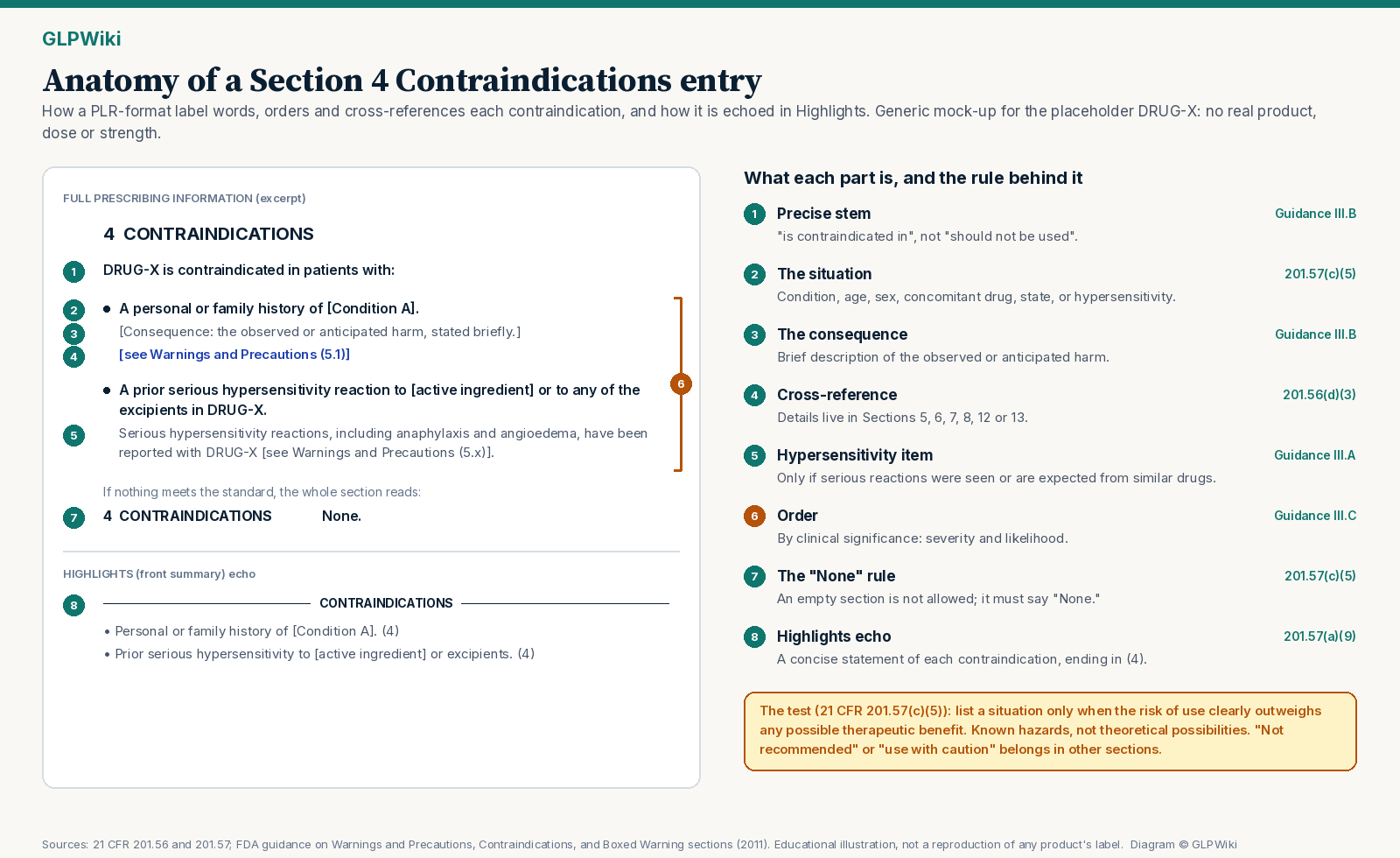
- Precise verb. Entries should say "Drug X is contraindicated in patients with condition Y," not "should not be used."
- Introductory stem plus bullets. When there is more than one contraindication, a stem such as "Drug X is contraindicated in:" is followed by a bulleted list.
- Two pieces of content per entry. Each entry briefly describes the contraindicated situation (with any predisposing characteristics) and the observed or anticipated consequence.
- Order by clinical significance. The guidance says ordering should reflect "the severity of the risk and the likelihood of occurrence."
- Cross-references. Detail lives elsewhere. Entries point to Warnings and Precautions, Drug Interactions, Adverse Reactions or Clinical Pharmacology, for example "[see Warnings and Precautions (5.1)]."
The hypersensitivity model sentence
For hypersensitivity the guidance even supplies a model sentence: "DRUG-X is contraindicated in patients with a history of a hypersensitivity reaction to [active ingredient]. Reactions have included anaphylaxis and anaphylactoid reactions [see Adverse Reactions (6.2)]." Current GLP-1 labels follow that pattern closely. Ozempic's reads: "A serious hypersensitivity reaction to semaglutide or to any of the excipients in OZEMPIC. Serious hypersensitivity reactions including anaphylaxis and angioedema have been reported with OZEMPIC [see Warnings and Precautions (5.8)]."
Note the words "any of the excipients." The contraindication covers the finished product, inactive ingredients included, not just the active molecule. A Section 4 entry is always about that specific approved product.
The GLP-1 pattern: two short bullets
Read Section 4 across the current GLP-1 receptor agonist labels on DailyMed and a clear pattern shows up. The list below summarizes it, and the notes after it explain what it teaches.
- Ozempic (semaglutide injection): thyroid (MTC / MEN 2) item — Yes; serious hypersensitivity item — Yes (anaphylaxis, angioedema reported); other Section 4 items — none
- Wegovy (semaglutide injection and tablets): thyroid (MTC / MEN 2) item — Yes; serious hypersensitivity item — Yes; other Section 4 items — none
- Rybelsus / Ozempic tablets (oral semaglutide): thyroid (MTC / MEN 2) item — Yes; serious hypersensitivity item — Yes; other Section 4 items — none
- Victoza (liraglutide): thyroid (MTC / MEN 2) item — Yes; serious hypersensitivity item — Yes; other Section 4 items — none
- Saxenda (liraglutide): thyroid (MTC / MEN 2) item — Yes; serious hypersensitivity item — Yes; other Section 4 items — Pregnancy (removed 05/2025)
- Trulicity (dulaglutide): thyroid (MTC / MEN 2) item — Yes; serious hypersensitivity item — Yes; other Section 4 items — none
- Mounjaro (tirzepatide): thyroid (MTC / MEN 2) item — Yes; serious hypersensitivity item — Yes; other Section 4 items — none
- Zepbound (tirzepatide): thyroid (MTC / MEN 2) item — Yes; serious hypersensitivity item — Yes; other Section 4 items — none
- Byetta (exenatide): thyroid (MTC / MEN 2) item — No; serious hypersensitivity item — Yes (severe hypersensitivity); other Section 4 items — Drug-induced immune-mediated thrombocytopenia
- Soliqua (insulin glargine + lixisenatide): thyroid (MTC / MEN 2) item — No; serious hypersensitivity item — Yes; other Section 4 items — During episodes of hypoglycemia
The thyroid item is a contraindication tied to a Boxed Warning
Each of the eight labels above that carry the thyroid item opens with "WARNING: RISK OF THYROID C-CELL TUMORS." Ozempic's box states that in rodents semaglutide causes thyroid C-cell tumors "at clinically relevant exposures," that "it is unknown whether OZEMPIC causes thyroid C-cell tumors, including medullary thyroid carcinoma (MTC), in humans," and then that Ozempic "is contraindicated in patients with a personal or family history of MTC or in patients with Multiple Endocrine Neoplasia syndrome type 2 (MEN 2) [see Contraindications (4)]." The same fact appears in the Boxed Warning, Highlights, Section 4, Section 5.1 and the nonclinical data in Section 13.1, and it is reflected in the patient counseling in Section 17. Each location serves a different reader at a different depth.
Why "personal or family history" and MEN 2?
MEN 2 is an inherited cancer syndrome caused by germline pathogenic variants in the RET proto-oncogene, passed on in an autosomal dominant pattern (GeneReviews; American Thyroid Association MTC guidelines). MTC is the cancer of the thyroid C-cells, the same cell type in which rodent tumors were seen. A family history therefore marks people who may carry a hereditary predisposition. This is an example of a contraindication defined by a "disease state, or other condition," in the regulation's words, rather than by an observed reaction in that group.
The evidence behind it is mostly nonclinical
Mechanistic work in rodents showed that GLP-1 receptor agonists activate rodent C-cells, causing calcitonin release and C-cell proliferation. The same work found low GLP-1 receptor expression in human and monkey C-cells, and 20 months of liraglutide exposure did not cause C-cell hyperplasia in monkeys (Bjerre Knudsen et al., Endocrinology 2010). Human observational studies have not settled the question. A French nationwide case-control study reported higher thyroid-cancer risk with one to three years of GLP-1 RA use (Bezin et al., Diabetes Care 2023). A Scandinavian active-comparator cohort found no substantially increased risk over a mean follow-up of 3.9 years (Pasternak et al., BMJ 2024). The labels themselves say that the human relevance of the rodent findings "has not been determined." The 2011 guidance's "anticipated adverse reaction" pathway, where animal data raise substantial concern, is the kind of evidence basis the regulation allows. That is different from a theoretical possibility, and it is also different from a proven human effect. Reading Section 4 well means keeping both of those distinctions in mind.
Byetta shows the observed-reaction route
Exenatide's label contraindicates use in patients with "a history of drug-induced immune-mediated thrombocytopenia from exenatide products," explaining that "serious bleeding, which may be fatal, from drug-induced immune-mediated thrombocytopenia has been reported with exenatide use [see Warnings and Precautions (5.8)]." That is an observed reaction where re-exposing the same person is the hazard, which fits the guidance's "observed adverse reactions" route.
Soliqua shows a state-based contraindication
The insulin glargine and lixisenatide combination is contraindicated "during episodes of hypoglycemia." A contraindication can describe a temporary physiological state, not just a permanent diagnosis.
Beyond GLP-1s: longer lists, and a label that says "None"
Contrasts help show what the GLP-1 pattern is not.
- Qsymia (phentermine and topiramate) lists pregnancy, glaucoma, hyperthyroidism, use during or within 14 days of stopping an MAOI, and known hypersensitivity or idiosyncrasy to sympathomimetic amines. Each entry cross-references Sections 5, 7 or 8.
- Contrave (naltrexone and bupropion) has one of the longest lists among weight-management drugs, including uncontrolled hypertension, seizure disorder, other bupropion-containing products, bulimia or anorexia nervosa, chronic opioid use, abrupt discontinuation of alcohol or certain sedatives, MAOI use, and known allergy. Several items are drug-interaction contraindications, which the 2011 guidance says should be described briefly in Section 4 and cross-referenced to Drug Interactions.
- Xenical (orlistat) lists pregnancy, chronic malabsorption syndrome, cholestasis and known hypersensitivity. Its Section 8.1 on DailyMed still carries the old heading "Pregnancy Category X," a holdover from the letter-category system the Pregnancy and Lactation Labeling Rule replaced.
- Symlin (pramlintide), an amylin-analog peptide, lists serious hypersensitivity, hypoglycemia unawareness and confirmed gastroparesis.
- Imcivree (setmelanotide), an MC4 receptor agonist peptide, has a single contraindication: prior serious hypersensitivity, with anaphylaxis reported.
- Gattex (teduglutide), a GLP-2 analog peptide, reads simply: "4 CONTRAINDICATIONS — None." Its Highlights repeats "None. (4)". Gattex still has serious Warnings and Precautions (its first is acceleration of neoplastic growth). "None" in Section 4 does not mean "no serious risks." It means no situation met the clearly-outweighs standard.
Length is not a safety score
The length of Section 4 reflects how often a product's risks, in a definable group, are so lopsided that no benefit could justify use. It is not a score of how "safe" a drug is overall.
Contraindicated vs not recommended vs warning vs limitation of use
Labels use a small vocabulary with fairly consistent meanings. Learning it is the most useful Section 4 skill.
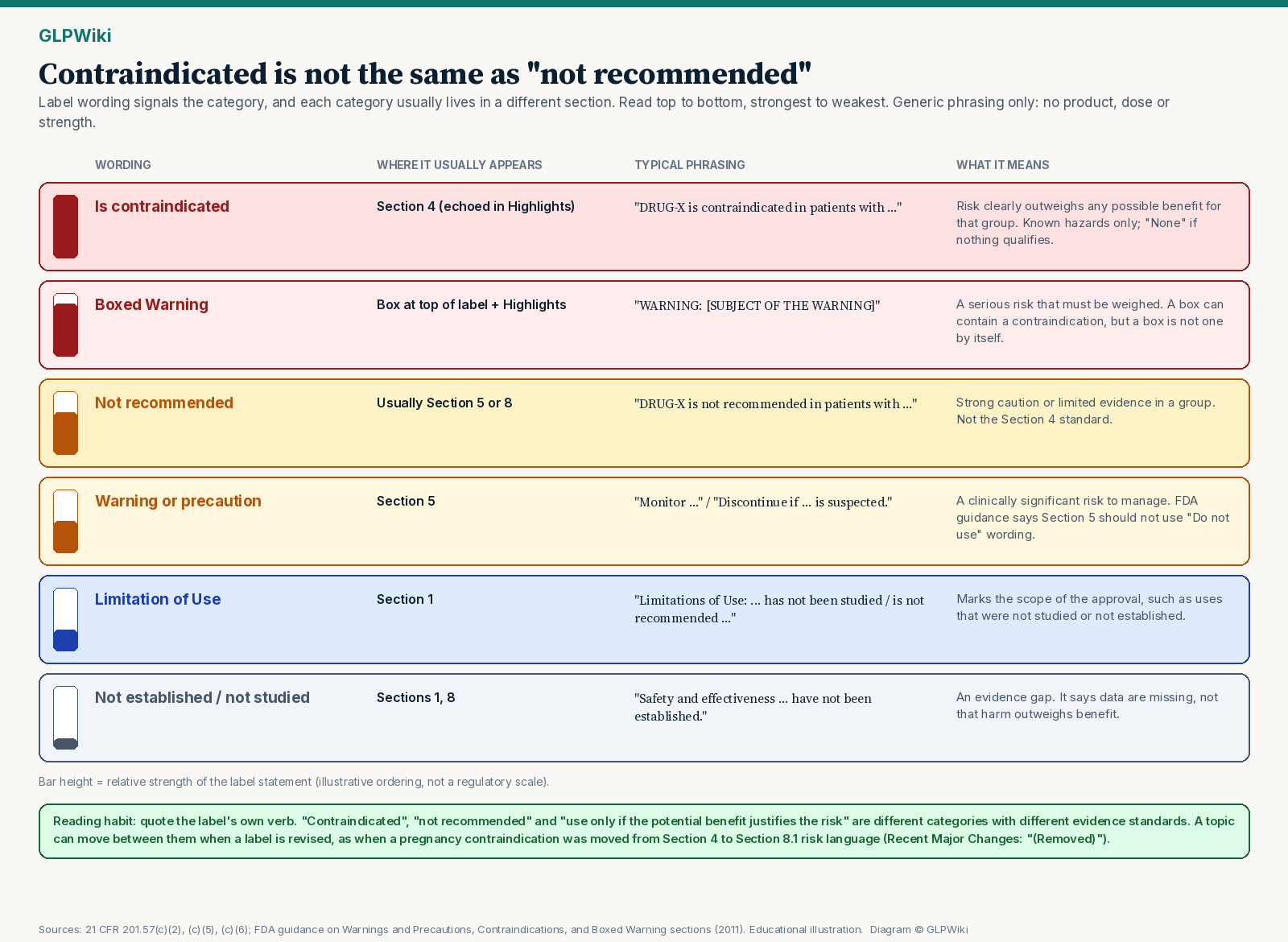
- "Is contraindicated" (Section 4). The strongest category. Risk clearly outweighs any possible benefit for that group, based on known hazards. Mirrored in Highlights with "(4)".
- Boxed Warning. Highlights a serious risk that must be considered when weighing risks and benefits. A box can include a contraindication (the GLP-1 thyroid box does), but a box is not itself a contraindication.
- "Not recommended" (often Section 5 or 8). For example, Zepbound's label states it "is not recommended in patients with severe gastroparesis" in Warnings and Precautions. That is strong caution, not a Section 4 contraindication.
- Monitoring and management statements (Section 5). Examples are "Discontinue if pancreatitis is suspected" or "Monitor renal function." These describe how to manage a risk while using the product. FDA's guidance says terminology that implies a contraindication ("Do not use") should not appear in Warnings and Precautions, and that vague phrases like "use with caution" should be avoided.
- Limitation of Use (Section 1). Flags uses where safety or effectiveness has not been established or that are otherwise outside the approved use (for example, Saxenda's Limitation of Use says coadministration with other GLP-1 receptor agonists "is not recommended"). It is a statement about the scope of the approval, not a finding that harm clearly outweighs benefit.
- "Has not been studied" / "safety and effectiveness have not been established" (Sections 1, 8). An evidence gap, not a contraindication.
Contraindications change: Saxenda and pregnancy
Section 4 is not frozen. One of the clearest recent examples is liraglutide for weight management. FDA's May 2025 supplement approval letter for Saxenda states that "in Section 4 Contraindications contraindication for pregnancy was removed," and that in Section 8.1 "pregnancy contraindication was removed and risk benefit language was added." The letter describes these as revisions made "to align with recently approved changes in other products in the glucagon-like peptide-1 receptor agonist class."
You can see the change on the label itself:
- Recent Major Changes in Saxenda's Highlights shows "Contraindications, Pregnancy (4) … (Removed) 05/2025."
- Section 4 now has two bullets (MTC/MEN 2 and serious hypersensitivity).
- Section 8.1 now says, in part, that based on animal reproduction studies "there may be risks to the fetus," that "weight loss offers no benefit to a pregnant patient and may cause fetal harm," and that when pregnancy is recognized the patient should be advised of the risk and the product discontinued.
The earlier wording is still on record
FDA's Drug Safety-related Labeling Changes (SrLC) database records the earlier wording too: "SAXENDA is contraindicated during pregnancy because weight loss offers no potential benefit to a pregnant woman and may result in fetal harm."
The literacy lesson is not about pregnancy advice. It is that moving a topic out of Section 4 changes its regulatory category, not whether the topic matters. The information still exists, in a different section with different wording. It also shows why a screenshot of an old label, or a summary written before 2025, can misstate the current contraindications. Always check the "Revised:" date and Recent Major Changes.
History: pregnancy category X and the PLLR
History adds context. Under the old-format rule, 21 CFR 201.80(f)(6), drugs in pregnancy category X had to state under Contraindications that the drug "is contraindicated in women who are or may become pregnant." The 2014 Pregnancy and Lactation Labeling Rule (79 FR 72063) removed the letter categories from PLR-format labeling and replaced them with narrative risk summaries in Section 8.1. A pregnancy contraindication can still exist under PLR when the Section 4 standard is met, as on the current Qsymia and Xenical labels, but it is no longer generated automatically by a letter.
Common misreadings
- "Not contraindicated means safe for me." Section 4 lists only situations that meet a very high bar. Many serious risks, monitoring needs and special populations are described in Sections 5 and 8 instead. A short Section 4 says nothing about whether a product suits any particular person. That is a conversation for a clinician.
- "'None' means no risks." Gattex's "None" sits alongside a substantial Warnings and Precautions section.
- "'Not recommended' is just a polite contraindication." The words are chosen deliberately and map to different sections and standards. Report and quote them as written.
- "A contraindication for one product applies to every product with the same molecule." Contraindications are labeled per approved product, and the hypersensitivity item explicitly includes that product's excipients. Byetta (exenatide) and Ozempic (semaglutide) are both GLP-1 receptor agonists, yet their Section 4 lists differ.
- "Trial exclusion criteria are contraindications." Clinical trials exclude people for many reasons: to define a study population, to reduce confounding, or to protect participants. For example, the STEP 1 trial of semaglutide for weight management (NCT03548935) excluded people with HbA1c of 6.5% or higher at screening, which kept people with diabetes out of that study. It is not a contraindication on the label. Section 4 reflects FDA's labeling decision, not a trial's enrollment rules.
- "An unapproved or compounded version has the same contraindications." Compounded and "research-use" products have no FDA-approved label, so there is no Section 4 to read. GLPWiki's compounded vs FDA-approved guide explains why an approved label's contents do not transfer.
- "The contraindication proves the drug causes the condition in humans." The GLP-1 thyroid item rests on rodent data and biological plausibility, and the labels say human relevance "has not been determined." A contraindication can be precautionary within the "known hazard" standard without being proof of a human effect.
A five-step way to read any Section 4
- Confirm the product and version. Check the title line and the "Revised:" date, and note where you read the label (Drugs@FDA, DailyMed or FDALabel).
- Read the stem and count the bullets. "Is contraindicated in…" tells you you are in the strongest category. If it says "None," move on to Section 5, which may hold just as much.
- Classify each entry. Is it a condition or disease state, a demographic factor, a drug combination, a temporary state, or hypersensitivity? Does the text say the reaction was "reported" (observed) or point to animal or class data (anticipated)?
- Follow every cross-reference. The detail behind a Section 4 bullet lives in Sections 5, 7, 8, 12 or 13, and sometimes in a Boxed Warning.
- Check Recent Major Changes. Look for added or "(Removed)" Contraindications entries from the past year, so you do not cite an outdated list.
Scope and disclaimer
GLPWiki is an educational resource. This guide explains how FDA prescription drug labeling is structured; it is not medical advice, does not provide dosing information, and does not recommend for or against any treatment. Whether any contraindication, warning or precaution applies to a particular person is a question for a licensed clinician or pharmacist. Label contents change; always check the current FDA-approved labeling. To report a suspected adverse reaction, contact the manufacturer or FDA MedWatch at 1-800-FDA-1088 or www.fda.gov/medwatch.
Last reviewed: October 27, 2026. Labeling and guidance may have changed since; verify with Drugs@FDA, DailyMed, and your pharmacist or clinician.
Frequently asked questions
- What is the Contraindications section of an FDA label?
- It is Section 4 of the Full Prescribing Information in PLR format. Under 21 CFR 201.57(c)(5) it must describe any situations in which the drug should not be used because the risk of use clearly outweighs any possible therapeutic benefit. If none are known, it must say "None."
- What is the difference between a contraindication and a warning?
- A contraindication (Section 4) means risk clearly outweighs any possible benefit for a defined group, based on known hazards. A warning or precaution (Section 5) describes a clinically significant risk that needs consideration, monitoring or management. FDA's guidance asks for a well-established causal link (or strong anticipated-reaction data) for Section 4, but only reasonable evidence of a causal association for Section 5.
- Why do GLP-1 labels contraindicate a family history of medullary thyroid carcinoma?
- Each long-acting GLP-1 label has a Boxed Warning about thyroid C-cell tumors seen in rodents, and it contraindicates use in people with a personal or family history of MTC or with MEN 2, an inherited syndrome linked to RET gene variants. The labels state that the human relevance of the rodent findings has not been determined.
- What does "None" in Section 4 mean?
- It means no situation met the regulatory standard for a contraindication. It does not mean the product has no serious risks. Gattex (teduglutide), for example, lists "None" in Section 4 but has several Warnings and Precautions.
- Is "not recommended" the same as "contraindicated"?
- No. "Not recommended" usually appears in Warnings and Precautions, Use in Specific Populations or a Limitation of Use, and signals strong caution or an evidence gap. "Contraindicated" is reserved for Section 4 and the clearly-outweighs standard.
- Can a contraindication be removed from a label?
- Yes. Saxenda's Highlights lists "Contraindications, Pregnancy (4) … (Removed) 05/2025," and FDA's approval letter describes moving pregnancy information to risk-benefit language in Section 8.1. Always check the current label and its Recent Major Changes.
- Why does the hypersensitivity contraindication mention excipients?
- Contraindications apply to the finished product. Serious reactions can involve inactive ingredients, so GLP-1 labels contraindicate prior serious hypersensitivity "to [the active ingredient] or to any of the excipients" in that product.
- Are clinical trial exclusion criteria the same as contraindications?
- No. Trials exclude participants for many scientific and safety reasons. Only FDA-approved labeling, Section 4, defines a product's contraindications.
SOURCES
- 0121 CFR 201.57 — Specific requirements on content and format of labeling (PLR); (a)(9) Highlights Contraindications, (a)(5) Recent Major Changes, (c)(5) Contraindications— U.S. Government Publishing Office / eCFR
- 0221 CFR 201.56 — Requirements on content and format of labeling; section order and applicability— U.S. Government Publishing Office / eCFR
- 0321 CFR 201.80 — Old-format labeling; (d) Contraindications and (f)(6) former pregnancy category X statement— U.S. Government Publishing Office / eCFR
- 04Warnings and Precautions, Contraindications, and Boxed Warning Sections of Labeling for Human Prescription Drug and Biological Products — Content and Format (guidance, Oct 2011), Section III— U.S. Food and Drug Administration
- 05Requirements on Content and Format of Labeling for Human Prescription Drug and Biological Products (final rule), 71 FR 3922, Jan 24, 2006— Federal Register
- 06Labeling for Human Prescription Drug and Biological Products — Implementing the PLR Content and Format Requirements (guidance, Feb 2013)— U.S. Food and Drug Administration
- 07Content and Format of Labeling for Human Prescription Drug and Biological Products; Requirements for Pregnancy and Lactation Labeling (final rule), 79 FR 72063, Dec 4, 2014— Federal Register
- 08Pregnancy and Lactation Labeling (Drugs) Final Rule— U.S. Food and Drug Administration
- 09Saxenda (liraglutide) supplement approval letter, NDA 206321/S-020 (2025): pregnancy contraindication removed from Section 4— U.S. Food and Drug Administration / Drugs@FDA
- 10Drug Safety-related Labeling Changes (SrLC): Saxenda— U.S. Food and Drug Administration
- 11Saxenda (liraglutide) — Section 4, Section 8.1, Recent Major Changes— U.S. FDA / DailyMed
- 12Ozempic (semaglutide) injection — Boxed Warning and Section 4— U.S. FDA / DailyMed
- 13Wegovy (semaglutide) injection and tablets — Section 4 and 8.1— U.S. FDA / DailyMed
- 14Rybelsus and Ozempic (semaglutide) tablets — Section 4— U.S. FDA / DailyMed
- 15Victoza (liraglutide) — Section 4— U.S. FDA / DailyMed
- 16Trulicity (dulaglutide) — Section 4— U.S. FDA / DailyMed
- 17Mounjaro (tirzepatide) — Section 4— U.S. FDA / DailyMed
- 18Zepbound (tirzepatide) — Section 4; "not recommended in patients with severe gastroparesis" (5.2)— U.S. FDA / DailyMed
- 19Byetta (exenatide) — Section 4 (drug-induced immune-mediated thrombocytopenia)— U.S. FDA / DailyMed
- 20Soliqua 100/33 (insulin glargine and lixisenatide) — Section 4— U.S. FDA / DailyMed
- 21Gattex (teduglutide) — Section 4 "None"— U.S. FDA / DailyMed
- 22Imcivree (setmelanotide) — Section 4— U.S. FDA / DailyMed
- 23Symlin (pramlintide) — Section 4— U.S. FDA / DailyMed
- 24Qsymia (phentermine and topiramate) — Section 4— U.S. FDA / DailyMed
- 25Contrave (naltrexone and bupropion) — Section 4— U.S. FDA / DailyMed
- 26Xenical (orlistat) — Section 4 and 8.1— U.S. FDA / DailyMed
- 27Bjerre Knudsen L, Madsen LW, Andersen S, et al. Glucagon-like peptide-1 receptor agonists activate rodent thyroid C-cells causing calcitonin release and C-cell proliferation. Endocrinology. 2010;151(4):1473-1486 (PMID 20203154)— Endocrinology / PubMed
- 28Bezin J, Gouverneur A, Pénichon M, et al. GLP-1 receptor agonists and the risk of thyroid cancer. Diabetes Care. 2023;46(2):384-390 (PMID 36356111)— Diabetes Care / PubMed
- 29Pasternak B, Wintzell V, Hviid A, et al. Glucagon-like peptide 1 receptor agonist use and risk of thyroid cancer: Scandinavian cohort study. BMJ. 2024;385:e078225 (PMID 38683947)— BMJ / PubMed
- 30Wells SA Jr, Asa SL, Dralle H, et al. Revised American Thyroid Association guidelines for the management of medullary thyroid carcinoma. Thyroid. 2015;25(6):567-610 (PMID 25810047)— Thyroid / PubMed
- 31Multiple Endocrine Neoplasia Type 2 — GeneReviews (NBK1257)— NCBI Bookshelf / GeneReviews
- 32STEP 1: Research Study Investigating How Well Semaglutide Works in People Suffering From Overweight or Obesity (NCT03548935), eligibility criteria— U.S. National Library of Medicine / ClinicalTrials.gov
EDUCATIONAL REFERENCE ONLY · Not medical advice. Nothing here diagnoses, treats, cures or prevents any disease, and nothing here is a dosing recommendation. Consult a licensed clinician before any treatment decision.