How to read the Dosage and Administration section (Section 2) of an FDA label: structure, not numbers

Section 2, Dosage and Administration, is the part of an FDA prescribing label that clinicians say they use most, and it is also the part people most often misread when they lift a single line out of context. This guide explains how the section is built rather than what it says for any product: the checklist in 21 CFR 201.57(c)(3), the rule that dosing regimens may not be implied anywhere else in the label, how FDA's January 2023 draft guidance orders the subsections, why "dose" and "dosage" mean different things, and how Section 2 cross-references Sections 3, 5, 7, 8, 12, 17 and the Instructions for Use. Examples come from current GLP-1 and other peptide labels on DailyMed, quoted for structure only. This page contains no doses, strengths, schedules or titration steps, and it is not medical advice.
UPDATED 28 OCT 2026 · 13 MIN READ
KEY TAKEAWAYS
- Section 2 is defined by 21 CFR 201.57(c)(3). It must state the recommended dose and, "as appropriate," a checklist of ten further items: dosage range, upper limit, dosages by indication and subpopulation, dosing intervals, the titration method, treatment duration when it should be limited, dosing driven by clinical pharmacology (such as food effects), modifications for drug interactions or special populations, adherence considerations, and therapeutic drug monitoring.
- The same regulation says "Dosing regimens must not be implied or suggested in other sections of the labeling if not included in this section." Section 2 is the only legitimate home of a regimen. A trial arm in Section 14 or an exposure value in Section 12 is not a dosing instruction.
- Section 2 must also contain directions on dilution, preparation and administration when needed, plus a verbatim visual-inspection statement for parenteral (injectable) products.
- FDA withdrew its 2010 Dosage and Administration guidance and issued a draft replacement (Revision 1) in January 2023. It is nonbinding, but it explains how modern labels are organized: critical safety information first, then the fundamental recommended dosage, then modifications, specific populations, switching, missed doses, discontinuation and preparation.
- FDA's draft guidance asks labels to use "dose" for one administration and "dosage" for an amount at a frequency over a duration, and to avoid the phrase "usual dose," which older-format labels under 21 CFR 201.80(j) still use.
- Contraindications, "not recommended" statements and efficacy data generally do not belong in Section 2. When you find a risk mentioned there, it is usually a short pointer to Warnings and Precautions (Section 5) or Use in Specific Populations (Section 8).
- GLP-1 labels show the pattern clearly: subsections for administration instructions, recommended dosage, missed doses and, for products with more than one presentation or route, switching. Older labels such as Byetta and Xenical have a single subsection; peptide labels such as Gattex and Imcivree add pre-treatment evaluation, patient selection, monitoring, discontinuation or preparation subsections.
- Compounded and "research" products have no FDA-approved Section 2. FDA has reported dosing errors when people converted between milligrams, milliliters and syringe "units" for compounded semaglutide, which is exactly the kind of ambiguity an approved label's Section 2 is designed to remove.
What this guide covers (and what it deliberately leaves out)
GLPWiki's FDA-labeling hub, How to read FDA peptide labeling, walks through the whole Prescribing Information. Our sister guides go deep on single sections: Indications and Usage (Section 1), Dosage Forms and Strengths (Section 3), Contraindications (Section 4), Warnings and Precautions with Adverse Reactions (Sections 5 and 6), Drug Interactions (7), Use in Specific Populations (8), Clinical Pharmacology (12), Patient Counseling (17) and the Highlights. Section 2 was the last numbered section in the series without its own guide.
It is also the section where a literacy guide has to be most careful. This page explains how Section 2 is organized, what the regulation requires it to contain, how FDA recommends ordering and wording it, and how it links to the rest of the label. It does not reproduce any product's doses, strengths, dose-escalation steps, intervals, missed-dose windows or injection technique, and nothing here suggests how anyone should take any medicine. When we quote a label, we quote headings or structural wording only. For the conceptual idea of gradual dose increases without numbers, see our Titration concepts explained guide.
The legal checklist: 21 CFR 201.57(c)(3)
In the Physician Labeling Rule (PLR) format, Dosage and Administration is numbered Section 2 of the Full Prescribing Information. The regulation, 21 CFR 201.57(c)(3)(i), says the section "must state the recommended dose and, as appropriate":
- (A) the dosage range
- (B) "an upper limit beyond which safety and effectiveness have not been established, or beyond which increasing the dose does not result in increasing effectiveness"
- (C) dosages for each indication and subpopulation
- (D) the intervals recommended between doses
- (E) "the optimal method of titrating dosage"
- (F) "the usual duration of treatment when treatment duration should be limited"
- (G) dosing recommendations based on clinical pharmacologic data (the regulation's example is clinically significant food effects)
- (H) modification of dosage needed because of drug interactions or in special populations (children, older adults, groups defined by genetic characteristics, or people with renal or hepatic disease)
- (I) important considerations concerning compliance with the dosage regimen
- (J) efficacious or toxic concentration ranges and therapeutic concentration windows, plus therapeutic drug monitoring information when monitoring is necessary
Paragraphs (ii) to (iv): one home, dosimetry, preparation
Three further paragraphs complete the rule. Paragraph (ii) is the one readers most need to know: "Dosing regimens must not be implied or suggested in other sections of the labeling if not included in this section." Paragraph (iii) covers radiation dosimetry for radioactive drugs. Paragraph (iv) requires "specific direction on dilution, preparation ... and administration of the dosage form, if needed," including the strength of a reconstituted solution, storage conditions for the prepared product when important, incompatibilities, and the verbatim statement for parenterals: "Parenteral drug products should be inspected visually for particulate matter and discoloration prior to administration, whenever solution and container permit."
The phrase "as appropriate" matters. A label includes only the items that apply. Under 21 CFR 201.56(d)(4), information that would ordinarily be required may be omitted if it is "clearly inapplicable." A Section 2 with no renal subsection usually means no renal dosage modification is recommended, not that the topic was forgotten; the evidence for that conclusion normally sits in Sections 8.6 and 12.3.
The Highlights echo
Under 21 CFR 201.57(a)(7), Highlights must carry "a concise summary" of Section 2, "including the recommended dosage regimen, starting dose, dose range, critical differences among population subsets, monitoring recommendations, and other clinically significant clinical pharmacologic information." Each Highlights bullet ends with a pointer such as "(2.1)" back to the full subsection, which is the version to read.
Old-format labels
Labels not yet converted to PLR follow 21 CFR 201.80(j), an unnumbered "Dosage and Administration" section that "shall state the recommended usual dose, the usual dosage range" and, if appropriate, an upper limit. The idea is the same; the vocabulary is older.
FDA's guidance: from the 2010 guidance to the 2023 draft
FDA first issued a guidance on this section in March 2010. In January 2023 it withdrew that document and published a draft guidance titled Dosage and Administration Section of Labeling for Human Prescription Drug and Biological Products — Content and Format (Revision 1), announced in the Federal Register on January 13, 2023. Like all draft guidance it is labeled "Contains Nonbinding Recommendations" and "Draft – Not for Implementation," and as of this review FDA's guidance page still lists it as a draft. It is still the clearest public statement of how FDA reviewers think about Section 2, and FDA staff walked through it in a 2023 Small Business and Industry Assistance webinar.
Its general principles are useful reading tools:
- Written for clinicians. The section should use "active voice and command language whenever possible" and be "pertinent and understandable to health care practitioners, which can help reduce medication errors." Detailed patient-facing steps for preparing, injecting, storing and disposing of a product typically belong in an FDA-approved Instructions for Use instead.
- Dose vs dosage. Applicants should use "dose" for "a specific amount of drug taken at one time" and "dosage" for "a specific amount of drug administered at a specific frequency (and over a certain duration, if applicable)." That is why modern headings say "Recommended Dosage."
- No "usual dose." FDA recommends avoiding "usual dose" and "usual dosage" because they "could be interpreted to refer to the most prescribed dose, which may be inconsistent with the recommended dose."
- Keep other content out. FDA generally recommends against putting contraindications or "avoid use" / "not recommended" statements, and efficacy data, in Section 2. Generic statements such as "use the optimal dosage" should also be left out.
- Cross-reference the rationale. When a recommendation rests on data elsewhere (for example, a food-effect study), Section 2 should point to that section, such as Clinical Pharmacology (12.3).
- Precise numbers, not percentages. For dosage modifications, FDA recommends stating the precise modified dosage rather than a percentage reduction, to reduce the risk of medication errors.
Why clinicians care about Section 2
The section matters to the people who use it. FDA's 2023 webinar slides cite an FDA-sponsored interview study of 70 physicians (Sullivan et al., 2022) in which 76% named Dosage and Administration as one of the most useful sections of the Prescribing Information, more than any other section. The same study found physicians strongly preferred that oral-drug labels always state the relationship to food (for example, "with or without food").
How Section 2 is ordered
FDA's draft guidance says the sequence should be "based on its relative clinical importance," with the most clinically relevant information first. It also recommends putting all content under numbered subsections, because text "floating" between the Section 2 heading and subsection 2.1 does not appear in the label's table of contents. Read in order, a typical modern Section 2 has up to seven zones.
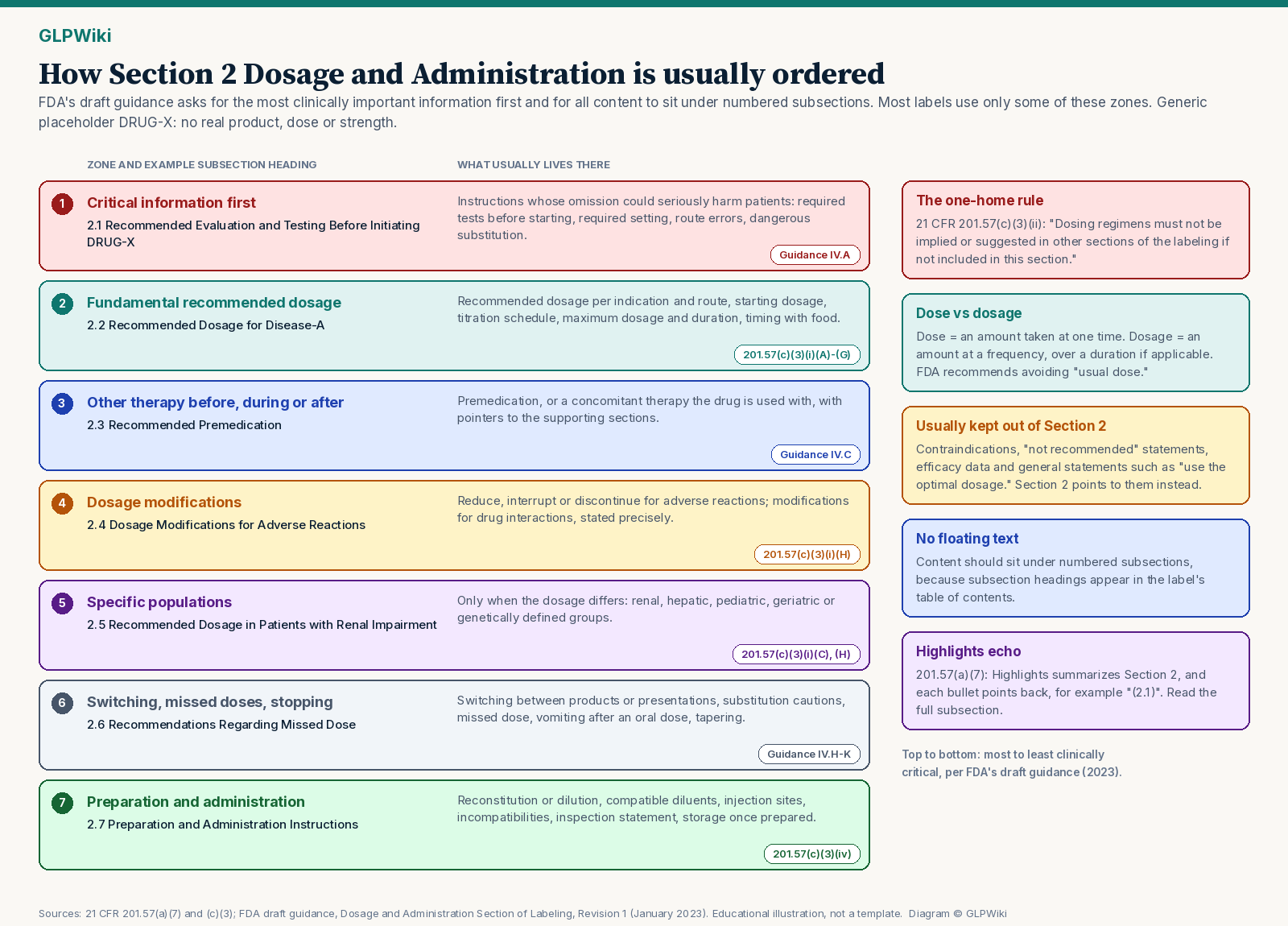
- Critical information first. When not knowing or not following an instruction "could have serious consequences for patients," it should come first, with a cross-reference to the detail (often Warnings and Precautions). FDA's examples include past route-of-administration errors, required dilution, dangerous substitution between products, a required care setting, and evaluations or tests needed before starting, such as "2.x Recommended Evaluation and Testing Before Initiating DRUG-X."
- Fundamental recommended dosage. The recommended dosage for each indication, with route, any starting or loading dosage, the titration schedule, the maximum recommended dosage and duration, and administration instructions tied to the dosage (for oral drugs, the timing relative to food).
- Other therapy before, during or after. Premedication, or a concomitant therapy the drug must be used with. If the indication is adjunctive (for example, alongside a reduced-calorie diet and increased physical activity), Section 1 must say so and Section 2 often repeats it.
- Dosage modifications. Changes for adverse reactions (reduce, interrupt or discontinue) and for drug interactions, each with a pointer to Sections 5, 6, 7 or 12.
- Specific populations. Recommended dosage in renal or hepatic impairment, pediatric or geriatric patients, or genetically defined groups, but only when it differs from the general recommendation. FDA recommends headings such as "Recommended Dosage in Patients with Renal Impairment," because the shorter "Renal Impairment" is reserved for Section 8.6.
- Switching, missed doses and discontinuation. How to switch to the drug from another product or presentation, cautions against substitution, what to do after a missed dose, what to do after vomiting an oral dose, and tapering when withdrawal is a risk.
- Preparation, administration and storage of the prepared product. Reconstitution or dilution, compatible diluents, containers or devices, injection sites and rotation where relevant, the parenteral inspection statement, and how long a reconstituted product may be stored.
Not every zone applies
No label uses all seven zones. The guidance says that "for many drugs, not all categories described below will be applicable," and a short, simple Section 2 is normal.
What GLP-1 and peptide labels actually show
Reading only the subsection headings of Section 2 across current DailyMed labels (versions checked October 28, 2026) shows how the template flexes to fit each product. We list headings only and leave out every number.
- Ozempic (semaglutide injection): 2.1 Important Administration Instructions; 2.2 Recommended Dosage. What the structure tells you: Administration rules come first; missed-dose and day-change rules sit inside 2.1.
- Rybelsus / Ozempic tablets (oral semaglutide): 2.1 Important Administration Instructions; 2.2 Recommended Starting, Escalation and Maintenance Dosage; 2.3 Switching Between RYBELSUS and OZEMPIC Tablets; 2.4 Switching from OZEMPIC Injection to RYBELSUS or OZEMPIC Tablets. What the structure tells you: Food and water timing rules lead; 2.1 states the two tablet products "are not substitutable on a mg-to-mg basis".
- Wegovy (semaglutide injection and tablets): 2.1 Important Monitoring and Administration Instructions; 2.2 Recommended Dosage for WEGOVY Injection; 2.3 Recommended Dosage of WEGOVY Tablets; 2.4 Recommendations Regarding Missed Dose(s); 2.5 Switching Between WEGOVY Injection and WEGOVY Tablets. What the structure tells you: Two presentations under one label, so dosage, missed-dose and switching rules are split by presentation.
- Mounjaro (tirzepatide): 2.1 Recommended Dosage; 2.2 Important Administration Instructions. What the structure tells you: Recommended dosage comes first; administration second.
- Zepbound (tirzepatide): 2.1 Recommended Dose Escalation Schedule; 2.2 Recommended Maintenance and Maximum Dosage; 2.3 Recommendations Regarding Missed Dose; 2.4 Important Administration Instructions. What the structure tells you: The 201.57(c)(3) items titration (E) and upper limit (B) each get a heading.
- Victoza (liraglutide): 2.1 Recommended Dosage; 2.2 Recommendations Regarding Missed Dose; 2.3 Important Administration Instructions. What the structure tells you: A compact three-part pattern.
- Saxenda (liraglutide): 2.1 Important Administration Instructions; 2.2 Dosage in Adults and Pediatric Patients Aged 12 Years and Older. What the structure tells you: Adult and adolescent recommendations share one subsection.
- Trulicity (dulaglutide): 2.1 Adult Dosage; 2.2 Pediatric Dosage; 2.3 Recommendations Regarding Missed Dose; 2.4 Important Administration Instructions. What the structure tells you: Separate subpopulation subsections, item (C).
- Byetta (exenatide): 2.1 Recommended Dosing. What the structure tells you: Older single-subsection structure.
- Soliqua 100/33 (insulin glargine and lixisenatide): 2.1 Important Dosage Information; 2.2 Recommended Starting Dose; 2.3 Titration of SOLIQUA 100/33; 2.4 Missed Doses; 2.5 Important Administration Instructions. What the structure tells you: Fixed-combination product: 2.1 explains how the units on the pen relate to each component, with a table.
- Gattex (teduglutide): 2.1 Important Administration Information; 2.2 Recommended Dosage and Administration for Adults and Pediatric Patients 1 Year of Age and Older; 2.3 Dosage Adjustment for Renal Impairment; 2.4 Monitoring to Assess Safety; 2.5 Discontinuation of Treatment; 2.6 Preparation Instructions. What the structure tells you: Pre-treatment evaluation, renal modification, safety monitoring, discontinuation and reconstitution all appear.
- Imcivree (setmelanotide): 2.1 Patient Selection; 2.2 and 2.3 Recommended Dosage by condition; 2.4 Recommended Dosage in Patients with Renal Impairment; 2.5 Administration Instructions. What the structure tells you: Patient selection by diagnosis or genotype comes first, as "critical information".
"Important Administration Instructions" is often where the safety-relevant wording lives
In the Wegovy and Zepbound labels, the administration subsection tells clinicians to tell patients which presentation (pen, vial or syringe) they will receive, to train them for that specific presentation, and to retrain them and point them to the new Instructions for Use if the presentation changes. Both labels also state that one of their single-patient-use pens "is not recommended for self-administration by those who are visually impaired." Those are structural safeguards, not dosing numbers, and they show why the section's first subsection deserves a careful read.
Switching and substitution get their own headings when products differ
FDA's draft guidance says Section 2 should advise against substitution that "would lead to harm or loss of effectiveness" and recommends wording such as "do not substitute DRUG-X for [insert drug name]." The oral semaglutide label's statement that its tablet products "are not substitutable on a mg-to-mg basis" is an example, and so are the separate switching subsections in the Rybelsus/Ozempic tablets and Wegovy labels.
Missed-dose rules are product-specific
The guidance asks for missed-dose recommendations only when there is "adequate information to support" them, and current GLP-1 labels give different rules for different products and presentations. Some labels place the rule in its own subsection; Ozempic places it inside 2.1. The practical lesson is to read the rule in the current label for the exact product, never a rule borrowed from a similar drug.
Peptide labels outside the GLP-1 class use more zones
Gattex opens with evaluation and testing to complete before treatment, with cross-references to Warnings and Precautions; it later has a monitoring subsection, a discontinuation subsection noting the risk of fluid and electrolyte imbalance, and step-by-step reconstitution in 2.6. Imcivree leads with Patient Selection. Both are consistent with the "critical information first" logic in the draft guidance.
Section 2 as a cross-reference hub
Section 2 says what to do; other sections say why. FDA's guidance repeatedly asks Section 2 to point to "detailed discussions in other sections of labeling that provide the basis for recommendations." Reading Section 2 well means following its bracketed pointers, written like "[see Clinical Pharmacology (12.3)]."
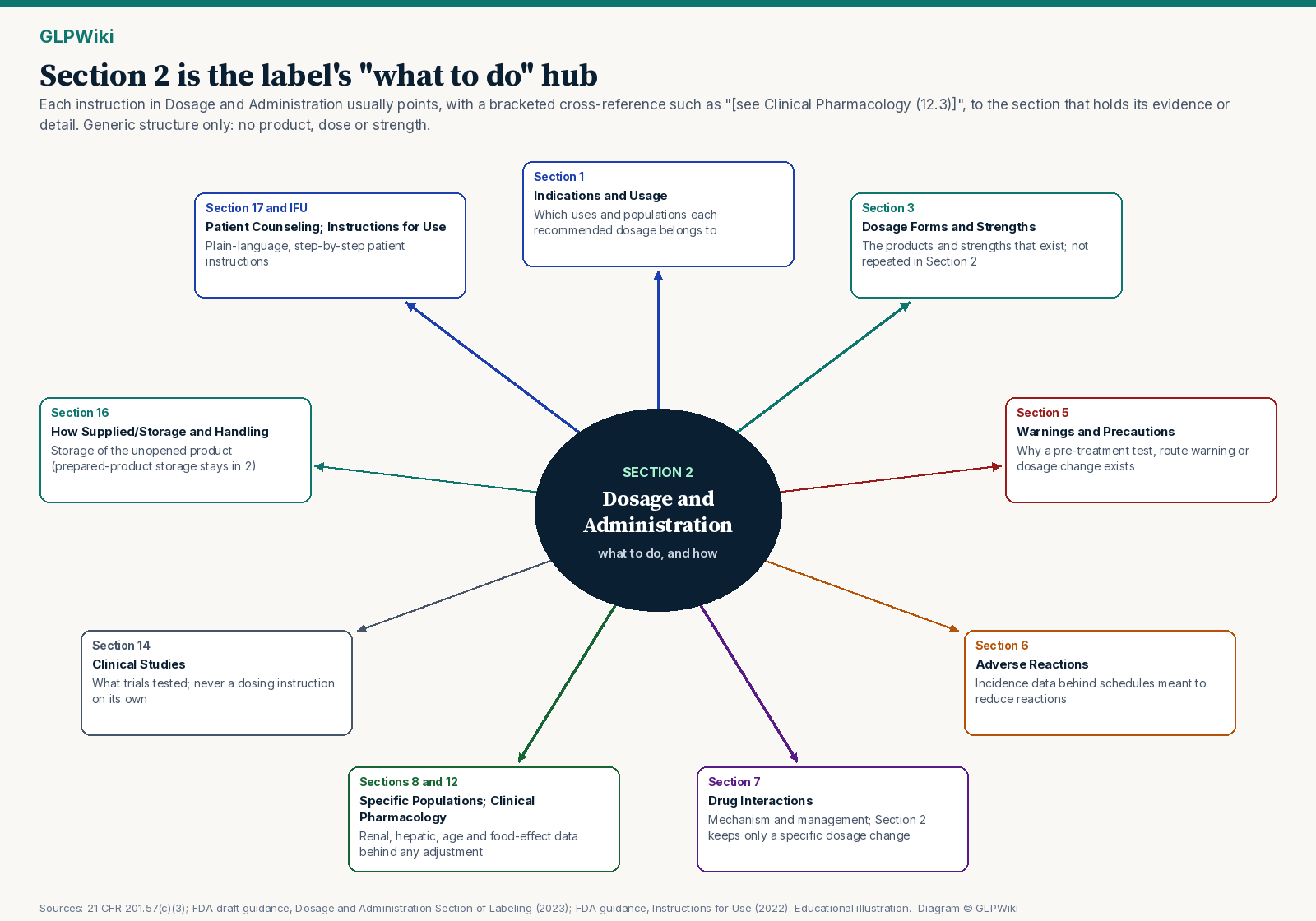
- Section 1, Indications and Usage. Section 2 recommends a dosage per indication, and its subsection headings should not simply copy Section 1's indication headings (FDA suggests "2.1 Recommended Dosage for Disease-A" rather than "2.1 Disease-A").
- Section 3, Dosage Forms and Strengths. The products and strengths that the recommended dosage can be delivered with are listed in Section 3, not Section 2. Package type and presentation details generally belong in Sections 3 and 16.
- Section 5, Warnings and Precautions. Pre-treatment testing, dosage modifications for adverse reactions and "do not administer" route warnings in Section 2 point to the full risk description in Section 5. Our Warnings, Precautions and Adverse Reactions guide covers that section.
- Section 6, Adverse Reactions. When a schedule exists to reduce adverse reactions (for example, a gradual increase to reduce gastrointestinal reactions), the supporting incidence data are in Section 6 and the clinical studies in Section 14. Clinical reviews of GLP-1 gastrointestinal effects, such as Wharton et al. (2022), discuss why gradual dose increases are used, but they do not replace the product's own Section 2.
- Section 7, Drug Interactions. Section 2 includes a dosage modification for an interaction only when there is enough information to support a specific one; the mechanism and the management detail stay in Section 7.
- Section 8, Use in Specific Populations, and Section 12, Clinical Pharmacology. Renal, hepatic, pediatric and geriatric recommendations in Section 2 rest on the data in Sections 8.4 to 8.7 and 12.3. A "no adjustment" conclusion is usually explained there, not in Section 2.
- Section 14, Clinical Studies. Trials show what was studied. The STEP 1 trial of semaglutide for weight management, for example, lists its protocol's escalation steps on ClinicalTrials.gov, but a protocol is not a label instruction. Only Section 2 carries the approved regimen, and 201.57(c)(3)(ii) bars other sections from implying one.
- Section 16, How Supplied/Storage and Handling. Storage of the unopened product is in Section 16; storage of a reconstituted or diluted product, when important, is in Section 2.
- Section 17 and the Instructions for Use. Patient-facing steps are written in plain language in the FDA-approved patient labeling. FDA's July 2022 guidance on Instructions for Use describes that document as written for patients or caregivers using products with "complicated or detailed patient-use instructions."
Preparation and administration instructions: what they are and are not
Paragraph (iv) of the regulation makes preparation and administration content mandatory "if needed." The draft guidance fills in what that usually means:
- directions for reconstituting a lyophilized powder or diluting a concentrate, naming compatible diluents by their established names (for example, "0.9% Sodium Chloride Injection" rather than "saline")
- the strength of the final solution after preparation, normally in milligrams per milliliter, and the volume to withdraw
- for subcutaneous or intramuscular products, recommended injection sites and rotation "if needed"
- incompatibilities with other drugs, diluents, containers or devices, described in general terms when the device is not part of the approved application
- a brief "do not" statement for a dangerous route, with a pointer to Section 5 (the guidance's example: "Do not administer intrathecally")
- the verbatim parenteral inspection statement, and storage time for the prepared product when important
Two reading points
Two reading points follow. First, these instructions describe the approved product, made by its approved manufacturer, in its approved container. Gattex's preparation subsection applies to Gattex's kit and diluent, not to any other teduglutide-labeled vial. Second, the existence of preparation text does not make the product a do-it-yourself item. The prescriber decides whether a patient may self-administer, and the Wegovy and Zepbound labels say that after training a patient may self-inject if the healthcare provider determines that it "can be properly administered." For GLPWiki's general, non-product material on handling, see our separate guides on aseptic technique and syringe types, which are educational and not a substitute for an approved label.
Why compounded and research products have no Section 2
Section 2 exists only in FDA-approved labeling, which is approved together with an NDA or BLA. Compounded drugs and products sold "for research use only" have no FDA-approved Prescribing Information, so there is no FDA-reviewed Section 2 to consult. Any instructions that come with them have not gone through the review that 201.57(c)(3) describes.
FDA has documented what can go wrong without that structure. In a July 2024 compounding risk alert, FDA reported adverse events, some requiring hospitalization, linked to dosing errors with compounded injectable semaglutide in multiple-dose vials. Contributing factors included patients unfamiliar with drawing medication into a syringe, instructions written in syringe "units" whose volume depends on concentration, syringes much larger than the prescribed volume, and clinicians miscalculating conversions between milligrams, milliliters and units. FDA noted that FDA-approved injectable semaglutide products "are dosed in milligrams, have standard concentrations" and were, at the time of the alert, available only in prefilled pens. FDA's broader statement on unapproved GLP-1 drugs also describes reports of compounded semaglutide or tirzepatide prescribed beyond the FDA-approved label, including faster titration. A 2023 poison-center case series (Lambson et al.) described similar administration errors and recommended more vigilance in labeling, dispensing and counseling.
FDA has separately warned that some compounders state injectable strength per milliliter more prominently than total strength per container, unlike conventional manufacturers, which has led to dosing errors with other compounded injectables. Our Dosage Forms and Strengths guide explains how approved labels express strength. The literacy lesson is simple: the safeguards described in this guide come from an approved label, and they do not carry over to a product that does not have one.
Common misreadings
- "The label says this dose, so it's the right dose for me." Section 2 is written for clinicians and states recommended dosages for an approved population. It is not an individual prescription, and the section itself often depends on monitoring, tolerability and other sections.
- "A dose in the Clinical Studies section is a recommended dose." Section 14 describes what trials tested. Under 201.57(c)(3)(ii), only Section 2 carries the regimen.
- "No renal subsection means kidney function doesn't matter." It usually means no renal dosage modification is recommended. Sections 5, 8.6 and 12.3 can still describe kidney-related risks.
- "The maximum recommended dosage is a target." Item (B) is "an upper limit beyond which safety and effectiveness have not been established, or beyond which increasing the dose does not result in increasing effectiveness." It is a ceiling, not a goal.
- "A titration schedule is a suggestion that can be sped up." FDA's guidance describes titration as increasing "incrementally to achieve effectiveness while reducing the risk of adverse reactions." Our Titration concepts guide explains the idea without numbers; the schedule itself is a prescriber's decision.
- "Missed-dose rules are the same across a drug class." They are written per product and per presentation, only when supporting information exists.
- "Switching between two products with the same ingredient is one-to-one." Some labels say the opposite; oral semaglutide's label states its tablet products "are not substitutable on a mg-to-mg basis."
- "An instruction from a clinic or seller is the same as the label." Only FDA-approved labeling for the exact product carries a Section 2.
A five-step way to read any Section 2
- Check the label version. Confirm the product, presentation and revision date on DailyMed or Drugs@FDA, and look at Recent Major Changes in Highlights for Section 2 updates.
- Read the subsection list first. Section 2's headings appear in the label's table of contents. They show at a glance whether the label has critical pre-treatment requirements, separate subpopulation dosages, switching rules, missed-dose rules or preparation steps.
- Read subsection 2.1 in full. Whatever its title, the first subsection usually holds the information FDA considers most critical to safe use.
- Follow every bracketed cross-reference. The "why" behind an instruction is in Sections 5, 7, 8, 12 or 14.
- Separate clinician text from patient text. Section 2 is written for prescribers. Patient steps are in the Medication Guide, Patient Information and Instructions for Use, and questions about a specific person belong with a clinician or pharmacist.
Scope and disclaimer
GLPWiki is an educational resource. This guide explains how the Dosage and Administration section of FDA prescription drug labeling is structured; it is not medical advice, does not provide doses, schedules or administration instructions, and does not recommend for or against any treatment. Decisions about any medicine, including whether, how much and how to take it, belong with a licensed clinician or pharmacist using the current FDA-approved labeling for the exact product. Label contents change; always check the current version. To report a suspected adverse reaction or medication error, contact the manufacturer or FDA MedWatch at 1-800-FDA-1088 or www.fda.gov/medwatch.
Last reviewed: October 28, 2026. Labeling and guidance may have changed since; verify with Drugs@FDA, DailyMed, and your pharmacist or clinician.
Frequently asked questions
- What is the Dosage and Administration section of an FDA label?
- It is Section 2 of the Full Prescribing Information in PLR format. Under 21 CFR 201.57(c)(3) it must state the recommended dose and, as appropriate, items such as the dosage range, upper limit, dosages by indication and subpopulation, intervals, titration method, modifications for interactions or special populations, and preparation and administration directions.
- Can dosing information appear in other sections of the label?
- A regimen cannot be implied elsewhere. 21 CFR 201.57(c)(3)(ii) says "Dosing regimens must not be implied or suggested in other sections of the labeling if not included in this section." Other sections may describe what trials tested or how a drug behaves, but the approved regimen lives in Section 2.
- What is the difference between "dose" and "dosage" on a label?
- FDA's draft guidance uses "dose" for a specific amount taken at one time and "dosage" for an amount given at a specific frequency, and over a duration if applicable. That is why modern labels use headings like "Recommended Dosage."
- Is FDA's Dosage and Administration guidance final?
- No. FDA withdrew the March 2010 guidance and issued a draft Revision 1 in January 2023. It is nonbinding and marked "Draft – Not for Implementation," though it explains how FDA reviewers approach the section. The regulation, 21 CFR 201.57(c)(3), is binding.
- Why do some labels have many Section 2 subsections and others only one?
- The regulation lists items "as appropriate," and FDA's guidance says not every category applies to every drug. Labels with several indications, presentations, routes, pre-treatment tests or preparation steps need more subsections. Older labels such as Byetta's use a single subsection.
- Where are injection or preparation steps for patients?
- Section 2 contains clinician-facing preparation and administration directions when needed. Step-by-step patient instructions are in the FDA-approved Instructions for Use, which FDA's July 2022 guidance describes as written for patients and caregivers using products with complicated or detailed instructions.
- Do compounded GLP-1 products have a Dosage and Administration section?
- No. Compounded drugs are not FDA-approved and have no FDA-approved Prescribing Information. FDA has reported dosing errors with compounded semaglutide related to units, concentrations and syringe sizes.
- Does a missing renal or hepatic subsection mean no precautions apply?
- Not necessarily. It usually means no dosage modification is recommended. Kidney- or liver-related risks may still be described in Warnings and Precautions, Use in Specific Populations (8.6, 8.7) or Clinical Pharmacology (12.3).
SOURCES
- 0121 CFR 201.57 — Specific requirements on content and format of labeling (PLR); (a)(7) Highlights Dosage and Administration, (c)(3) Dosage and Administration— U.S. Government Publishing Office / eCFR
- 0221 CFR 201.56 — Requirements on content and format of labeling; section order and omission of clearly inapplicable information— U.S. Government Publishing Office / eCFR
- 0321 CFR 201.80 — Old-format labeling; (j) Dosage and Administration— U.S. Government Publishing Office / eCFR
- 04Dosage and Administration Section of Labeling for Human Prescription Drug and Biological Products — Content and Format (draft guidance, Revision 1, Jan 2023)— U.S. Food and Drug Administration
- 05Dosage and Administration Section of Labeling — draft guidance full text (PDF)— U.S. Food and Drug Administration
- 06Dosage and Administration Section of Labeling — Content and Format; Draft Guidance for Industry; Availability (withdrawal of the 2010 guidance), Jan 13, 2023— Federal Register
- 07Dosage and Administration Section of Labeling: Part 1 of 2 (CDER SBIA webinar slides, Apr 2023)— U.S. Food and Drug Administration
- 08Labeling for Human Prescription Drug and Biological Products — Implementing the PLR Content and Format Requirements (guidance, Feb 2013)— U.S. Food and Drug Administration
- 09Requirements on Content and Format of Labeling for Human Prescription Drug and Biological Products (final rule), 71 FR 3922, Jan 24, 2006— Federal Register
- 10Instructions for Use — Patient Labeling for Human Prescription Drug and Biological Products — Content and Format (guidance, Jul 2022)— U.S. Food and Drug Administration
- 11Warnings and Precautions, Contraindications, and Boxed Warning Sections of Labeling — Content and Format (guidance, Oct 2011)— U.S. Food and Drug Administration
- 12FDA alerts health care providers, compounders and patients of dosing errors associated with compounded injectable semaglutide products (Jul 2024)— U.S. Food and Drug Administration
- 13FDA's Concerns with Unapproved GLP-1 Drugs Used for Weight Loss— U.S. Food and Drug Administration
- 14Differences in strength expression on product labels of compounders and conventional manufacturers may lead to dosing errors— U.S. Food and Drug Administration
- 15OZEMPIC (semaglutide) injection — Prescribing Information, Section 2— U.S. NLM / DailyMed
- 16RYBELSUS and OZEMPIC (semaglutide) tablets — Prescribing Information, Section 2— U.S. NLM / DailyMed
- 17WEGOVY (semaglutide) injection and tablets — Prescribing Information, Section 2— U.S. NLM / DailyMed
- 18MOUNJARO (tirzepatide) — Prescribing Information, Section 2— U.S. NLM / DailyMed
- 19ZEPBOUND (tirzepatide) — Prescribing Information, Section 2— U.S. NLM / DailyMed
- 20VICTOZA (liraglutide) — Prescribing Information, Section 2— U.S. NLM / DailyMed
- 21SAXENDA (liraglutide) — Prescribing Information, Section 2— U.S. NLM / DailyMed
- 22TRULICITY (dulaglutide) — Prescribing Information, Section 2— U.S. NLM / DailyMed
- 23BYETTA (exenatide) — Prescribing Information, Section 2— U.S. NLM / DailyMed
- 24SOLIQUA 100/33 (insulin glargine and lixisenatide) — Prescribing Information, Section 2— U.S. NLM / DailyMed
- 25GATTEX (teduglutide) — Prescribing Information, Section 2— U.S. NLM / DailyMed
- 26IMCIVREE (setmelanotide) — Prescribing Information, Section 2— U.S. NLM / DailyMed
- 27Xenical (orlistat) — Prescribing Information, Section 2— U.S. NLM / DailyMed
- 28Sullivan HW, et al. Physicians' use of and preferences for FDA-approved prescribing information. Res Social Adm Pharm. 2022;18(6):3027-3037— Res Social Adm Pharm / PubMed
- 29Lambson JE, Flegal SC, Johnson AR. Administration errors of compounded semaglutide reported to a poison control center — case series. J Am Pharm Assoc. 2023;63(5):1643-1645— J Am Pharm Assoc / PubMed
- 30Wharton S, et al. Managing the gastrointestinal side effects of GLP-1 receptor agonists in obesity: recommendations for clinical practice. Postgrad Med. 2022— Postgrad Med / PubMed
- 31STEP 1: semaglutide in overweight or obesity (NCT03548935) — study record— U.S. National Library of Medicine / ClinicalTrials.gov
EDUCATIONAL REFERENCE ONLY · Not medical advice. Nothing here diagnoses, treats, cures or prevents any disease, and nothing here is a dosing recommendation. Consult a licensed clinician before any treatment decision.